


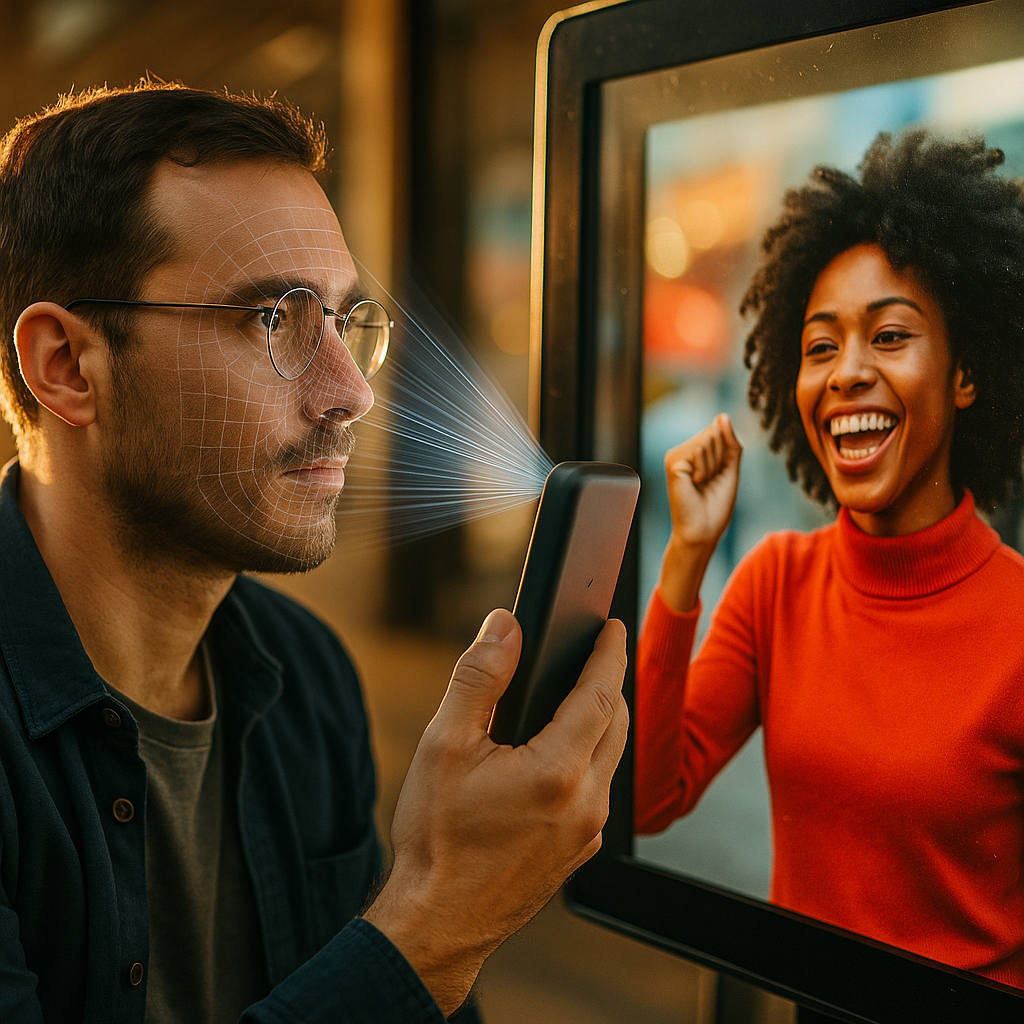
In 2025, performance marketing is shifting from assumptions to evidence. The Rise of “Bio-Metric” Marketing: Real-Time Creative Optimization is reshaping how brands design, test, and refine ads by using signals from attention, emotion, and engagement as campaigns run. Done well, it reduces waste and improves relevance. Done poorly, it risks trust, privacy, and compliance—so what separates the leaders?
What is bio-metric marketing and why it’s accelerating in 2025
Bio-metric marketing uses biological and behavioral signals to understand how people respond to creative assets, then applies those insights to improve messaging, design, and delivery. In practice, most programs blend two categories:
- Biometric signals: facial expression analysis, eye tracking, heart-rate variability, skin conductance, voice tone, and other indicators that can correlate with attention or emotional arousal.
- Behavioral signals: scroll depth, dwell time, cursor movement, tap patterns, video completion, repeat views, add-to-cart timing, and brand search lift.
The acceleration in 2025 comes from three converging forces. First, creative volume has exploded across platforms and placements, making manual optimization too slow. Second, AI production tools can generate variants quickly, but marketers still need ground truth on what works. Third, privacy expectations and regulations are pushing teams to measure impact with more care—favoring aggregated, consent-based approaches and on-device processing where possible.
Marketers often ask: “Is this just a rebrand of neuromarketing?” It’s related, but the differentiator is real-time application. Instead of periodic lab studies, teams are moving toward continuous measurement loops that inform creative decisions while spend is live, without relying on personal identity.
Real-time creative optimization: how the feedback loop actually works
Real-time creative optimization turns response signals into rapid creative decisions. The most effective systems follow a disciplined loop, not an improvisational one:
- Instrument: define the placement and the measurable response events (attention proxies like viewability and dwell, emotional indicators where appropriate, and downstream actions like conversions).
- Collect with consent: gather signals through opt-in panels, first-party experiences, or aggregated platform measurement. Avoid “silent collection” that undermines trust.
- Normalize: adjust for device type, context, and baseline behavior so results don’t simply reflect “mobile vs. desktop” or “morning vs. evening.”
- Model: connect signals to outcomes. For example, link early attention markers to later conversion probability, controlling for audience and frequency.
- Decide: set rules for creative rotation, spend allocation, and variant generation. Decisions should be explainable, not just “the model said so.”
- Validate: run incrementality checks (holdouts, geo tests, or platform experiments) so optimization improves business results, not just engagement.
Follow-up question: “What counts as real-time?” For most brands, intra-day is realistic: creative can be adjusted within hours based on stable signals. True minute-by-minute swapping is possible in some channels, but it can increase noise and brand risk if guardrails are weak.
Another practical issue is creative supply. If you only have two versions of an ad, optimization quickly hits a ceiling. High-performing teams prepare structured variant families: multiple hooks, visual hierarchies, calls-to-action, and proof elements, all on brand.
Consumer attention signals: what you can measure without breaking trust
Consumer attention signals are the backbone of bio-metric approaches because they can often be captured in privacy-respecting ways. Not every program needs facial analysis or physiological sensors. Many “biometric-like” insights come from behavioral data that indicates attention quality:
- Attention proxies: viewable time, dwell time, screen percentage, sound-on rate, and replays.
- Engagement depth: scroll velocity changes, interaction with product hotspots, carousel swipes, and time-to-first-action.
- Comprehension indicators: pauses on key frames, caption-on behavior, and repeated exposure to benefit statements.
When true biometric measurement is used (for example, eye tracking in a research panel), the strongest programs separate research learning from production targeting. They use biometrics to learn which creative elements attract attention and reduce cognitive load, then deploy those learnings broadly without needing ongoing biometric identification in the wild.
Readers often ask if attention metrics are reliable. They can be, but only when you acknowledge context. Attention in a calm environment differs from attention on a crowded commute. That’s why the best teams segment results by placement, device, and content adjacency, then look for creative patterns that remain stable across contexts.
Another key trust point: clearly communicate data use. If an experience includes camera-based measurement, state what is collected, how it is processed, how long it’s retained, and how users can opt out. Trust is a performance lever, not a legal checkbox.
AI creative testing: turning biometric insight into scalable variants
AI creative testing closes the gap between insight and output. Once you identify what drives attention and response—such as the first two seconds of a video, the clarity of a value proposition, or the placement of social proof—you need a system that can generate and test variations quickly while maintaining brand integrity.
High-performing workflows in 2025 typically use a “human-in-the-loop” approach:
- Creative strategy defines hypotheses: “A problem-first opening will outperform a product-first opening for new prospects.”
- AI generates structured variants: multiple hooks, thumbnails, captions, background scenes, and CTA phrasing, all constrained by brand rules.
- Automated QA and brand checks: forbidden claims, regulated terms, readability thresholds, and accessibility requirements.
- Live testing with guardrails: limit exposure to unproven variants, cap frequency, and prevent jarring brand shifts.
- Learning library: store what worked, for whom, and in which context so insights compound instead of resetting each campaign.
To make biometric insight actionable, translate it into creative directives. Example: if eye-tracking shows users miss the price anchor, the directive becomes “increase price contrast and place it within the first visual cluster.” If facial response suggests confusion at a specific frame, the directive becomes “reduce on-screen text, simplify motion, and front-load the benefit statement.”
A common follow-up: “Will AI just optimize toward clickbait?” Only if you reward it for shallow metrics. If your objective is short-term clicks, the system will chase them. If your objective includes qualified leads, retention, and brand lift, and you validate with incrementality, the system will optimize for outcomes that matter.
Privacy-first measurement: consent, compliance, and ethical guardrails
Privacy-first measurement is non-negotiable for bio-metric marketing. The same signals that improve creative can feel invasive if collected without clear permission or if repurposed beyond the original intent. Leaders treat privacy as part of product design and campaign design, not as an afterthought.
Practical guardrails to implement:
- Explicit consent for biometric collection: opt-in flows, plain-language disclosures, and easy withdrawal mechanisms.
- Data minimization: collect only what you need; avoid raw video storage when derived, aggregated metrics will do.
- On-device processing where feasible: analyze signals locally and upload only anonymized summaries.
- Purpose limitation: use biometric research to improve creative, not to identify individuals or infer sensitive traits.
- Retention controls: clear timelines for deletion and documented access policies.
- Independent review: involve legal, security, and ethics stakeholders before launch; audit vendors regularly.
Many teams also ask about bias. Biometrics can behave differently across skin tones, lighting conditions, disabilities, and cultural expression norms. Mitigate this by validating tools across diverse samples, avoiding overconfident emotion labels, and using biometrics as directional insight rather than definitive truth.
Finally, build a “trust narrative” into your marketing. When you ask for consent, explain the benefit to the customer: better relevance, fewer repetitive ads, and improved experiences. Transparency increases opt-in rates and reduces reputational risk.
EEAT-driven implementation: building credibility, accuracy, and repeatable ROI
EEAT (Experience, Expertise, Authoritativeness, Trustworthiness) is the difference between responsible optimization and gimmicks. Bio-metric marketing touches sensitive data and brand perception, so credibility must be engineered into the process.
Use these EEAT-aligned practices:
- Experience: start with controlled pilots. Use research panels or first-party environments where you can explain the measurement and validate findings.
- Expertise: include behavioral scientists, UX researchers, and data scientists alongside creative and media teams. Interpret signals carefully; avoid simplistic “smile equals purchase intent” conclusions.
- Authoritativeness: document methodology. Define sample sizes, confidence thresholds, and what metrics mean operationally. Share learnings internally so stakeholders understand the “why.”
- Trustworthiness: publish clear privacy disclosures, vendor lists, and governance policies. Establish escalation paths for complaints and data requests.
For ROI, combine three measurement layers:
- Creative diagnostics: attention and comprehension indicators that explain performance.
- Performance metrics: CPA, ROAS, conversion rate, and lead quality.
- Causal validation: holdouts or experiments that prove the creative change caused incremental lift.
Answering a common follow-up: “How do I know this won’t just optimize for one channel?” You prevent that by creating a cross-channel creative scorecard and testing the same hypotheses in multiple environments. When a creative principle works across contexts, it becomes a durable asset, not a platform trick.
FAQs about bio-metric marketing and real-time creative optimization
-
Is bio-metric marketing legal in 2025?
It can be legal when you use explicit consent for biometric collection, minimize data, secure it, and follow applicable privacy and biometric regulations in the regions where you operate. Treat biometrics as sensitive data and involve legal and security teams before launch.
-
Do I need cameras or wearables to benefit from biometric-style optimization?
No. Many brands start with privacy-respecting attention and engagement proxies such as viewable time, dwell, sound-on rate, and interaction depth. Biometric panels are most useful for diagnosing why creative works, then applying those learnings broadly.
-
What’s the difference between attention optimization and conversion optimization?
Attention optimization improves the chance someone notices and understands your message. Conversion optimization improves the chance they take action. The best programs connect the two by proving that attention-quality changes lead to incremental conversions, not just higher engagement.
-
How fast can I optimize creative in real time without harming the brand?
Most teams can make safe, meaningful adjustments within hours when they use guardrails: pre-approved brand templates, capped exposure for new variants, and clear stop rules for underperformers. Faster is possible, but it increases volatility unless measurement is stable.
-
What metrics should I prioritize first?
Start with a small set tied to business outcomes: viewable time or dwell (attention), message recall or comprehension proxies (clarity), and incremental conversions or qualified leads (impact). Add more biometric measures only when they answer a specific creative question.
-
How do I choose vendors for biometric measurement?
Ask for validation studies, bias testing documentation, data retention policies, security certifications, and clear explanations of how models interpret signals. Favor vendors that support on-device processing or aggregated outputs and that allow independent audits.
Bio-metric marketing is rising because it makes creative optimization more measurable, faster, and less dependent on guesswork. In 2025, the winning approach pairs consent-based attention signals with disciplined experimentation, AI-assisted variant production, and rigorous validation against incremental business outcomes. Treat biometrics as sensitive, directional insight, not magic. Build trust and governance first—then let data sharpen creativity.