


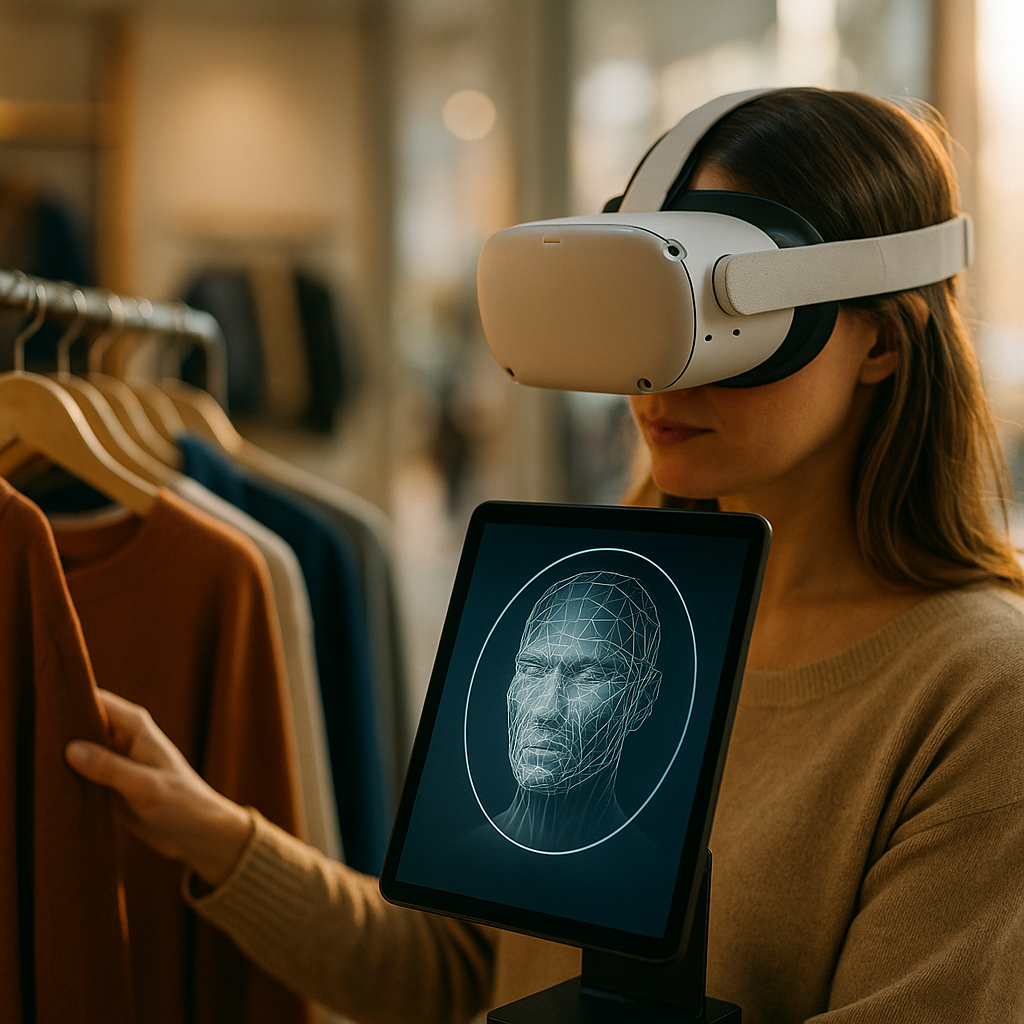
As virtual stores become lifelike, shoppers can browse aisles, try on products, and pay without leaving home. Yet this convenience depends on sensors that read faces, voices, bodies, and even emotions. Navigating biometric data privacy in virtual reality shopping now matters as much as price or delivery speed. Know what data is collected, why it’s sensitive, and how to stay in control—before your next headset session.
What counts as biometric data in VR shopping
In VR commerce, “biometric data” is broader than fingerprints. It includes any uniquely identifying or health-adjacent signals captured from your body or behavior. Many headsets and controllers collect these signals continuously to keep the experience stable, responsive, and personalized.
Common biometric and biometric-adjacent signals in VR shopping include:
- Eye tracking (gaze direction, dwell time, pupil movement) used for foveated rendering, interface selection, and attention analytics.
- Facial expression tracking (smiles, frowns, micro-expressions) used for avatars, social shopping, and “emotion-aware” experiences.
- Hand and body tracking (skeletal mapping, reach, posture, gait) used for navigation, virtual try-ons, and accessibility.
- Voiceprints and speech patterns used for voice search, customer service, and identity confirmation.
- Heart rate and other physiological signals from wearables or advanced headsets, sometimes used for comfort settings or engagement scoring.
- Motion and interaction telemetry (head movements, controller dynamics, reaction timing) that can be identifying when combined over time.
Why this matters: biometric signals are difficult to change if compromised. You can reset a password, but you cannot realistically reset your face geometry, voice characteristics, or movement signature. In VR, these signals may also reveal inferences—such as stress level, attention, or physical limitations—creating additional privacy risk beyond identity.
Biometric data privacy risks in immersive retail
VR shopping adds new privacy pressures because the device sits on your face, watches your eyes, and maps your movements. That creates a richer profile than typical web shopping, and it can be tempting for businesses to use it for conversion and advertising.
Key risks to understand before you shop:
- Identification and re-identification: Even if a platform says data is “de-identified,” eye-movement patterns, body dynamics, and voice can make a user re-identifiable when linked with account info or device IDs.
- Inference of sensitive traits: Gaze and physiological signals can be used to infer interest, arousal, fatigue, or anxiety. That can enable targeting that feels manipulative or discriminatory.
- Function creep: Data collected for performance (like eye tracking for rendering) may later be repurposed for marketing analytics unless strong governance prevents it.
- Third-party sharing in VR ecosystems: VR stores often embed SDKs for payments, analytics, ads, and customer support. Each integration can expand who receives data and how it is used.
- Security and breach impact: If biometric templates or raw sensor streams leak, the harm can be long-lived. Attackers may exploit it for spoofing, deepfake training, or identity verification bypass.
- Household exposure: Headsets used at home may capture voices or body data of bystanders, creating consent issues and unexpected data subjects.
Readers often ask whether VR shopping is “more dangerous” than mobile shopping. The better framing is: VR increases the sensitivity and richness of signals. That means the same weak privacy practices (over-collection, vague consent, broad sharing) can cause greater harm in VR than on a typical website.
Consent and transparency for VR biometric tracking
In 2025, the most privacy-protective VR shopping experiences treat biometric collection as a privilege, not a default. They offer clear choices, explain consequences, and avoid bundling consent into a single “accept all” screen.
What good consent looks like in VR:
- Just-in-time notices: When you enter a virtual fitting room and facial tracking is needed, the app explains what it captures and why—right then, not buried in a policy.
- Separate toggles for separate purposes: “Eye tracking for rendering” should be distinct from “eye tracking for advertising measurement.”
- Plain-language descriptions of outputs: If the system creates a “biometric template,” “emotion score,” or “engagement metric,” it names that output and states whether it is stored.
- Real refusal options: You can still shop if you decline non-essential tracking, with no punitive degradation beyond what is technically necessary.
- Visible status indicators: A clear indicator shows when microphones, cameras, or eye tracking are active.
How to evaluate transparency quickly: Look for disclosures that answer five questions: What is collected? Is it raw data or derived? For what purpose? For how long? Who receives it? If any of these are missing or vague (“to improve services”), treat that as a signal to limit permissions.
Also consider whether the company provides a biometric-specific privacy notice rather than relying on a general privacy policy. Biometric handling deserves dedicated explanations because risks and retention expectations are different from ordinary clickstream data.
Compliance: GDPR, CCPA/CPRA, and biometric laws in VR commerce
Legal protections vary by region, but VR shopping platforms typically operate globally. In practice, many adopt a “highest common standard” approach—especially for biometrics—because it reduces compliance complexity and builds user trust.
Regulatory themes that shape VR biometric practices:
- Special-category treatment: In many jurisdictions, biometric data used for identification is regulated more strictly than standard personal data, with higher consent and security expectations.
- Purpose limitation and data minimization: Collect only what is necessary, and do not reuse it for unrelated purposes without a new lawful basis and clear notice.
- Consumer rights: Depending on where you live, you may have rights to access, delete, correct, or limit the use of your data, and to opt out of certain sharing.
- Vendor accountability: If a VR retailer uses third-party analytics or ad tools, contracts should define roles, limit usage, require security controls, and restrict onward sharing.
- Children and teens: Age-sensitive design, parental consent mechanisms, and default privacy protections are essential if minors can access the experience.
What this means for shoppers: you can often request a copy of your data, ask whether biometric templates are stored, and demand deletion—especially if the platform offers regional privacy portals. For businesses, it means building privacy into the product, not retrofitting it after launch. If your VR shop cannot operate without biometric tracking, you must be able to justify that necessity and protect users accordingly.
Security and data minimization strategies for VR platforms
Strong privacy promises fail without strong technical controls. The best VR commerce implementations reduce risk by limiting collection, processing locally when possible, and locking down any data that must leave the device.
High-impact safeguards for biometric data:
- On-device processing by default: Keep eye-tracking and facial-expression interpretation on the headset when feasible, sending only non-identifying results needed for the session.
- Ephemeral session design: Use data to run the experience and then discard it, rather than storing raw streams “just in case.”
- Template protection: If biometric templates are required, store them encrypted, separated from account identifiers, and protected with strict access controls and audit logs.
- Data minimization in analytics: Replace user-level biometric analytics with aggregated metrics. Avoid collecting raw gaze coordinates when heatmaps can be computed locally and summarized.
- Short, enforced retention windows: Define retention in days, not “as long as necessary,” and apply automatic deletion.
- Segmentation and least privilege: Limit internal access so marketing teams cannot access biometric signals. Restrict developer and support access to the minimum required.
- Secure SDK governance: Vet third-party libraries, block unnecessary sensor access, and maintain an inventory of what each SDK collects and transmits.
- Incident readiness: Maintain a response plan specifically for biometric exposure, including user notification workflows and credential/verification hardening.
A practical follow-up question is whether “anonymizing” biometric data is enough. Often it is not. Because biometric and behavioral patterns can be unique, anonymity can collapse when combined with device IDs, account logins, or repeated sessions. That’s why minimization and local processing are usually more protective than attempting to anonymize large datasets after collection.
Consumer controls: how shoppers can protect biometric privacy in VR
You do not need to be a security expert to reduce biometric exposure. Small choices—especially around permissions and accounts—make a measurable difference.
Steps to take before and during VR shopping:
- Review headset permissions: Disable eye tracking, microphone, or camera access unless a feature truly needs it. Re-enable only for specific sessions.
- Prefer guest checkout when available: If you can buy without linking a long-term profile, you reduce the risk of biometric signals being tied to identity over time.
- Use separate accounts: Consider separating your VR platform profile from your retail accounts to limit cross-context profiling.
- Opt out of targeted ads and “personalization”: Many platforms expose toggles for ad measurement, personalization, or sharing. Turn them off first, then selectively enable what you value.
- Check data download and deletion tools: Use the privacy portal to request access and deletion, and confirm whether biometric-derived data is included.
- Be careful with social shopping: Shared rooms may record voice and body cues. Choose private sessions for sensitive purchases.
- Update firmware and apps: Security patches matter more for sensor-heavy devices. Keep automatic updates on where possible.
What to do if a VR store demands biometric tracking: Ask whether there is a non-biometric alternative (controller-only navigation, non-face-tracked avatar, standard payment verification). If the answer is no, decide if the product value outweighs the privacy cost. If it does not, shop via the retailer’s web or mobile storefront instead.
FAQs
Is eye tracking considered biometric data in VR shopping?
It can be. Eye-tracking signals may uniquely identify a person when analyzed over time, and they can reveal sensitive inferences about attention and preferences. Even when not used for identification, it is high-sensitivity data and should be minimized and protected.
Can VR retailers sell biometric data?
Some jurisdictions restrict or heavily regulate the sale or sharing of sensitive personal data, including biometrics. Whether a specific retailer can do so depends on location, consent, and the exact data type. As a shopper, use opt-out controls, read biometric-specific notices, and avoid services that require broad sharing for “marketing partners.”
Do virtual try-ons require facial scanning?
Often they rely on face geometry or body measurements for fit and realism, but they do not always require storing a face scan. Look for experiences that process measurements on-device, store only what is necessary for the session, and provide clear deletion options.
How can I tell if a VR app is recording my voice or face?
Check system-level permission indicators and the app’s privacy settings. Trustworthy apps display clear in-experience indicators when microphone, cameras, or face tracking are active and explain what is captured and for how long.
What should I ask customer support about biometric privacy?
Ask whether raw biometric data is stored, whether biometric templates are created, retention duration, whether data is shared with third parties, and how to request access or deletion. If the answers are vague, limit permissions or avoid the service.
Is on-device processing always safer?
Usually, yes, because it reduces transmission and central storage risks. However, it still requires strong device security and clear controls. The safest approach combines on-device processing with minimal retention, strict permissions, and transparent purpose limitations.
VR shopping can feel effortless, but it runs on sensors that can expose identity, habits, and sensitive inferences. The safest path in 2025 is simple: collect less, process locally, keep retention short, and give shoppers clear controls. As a consumer, audit permissions and opt out of non-essential tracking. As a retailer, design for trust—because privacy failures in immersive commerce are hard to undo.