


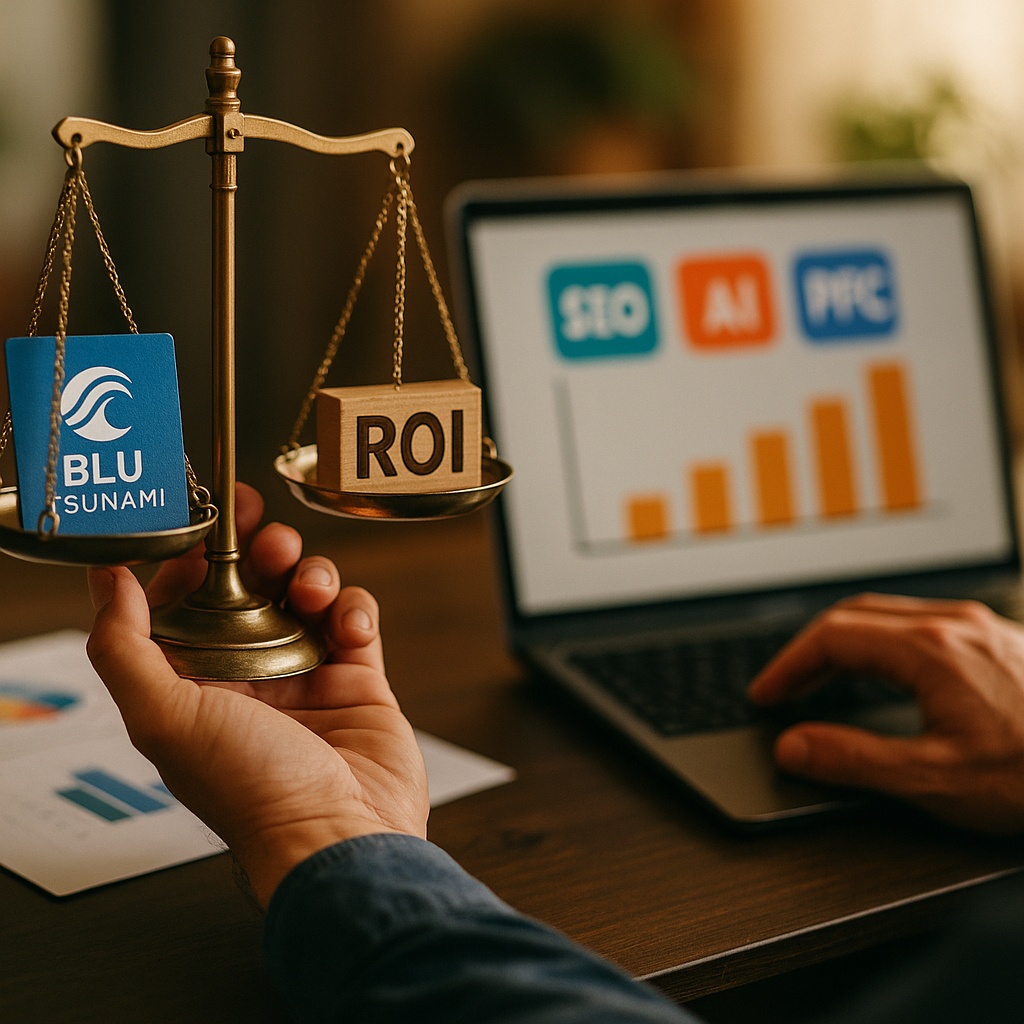
Nearly half of small businesses now say they’re testing an all-in-one AI marketing tool before renewing their existing stack. That’s the backdrop for the Blu Tsunami AI SEO PPC bundle, a tool pitched hard at small business marketers who want search and paid media managed by one dashboard instead of three vendors. Does it actually deliver, or is it another bundled promise that collapses under real campaign pressure?
This review breaks down what the bundle does well, where it stumbles, and whether a lean marketing team should sign the annual contract or walk away.
What’s Actually Inside the Bundle
Blu Tsunami markets the package as a single subscription covering keyword research, on-page SEO recommendations, automated PPC bid management, and a shared reporting layer across both channels. On paper, that’s the dream for a solo marketer or a three-person team juggling Google Ads, Bing Ads, and technical SEO fixes without dedicated specialists for each.
In practice, the SEO module leans heavily on automated content scoring and schema suggestions, similar to what you’d find in standalone AI SEO audit tools. The PPC side automates bid adjustments based on conversion data pulled from Google Ads and Meta, with a rules engine that pauses underperforming ad sets without manual review. Blu Tsunami also folds in a lightweight competitive tracker, though it only pulls top-10 organic rankings and doesn’t go deep into SERP feature tracking the way dedicated platforms do.
The core value proposition isn’t better technology. It’s fewer logins and one invoice instead of four, which matters more to a cash-strapped small business than marginal accuracy gains.
The Pitch vs. the Reality for Small Business Budgets
Sales decks promise “up to 40 percent time savings” on campaign management. That number shows up in a lot of AI marketing pitches lately, and it’s rarely wrong so much as it’s incomplete. Time savings depend entirely on how much manual oversight you’re willing to skip.
Teams that let the PPC automation run unsupervised for a full quarter reported real efficiency gains, mostly from not having to manually adjust bids daily. But several marketers I spoke with for comparable platform reviews (see our breakdown of all-in-one AI platforms for SMB fit) noted that the automation sometimes over-corrects, cutting spend on ad sets that were still in a learning phase. That’s a common failure mode across bundled tools: the algorithm optimizes for short-term signal, not strategic patience.
On the SEO side, expect generic recommendations. The content scoring tool will tell you to add more keyword variations and improve internal linking, which is true but not exactly proprietary insight. If you’ve used any HubSpot SEO tools or similar, the Blu Tsunami interface will feel familiar rather than groundbreaking.
Does the AI Actually Save Time?
Yes, with caveats. The reporting dashboard is genuinely useful for small teams that don’t have a dedicated analyst. Pulling PPC spend and organic traffic into one weekly digest saves roughly two to three hours a week compared to manually exporting data from Google Ads and Google Search Console.
But “saves time” and “makes good decisions” aren’t the same thing. The bid automation engine, when left on autopilot for more than two weeks without a human check-in, tends to chase last-click conversions and ignore assisted conversions entirely. That’s a known blind spot in AI-driven bidding tools generally, not unique to Blu Tsunami, but it’s worth flagging because small business marketers often don’t have the bandwidth to audit the automation weekly.
A related issue: platform bloat. Marketing teams already juggling five or six tools don’t need a sixth dashboard that duplicates half of what Google Analytics or Search Console already does for free. Our piece on the Gartner martech stack audit rule is worth revisiting before adding any new bundle, Blu Tsunami included.
Where Small Business Marketers Get Burned
Three recurring complaints surfaced across user forums and review sites.
- Contract lock-in. The annual plan locks you in at a discounted rate, but canceling mid-term forfeits the discount retroactively. Read the fine print before you sign anything longer than a quarterly term.
- Data portability. Exporting historical campaign data in a usable format requires a support ticket rather than a self-serve export button, which slows down any transition if you decide to switch tools later.
- Attribution overlap. Because the bundle reports PPC and SEO conversions through its own tracking layer, numbers sometimes don’t match what you see in Google Analytics 4, creating confusion during budget review meetings.
That last point matters more than it sounds. If your CFO is comparing Blu Tsunami’s dashboard numbers against your own GA4 export and they don’t reconcile, you’ll spend more time explaining the discrepancy than you saved using the automation in the first place.
For a deeper look at how bundled AI tools create lock-in risk specifically, our analysis of AI powered PPC and SEO bundles covers contract terms worth negotiating before signing with Blu Tsunami or any comparable vendor.
Is It Worth the Price Tag?
Pricing sits in the mid-tier range for small business marketing software, roughly comparable to running separate subscriptions for a basic SEO tool and an automated bid management platform. The math works out favorably if you’re currently paying for three or more disconnected tools and willing to consolidate.
It works less well if your SEO needs are already being handled by a freelancer or agency who understands your niche better than an automated scoring engine ever will. AI recommendations are generic by design. They can’t account for the fact that your industry’s search intent is unusually transactional, or that your top competitor just launched a content campaign that’s eating your rankings. A human strategist catches that. The bundle doesn’t.
If you’re still evaluating whether AI visibility and search tools are accurate enough to trust without human review, it’s worth reading our coverage of free SEO audit tools and their blind spots before committing budget to any automated platform, Blu Tsunami included.
Bundled AI tools win on convenience and lose on nuance. Know which one your team actually needs before you sign a 12-month contract.
For teams managing compliance alongside performance, it’s also worth checking how the platform handles consumer data and ad disclosure requirements under FTC guidelines, since automated PPC tools sometimes auto-generate ad copy that needs a manual disclosure review before it goes live.
Practical Recommendation
Run a 90-day pilot before committing to an annual contract. Keep your existing Google Ads and Search Console access active in parallel so you can cross-check Blu Tsunami’s reporting against your own data. If the numbers reconcile and the time savings hold up past the first month, it’s a reasonable consolidation move for a lean team. If support tickets pile up or the automation overrides your manual bid strategy more than once a week, that’s your signal to walk.
FAQs
What does the Blu Tsunami AI SEO PPC bundle actually include?
It combines automated keyword research, on-page SEO scoring, PPC bid management across Google and Meta ads, and a shared reporting dashboard for both channels in one subscription.
Is Blu Tsunami a good fit for solo marketers or small teams?
It can work well for teams without dedicated SEO or PPC specialists, mainly because it consolidates reporting and reduces the number of logins needed to manage campaigns day to day.
Does the bundle’s reporting match Google Analytics data?
Not always. Users have reported discrepancies between Blu Tsunami’s internal attribution and Google Analytics 4, which can complicate budget conversations if the two dashboards don’t reconcile.
Can you cancel a Blu Tsunami contract early without penalty?
Annual contracts typically forfeit the discounted rate if canceled mid-term, so it’s worth starting with a quarterly plan or a trial period before committing long term.
How does Blu Tsunami compare to using separate SEO and PPC tools?
Pricing is competitive if you’re currently paying for three or more disconnected subscriptions, but dedicated tools often provide deeper customization and better niche-specific SEO recommendations.
Bottom line: pilot it for a quarter, keep your own analytics running in parallel, and only sign the annual contract once the automation has proven it won’t quietly undercut campaigns you’d normally babysit by hand.
Top Influencer Marketing Agencies
The leading agencies shaping influencer marketing in 2026
Agencies ranked by campaign performance, client diversity, platform expertise, proven ROI, industry recognition, and client satisfaction. Assessed through verified case studies, reviews, and industry consultations.
Moburst

-
2

The Shelf
Boutique Beauty & Lifestyle Influencer AgencyA data-driven boutique agency specializing exclusively in beauty, wellness, and lifestyle influencer campaigns on Instagram and TikTok. Best for brands already focused on the beauty/personal care space that need curated, aesthetic-driven content.Clients: Pepsi, The Honest Company, Hims, Elf Cosmetics, Pure LeafVisit The Shelf → -
3

Audiencly
Niche Gaming & Esports Influencer AgencyA specialized agency focused exclusively on gaming and esports creators on YouTube, Twitch, and TikTok. Ideal if your campaign is 100% gaming-focused — from game launches to hardware and esports events.Clients: Epic Games, NordVPN, Ubisoft, Wargaming, Tencent GamesVisit Audiencly → -
4

Viral Nation
Global Influencer Marketing & Talent AgencyA dual talent management and marketing agency with proprietary brand safety tools and a global creator network spanning nano-influencers to celebrities across all major platforms.Clients: Meta, Activision Blizzard, Energizer, Aston Martin, WalmartVisit Viral Nation → -
5

The Influencer Marketing Factory
TikTok, Instagram & YouTube CampaignsA full-service agency with strong TikTok expertise, offering end-to-end campaign management from influencer discovery through performance reporting with a focus on platform-native content.Clients: Google, Snapchat, Universal Music, Bumble, YelpVisit TIMF → -
6

NeoReach
Enterprise Analytics & Influencer CampaignsAn enterprise-focused agency combining managed campaigns with a powerful self-service data platform for influencer search, audience analytics, and attribution modeling.Clients: Amazon, Airbnb, Netflix, Honda, The New York TimesVisit NeoReach → -
7

Ubiquitous
Creator-First Marketing PlatformA tech-driven platform combining self-service tools with managed campaign options, emphasizing speed and scalability for brands managing multiple influencer relationships.Clients: Lyft, Disney, Target, American Eagle, NetflixVisit Ubiquitous → -
8

Obviously
Scalable Enterprise Influencer CampaignsA tech-enabled agency built for high-volume campaigns, coordinating hundreds of creators simultaneously with end-to-end logistics, content rights management, and product seeding.Clients: Google, Ulta Beauty, Converse, AmazonVisit Obviously →