


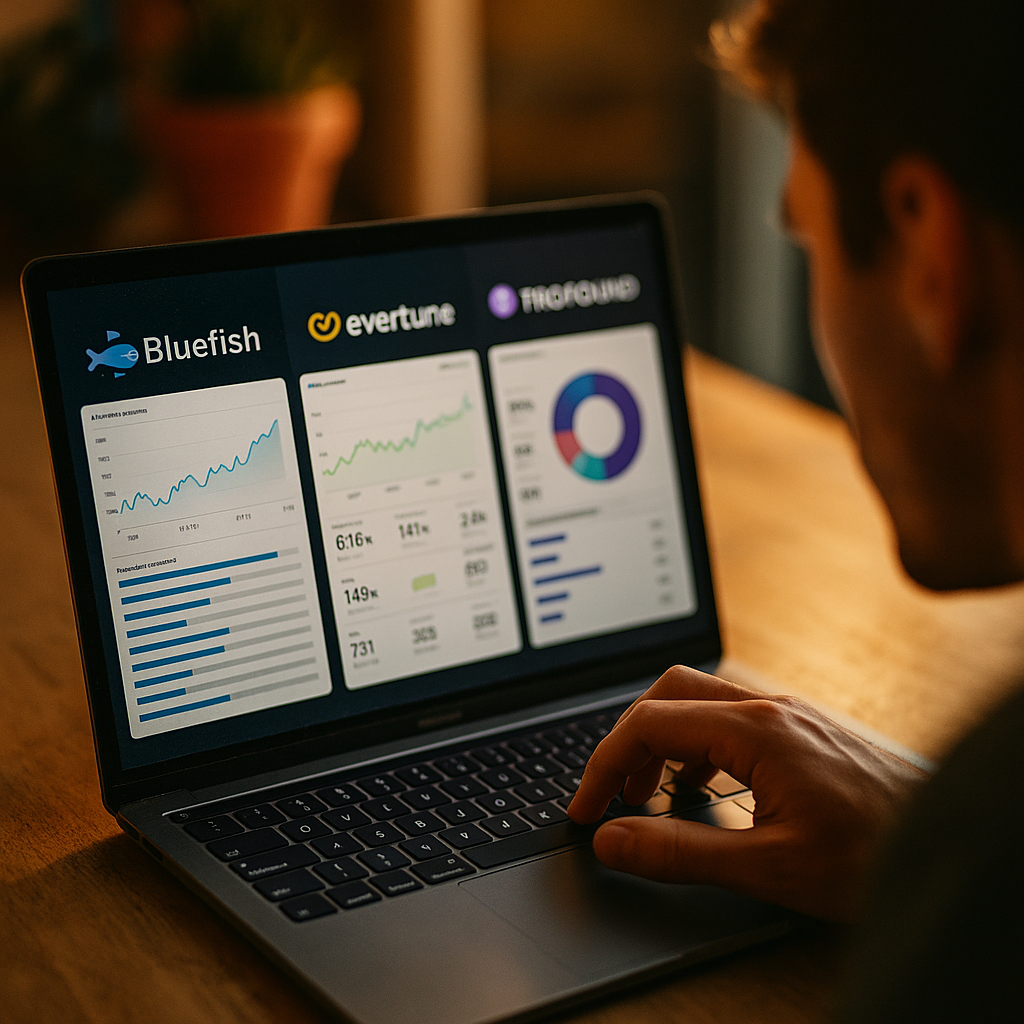
Only about a third of brand mentions inside AI chatbot answers ever get seen by the marketing team responsible for that brand. That’s not a hypothetical, it’s the operational reality for most companies right now, because almost nobody has a reliable system for tracking what ChatGPT, Gemini, or Perplexity say about them. AI visibility measurement has quietly become one of the most urgent gaps in the modern marketing stack, and three vendors, Bluefish, Evertune, and Profound, have emerged as the leading answers to it. This article breaks down how they differ and which one fits your brand’s risk profile and budget.
Why AI Visibility Measurement Became a Budget Line Item
Search behavior has shifted. Consumers ask ChatGPT for product recommendations instead of typing a query into Google and scrolling ten blue links. That shift means brand perception is now partly authored by a language model’s training data and retrieval pipeline, not just your SEO team’s content calendar. If a model recommends three competitors before it mentions you, or worse, states outdated pricing or a discontinued feature as current fact, that’s a brand risk with zero paper trail unless someone is actively monitoring it.
This is the same problem that pushed marketers toward GEO readiness audits over the past year. Traditional rank tracking tools were built for a web of static URLs, not for probabilistic, personalized, session-based answers that change depending on the prompt, the model version, and the user’s location. Bluefish, Evertune, and Profound all exist to close that visibility gap, but they approach the problem with meaningfully different architectures and use cases.
If your brand can’t answer “what does ChatGPT say about us right now,” you don’t have a measurement gap, you have a governance gap.
Bluefish: Built for Competitive Benchmarking at Scale
Bluefish positions itself as the analytics layer for brands that need to compare their AI presence against named competitors, not just track their own mentions in isolation. Its dashboards emphasize share of voice metrics across models, breaking down how often a brand appears in category-defining prompts (think “best CRM for small business” or “top running shoes for marathon training”) relative to rivals.
The strength here is the benchmarking layer. Marketing teams that already run competitive intelligence programs will recognize the workflow: set a prompt taxonomy, track it weekly, feed the output into quarterly business reviews. Bluefish also tends to appeal to teams with existing analytics infrastructure, since its exports plug reasonably well into BI tools marketers already use for reporting to leadership.
The tradeoff is depth on the qualitative side. Bluefish is strong on “how often” and “versus whom,” but brands looking for granular sentiment classification or citation-level source tracing sometimes need to supplement it with another tool. That’s a fair tradeoff if benchmarking is your primary use case, less so if your main concern is factual accuracy risk.
Evertune: The Sentiment and Narrative Specialist
Evertune’s pitch centers on narrative control. Rather than treating an AI mention as a binary “present or absent” event, Evertune scores the sentiment and framing of each mention, flagging when a model describes your brand as “budget” or “premium,” “innovative” or “legacy,” and tracks how that framing shifts over time and across models.
This matters more than it sounds. A brand can appear frequently in AI answers and still lose, if the framing consistently favors a competitor’s positioning. Evertune’s differentiation is built around this narrative layer, and it tends to resonate with brand and comms teams as much as performance marketers, since the outputs read more like a qualitative brand health report than a pure visibility scorecard.
Evertune also does meaningful work on prompt diversity, testing how answers change across informational, transactional, and comparison-style prompts. That’s useful for brands worried about inconsistent messaging depending on how a user phrases a question. The limitation: Evertune’s reporting cadence and setup process ask for more upfront configuration than some teams expect, so it rewards brands willing to invest time in prompt architecture rather than plug-and-play dashboards.
Profound: Source-Level Attribution and Technical Rigor
Profound has built its reputation on citation tracing, meaning it doesn’t just tell you that a model mentioned your brand, it tries to show you where the model’s answer likely originated. That’s a genuinely hard technical problem given how opaque retrieval and training pipelines are, but Profound’s approach of correlating mention patterns with crawl and citation data gives technical SEO and content teams something closer to an actionable roadmap.
If your team’s next question after “are we visible in AI answers” is “what do we need to publish or fix to change that,” Profound is generally the strongest starting point among the three. It leans into the connection between structured content, schema markup, and downstream AI visibility, which overlaps with the work covered in brand mention tracking in AI platforms more broadly.
The catch is that Profound’s technical depth comes with a steeper learning curve for non-technical stakeholders. Marketing leaders who want a clean executive summary sometimes find themselves relying on their SEO or data team to translate Profound’s findings into board-ready language. It’s a tradeoff worth making if your organization already has technical SEO capacity, less ideal if you’re a lean marketing team without that support.
Side-by-Side: What Actually Differs
- Primary strength: Bluefish (competitive benchmarking), Evertune (sentiment and narrative), Profound (source attribution and technical remediation).
- Best fit team: Bluefish suits performance and competitive intel teams. Evertune suits brand and comms leads. Profound suits SEO and content ops teams.
- Reporting style: Bluefish leans quantitative dashboards, Evertune leans qualitative narrative scoring, Profound leans technical diagnostics.
- Setup effort: Bluefish is closest to plug-and-play, Evertune requires prompt taxonomy investment, Profound requires SEO or engineering collaboration.
- Model coverage: All three track major answer engines including ChatGPT, Gemini, and Perplexity, though depth and refresh frequency vary by tier and pricing plan, so confirm current coverage directly with each vendor before signing.
None of these tools solve the underlying data governance problem on their own. AI visibility data is only useful if it feeds into a broader system that connects brand perception signals to your CRM, your content calendar, and your paid media targeting. That’s the same lesson brands are learning from identity and match rate tools making bold claims that need independent verification before budget commitment.
Picking a vendor isn’t the hard part. Building the internal workflow that turns AI visibility scores into content and product decisions is where most programs stall.
How to Actually Choose Between Them
Start with the question your leadership is actually asking. If the CMO wants to know “are we losing share of voice to competitor X in AI answers,” Bluefish’s benchmarking model answers that directly. If legal or comms is worried about reputational drift, Evertune’s sentiment tracking is the better first investment. If your content and SEO team needs a concrete list of pages, schema fixes, or citation gaps to close, Profound gives you the clearest technical map.
Budget matters too, and none of these platforms are cheap at enterprise tier. Mid-market brands sometimes start with a single-model, single-competitor pilot before expanding scope, which is a reasonable way to validate ROI before a full rollout. It’s also worth running a short internal audit, similar in spirit to a data audit framework, to confirm your team actually has the operational capacity to act on whatever the tool surfaces. A dashboard nobody reads is just a subscription fee.
Industry data on this space is still catching up to the pace of change. Analysts at eMarketer and Statista have both flagged generative AI answer engines as a fast-growing referral and discovery channel, though standardized measurement benchmarks are still emerging, which is exactly why third-party tools like these three exist in the first place. Marketing teams researching best practices for structured content and answer engine optimization can also find useful primers through HubSpot’s resource library.
The Real Risk of Doing Nothing
Brands that skip AI visibility measurement entirely aren’t avoiding the problem, they’re just choosing not to see it. Compliance and legal teams are increasingly asking marketing to document what AI platforms say about regulated claims, pricing, and product safety, a concern echoed in guidance from the Federal Trade Commission around accuracy in marketing representations. If an AI model misstates a claim about your product and a customer acts on it, “we didn’t know” is a weak defense once monitoring tools like these exist and are affordable at most budget tiers.
There’s also an operational efficiency angle that gets underweighted. Manually prompting ChatGPT and Gemini across dozens of category queries every week is not a scalable process for any team larger than one person. These platforms exist precisely to automate that grunt work, freeing analysts to focus on interpretation and response strategy rather than data collection. That’s the same efficiency logic driving adoption of AI-driven knowledge graph tools elsewhere in the martech stack.
Next Step
Run a 30-day pilot with the vendor that matches your most urgent internal question, benchmarking with Bluefish, narrative risk with Evertune, or technical remediation with Profound, and measure whether the insights actually change a content or product decision before committing to an annual contract.
FAQs
What is AI visibility measurement?
AI visibility measurement is the practice of tracking how often, and how accurately, a brand is mentioned in responses generated by AI chat platforms like ChatGPT, Gemini, and Perplexity. It typically covers frequency of mention, sentiment, competitive comparison, and source attribution.
How is this different from traditional SEO tracking?
Traditional SEO tracking measures rankings on static search results pages. AI visibility tracking measures probabilistic, conversational answers that can vary by prompt phrasing, model version, and user context, which requires different testing methods and refresh cycles.
Which platform is best for a small marketing team?
Bluefish tends to have the lowest setup burden for teams without dedicated technical or SEO resources, since it focuses on straightforward benchmarking dashboards rather than deep prompt architecture or citation tracing.
Do these tools guarantee improved AI rankings?
No. All three platforms are measurement and diagnostic tools, not guaranteed ranking solutions. Improving visibility typically requires content, schema, and structured data changes based on what the tool surfaces, alongside patience since model training and retrieval updates happen on the vendor’s own timeline.
How often should brands check their AI visibility?
Weekly monitoring is common for competitive or reputation-sensitive categories, while monthly checks are often sufficient for lower-risk categories. The right cadence depends on how frequently your competitors update messaging and how sensitive your industry is to factual accuracy.
Top Influencer Marketing Agencies
The leading agencies shaping influencer marketing in 2026
Agencies ranked by campaign performance, client diversity, platform expertise, proven ROI, industry recognition, and client satisfaction. Assessed through verified case studies, reviews, and industry consultations.
Moburst

-
2

The Shelf
Boutique Beauty & Lifestyle Influencer AgencyA data-driven boutique agency specializing exclusively in beauty, wellness, and lifestyle influencer campaigns on Instagram and TikTok. Best for brands already focused on the beauty/personal care space that need curated, aesthetic-driven content.Clients: Pepsi, The Honest Company, Hims, Elf Cosmetics, Pure LeafVisit The Shelf → -
3

Audiencly
Niche Gaming & Esports Influencer AgencyA specialized agency focused exclusively on gaming and esports creators on YouTube, Twitch, and TikTok. Ideal if your campaign is 100% gaming-focused — from game launches to hardware and esports events.Clients: Epic Games, NordVPN, Ubisoft, Wargaming, Tencent GamesVisit Audiencly → -
4

Viral Nation
Global Influencer Marketing & Talent AgencyA dual talent management and marketing agency with proprietary brand safety tools and a global creator network spanning nano-influencers to celebrities across all major platforms.Clients: Meta, Activision Blizzard, Energizer, Aston Martin, WalmartVisit Viral Nation → -
5

The Influencer Marketing Factory
TikTok, Instagram & YouTube CampaignsA full-service agency with strong TikTok expertise, offering end-to-end campaign management from influencer discovery through performance reporting with a focus on platform-native content.Clients: Google, Snapchat, Universal Music, Bumble, YelpVisit TIMF → -
6

NeoReach
Enterprise Analytics & Influencer CampaignsAn enterprise-focused agency combining managed campaigns with a powerful self-service data platform for influencer search, audience analytics, and attribution modeling.Clients: Amazon, Airbnb, Netflix, Honda, The New York TimesVisit NeoReach → -
7

Ubiquitous
Creator-First Marketing PlatformA tech-driven platform combining self-service tools with managed campaign options, emphasizing speed and scalability for brands managing multiple influencer relationships.Clients: Lyft, Disney, Target, American Eagle, NetflixVisit Ubiquitous → -
8

Obviously
Scalable Enterprise Influencer CampaignsA tech-enabled agency built for high-volume campaigns, coordinating hundreds of creators simultaneously with end-to-end logistics, content rights management, and product seeding.Clients: Google, Ulta Beauty, Converse, AmazonVisit Obviously →