


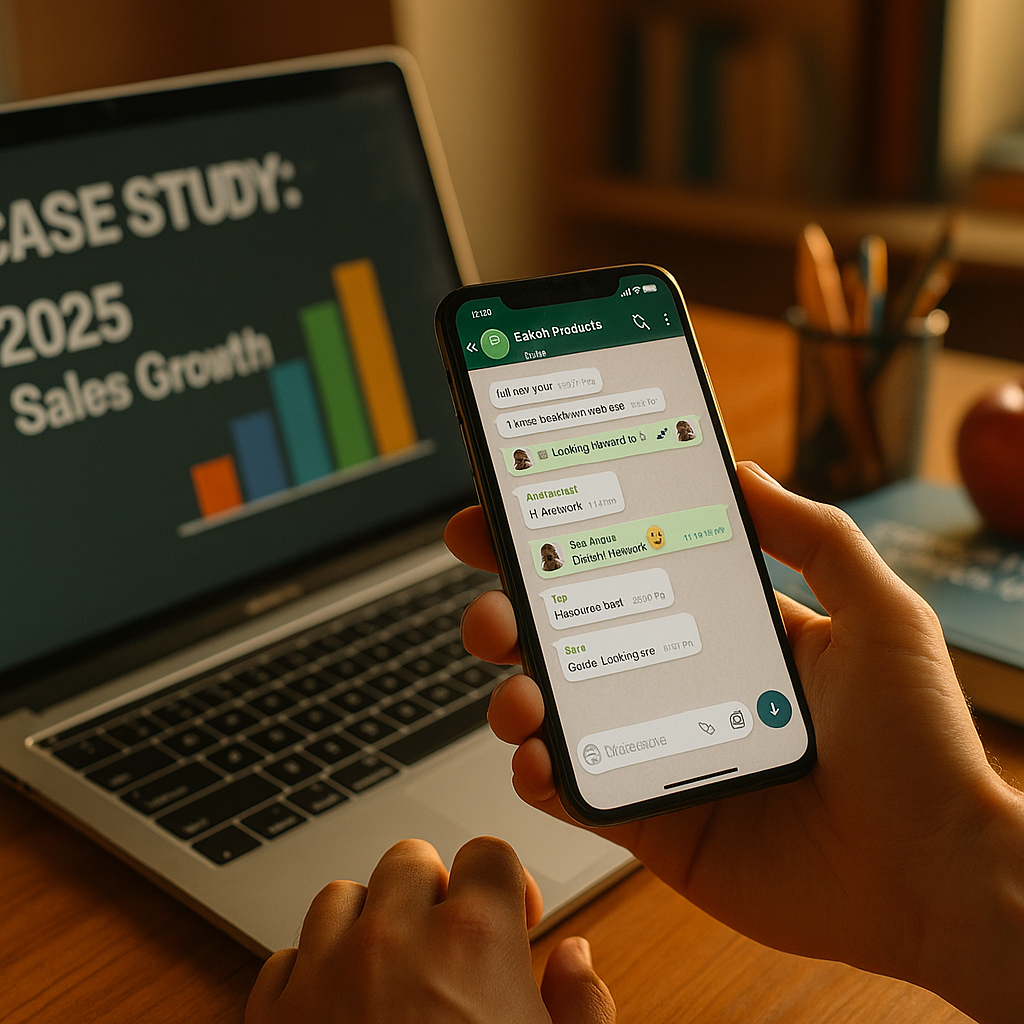
In 2025, many education businesses rely on email and ads, yet messaging apps often outperform both for speed and trust. This case study shows how an EdTech brand used WhatsApp Groups for sales by pairing community-led conversations with clear enrollment pathways. You’ll see the exact funnel, scripts, safeguards, and results—plus what to copy and what to avoid. Ready to see why groups converted?
WhatsApp sales funnel: The brand, the offer, and the starting problem
This case study follows a mid-sized EdTech brand that sells a job-focused upskilling program for early-career professionals. The core product is a 10-week cohort-based course with live sessions, projects, and hiring support. Average course price sits in the mid-ticket range (high enough to require trust, low enough for fast decisions).
The team had three challenges:
- Lead quality was uneven: paid social brought volume, but many leads didn’t understand the time commitment.
- Follow-up friction: email open rates were inconsistent, and calling every lead didn’t scale.
- Trust gap: prospects wanted proof—student outcomes, instructor credibility, and a sense of “fit”—before paying.
Instead of pushing harder on ads, the brand redesigned its conversion path around a high-intent environment: WhatsApp Groups. The goal wasn’t “more messages.” The goal was a measurable, ethical funnel that moved prospects from curiosity to enrollment with minimal friction.
EEAT note: The system was designed with verifiable proof points (instructor profiles, transparent syllabus, clear refund policy), documented processes, and compliance controls to protect users from spam-like behavior.
WhatsApp Groups strategy: Group architecture that drives intent (without chaos)
The biggest insight: a single “mega group” doesn’t sell—it overwhelms. The brand used a tiered group architecture that matched content to intent. Each group had a clear purpose, rules, and a defined start/end date to keep engagement high.
Group types and roles:
- Lead Magnet Group (7 days): a short “challenge” group where prospects received daily tasks, templates, and a live Q&A. This group built momentum fast.
- Webinar/Info Session Group (3 days): created for registrants, used to deliver reminders, worksheets, and post-session follow-up with FAQs.
- Admissions Concierge Group (rolling): smaller groups segmented by goal (career switchers, fresh grads, working professionals). Staffed by one counselor and one community moderator.
- Student-Only Cohort Group: access granted only after payment, used for onboarding and ongoing support.
Segmentation rules kept the experience relevant:
- Users were routed based on a two-question form: current role + target outcome.
- Each group capped at a manageable size; when full, a new group opened.
- Admins restricted posting in high-volume phases to prevent noise, then opened discussion windows for peer interaction.
Trust-building mechanics were baked into the structure:
- Every group description listed: agenda, admin identities, support hours, and opt-out instructions.
- Admins used named profiles (not anonymous brand-only numbers) and included role context like “Admissions Counselor.”
- Student testimonials were shared as verifiable stories (role before, what they built, time-to-result), not vague praise.
This design kept the groups from becoming a noisy broadcast channel and turned them into guided micro-communities where people could self-qualify.
EdTech lead nurturing on WhatsApp: Content, cadence, and conversion triggers
The brand treated WhatsApp like a learning environment, not a notification feed. They implemented a consistent cadence that answered the real questions prospects ask before buying: “Will this work for me?”, “Is it worth the money?”, “Can I keep up?”, and “Do I trust these instructors?”
7-day Lead Magnet Group cadence:
- Day 1: Welcome message + clear rules + “What you’ll achieve in 7 days” + quick poll to surface goals.
- Day 2: Mini-lesson + a 20-minute task + template download link.
- Day 3: Instructor voice note: common mistakes + what the program expects from students.
- Day 4: Student case snippet: before/after project outcome + short screen recording demo.
- Day 5: Live Q&A (30 minutes) + pinned recap with timestamps.
- Day 6: “Fit check” message: who should enroll and who shouldn’t (this reduced refunds and improved trust).
- Day 7: Enrollment pathway: deadline, bonuses, and a clear step-by-step to apply.
Conversion triggers were intentional and ethical:
- Micro-commitments: users completed a small task and shared progress, creating momentum and community accountability.
- Social proof with context: examples tied to specific outcomes (portfolio project, interview results) rather than generic “life-changing.”
- Risk reversal: a transparent refund window and a documented admissions process reduced perceived risk.
How they handled follow-up questions without burning the team:
- A pinned “Start Here” post answered the top 15 questions: schedule, prerequisites, devices needed, payment plans, refunds, certificates, and job support details.
- Moderators used approved snippets for consistent answers, then escalated edge cases to counselors.
- Office hours were set (and respected). Outside hours, users got an automated response with the next available time.
This approach increased conversion because prospects experienced the teaching style, clarity, and support quality before paying.
WhatsApp automation for admissions: Tools, workflows, and compliance
The brand avoided risky “spray-and-pray” automation. Instead, they used a workflow that kept users in control while still moving fast. Their guiding principle: automate routing and reminders, not relationships.
Workflow overview:
- Entry point: Ads and landing pages offered a free 7-day challenge. Users opted in and were told they would be added to a WhatsApp Group.
- Qualification: A short form captured intent signals (goal, timeframe, budget comfort). This determined which group they entered.
- Routing: Users were added to the correct group and tagged inside the CRM (e.g., “Career Switcher / High Intent”).
- Reminders: Automated nudges for live Q&A and deadlines were sent only to opt-in users, with clear opt-out instructions.
- Handoff: High-intent users were invited to a 1:1 chat for an admissions call or payment link.
What they automated:
- Group invite sequence after opt-in.
- Calendar booking link delivery for counseling calls.
- Deadline reminders and “session starting” notifications.
- Payment confirmation and onboarding checklist after purchase.
What they kept human:
- Eligibility and “fit” conversations.
- Handling objections about time, confidence, or prior experience.
- Refund and financing discussions.
Compliance and user trust safeguards:
- Explicit consent before adding users to groups, with a simple exit path.
- Clear identification of admins and business purpose in group descriptions.
- Data minimization: only essential data captured; sensitive details handled via secure forms, not chat.
- Frequency caps to prevent message fatigue and reduce spam complaints.
These measures supported a sustainable channel—one that improved sales while protecting brand reputation.
WhatsApp conversion metrics: What improved, what didn’t, and why
The brand measured WhatsApp Groups like a revenue channel, not a “community project.” They defined leading indicators (engagement and intent) and lagging indicators (applications, payments, refunds). They also tracked operational load to ensure the approach scaled.
Core metrics they monitored weekly:
- Join-to-active rate: percentage of users who interacted at least once in the first 48 hours.
- Task completion rate in the 7-day challenge (a strong predictor of enrollment readiness).
- Q&A attendance rate and questions per attendee (signals clarity vs confusion).
- Application rate from group members.
- Payment conversion rate from applicants.
- Refund rate and support ticket volume (quality and expectation management).
What improved:
- Speed to decision improved because users got answers in minutes, not days.
- Lead quality increased as the challenge filtered out low-commitment prospects.
- Show-up rates for counseling calls improved due to group accountability and reminders.
What didn’t improve automatically:
- Conversions didn’t rise just from posting more. The team learned that fewer, higher-value posts outperformed frequent promotions.
- Scaling required moderation. When groups grew without caps, question quality dropped and counselors burned out.
- Discounting backfired when used too early; it attracted price-shoppers and increased churn risk.
Why the numbers moved (the causal levers): the group format compressed the trust-building cycle, increased proof exposure, and created a low-friction path from curiosity to a real conversation. At the same time, strict rules and “fit check” messaging protected outcomes and reduced misalignment.
WhatsApp community management: Playbook you can replicate
If you want similar results, treat WhatsApp Groups as a structured admissions environment. This playbook distills what worked into repeatable steps.
Step 1: Define one group goal
- Examples: “Complete a 7-day challenge,” “Attend the info session,” or “Finish enrollment.”
- End-date groups perform better than indefinite groups because urgency stays natural.
Step 2: Publish rules that protect the experience
- No unsolicited DMs, no external promotion, and respectful communication.
- Set posting windows if your group volume is high.
Step 3: Build credibility fast
- Introduce instructors with credentials and what they’ve shipped or taught.
- Share outcomes with context: who the student was, what they did, and what changed.
- Link to a transparent syllabus and expectations document.
Step 4: Use a “fit check” to reduce refunds
- State prerequisites, weekly time requirements, and who should not buy yet.
- Offer a prep resource for those not ready; this keeps trust intact and creates future demand.
Step 5: Make enrollment steps simple
- One primary CTA at a time: apply, book a call, or pay.
- Confirm next steps immediately after a user acts (application received, payment received, onboarding link).
Step 6: Protect your team
- Assign roles: moderator (routing + rules) and counselor (sales + fit).
- Create a shared FAQ library and escalation guidelines.
- Track counselor load per group and cap group size accordingly.
This playbook keeps WhatsApp Groups from becoming an unstructured chat—and turns them into a predictable pipeline.
FAQs: WhatsApp Groups for EdTech sales
Do WhatsApp Groups work for high-ticket EdTech programs?
Yes, if you use them to shorten the trust cycle: structured proof, live access to experts, and clear “fit” criteria. For higher price points, pair groups with 1:1 counseling and transparent policies so prospects can validate value before paying.
Should we use a WhatsApp Group or a WhatsApp Channel?
Use a Group when you need interaction (Q&A, peer accountability, quick qualification). Use a Channel when you mainly broadcast updates. Many teams run both: Channel for announcements, Groups for conversion-focused cohorts.
How do we prevent spam and off-topic messages?
Set rules in the description, restrict posting during high-volume periods, and assign an active moderator. Use pinned “Start Here” messages and steer questions into defined threads or time windows.
What’s the best way to move from group engagement to payment?
Use one CTA at a time, tied to a deadline and a clear next step: apply, book a call, or pay. Share a short checklist of who the program is for, then invite qualified users to a 1:1 chat with a counselor.
How many messages per day is too many?
It depends on the group’s purpose, but message fatigue rises quickly. Prioritize one high-value post per day during challenges, plus reminders for live sessions. If users ask the same questions repeatedly, improve pinned resources instead of posting more.
What should we measure to prove ROI?
Track join-to-active rate, task completion, call booking and show-up rate, application rate, payment conversion, refund rate, and support load per counselor. Tie each cohort group to a campaign tag in your CRM to connect chats to revenue.
WhatsApp Groups can become a reliable sales engine when you design them as structured, time-bound cohorts rather than endless chat rooms. In 2025, the winning approach blends community, proof, and clear admissions steps while respecting consent and message frequency. Build a tiered group system, nurture with practical micro-lessons, and convert through fit-first counseling. The takeaway: clarity and moderation drive revenue.
Top Influencer Marketing Agencies
The leading agencies shaping influencer marketing in 2026
Agencies ranked by campaign performance, client diversity, platform expertise, proven ROI, industry recognition, and client satisfaction. Assessed through verified case studies, reviews, and industry consultations.
Moburst

-
2

The Shelf
Boutique Beauty & Lifestyle Influencer AgencyA data-driven boutique agency specializing exclusively in beauty, wellness, and lifestyle influencer campaigns on Instagram and TikTok. Best for brands already focused on the beauty/personal care space that need curated, aesthetic-driven content.Clients: Pepsi, The Honest Company, Hims, Elf Cosmetics, Pure LeafVisit The Shelf → -
3

Audiencly
Niche Gaming & Esports Influencer AgencyA specialized agency focused exclusively on gaming and esports creators on YouTube, Twitch, and TikTok. Ideal if your campaign is 100% gaming-focused — from game launches to hardware and esports events.Clients: Epic Games, NordVPN, Ubisoft, Wargaming, Tencent GamesVisit Audiencly → -
4

Viral Nation
Global Influencer Marketing & Talent AgencyA dual talent management and marketing agency with proprietary brand safety tools and a global creator network spanning nano-influencers to celebrities across all major platforms.Clients: Meta, Activision Blizzard, Energizer, Aston Martin, WalmartVisit Viral Nation → -
5

The Influencer Marketing Factory
TikTok, Instagram & YouTube CampaignsA full-service agency with strong TikTok expertise, offering end-to-end campaign management from influencer discovery through performance reporting with a focus on platform-native content.Clients: Google, Snapchat, Universal Music, Bumble, YelpVisit TIMF → -
6

NeoReach
Enterprise Analytics & Influencer CampaignsAn enterprise-focused agency combining managed campaigns with a powerful self-service data platform for influencer search, audience analytics, and attribution modeling.Clients: Amazon, Airbnb, Netflix, Honda, The New York TimesVisit NeoReach → -
7

Ubiquitous
Creator-First Marketing PlatformA tech-driven platform combining self-service tools with managed campaign options, emphasizing speed and scalability for brands managing multiple influencer relationships.Clients: Lyft, Disney, Target, American Eagle, NetflixVisit Ubiquitous → -
8

Obviously
Scalable Enterprise Influencer CampaignsA tech-enabled agency built for high-volume campaigns, coordinating hundreds of creators simultaneously with end-to-end logistics, content rights management, and product seeding.Clients: Google, Ulta Beauty, Converse, AmazonVisit Obviously →