


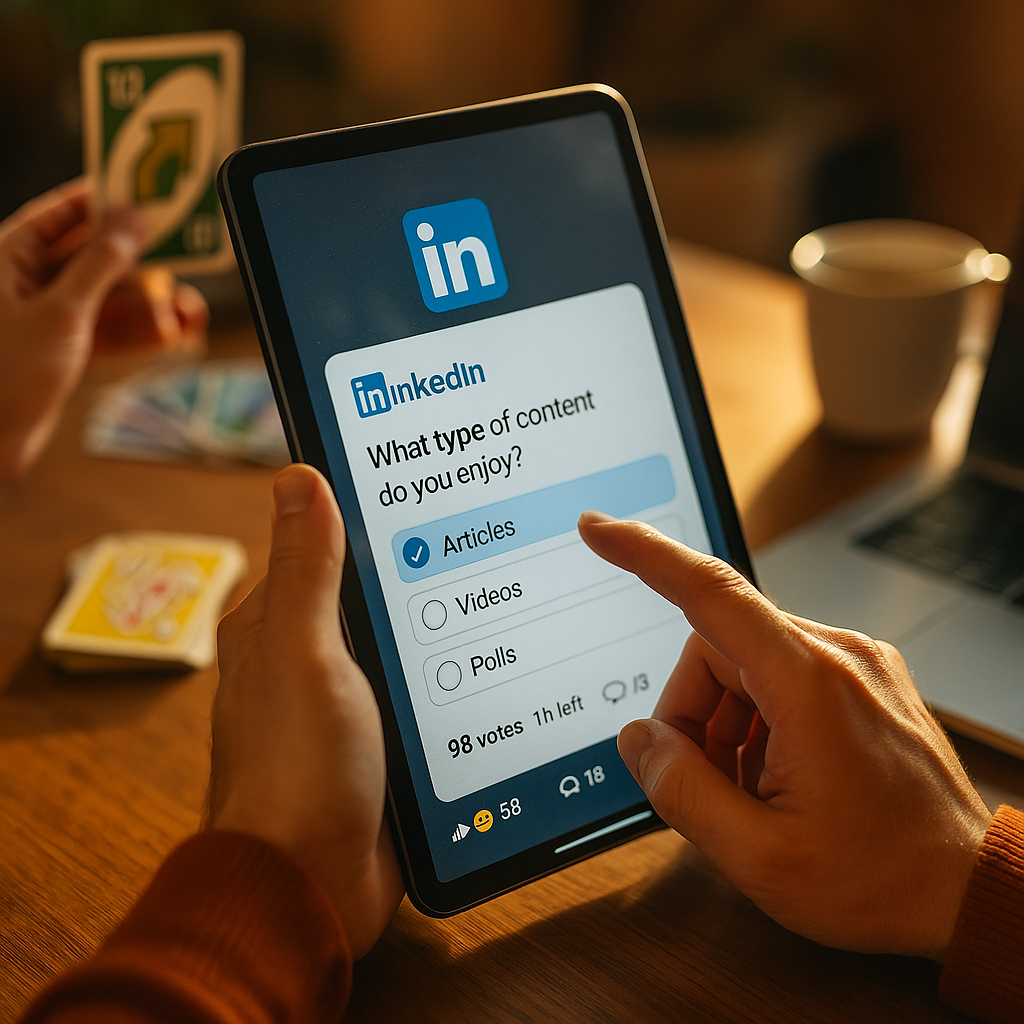
Interactive polls and gamification on LinkedIn can turn passive scrollers into active participants when you design them with intent. In 2025, the platform rewards content that sparks meaningful conversations, not empty clicks. This playbook shows how to choose the right format, write prompts people want to answer, and convert engagement into measurable business outcomes—without gimmicks. Ready to build a repeatable system?
LinkedIn engagement strategy: start with goals, not gimmicks
Polls and game mechanics work best when they support a clear LinkedIn engagement strategy. Before you publish anything, decide what success looks like and how you’ll measure it. Engagement for its own sake is fragile; engagement tied to a business objective compounds.
Pick one primary goal per campaign:
- Market insight: validate a hypothesis (pricing, positioning, pain points) with a fast pulse-check.
- Demand generation: attract the right buyers to a problem and move them into a conversation.
- Community building: create recurring participation so your audience expects and seeks your posts.
- Brand authority: teach by revealing patterns in results and explaining what they mean.
Define success metrics that match the goal:
- Market insight: number of relevant voters, quality of comments, DM replies from your ICP, and whether results confirm or challenge your assumptions.
- Demand generation: profile visits from target roles, connection requests, qualified inbound messages, and booked calls attributed to the post.
- Community: repeat commenters, follower growth from your niche, and participation rate over time.
- Authority: saves, shares with commentary, and invitations to speak/collaborate.
Build a simple tracking habit: for each poll/game post, record the prompt, audience, posting time, votes, comments, top commenters (titles/industries), and the next action you took. This turns “content” into an iterative program and strengthens EEAT by anchoring future claims in your own observed results.
LinkedIn poll best practices: craft prompts people can answer fast
Great LinkedIn polls feel easy to answer and hard to ignore. The best prompts reduce mental load while still revealing something meaningful. Your job is to eliminate confusion, avoid bias, and make each option a real choice.
Use a proven poll structure:
- One clear question focused on a single decision, belief, or experience.
- Three to four options that are mutually exclusive and collectively cover most reality.
- A short context line explaining why you’re asking and who should vote.
Write options that are balanced: Avoid one option that sounds obviously “smart” while others sound careless. If your poll reads like a test, people won’t participate—or they’ll choose what looks socially acceptable rather than what’s true.
Examples of high-signal poll angles:
- Trade-offs: “When hiring for a senior role, what do you prioritize first?”
- Thresholds: “What response time counts as ‘fast’ for support in B2B?”
- Process reality: “What’s the biggest bottleneck in your content workflow?”
- Tool adoption: “Which workflow is most automated in your team today?”
Answer the follow-up inside the post: Add a sentence like, “Vote, then comment with the context behind your choice—industry and company size help.” This improves comment quality and keeps the conversation on-topic.
Use ethical targeting: Don’t imply false urgency, don’t farm engagement, and don’t ask for sensitive personal data. EEAT favors transparent intent: tell readers what you’ll do with the insights (for example, “I’ll share a breakdown and practical recommendations in 48 hours”).
LinkedIn gamification ideas: add game mechanics that feel professional
Gamification works on LinkedIn when it respects the platform’s professional context. The goal is not to “make it fun” in the abstract; it’s to create structured participation, friendly competition, and clear progression toward insight.
Game mechanics that fit LinkedIn:
- Prediction polls: Ask people to predict an outcome (trend, KPI range, what will happen next). Reveal results with analysis and what you’d do if the prediction is right or wrong.
- Choose-your-path series: Run a weekly sequence where the audience votes on the next step in a case study (positioning, pricing, outreach). Each post references prior decisions.
- Challenge prompts: “Comment with your one-sentence positioning statement. I’ll reply with one improvement.” This builds authority through visible coaching.
- Mini-audits by vote: Share three anonymized examples and ask which is strongest and why. Then teach the underlying principle.
- Scorecards: Provide a simple checklist (“0–10 points”) and ask readers to score themselves, then vote for their range.
Keep the rules obvious: In the first two lines, state what to do and what happens next. Confusing games create friction and reduce participation.
Reward systems that don’t require prizes: On LinkedIn, recognition is often enough. Offer “top insights roundup,” a thoughtful reply, a follow-up template, or a short Loom-style explanation you summarize in text. Avoid tactics that encourage spammy comments (for example, “comment YES for the link”) and instead invite genuine discussion and opt-in DMs when appropriate.
Protect trust: If you use anonymized examples, say they’re anonymized. If you’re using your own client experiences, generalize details and share what you learned without exposing confidential information. Trust is the strongest gamification mechanic you have.
Audience targeting on LinkedIn: reach the right voters and commenters
Poll performance depends heavily on who sees it. If your network is broad, you can still get sharp insights by narrowing the audience with your language and distribution approach.
Target in three layers:
- In-post targeting: State who should vote: role, industry, business model, or company stage. Example: “If you run revenue ops at a B2B SaaS company, I’d value your vote.”
- Comment targeting: Ask for context that matters (company size, region, sales motion). This turns raw votes into usable insight.
- Network targeting: Tagging should be used sparingly and only when someone has a clear reason to contribute. Better: send a short DM to 5–10 relevant peers asking them to weigh in with a perspective comment.
Timing in 2025: Rather than chasing universal “best times,” test two consistent slots that match your audience’s workday. Run a four-post experiment: same topic family, same structure, different time slots. Track not only votes, but also the seniority and relevance of commenters.
Participation flywheel: Respond to early comments within the first hour when possible. Ask one follow-up question per strong comment. This deepens threads and signals the post is a conversation, not a broadcast.
Accessibility and clarity: Use plain language, avoid jargon-heavy options, and keep formatting clean. This improves comprehension across industries and global audiences, increasing valid responses.
Lead generation on LinkedIn: convert engagement into next steps without pressure
Polls and gamified posts can drive lead generation on LinkedIn, but only if you design the transition from public interaction to private action. People vote quickly; they convert when you offer the right next step at the right moment.
Use a two-step conversion path:
- Step 1 (public): Earn trust with a useful interpretation of results. Summarize what surprised you, what you’d recommend, and what you’d test next.
- Step 2 (private or deeper public): Offer an opt-in resource or conversation for those who match a specific scenario.
Effective calls to action that stay professional:
- Comment-based: “If you’re in the ‘Option B’ camp, what’s the constraint that forces that choice?”
- Resource-based: “I can share the checklist I use to evaluate this—message me if you want it.”
- Diagnostic-based: “If you want a second opinion, send your current approach and I’ll reply with one improvement.”
Qualify without interrogating: When someone DMs, ask one clarifying question that directly affects your advice. Example: “Are you selling to mid-market or enterprise?” This keeps the conversation helpful and efficient.
Repurpose with integrity: Turn high-performing polls into a short insight post, a carousel-style breakdown (if you use that format), a newsletter section, or a webinar topic. Always credit the community: “Based on responses from ops leaders here, three patterns emerged…” This demonstrates experience and reinforces authority.
LinkedIn analytics for polls: measure what matters and iterate
Without measurement, you’ll optimize for vanity numbers. LinkedIn analytics for polls should focus on signal quality: did the post attract the right people, produce actionable insight, and lead to meaningful conversations?
Build a simple scorecard:
- Relevance score: Percentage of commenters who match your target roles/industries.
- Insight score: Number of comments that include context, examples, or data (not just a vote).
- Conversation score: Thread depth (replies per commenter) and whether peers respond to each other.
- Conversion score: Qualified DMs, booked calls, or sign-ups attributed to the post.
Run A/B tests responsibly: Don’t change five variables at once. Test one element per week: question framing, option wording, or the first two lines of the post. Keep your audience targeting consistent so results are comparable.
Common fixes based on outcomes:
- High votes, low comments: Add a sharper follow-up question and request one piece of context. Consider more polarizing (but fair) trade-offs.
- Low votes, high-quality comments: Your prompt may be too niche. Keep it, but improve targeting language and distribution to reach more of the right people.
- High engagement, low relevance: Your wording is too broad. Specify role, company type, or use-case.
- Good engagement, no business impact: Your next step is unclear. Publish a results breakdown with a specific opt-in CTA tied to a scenario.
Document what you learn: A one-page internal “poll insights log” becomes proprietary knowledge over time. That is a practical EEAT advantage: you’re not just repeating tips—you’re building evidence from your own experiments.
FAQs
How often should I run polls on LinkedIn?
Start with one poll every one to two weeks, then adjust based on audience fatigue and insight quality. If you can reliably follow up with analysis and conversation, you can increase frequency. If you skip the follow-up, reduce frequency and focus on fewer, higher-quality polls.
What’s the ideal number of poll options?
Three to four options usually performs best because it keeps decision effort low while still producing meaningful segmentation. Use three when the choices are clear trade-offs; use four when there’s a common “other” category you can define cleanly.
Should I include an “Other” option?
Include “Other” only if you plan to ask commenters to specify what “Other” means. Otherwise, it becomes a catch-all that reduces insight. If you expect many nuanced answers, replace “Other” with a fourth option that reflects the most likely alternative.
How do I prevent my poll from attracting the wrong audience?
Use in-post targeting (“If you’re a…”) and ask for context in comments (industry, team size, segment). Also, engage a few relevant peers early by inviting them to add perspective comments, which signals who the post is for.
Can gamification hurt credibility on LinkedIn?
Yes—if it looks like a gimmick or encourages low-effort engagement. Keep game mechanics tied to professional outcomes, make rules transparent, and reward participants with insight, feedback, or structured resources instead of hype.
How do I turn poll results into leads without being pushy?
Publish a short results interpretation with practical recommendations, then offer an opt-in next step for a specific scenario (template, checklist, quick diagnostic). Let people self-identify by messaging you, and keep the first DM focused on helping, not pitching.
Interactive polls and gamification can strengthen your LinkedIn presence when you treat them as a system: clear goals, easy-to-answer prompts, professional game mechanics, and disciplined follow-through. Focus on attracting the right participants, not the most participants. Measure relevance, insight, and conversions—not just votes. Publish the results, explain what they mean, and invite an opt-in next step. That’s how engagement becomes momentum.