


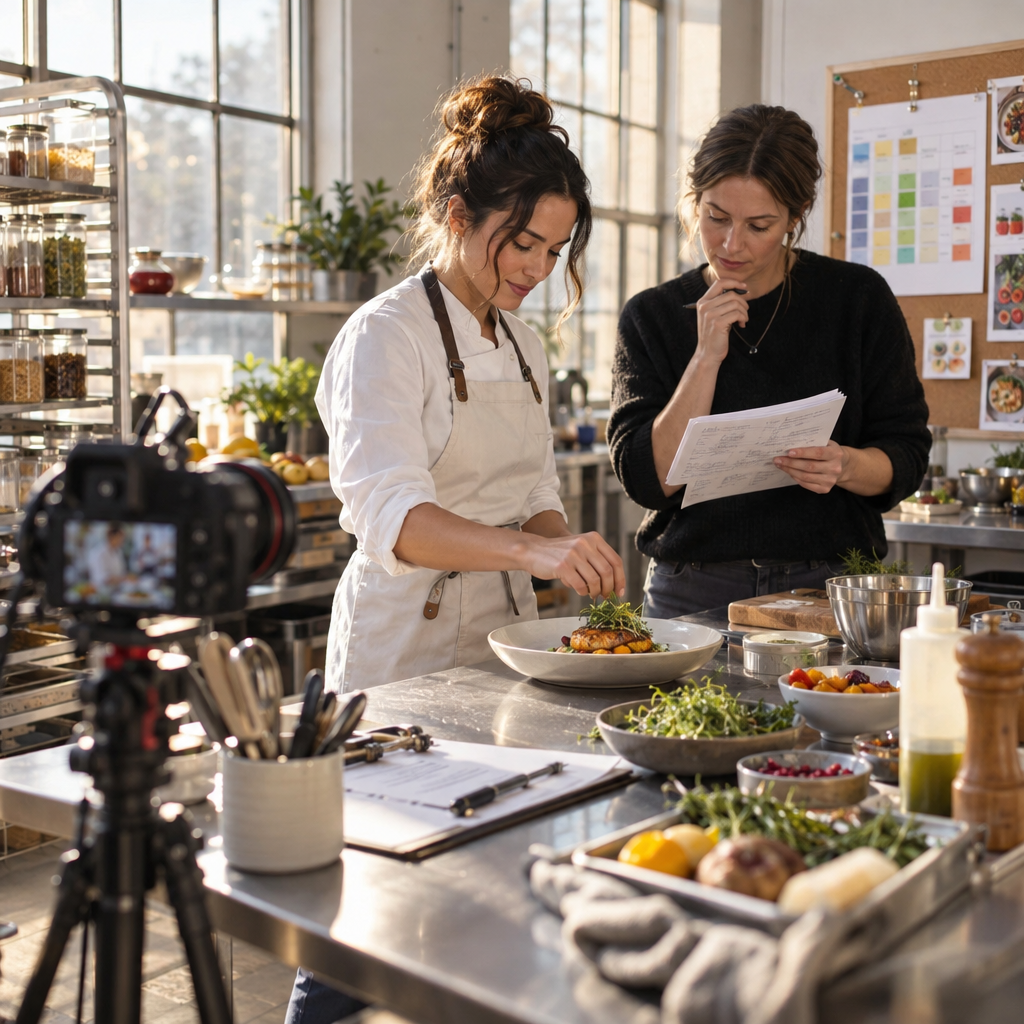
Most branded cooking series fail before the first pan heats up. The brief is the reason. A vague “make something delicious with our product” request produces one-off posts, off-brand recipes and legal rework. If you want recipe collab content that compounds across episodes, the brief has to do more than the recipe card does.
Why food briefs break differently
Food creators sell something other verticals don’t: usable instructions. Viewers cook along, save, screenshot and come back in three weeks. That changes what you are buying.
A beauty brief can get away with a feeling. A recipe brief gets tested in someone’s kitchen. If the measurements are wrong or the product substitution fails, the comments will say so publicly.
So treat the brief as a production document. It should cover the product role, the recipe ownership, the series arc, the compliance guardrails and the approval path. Skip any one of those and you will pay for it later in revisions.
Define the product’s job in the recipe
“Feature the product” is not a role. Is it the hero ingredient, a shortcut, a swap, or a finishing touch? Each one demands a different shot list and a different claim.
- Hero: The dish fails without it. Best for sauces, spice blends and specialty staples.
- Shortcut: It replaces a labor-heavy step. Best for frozen, canned or prepped items.
- Swap: It substitutes for a familiar ingredient. This one needs a side-by-side proof moment.
- Finisher: It lifts the dish at the end. Easiest to integrate, easiest to skip, so require a visible close-up.
Then write one sentence the creator must make true on camera. Not scripted, but verifiable. “Ready in 20 minutes with the product” is testable. “The best weeknight dinner ever” is not.
Who owns the recipe?
This is the question that quietly kills series in month three.
Decide upfront whether the recipe is a creator asset licensed to the brand, a brand asset the creator interprets, or co-owned. Then spell out where it can live: the creator’s blog, your product pages, retail shelf talkers, paid social. A creator’s signature dish repurposed on packaging without a license is a dispute waiting to happen.
Cover these in the contract and mirror them in the brief:
- Usage window and channels for the video and the written recipe
- Whether the creator may publish the same recipe with a competing brand
- Whether you may edit or adapt the recipe (portion sizes, regional versions)
- Credit requirements when the recipe appears on your owned channels
If paid amplification is in play, our guide on licensing creator video rights covers the clauses most teams forget.
A recipe is both content and instructions. License it like content, but review it like a product claim.
Build the series, not the post
A branded cooking series earns its return through repetition. Viewers learn the format, and the algorithm learns who to show it to. Give the creator a repeatable skeleton and freedom inside it.
A workable episode frame looks like this:
- First 3 seconds: The finished dish, not the ingredients. Show the payoff first.
- Middle: Three to five clear steps, with the product appearing at the moment it matters.
- Close: A taste reaction or texture proof, then a single call to action.
Fix three elements across episodes (title format, opening shot, sign-off) and let ingredients, theme and tone vary. For multi-part planning, the principles in our piece on multi-episode vertical formats translate directly to a cooking run.
Sensory proof matters too. Sizzle, crunch and pour shots carry weight in food more than anywhere else, and our breakdown of ASMR product demos shows how to brief for them without making the video feel staged.
Compliance: the part creators assume you handled
Two risk areas matter most for food: sponsorship disclosure and allergen or ingredient accuracy.
Disclosure. The FTC’s staff guidance says that a connection between endorser and marketer that a significant minority of consumers wouldn’t expect should be disclosed clearly and conspicuously. Free product counts as a connection. Be careful about the placement, too. In its influencer guide, the agency states that for video endorsements, the disclosure should be in the video and not just in the description. The same document adds that viewers are more likely to notice disclosures made in both audio and video.
For a cooking series, that means a spoken line and an on-screen label in every episode, not only the first. Viewers who land on episode four from search never saw episode one.
Allergens. If a recipe includes your product or the ingredients around it, an accuracy error is more than embarrassing. It can hurt someone. Per the FDA, sesame became the 9th major food allergen starting January 1, 2023. Many sauces, breads and spice blends contain it, and creators don’t always know.
Add an allergen line to your brief: the creator must state any major allergens in the recipe, and your team confirms them against the product label before publication. Simple. Non-negotiable.
What should the brief actually contain?
Keep it to two pages. Longer briefs get skimmed, and food creators work fast.
- Series objective: One goal, such as trial, recipe saves or retail lift.
- Product role and the one verifiable claim.
- Recipe ownership and usage terms.
- Episode skeleton: Fixed elements and flexible elements.
- Must-haves: Disclosure placement, allergen statement, product close-up.
- Must-avoids: Health claims, unapproved comparisons, competitor products in frame.
- Approval flow: Who reviews, how fast, and what counts as a blocking issue.
- Delivery specs: Formats, caption copy, chapters and recipe text.
On that last point, recipe videos are searched, not just scrolled. Ask for chapters that mirror the steps, and a written recipe in the description or on the creator’s site. Our guide on chapters and tags search can find goes deeper on structure.
Approvals without killing the vibe
Brands lose food creators by over-editing. A brand manager who rewrites a casual voiceover into copy-approved language flattens the very thing that made the creator worth hiring.
Separate what is reviewable from what is not. Review the claims, the allergen statement, the disclosure and the product depiction. Leave humor, pacing, plating and personality alone.
Ask for a recipe outline and a rough cut, not just a final. Two checkpoints catch most problems. One more tip: have someone on your team actually cook the recipe with the product before launch. It takes an hour and it surfaces broken ratios that no review call will.
Logistics and measurement
Perishables and fragile packaging make shipping a real variable. If your series depends on a specific product batch or a pantry kit, plan the send early and include backup units for retakes. Teams scaling gifting across many creators will find useful operational detail in our guide to seeding box logistics.
For measurement, match metrics to the objective you set. Saves and shares signal recipe utility. Tracked links or retailer codes signal purchase intent. Comments asking where to buy the product signal awareness working. Track by episode, since the pattern tells you which product role and recipe type to repeat.
FAQs
How long should a branded cooking series run?
Start with four to six episodes. That is enough to test whether the format builds a returning audience, and short enough to adjust the product role or recipe type before you commit a larger budget.
Should the creator or the brand own the recipe?
It depends on where you want to use it. If you plan to put the recipe on packaging, retail displays or paid ads, secure a clear license or buy-out. If the recipe stays on the creator’s channels, a shorter usage window and a non-exclusivity clause are usually enough.
Do food creators have to disclose free product?
Yes, when the connection would affect how viewers weigh the endorsement and they wouldn’t expect it. The FTC’s guidance treats the disclosure as something that must be clear and conspicuous, and for video it should appear in the video itself, not only the caption.
How do I handle allergen and nutrition claims?
Require creators to name major allergens in the recipe and have your team verify them against the product label. Avoid health or nutrition claims in the brief unless your legal team has approved the exact wording.
How much creative control should the brand keep?
Keep control over claims, compliance and product depiction. Give the creator control over voice, recipe development, plating and pacing. That split protects the brand without flattening the content.
What metrics show a recipe series is working?
Use saves and shares for recipe utility, tracked links or retailer codes for purchase intent, and episode-level retention for format strength. Pick one primary metric in the brief so the creator knows what success looks like.
Before your next series, turn the eight-point brief above into a two-page template, then cook the recipe in-house with the product before you approve a single frame.
Top Influencer Marketing Agencies
The leading agencies shaping influencer marketing in 2026
Agencies ranked by campaign performance, client diversity, platform expertise, proven ROI, industry recognition, and client satisfaction. Assessed through verified case studies, reviews, and industry consultations.
Moburst

-
2

The Shelf
Boutique Beauty & Lifestyle Influencer AgencyA data-driven boutique agency specializing exclusively in beauty, wellness, and lifestyle influencer campaigns on Instagram and TikTok. Best for brands already focused on the beauty/personal care space that need curated, aesthetic-driven content.Clients: Pepsi, The Honest Company, Hims, Elf Cosmetics, Pure LeafVisit The Shelf → -
3

Audiencly
Niche Gaming & Esports Influencer AgencyA specialized agency focused exclusively on gaming and esports creators on YouTube, Twitch, and TikTok. Ideal if your campaign is 100% gaming-focused — from game launches to hardware and esports events.Clients: Epic Games, NordVPN, Ubisoft, Wargaming, Tencent GamesVisit Audiencly → -
4

Viral Nation
Global Influencer Marketing & Talent AgencyA dual talent management and marketing agency with proprietary brand safety tools and a global creator network spanning nano-influencers to celebrities across all major platforms.Clients: Meta, Activision Blizzard, Energizer, Aston Martin, WalmartVisit Viral Nation → -
5

The Influencer Marketing Factory
TikTok, Instagram & YouTube CampaignsA full-service agency with strong TikTok expertise, offering end-to-end campaign management from influencer discovery through performance reporting with a focus on platform-native content.Clients: Google, Snapchat, Universal Music, Bumble, YelpVisit TIMF → -
6

NeoReach
Enterprise Analytics & Influencer CampaignsAn enterprise-focused agency combining managed campaigns with a powerful self-service data platform for influencer search, audience analytics, and attribution modeling.Clients: Amazon, Airbnb, Netflix, Honda, The New York TimesVisit NeoReach → -
7

Ubiquitous
Creator-First Marketing PlatformA tech-driven platform combining self-service tools with managed campaign options, emphasizing speed and scalability for brands managing multiple influencer relationships.Clients: Lyft, Disney, Target, American Eagle, NetflixVisit Ubiquitous → -
8

Obviously
Scalable Enterprise Influencer CampaignsA tech-enabled agency built for high-volume campaigns, coordinating hundreds of creators simultaneously with end-to-end logistics, content rights management, and product seeding.Clients: Google, Ulta Beauty, Converse, AmazonVisit Obviously →