


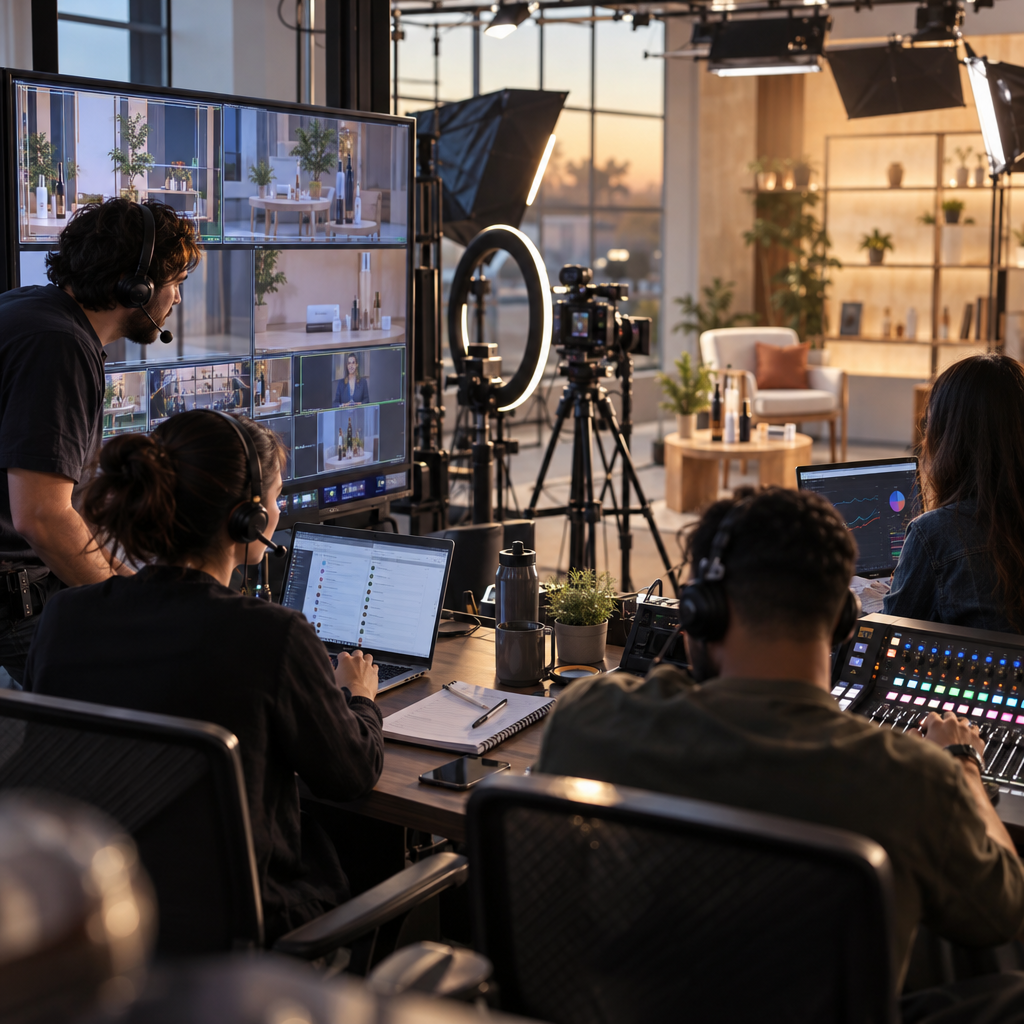
TikTok Shop lets a single livestream carry up to 20 moderators. That detail says more about live commerce production roles than any market forecast. The platform assumes a stream is a team sport, yet most brands still staff it as a host, a phone and hope.
The host is only the visible part
Brands often hire a charismatic creator, point a camera at them and wait for revenue. Then the stream stalls. Viewers ask about sizing and nobody answers. A product card vanishes. Paid traffic arrives and bounces off a host who is busy reading comments.
The fix is structural, not motivational. A practitioner guide on livestream e-commerce team structure, written around Douyin, describes the same pattern: the front end adds a streamer and an on-site controller, while operations and customer service stay as the backbone. The author argues that operations is the hub, because that team feeds traffic, scripts and training into the stream.
The logic travels. Whether you run TikTok Shop, Amazon Live or a shoppable stream on your own site, the on-camera person converts attention that someone else has built, scheduled and protected.
The core crew: who sits where
Roles are not job titles. At small scale, one person can hold two seats. What cannot happen is a seat sitting empty. Here is the map I use when auditing a live program.
- Executive producer or live commerce lead. Owns the run of show, the calendar, the budget and the post-stream readout. This is the single accountable owner.
- Host (the creator). Demonstrates, persuades and handles the room. Should not be doing anything technical.
- Co-host or on-site controller. Watches the stream as a viewer would, adds product links, sets quick replies and steadies the pace when the host flags. The 36Kr guide treats this person as a sales partner, not an assistant.
- Chat moderator. Answers questions, mutes abusers and escalates complaints. TikTok’s seller academy says moderators can mute or block users from commenting during the stream.
- Technical operator. Lighting, audio, camera angles, backup connection, and the call on when to cut to a fallback.
- Paid media and traffic specialist. Feeds the room with viewers before and during the stream.
- Customer service and fulfillment liaison. Handles the aftermath: orders, returns and stock alerts.
- Compliance reviewer. Signs off scripts, claims and disclosures before anyone goes live.
If a stream converts badly, audit the empty seats before you replace the host. In most programs we review, the missing role is the moderator or the traffic owner, not the talent.
What does a producer actually do during a stream?
Mostly, they prevent small failures from becoming public ones. TikTok’s own guidance shows how granular the work gets. It tells sellers to pin one product at a time, to re-pin the product card about every 30 seconds, and to post a teaser video a day before the stream, then promote it two hours ahead. It also suggests a second phone dedicated to managing comments.
Read that list as a task assignment problem. Somebody has to own the pin cadence. Somebody has to own teasers. Somebody has to watch comments while the host sells. If those tasks fall to the host, the host sells less.
The producer’s pre-stream checklist should be written down and owned. Mine has five items: the run of show with product order and timing, the approved script and claims sheet, the moderator roster with escalation rules, the paid media plan, and a tested fallback if audio or connectivity fails.
Paid media is a production role, not a side job
Live is short. A stream that runs an hour cannot wait for a slow-learning campaign. TikTok’s ad documentation for LIVE Shopping Ads notes that audiences built on past shop activity can be too narrow for a short-duration livestream, and recommends a separate ad group with a broader audience. It also suggests keeping targeting to 18+ and, for retargeting, using product page view, add to cart and initiate checkout events from the last 30 days while excluding anyone who bought in the last 7 days. The details are on the LIVE Shopping Ads audience guidance.
Who makes those calls? Not the host. Not the producer, who is busy. A named traffic specialist should sit in the stream’s control channel, watching concurrent viewers and adjusting spend while the room is live. If you plan paid support as part of a wider mix, the unified creator budget plan shows how to size it against other channels.
The compliance seat nobody wants to fund
Here is where brands get hurt. Live is unscripted by nature, so risk lives in the ad-libs. TikTok’s guidance on top LIVE quality issues lists several things that cost sellers: drifting off-topic, playing pre-recorded or looping clips, ignoring viewer engagement, and sending buyers outside the app. Each one is a producer or moderator catch, not a host catch.
Add your own category risks on top: health claims, pricing statements, giveaway terms and disclosure of the creator relationship. A one-page claims sheet, reviewed by legal in advance, plus a moderator empowered to flag a live statement, is cheap insurance. For larger programs, formalize it through a creator governance board so approvals do not depend on who happens to be online.
Build, borrow or rent the crew?
You do not need eight full-time hires on day one. You do need eight seats covered. A sensible progression looks like this:
- Pilot (first 4 to 6 streams). One producer-operator, one co-host who doubles as moderator, one paid media owner borrowed from your performance team. Compliance review happens before each stream, not during.
- Repeatable program. Split the moderator and technical roles. Name a dedicated live commerce lead. Document a run-of-show template.
- Always-on channel. Add customer service coverage during live windows, a backup producer and a bench of hosts, so one absence never cancels a stream.
The build-or-buy question matters most at step three. If you are weighing an outside production partner against in-house hires, borrow the logic of a scorecard. The build vs buy scorecard was written for UGC studios, but the criteria (control, speed, cost at volume, institutional knowledge) transfer cleanly to live crews.
How to cost the crew and judge it
Do not judge a stream on host fee versus sales alone. That framing makes every support seat look like overhead. Instead, build a fully loaded cost per stream: host fee, crew time, equipment, paid media and fulfillment support. Then compare it with contribution margin, not gross sales.
Then run the counterfactual on each seat. What does a stream look like without a moderator? Without a traffic owner? You will not have a clean answer on day one, which is why you should vary staffing deliberately across early streams and log the results. Pair the numbers with category benchmarks from a vertical KPI scorecard so you compare like with like.
A few metrics belong on every post-stream readout:
- Peak and average concurrent viewers, split by paid and organic.
- Comment response time and unanswered question count.
- Conversion rate per featured product.
- Return and complaint rate in the week after the stream.
- Fully loaded cost per order.
Treat the crew as a unit of production with its own cost and output, not as a hidden subsidy to the creator’s fee.
Common staffing mistakes
Three show up repeatedly. First, brands let the host answer comments, which splits attention at the exact moment of persuasion. Second, they launch paid traffic with nobody authorized to change it live. Third, they skip a debrief, so each stream starts from zero.
A fourth deserves a mention: hiring the crew around one star host. If that creator leaves, the knowledge leaves with them. Document the run of show, the scripts and the playbook so that production capability belongs to the brand.
Next step: list the eight seats above, put a name beside each for your next scheduled stream, and fix any blank before you spend another dollar on talent.
FAQs
What are the essential live commerce production roles?
At minimum: a producer who owns the run of show, a host, a co-host or on-site controller, a chat moderator, a technical operator, a paid media owner, customer service coverage and a compliance reviewer. In small pilots, one person can hold two seats, but every function needs an owner.
How many people do you need to run a live shopping stream?
A pilot can run with three or four people: a host, a producer who also handles tech, a co-host who also moderates, and a part-time paid media owner. As volume grows, split those roles so no one is selling and troubleshooting at once.
Can the creator host handle moderation themselves?
They can, but it usually hurts conversion. Replying to comments while demonstrating products splits attention. TikTok’s own guidance suggests using a second phone to manage comments and lets you add moderators in settings, which signals that the work is meant to be separated.
Should we hire in-house or outsource live production?
Start by borrowing or renting capability during a pilot, then move the roles that carry institutional knowledge (producer, traffic owner) in-house once streams are regular. Score the options on control, speed, cost at volume and knowledge retention before committing.
Who is responsible for compliance during a live stream?
Assign a named reviewer who signs off scripts and a claims sheet before the stream, and give the moderator or producer authority to correct a risky statement live. Legal should own the rules, but operations should own enforcement during the broadcast.
How do we measure whether the support crew is paying off?
Compare fully loaded cost per stream against contribution margin, then vary staffing across early streams. Track comment response time, conversion by product, post-stream returns and cost per order to see which seats move results.
Top Influencer Marketing Agencies
The leading agencies shaping influencer marketing in 2026
Agencies ranked by campaign performance, client diversity, platform expertise, proven ROI, industry recognition, and client satisfaction. Assessed through verified case studies, reviews, and industry consultations.
Moburst

-
2

The Shelf
Boutique Beauty & Lifestyle Influencer AgencyA data-driven boutique agency specializing exclusively in beauty, wellness, and lifestyle influencer campaigns on Instagram and TikTok. Best for brands already focused on the beauty/personal care space that need curated, aesthetic-driven content.Clients: Pepsi, The Honest Company, Hims, Elf Cosmetics, Pure LeafVisit The Shelf → -
3

Audiencly
Niche Gaming & Esports Influencer AgencyA specialized agency focused exclusively on gaming and esports creators on YouTube, Twitch, and TikTok. Ideal if your campaign is 100% gaming-focused — from game launches to hardware and esports events.Clients: Epic Games, NordVPN, Ubisoft, Wargaming, Tencent GamesVisit Audiencly → -
4

Viral Nation
Global Influencer Marketing & Talent AgencyA dual talent management and marketing agency with proprietary brand safety tools and a global creator network spanning nano-influencers to celebrities across all major platforms.Clients: Meta, Activision Blizzard, Energizer, Aston Martin, WalmartVisit Viral Nation → -
5

The Influencer Marketing Factory
TikTok, Instagram & YouTube CampaignsA full-service agency with strong TikTok expertise, offering end-to-end campaign management from influencer discovery through performance reporting with a focus on platform-native content.Clients: Google, Snapchat, Universal Music, Bumble, YelpVisit TIMF → -
6

NeoReach
Enterprise Analytics & Influencer CampaignsAn enterprise-focused agency combining managed campaigns with a powerful self-service data platform for influencer search, audience analytics, and attribution modeling.Clients: Amazon, Airbnb, Netflix, Honda, The New York TimesVisit NeoReach → -
7

Ubiquitous
Creator-First Marketing PlatformA tech-driven platform combining self-service tools with managed campaign options, emphasizing speed and scalability for brands managing multiple influencer relationships.Clients: Lyft, Disney, Target, American Eagle, NetflixVisit Ubiquitous → -
8

Obviously
Scalable Enterprise Influencer CampaignsA tech-enabled agency built for high-volume campaigns, coordinating hundreds of creators simultaneously with end-to-end logistics, content rights management, and product seeding.Clients: Google, Ulta Beauty, Converse, AmazonVisit Obviously →