


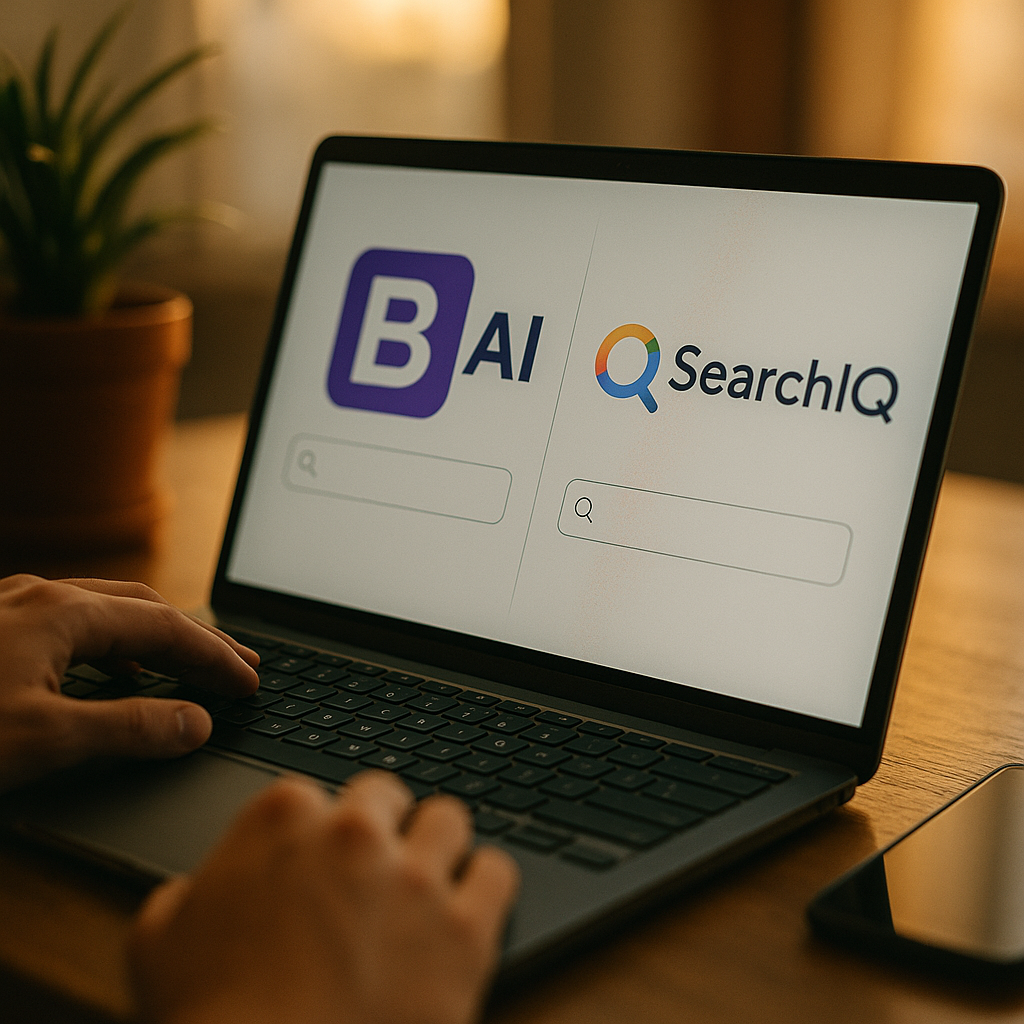
ChatGPT now answers over a billion queries a day, and a growing share of them are product recommendations your brand either shows up in or doesn’t. If you’re not actively measuring AI search visibility, you’re flying blind in the channel that’s quietly replacing page-one Google rankings. Two platforms — Brandi AI and BrandPilot AI’s SearchIQ — have emerged as the leading options for tracking brand citations across large language models. Here’s how they actually stack up.
Why Brand Citations in LLMs Suddenly Matter
Six months ago, most CMOs hadn’t heard the term “generative engine optimization.” Now it’s a line item. The shift is simple: consumers increasingly ask ChatGPT, Perplexity, Gemini, and Claude for recommendations instead of typing a query into a search bar and scrolling. If your brand isn’t cited in that answer, you don’t just lose a click — you lose the sale before the customer ever reaches your site.
That’s a structural problem for traditional SEO teams. Rank tracking tools were built for blue links, not for synthesized answers that cite three competitors and never mention you. Brands need visibility into which LLMs mention them, how often, in what context, and — critically — why competitors get cited instead. That’s the gap Brandi AI and SearchIQ are racing to fill.
A brand that’s invisible in AI-generated answers isn’t just losing organic traffic — it’s losing the pre-purchase conversation entirely, often without any dashboard flagging the loss.
Brandi AI: Built for Brand Teams, Not Just SEO Analysts
Brandi AI positions itself as a brand intelligence layer rather than a pure SEO tool. Its core pitch: track how your brand, your products, and your executives are represented across ChatGPT, Gemini, Perplexity, and Copilot, then translate that into narrative-level insights a CMO can actually use.
What sets it apart operationally is the qualitative layer. Instead of just counting mentions, Brandi AI scores sentiment and framing — is the LLM describing you as “premium” or “budget,” “innovative” or “legacy”? For brand teams worried about reputation drift in an AI-mediated world, that nuance matters more than raw citation volume. It’s a similar philosophy to the one we covered when comparing Brandi AI against Howl Louder’s service model, where the differentiator wasn’t tooling depth but how the output gets operationalized by marketing teams.
Brandi AI also leans into competitive benchmarking. You can see not just your own citation frequency but how you stack against three or four named competitors, across the same prompt sets, updated on a rolling basis. For brand strategists building a business case for GEO budget, that side-by-side view is often the slide that gets executive buy-in.
Where Brandi AI Falls Short
It’s less granular on technical diagnostics. If you want to know exactly which page, schema markup, or third-party citation triggered a mention, Brandi AI gives you directional signal, not forensic detail. Teams with in-house technical SEO resources sometimes find themselves cross-referencing Brandi AI’s outputs with their own crawl data to close that gap.
SearchIQ: BrandPilot AI’s Answer for Performance Marketers
SearchIQ, BrandPilot AI’s flagship visibility module, takes a more performance-marketing-native approach. Think of it as the rank-tracker mentality applied to LLMs: prompt-level tracking, citation-source attribution, and exportable data feeds built for teams that already live in dashboards.
The standout feature is source-mapping. SearchIQ tries to identify which web sources (a review site, a Reddit thread, your own product page) an LLM likely pulled from when generating a citation. That’s a genuinely hard technical problem, since most LLM providers don’t expose retrieval sources cleanly. SearchIQ’s confidence scores aren’t perfect, but they’re directionally useful enough to inform a content or PR strategy — if three competitor mentions trace back to the same G2 comparison page, that’s an actionable insight, not just a vanity metric.
SearchIQ also plugs into existing martech stacks more readily, with API access and integrations aimed at teams already running attribution or identity resolution tooling. If your org has invested in stitching together fragmented attribution data, SearchIQ’s exportability is a meaningful advantage over more closed, dashboard-only competitors.
The Tradeoff: More Data, Less Narrative
SearchIQ’s weakness mirrors Brandi AI’s strength. It’s data-rich but narrative-light. You get citation counts, source attribution, and share-of-voice metrics broken out by model, but translating that into “here’s what to tell the CEO” takes more manual synthesis. For a growth marketer, that’s fine — they’re used to building the story themselves. For a brand marketing lead who needs a client-ready report by Friday, it’s more work.
Head-to-Head: Where the Real Differences Show Up
- Depth of LLM coverage: Both track ChatGPT, Gemini, and Perplexity as core models. Brandi AI has slightly broader coverage of newer assistants embedded in browsers and OS-level copilots; SearchIQ prioritizes depth on the top three over breadth across a dozen.
- Reporting cadence: Brandi AI ships weekly narrative summaries designed for stakeholder decks. SearchIQ offers near-real-time dashboards but expects you to build your own summary layer.
- Competitive benchmarking: Brandi AI’s competitor comparisons are more visual and presentation-ready. SearchIQ’s are more granular but require export-and-analyze workflows.
- Source attribution: SearchIQ wins clearly here. Its citation-source mapping, while imperfect, is more developed than anything Brandi AI currently offers.
- Pricing model: Both use tiered SaaS pricing based on prompt volume and tracked brand/competitor count, though SearchIQ’s enterprise tier scales more aggressively for teams needing API throughput.
Neither platform has solved the fundamental measurement problem plaguing this category: LLM outputs are non-deterministic. Ask the same question twice and you might get different citations. Both platforms address this by running high-volume repeated prompts and reporting statistical frequency rather than single-query snapshots, which is the right instinct — but it means “visibility score” is inherently probabilistic, not a hard number like a Google ranking position.
How to Choose: Match the Tool to Your Team’s Job
The honest answer is that these platforms serve different buyers inside the same org, and in a lot of enterprise setups, you’d eventually want both. But if you’re picking one to start:
Choose Brandi AI if your primary stakeholder is a CMO or brand VP who needs monthly narrative reporting, competitive sentiment tracking, and something that plays well in a board deck. It’s the better fit for brand protection and reputation monitoring use cases, especially for consumer brands sensitive to how AI assistants characterize them.
Choose SearchIQ if your team is embedded in growth or performance marketing, already has a content or digital PR function that acts on data quickly, and wants to integrate AI visibility metrics into an existing attribution stack. It rewards teams with technical resources who can turn source-attribution data into a content roadmap.
The platforms don’t just differ in features — they differ in who’s expected to do the thinking. Brandi AI does more interpretation for you; SearchIQ hands you the raw signal and trusts you to build the strategy.
Budget matters too. If you’re already evaluating GEO vendors with a fraud-and-fake-metrics lens, apply the same scrutiny here: ask both vendors for raw prompt logs, not just aggregated scores, before you sign an annual contract. Any platform unwilling to show its underlying prompt methodology should be a red flag, regardless of how polished the dashboard looks.
The Bigger Picture: This Category Will Consolidate
Right now, GEO and AI-visibility tracking feels a lot like early-2010s social listening: a dozen vendors, overlapping claims, inconsistent methodology. Expect consolidation. Larger martech suites are already eyeing this space, the same way CRM and automation platforms have been absorbing adjacent categories, a pattern we’ve tracked in Klaviyo’s CRM consolidation and the broader shift toward AI suites versus best-of-breed tools.
For now, both Brandi AI and SearchIQ are point solutions solving a real, urgent problem. Neither has full-market maturity. Buy for the next twelve months, not a five-year roadmap, and revisit the category every couple of quarters — it’s moving that fast.
According to eMarketer, AI-driven search interactions are climbing sharply as a share of overall discovery traffic, and Statista data on generative AI adoption backs up the urgency brands feel. Marketing teams citing best practices from HubSpot on content structuring for AI retrieval are already adjusting their SEO briefs accordingly — proof that this isn’t a future problem, it’s a this-quarter problem.
FAQs
What is AI search visibility tracking?
It’s the practice of monitoring how often and how favorably a brand is mentioned when users query large language models like ChatGPT, Gemini, Perplexity, or Copilot, rather than tracking rankings on traditional search engine results pages.
How is this different from traditional SEO rank tracking?
Traditional SEO tracks keyword positions on a results page. AI visibility tracking measures whether and how a brand gets cited inside a generated, synthesized answer, which has no fixed “position” and can vary between identical queries.
Which platform is better for small marketing teams, Brandi AI or SearchIQ?
Brandi AI tends to suit smaller teams better because its reporting is more digestible and requires less manual analysis. SearchIQ offers deeper data but expects more analytical bandwidth to turn it into action.
Can these tools guarantee a brand gets cited more often by LLMs?
No. Neither platform controls how LLMs generate answers. They provide measurement and diagnostic insight that inform content and PR strategy, but citation frequency ultimately depends on the underlying model’s training data and retrieval behavior.
Should brands invest in AI visibility tools now or wait for the category to mature?
Waiting carries real risk. AI-driven discovery is already shaping purchase decisions, and brands that establish baseline visibility data now will have a clearer view of competitive shifts as the category evolves.
Bottom line: pick Brandi AI if you need executive-ready brand narrative, pick SearchIQ if you need granular, integrable data — and audit both vendors’ methodology before you commit budget, because this category is still proving its own measurement standards.
FAQs
What is AI search visibility tracking?
It’s the practice of monitoring how often and how favorably a brand is mentioned when users query large language models like ChatGPT, Gemini, Perplexity, or Copilot, rather than tracking rankings on traditional search engine results pages.
How is this different from traditional SEO rank tracking?
Traditional SEO tracks keyword positions on a results page. AI visibility tracking measures whether and how a brand gets cited inside a generated, synthesized answer, which has no fixed “position” and can vary between identical queries.
Which platform is better for small marketing teams, Brandi AI or SearchIQ?
Brandi AI tends to suit smaller teams better because its reporting is more digestible and requires less manual analysis. SearchIQ offers deeper data but expects more analytical bandwidth to turn it into action.
Can these tools guarantee a brand gets cited more often by LLMs?
No. Neither platform controls how LLMs generate answers. They provide measurement and diagnostic insight that inform content and PR strategy, but citation frequency ultimately depends on the underlying model’s training data and retrieval behavior.
Should brands invest in AI visibility tools now or wait for the category to mature?
Waiting carries real risk. AI-driven discovery is already shaping purchase decisions, and brands that establish baseline visibility data now will have a clearer view of competitive shifts as the category evolves.
Top Influencer Marketing Agencies
The leading agencies shaping influencer marketing in 2026
Agencies ranked by campaign performance, client diversity, platform expertise, proven ROI, industry recognition, and client satisfaction. Assessed through verified case studies, reviews, and industry consultations.
Moburst

-
2

The Shelf
Boutique Beauty & Lifestyle Influencer AgencyA data-driven boutique agency specializing exclusively in beauty, wellness, and lifestyle influencer campaigns on Instagram and TikTok. Best for brands already focused on the beauty/personal care space that need curated, aesthetic-driven content.Clients: Pepsi, The Honest Company, Hims, Elf Cosmetics, Pure LeafVisit The Shelf → -
3

Audiencly
Niche Gaming & Esports Influencer AgencyA specialized agency focused exclusively on gaming and esports creators on YouTube, Twitch, and TikTok. Ideal if your campaign is 100% gaming-focused — from game launches to hardware and esports events.Clients: Epic Games, NordVPN, Ubisoft, Wargaming, Tencent GamesVisit Audiencly → -
4

Viral Nation
Global Influencer Marketing & Talent AgencyA dual talent management and marketing agency with proprietary brand safety tools and a global creator network spanning nano-influencers to celebrities across all major platforms.Clients: Meta, Activision Blizzard, Energizer, Aston Martin, WalmartVisit Viral Nation → -
5

The Influencer Marketing Factory
TikTok, Instagram & YouTube CampaignsA full-service agency with strong TikTok expertise, offering end-to-end campaign management from influencer discovery through performance reporting with a focus on platform-native content.Clients: Google, Snapchat, Universal Music, Bumble, YelpVisit TIMF → -
6

NeoReach
Enterprise Analytics & Influencer CampaignsAn enterprise-focused agency combining managed campaigns with a powerful self-service data platform for influencer search, audience analytics, and attribution modeling.Clients: Amazon, Airbnb, Netflix, Honda, The New York TimesVisit NeoReach → -
7

Ubiquitous
Creator-First Marketing PlatformA tech-driven platform combining self-service tools with managed campaign options, emphasizing speed and scalability for brands managing multiple influencer relationships.Clients: Lyft, Disney, Target, American Eagle, NetflixVisit Ubiquitous → -
8

Obviously
Scalable Enterprise Influencer CampaignsA tech-enabled agency built for high-volume campaigns, coordinating hundreds of creators simultaneously with end-to-end logistics, content rights management, and product seeding.Clients: Google, Ulta Beauty, Converse, AmazonVisit Obviously →