


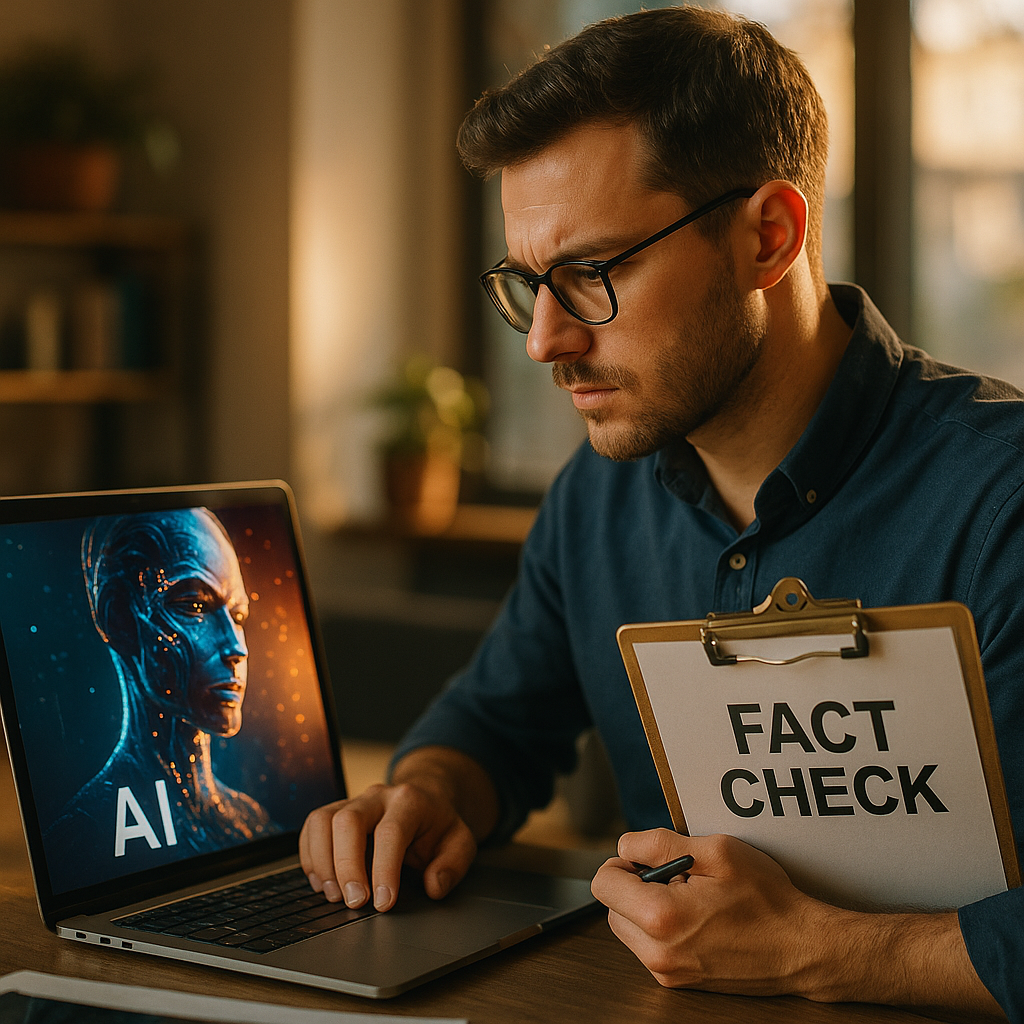
Ask ChatGPT what your return policy is. Now check if it’s actually right. A 2026 audit by Profound found that generative engines misstate brand facts — pricing, ingredients, warranty terms — in roughly one out of every six branded queries. That’s not a rounding error. It’s a trust leak, and it’s why a growing number of marketing and legal teams are quietly building their own FactCheck agent systems to monitor what AI says about them, in real time, before customers or regulators catch the mistake first.
The problem nobody budgeted for
Two years ago, “brand monitoring” meant social listening and review management. Now there’s a third channel nobody staffed for: what large language models say about you when a customer asks Gemini, ChatGPT, or Perplexity a question you never got to answer directly.
These summaries are confident. They’re often well-written. And they’re frequently wrong in small, corrosive ways — a discontinued product listed as current, a price that’s eighteen months stale, a compliance claim your legal team never approved. The AI doesn’t flag uncertainty. It just states things, and consumers tend to believe it.
The risk isn’t that AI gets your brand wrong occasionally. It’s that it gets your brand wrong confidently, at scale, across every platform simultaneously — with no editorial review in between.
This is a different category of risk than a bad review or a viral complaint. A dissatisfied customer is one voice. A hallucinating AI answer engine is potentially the first — and only — touchpoint a prospective buyer has with your brand. If it’s wrong, you may never know they left.
Why brands stopped waiting on vendors
Third-party brand monitoring tools exist, and some are decent. But most were built for search-era problems: tracking mentions, sentiment, share of voice. Retrofitting them for generative engines has been slow, and coverage gaps are common — a tool might catch hallucinations on ChatGPT but miss them entirely on AI Overviews or Meta AI.
Brands with real exposure (regulated industries, high-SKU retailers, anything with pricing or safety claims) got tired of waiting. So they built internal tooling instead: lightweight agents that query major AI platforms on a schedule, pull the brand-related responses, and cross-reference them against a verified source of truth — usually a structured internal knowledge base, a product catalog, or a compliance-approved FAQ set.
This isn’t exotic engineering anymore. Teams are stitching together retrieval pipelines, a verified data layer, and scheduled prompt runs using the same RAG (retrieval-augmented generation) patterns marketers are already using to fix hallucinated product claims in creative briefs. The agent essentially becomes a standing auditor: it asks the same questions a customer would, checks the answer against ground truth, and flags discrepancies before they compound.
What a FactCheck agent actually does
- Scheduled querying: runs a bank of brand-relevant prompts across ChatGPT, Gemini, Copilot, and Perplexity on a recurring cadence — daily for high-risk claims, weekly for general brand facts.
- Ground-truth comparison: checks AI output against an internal source of record (product database, pricing sheet, legal-approved policy language).
- Discrepancy scoring: flags outputs by severity — a stale blog date is low-risk; a wrong refund policy or safety claim is high-risk and routed for immediate review.
- Escalation routing: sends high-severity flags to legal, comms, or brand teams rather than burying them in a dashboard nobody checks.
- Trend tracking: logs whether errors are one-off or recurring, which matters for deciding whether to pursue structured data fixes, schema markup, or direct outreach to platform providers.
None of this requires a data science team of twenty. Most in-house builds start with a handful of engineers, a prompt library, and an existing internal knowledge base repurposed as the verification layer.
Isn’t this just brand monitoring with extra steps?
Sort of — but the stakes and mechanics are different enough to matter. Traditional brand monitoring needs a generative search upgrade because the old model assumes a human wrote the content you’re tracking. AI-generated summaries are synthesized on the fly, often blending outdated training data with live retrieval, which means the same query can produce different answers a week apart.
That volatility is the real argument for building in-house. A third-party tool checking in weekly might miss a hallucination that appears for three days and disappears. An internal agent tuned to your specific risk areas — say, financial disclosures or health claims — can run far more frequently and with far more precision than a generalized vendor product designed to serve thousands of brands at once.
There’s also a data sensitivity angle. Feeding your full product catalog, pricing history, and legal policy language into a third-party monitoring platform means trusting that vendor with commercially sensitive detail. Plenty of legal teams would rather keep that verification loop internal, especially post-GDPR and with the EU AI Act’s transparency provisions now in force. If you’re already working through EU AI Act labeling requirements, adding a third-party data-sharing arrangement on top of it is one more compliance headache most teams would rather avoid.
The compliance case is getting sharper
Regulators haven’t caught up fully to AI-generated misinformation about brands, but they’re paying attention. The FTC has been explicit that companies remain accountable for deceptive claims regardless of whether a human or an algorithm generated them — see the FTC’s guidance on AI and deceptive practices. If an AI answer engine tells a customer your supplement cures a condition it doesn’t, and you knew (or should have known) that error was circulating, “the AI said it, not us” is a weak defense.
That single fact is turning FactCheck agents from a nice-to-have into something closer to a legal necessity for regulated categories: pharma, finance, insurance, food and beverage. Expect procurement and compliance teams to start asking about AI-summary monitoring the same way they ask about data retention policies.
Building versus buying: the real trade-off
Not every brand needs to build this in-house. If your product catalog is small, your claims are low-risk, and your exposure is mostly reputational rather than regulatory, a vendor tool plus a monthly manual audit might be plenty. Influencers Time covered one such option in a hands-on review of a purpose-built FactCheck agent that catches AI hallucinations — useful groundwork if you’re deciding whether off-the-shelf coverage is enough before committing engineering time to a custom build.
But for brands with SKU counts in the thousands, frequent pricing changes, regulated claims, or multi-market compliance variance, the calculus shifts. A few things tend to tip teams toward building:
- Query volume outpaces vendor refresh rates. If your catalog changes weekly and the vendor tool audits monthly, you’re always behind.
- Legal wants direct control over the ground-truth source. Internal builds let compliance own the verification data rather than syncing it to a third party.
- You already have the RAG infrastructure. Teams that adopted small language models for marketing tasks often find the FactCheck agent is a light extension of pipelines they’ve already built, not a new project from scratch.
- Attribution stakes are high. If AI Overviews and zero-click surfaces are already distorting your attribution windows, you likely need tighter control over what those surfaces are saying in the first place.
The honest answer for most mid-size brands: start with a narrow build. Pick the ten highest-risk claims — pricing, returns, safety, eligibility — and monitor just those across the three or four AI platforms your customers actually use. Expand from there. Trying to monitor every possible brand fact across every model on day one is how these projects stall before shipping.
What this means for the influencer and content supply chain
There’s a second-order effect brand teams are only starting to reckon with. If AI summaries are pulling from a mix of owned content, press coverage, and creator-generated content, then a hallucination might trace back to something a creator said in a sponsored post three years ago that was never fully accurate to begin with. That’s a strong argument for tightening the creator brief generation process now, so the claims creators make are consistent with verified brand facts from the outset, rather than becoming tomorrow’s AI training data error.
It also means the FactCheck agent’s job isn’t just defensive. Once you know which claims AI models consistently get wrong, that’s a roadmap for where your structured data, schema markup, and owned content need reinforcement. Fix the source, and the hallucination often stops recurring.
Every hallucination your agent catches is a data gap somewhere in your public content. Fixing the gap is cheaper than fighting the symptom forever.
Start narrow, then scale the watchlist
Pick your five highest-stakes brand claims, set up scheduled queries across the AI platforms your customers actually use, and route flagged discrepancies straight to legal or brand — not a dashboard nobody opens. Build coverage outward from there once the process proves itself.
Frequently Asked Questions
What is a FactCheck agent in the context of brand monitoring?
It’s an automated system that queries AI platforms like ChatGPT, Gemini, and Perplexity with brand-relevant questions on a schedule, then compares the responses against a verified internal source of truth to catch factual errors before customers act on them.
Why can’t we just rely on third-party brand monitoring tools?
Most third-party tools were built for search-era mention tracking and are still catching up to generative AI’s volatility. They often check less frequently, miss platform-specific hallucinations, and require sharing sensitive pricing or compliance data externally — issues that push higher-risk brands toward in-house builds.
How often should brands check AI-generated summaries about them?
High-risk claims — pricing, safety, refund policies, regulated statements — warrant daily or near-daily checks. Lower-risk general brand facts can be monitored weekly. The right cadence depends on how frequently your underlying facts change.
Is this only relevant for large enterprises?
No, but the build-versus-buy decision differs by size. Smaller brands with limited SKUs and low regulatory exposure may do fine with a vendor tool and periodic manual checks. Larger or regulated brands typically need the precision and control of an internal system.
What happens if an AI hallucination causes real customer harm?
Regulators, including the FTC, have signaled that companies remain accountable for deceptive claims regardless of whether a human or an algorithm generated them. Brands that knew about a recurring hallucination and didn’t act face heightened legal exposure.
Does fixing hallucinations also improve AI visibility?
Often yes. Correcting the structured data, schema, and owned content that AI models pull from tends to reduce both hallucination frequency and improve how accurately and prominently a brand appears in AI-generated answers.
Top Influencer Marketing Agencies
The leading agencies shaping influencer marketing in 2026
Agencies ranked by campaign performance, client diversity, platform expertise, proven ROI, industry recognition, and client satisfaction. Assessed through verified case studies, reviews, and industry consultations.
Moburst

-
2

The Shelf
Boutique Beauty & Lifestyle Influencer AgencyA data-driven boutique agency specializing exclusively in beauty, wellness, and lifestyle influencer campaigns on Instagram and TikTok. Best for brands already focused on the beauty/personal care space that need curated, aesthetic-driven content.Clients: Pepsi, The Honest Company, Hims, Elf Cosmetics, Pure LeafVisit The Shelf → -
3

Audiencly
Niche Gaming & Esports Influencer AgencyA specialized agency focused exclusively on gaming and esports creators on YouTube, Twitch, and TikTok. Ideal if your campaign is 100% gaming-focused — from game launches to hardware and esports events.Clients: Epic Games, NordVPN, Ubisoft, Wargaming, Tencent GamesVisit Audiencly → -
4

Viral Nation
Global Influencer Marketing & Talent AgencyA dual talent management and marketing agency with proprietary brand safety tools and a global creator network spanning nano-influencers to celebrities across all major platforms.Clients: Meta, Activision Blizzard, Energizer, Aston Martin, WalmartVisit Viral Nation → -
5

The Influencer Marketing Factory
TikTok, Instagram & YouTube CampaignsA full-service agency with strong TikTok expertise, offering end-to-end campaign management from influencer discovery through performance reporting with a focus on platform-native content.Clients: Google, Snapchat, Universal Music, Bumble, YelpVisit TIMF → -
6

NeoReach
Enterprise Analytics & Influencer CampaignsAn enterprise-focused agency combining managed campaigns with a powerful self-service data platform for influencer search, audience analytics, and attribution modeling.Clients: Amazon, Airbnb, Netflix, Honda, The New York TimesVisit NeoReach → -
7

Ubiquitous
Creator-First Marketing PlatformA tech-driven platform combining self-service tools with managed campaign options, emphasizing speed and scalability for brands managing multiple influencer relationships.Clients: Lyft, Disney, Target, American Eagle, NetflixVisit Ubiquitous → -
8

Obviously
Scalable Enterprise Influencer CampaignsA tech-enabled agency built for high-volume campaigns, coordinating hundreds of creators simultaneously with end-to-end logistics, content rights management, and product seeding.Clients: Google, Ulta Beauty, Converse, AmazonVisit Obviously →