


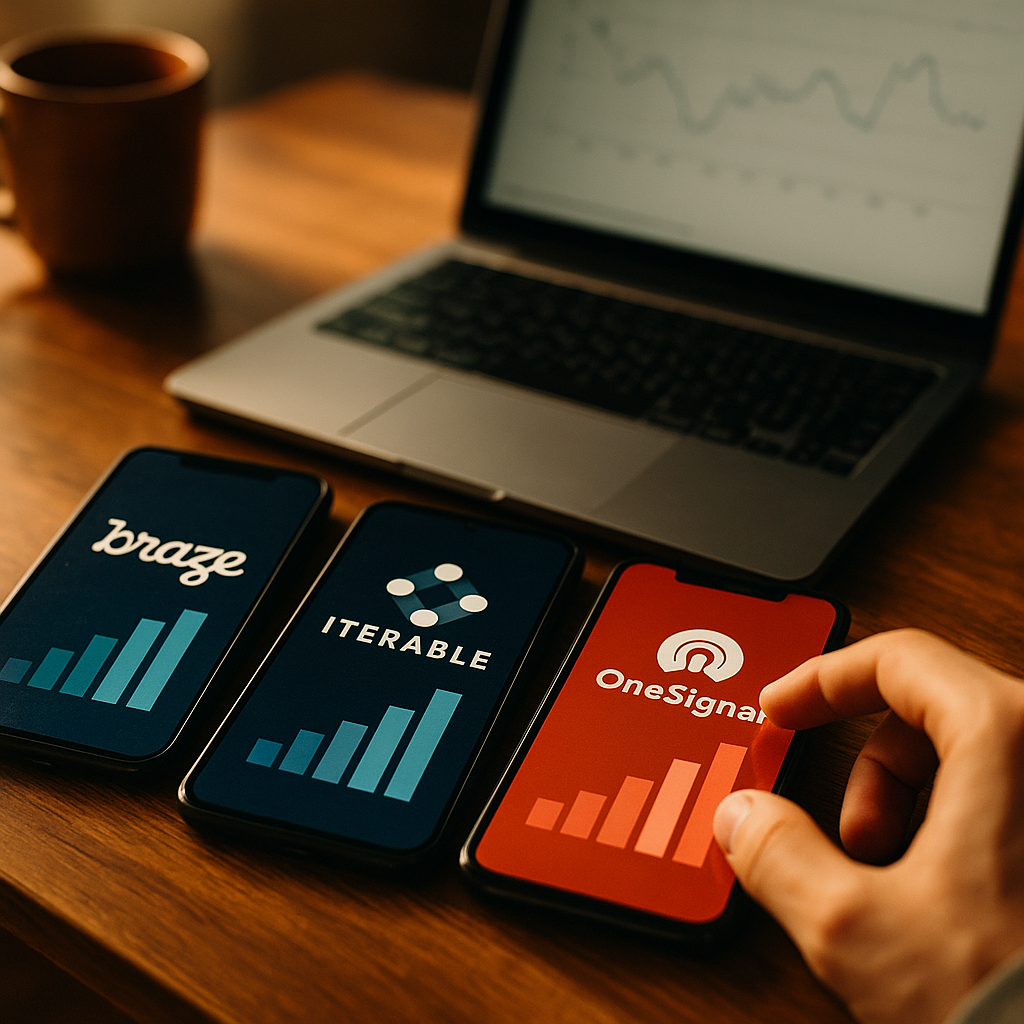
Send-time optimization sounds like a solved problem. It isn’t. Brands using predictive AI send-time features report open-rate lifts anywhere from 4% to over 20%, depending entirely on which platform, which data volume, and which use case. That spread is too wide to ignore if you’re running lifecycle campaigns at scale. Choosing between Braze, Iterable, and OneSignal’s predictive AI send-time capabilities isn’t a checkbox exercise — it’s a decision that compounds across every campaign you ship for the next contract cycle.
This comparison is built for lifecycle marketing teams evaluating a switch, a renewal, or a first-time platform buy. We’ll skip the marketing-speak and get into what actually differs under the hood.
Why Send-Time AI Matters More Than It Used To
Five years ago, “send-time optimization” meant picking 9am or 6pm and calling it a day. Today’s lifecycle teams are managing cross-channel journeys — push, email, SMS, in-app — often personalized down to the individual user’s behavioral fingerprint. Static send windows just don’t hold up when your audience spans time zones, device habits, and engagement patterns that shift week to week.
Predictive send-time models solve a real problem: engagement decays fast. A push notification sent at the wrong moment doesn’t just underperform, it trains users to ignore your brand entirely. According to eMarketer, mobile engagement windows have narrowed as users face more app-based competition for attention than ever. That makes timing precision a genuine ROI lever, not a nice-to-have.
The platforms don’t just differ in accuracy — they differ in what “optimized” even means, which makes apples-to-apples benchmarking nearly impossible without running your own test.
Braze: Intelligent Timing Built on Deep Behavioral Data
Braze’s Intelligent Timing feature leans heavily on its Customer Engagement Platform architecture, using historical open and engagement data per user to predict the best individual send window. It’s not guessing at a segment level — it’s modeling at the user level, which matters a lot for brands with high-frequency touchpoints like retail apps or subscription products.
The tradeoff? Braze’s model needs volume. Smaller lists or newer accounts won’t see the same lift because the algorithm needs sufficient historical signal to make confident predictions. Braze also requires a minimum engagement history window before Intelligent Timing kicks in fully, which can frustrate teams expecting immediate results post-implementation.
Where Braze pulls ahead is in its integration with Catalyst and its broader AI suite, which ties send-time predictions into content personalization and audience segmentation simultaneously. That’s a genuine differentiator for teams already deep into Braze’s ecosystem, since predictive timing isn’t operating in a silo — it’s one layer of a larger orchestration engine.
For enterprise brands with millions of active users and rich behavioral data, this is often the strongest option. For leaner teams, it can feel like overkill.
Iterable: Send Time Optimization With a Channel-Agnostic Lens
Iterable’s approach, branded Send Time Optimization (STO), was built with cross-channel parity in mind. Instead of treating email and push as separate optimization problems, Iterable’s model considers a user’s behavior across the full channel mix to determine the ideal send window per message.
This channel-agnostic design is a meaningful advantage for lifecycle teams running true omnichannel journeys — think a retail brand coordinating abandoned-cart email, push reminders, and SMS nudges within the same 48-hour window. Iterable’s model tries to avoid channel cannibalization, which Braze and OneSignal handle less explicitly.
The catch: Iterable’s STO has historically required more manual tuning for edge cases, like sparse-data users or B2B audiences with irregular engagement rhythms. Marketing ops teams report needing to combine STO with manual send-window overrides for certain segments, which adds operational overhead. It’s powerful, but it’s not fully “set and forget.”
Iterable also publishes more transparent documentation around how its predictive models are trained and validated, which matters if your legal or compliance team is asking pointed questions about algorithmic decision-making — a topic covered in depth in our piece on AI model transparency standards for marketing vendors.
OneSignal: Fast, Lightweight, and Built for Speed of Deployment
OneSignal plays a different game entirely. It’s historically been the go-to for mobile-first teams and smaller marketing orgs that need push notification infrastructure without enterprise pricing or enterprise complexity. Its predictive send-time feature, layered into its broader AI-driven personalization tools, optimizes primarily around push and in-app messaging rather than full omnichannel orchestration.
The upside is speed. OneSignal’s setup for predictive send-time is notably faster to implement than Braze or Iterable, often requiring less historical data before showing measurable lift. That makes it attractive for startups, app-first brands, or teams that don’t have years of engagement history to feed a model.
The downside is scope. If your lifecycle program spans email, SMS, and push with deep cross-channel dependencies, OneSignal’s send-time AI won’t give you the same unified view that Iterable or Braze can. It’s a strong point solution, not a full orchestration layer — and it’s priced and positioned accordingly.
The Real Differentiator: Data Requirements and Time-to-Value
Here’s the part vendors gloss over in sales decks: predictive AI is only as good as the data feeding it. Braze wants deep behavioral history. Iterable wants cross-channel signal. OneSignal wants volume and frequency on mobile touchpoints specifically. None of them work well on thin data.
If you’re migrating platforms or launching a new lifecycle program, expect a ramp period before any of these tools show their full predictive value. Teams that skip this step and expect day-one optimization are almost always disappointed — and then blame the platform instead of the data gap.
A few practical questions to ask before you commit:
- How many months of engagement history do you have per active user, and is it clean enough to model on?
- Are you optimizing primarily for a single channel (push) or true cross-channel timing?
- Does your compliance team need visibility into how the model makes decisions, particularly under evolving data privacy expectations?
- What’s your appetite for manual override and rules-based fallback when the AI model has insufficient data?
These questions matter more than any benchmark chart a vendor hands you in a pitch. This ties closely into broader questions of CRM and CDP fusion — because send-time AI is only as strong as the identity and behavioral data pipeline underneath it.
What the Numbers Actually Show
Vendor-reported lift numbers should always be read skeptically — they’re marketing claims, not independent audits. That said, directional patterns are consistent across public case studies and practitioner reports:
Braze customers with high-volume, high-frequency engagement (think daily active retail or media apps) tend to report the strongest lift from Intelligent Timing, often in double digits for open rates. Iterable customers running true multichannel journeys report the most consistent lift across the full funnel, not just at the open-rate stage — which suggests its channel-agnostic model does what it claims. OneSignal customers, largely mobile-app-first, report faster time-to-lift but smaller absolute gains, consistent with its lighter-weight approach.
None of this should be taken as gospel. Your list quality, industry vertical, and existing send cadence will swing results more than the platform choice alone. If you’re currently running HubSpot or another CRM-adjacent tool for lifecycle sends and considering a dedicated engagement platform, the jump in sophistication is real — but so is the implementation lift.
Compliance and Governance: The Part Nobody Asks About Until Legal Does
Predictive send-time models are, technically, automated decision-making systems that use behavioral and personal data. That puts them squarely in the crosshairs of evolving privacy frameworks. Teams operating in the UK or EU should be reviewing how these platforms handle consent for behavioral profiling, per guidance from the ICO. U.S. teams aren’t off the hook either — the FTC has increased scrutiny on algorithmic marketing practices broadly.
Practically, this means lifecycle teams should be asking vendors for documentation on data retention windows for behavioral modeling, opt-out mechanics that don’t degrade to “off” entirely, and whether predictive models are trained on aggregate or account-specific data. None of the three platforms discussed here have had major public compliance incidents tied specifically to send-time AI, but the regulatory environment is tightening fast enough that “no incidents yet” isn’t a strategy.
For teams building out a broader martech governance framework, this decision shouldn’t be made in isolation. It connects directly to how you’re auditing your stack overall — see our five-layer martech audit model for a structured way to evaluate where send-time AI fits into your compliance posture.
Making the Call: A Practical Framework
If you’re running an enterprise-scale program with rich historical data and want send-time AI woven into a broader personalization engine, Braze is the strongest bet. If your priority is true omnichannel journey orchestration and you’re willing to invest in tuning, Iterable earns its complexity. If you need to move fast, you’re mobile-first, and you don’t have years of engagement history to lean on, OneSignal gets you to value quickest.
None of these are wrong choices in isolation — they’re optimized for different starting conditions. The mistake is picking based on brand reputation or sales-deck benchmarks instead of your actual data maturity and channel mix.
For a deeper technical breakdown of how each platform’s algorithm architecture differs, our companion piece on predictive send-time AI architecture walks through the modeling approaches in more detail. It’s worth pairing with the practical framework here before you sign anything.
Frequently Asked Questions
FAQs
Which platform has the most accurate predictive send-time AI?
Accuracy depends heavily on your data volume and channel mix. Braze tends to perform best with high-frequency, high-volume behavioral data. Iterable performs strongest for true cross-channel journeys. OneSignal delivers faster but generally smaller lift, particularly for mobile-first, push-heavy programs.
How much historical data do I need before predictive send-time AI works well?
Most platforms need several months of consistent engagement history per active user before predictions stabilize. Thin or inconsistent data will produce unreliable results regardless of which vendor you choose.
Does predictive send-time AI replace manual send-time rules entirely?
Not typically. Most lifecycle teams keep rules-based fallback logic for segments with sparse data, new users, or compliance-sensitive audiences where automated decisioning needs a manual override option.
Are there compliance risks with using AI to determine send times?
Yes, particularly around behavioral profiling and automated decision-making under frameworks enforced by regulators like the ICO and FTC. Teams should confirm how vendors handle data retention, consent, and opt-out mechanics before deployment.
Can smaller brands see real value from these tools, or are they built for enterprise scale?
OneSignal is generally the most accessible for smaller or newer brands due to lower data requirements and faster implementation. Braze and Iterable tend to reward larger, data-rich programs more heavily.
Bottom line: don’t pick a platform off a feature list. Pull your last six months of engagement data, map your actual channel mix, and test whichever platform aligns with the data you already have — not the data you wish you had.
Top Influencer Marketing Agencies
The leading agencies shaping influencer marketing in 2026
Agencies ranked by campaign performance, client diversity, platform expertise, proven ROI, industry recognition, and client satisfaction. Assessed through verified case studies, reviews, and industry consultations.
Moburst

-
2

The Shelf
Boutique Beauty & Lifestyle Influencer AgencyA data-driven boutique agency specializing exclusively in beauty, wellness, and lifestyle influencer campaigns on Instagram and TikTok. Best for brands already focused on the beauty/personal care space that need curated, aesthetic-driven content.Clients: Pepsi, The Honest Company, Hims, Elf Cosmetics, Pure LeafVisit The Shelf → -
3

Audiencly
Niche Gaming & Esports Influencer AgencyA specialized agency focused exclusively on gaming and esports creators on YouTube, Twitch, and TikTok. Ideal if your campaign is 100% gaming-focused — from game launches to hardware and esports events.Clients: Epic Games, NordVPN, Ubisoft, Wargaming, Tencent GamesVisit Audiencly → -
4

Viral Nation
Global Influencer Marketing & Talent AgencyA dual talent management and marketing agency with proprietary brand safety tools and a global creator network spanning nano-influencers to celebrities across all major platforms.Clients: Meta, Activision Blizzard, Energizer, Aston Martin, WalmartVisit Viral Nation → -
5

The Influencer Marketing Factory
TikTok, Instagram & YouTube CampaignsA full-service agency with strong TikTok expertise, offering end-to-end campaign management from influencer discovery through performance reporting with a focus on platform-native content.Clients: Google, Snapchat, Universal Music, Bumble, YelpVisit TIMF → -
6

NeoReach
Enterprise Analytics & Influencer CampaignsAn enterprise-focused agency combining managed campaigns with a powerful self-service data platform for influencer search, audience analytics, and attribution modeling.Clients: Amazon, Airbnb, Netflix, Honda, The New York TimesVisit NeoReach → -
7

Ubiquitous
Creator-First Marketing PlatformA tech-driven platform combining self-service tools with managed campaign options, emphasizing speed and scalability for brands managing multiple influencer relationships.Clients: Lyft, Disney, Target, American Eagle, NetflixVisit Ubiquitous → -
8

Obviously
Scalable Enterprise Influencer CampaignsA tech-enabled agency built for high-volume campaigns, coordinating hundreds of creators simultaneously with end-to-end logistics, content rights management, and product seeding.Clients: Google, Ulta Beauty, Converse, AmazonVisit Obviously →