


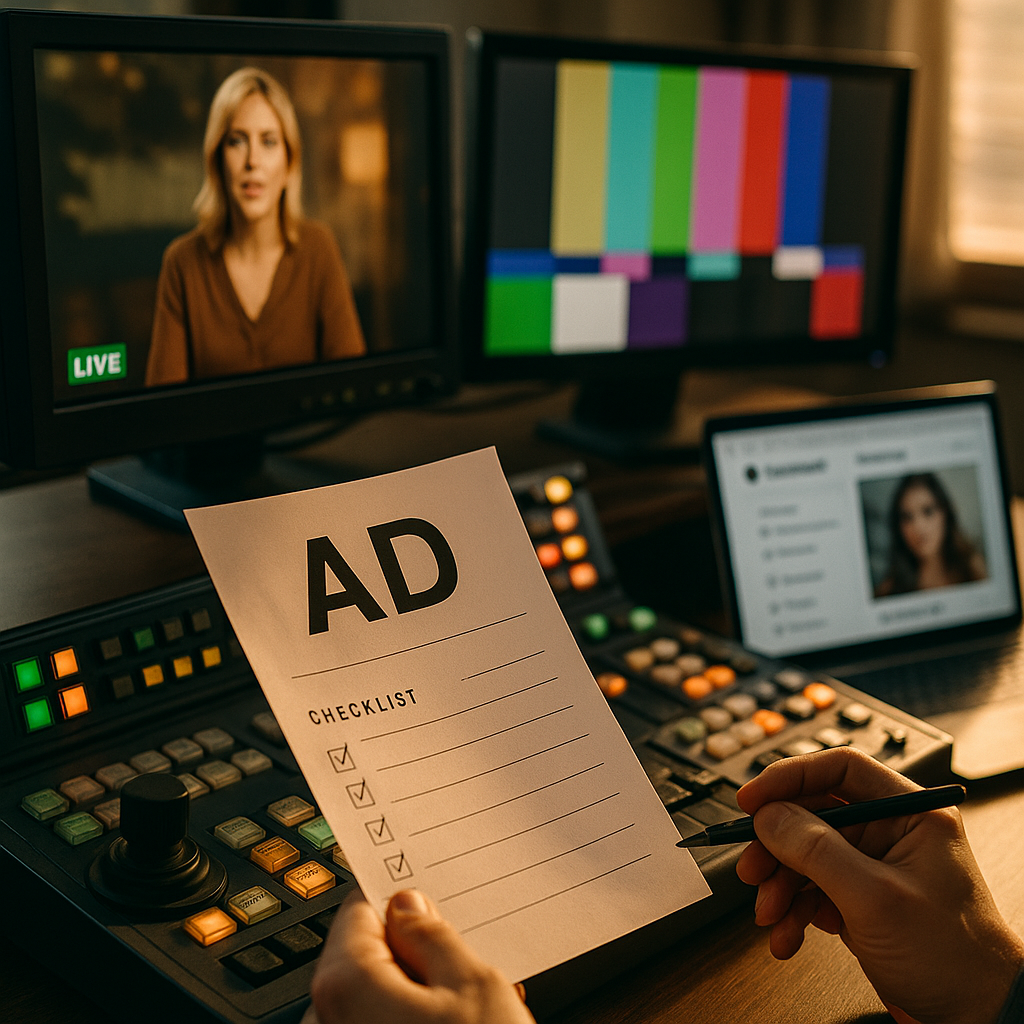
Here’s an uncomfortable truth for every brand repurposing creator content for TV: the “#ad” tag that satisfies the FTC on Instagram means nothing to a network’s standards and practices department. Broadcast standards vs social disclosure rules is no longer a theoretical legal debate. As connected TV and linear buys increasingly pull from creator libraries, the two regulatory worlds are colliding, and most marketing teams aren’t ready for the impact.
Two Rulebooks, One Piece of Content
Social disclosure compliance lives under the FTC’s Endorsement Guides. It’s built for feeds: a hashtag, a verbal mention, a platform-native “Paid Partnership” label. Broadcast standards are a different animal entirely, governed by network clearance departments, state and local advertising codes, and in some cases, National Advertising Division scrutiny over substantiation claims.
When a brand pulls a thirty-second TikTok clip and drops it into a linear TV buy, it assumes the content is “already compliant.” It isn’t. Network clearance teams at CBS, NBC, Fox, and major cable groups apply their own testimonial and endorsement standards, often stricter than the FTC’s, and they don’t care that the creator already disclosed on social.
A disclosure that satisfies the FTC on a scrolling feed can be functionally invisible, or entirely absent, once that same clip is re-edited for a thirty-second TV spot.
Why “#ad” Doesn’t Survive the Edit
Think about how creator content actually gets built for TV. Editors cut for pacing. They trim the first three seconds (where disclosure usually lives). They remove on-screen text overlays that don’t fit broadcast-safe margins. The result: a spot that looks organic, feels authentic, and has quietly stripped out every disclosure cue that made the original post compliant.
This isn’t hypothetical. Brands have run creator-sourced TV spots where the only disclosure was a verbal “thanks for the partnership” buried in dialogue, inaudible under background music. That might slide on a social platform where a caption carries the legal weight. On broadcast, where captions are often stripped and audio is the only channel, it’s a liability.
- Network standards and practices reviewers flag anything resembling a testimonial without clear substantiation.
- State consumer protection statutes can apply independently of FTC guidance, especially in advertising-heavy states.
- Closed captioning requirements (FCC-mandated for certain broadcasts) can inadvertently expose or omit disclosure language depending on how captions are generated.
Network Clearance Is Its Own Beast
Every major network has a clearance process, and it predates influencer marketing by decades. These teams were built to vet claims in pharmaceutical ads and detergent commercials. They are now applying that same lens to a TikTok creator’s kitchen demo, and the questions they ask are different from anything a social compliance checklist covers.
Clearance reviewers typically want: substantiation for any product claim made on camera, confirmation the creator is a bona fide user (not just a paid actor reading lines), and documentation proving the relationship between brand and creator. That last point matters enormously. If your influencer agreement doesn’t explicitly address broadcast usage, you may not have the rights to air it at all, regardless of what the social contract says.
This is where the paperwork gap becomes expensive. A contract drafted purely for social placement often has narrow usage language, limited to specific platforms, specific durations, specific formats. Pushing that same asset into a linear buy without renegotiating usage rights isn’t just a disclosure problem. It’s a breach of contract waiting to happen. Brands running whitelisting arrangements already know how messy ad variation rights can get; the same logic applies tenfold when the “variation” is a national TV spot. For a deeper look at how usage rights fall apart under pressure, see our breakdown of whitelisting consent clauses.
The Consent Gap Nobody Reads Until It’s Too Late
Ask most brand legal teams whether their creator contracts cover “broadcast and linear television distribution” and you’ll get a long pause. Most influencer agreements were written with social-first assumptions: Instagram, TikTok, YouTube Shorts. Television wasn’t in the room when those clauses were drafted.
That gap creates two separate risks. First, there’s the publicity and likeness risk: airing someone’s image nationally without explicit consent for that medium can trigger right of publicity claims in states with aggressive statutes. Our coverage of state right of publicity laws walks through how exposure multiplies once content leaves its original platform context. Second, there’s the disclosure risk itself: if the FTC later audits the campaign and finds the TV version omitted adequate disclosure, the brand, not the creator, typically bears primary responsibility.
According to eMarketer, connected TV ad spend continues climbing as brands blend linear-style buys with programmatic CTV inventory, much of it increasingly sourced from creator content libraries. That trend only accelerates the compliance mismatch. The faster creator content moves toward traditional screens, the less time legal teams have to catch these gaps before air date.
If your influencer contract doesn’t explicitly grant broadcast and CTV usage rights, assume you don’t have them, no matter how the social agreement reads.
Where the FTC Still Has Teeth
Don’t mistake “broadcast rules are different” for “the FTC doesn’t apply.” It absolutely does. The Endorsement Guides govern any advertising that features a material connection between endorser and brand, regardless of medium. Television doesn’t exempt a brand from disclosure obligations; it just changes the mechanics of how disclosure needs to be delivered.
For a TV spot built from creator content, that typically means on-screen text disclosure that’s legible for the required duration, not a quick flash that a social audience might catch mid-scroll but a TV viewer blinks through. It may also mean a verbal disclosure that’s clearly audible, not buried under a music bed. Brands that have already built strong disclosure habits for affiliate and commission-based content have a head start here. Our guide on FTC disclosure for paid partnerships covers the baseline standards that still apply once content crosses into broadcast.
There’s also a documentation angle most teams underestimate. Regulators and network clearance teams alike may request records showing exactly what disclosure language appeared, when, and how it was verified. If your content archiving process wasn’t built to retain broadcast cuts alongside original social posts, you’re going to struggle to reconstruct compliance after the fact. We’ve written about what a defensible archive actually looks like in surviving a multi-year FTC audit, and the same retention discipline applies, arguably more urgently, to broadcast cuts.
Building a Pipeline That Doesn’t Break at the Edit Bay
The fix isn’t complicated, but it does require cross-functional coordination that most teams currently skip. Legal, media buying, and creative all need to sign off before a creator asset moves from feed to flight.
- Audit usage rights before repurposing. Confirm the original creator contract explicitly covers broadcast, CTV, and linear distribution, not just “all media” boilerplate that a court might interpret narrowly.
- Route every broadcast cut through clearance early. Don’t wait until the week before air date. Network clearance can take days, and rejected spots mean scrambling for replacement inventory.
- Preserve disclosure through the edit. Build disclosure language into the broadcast-safe cut from the start, on-screen text with adequate duration and contrast, not an afterthought bolted on after creative approval.
- Insure against the gap. Given how often this exact scenario triggers claims, reviewing your E&O insurance coverage for cross-platform and broadcast exposure is worth the hour it takes.
- Document everything. Screenshots of the social version, the final broadcast cut, clearance correspondence, and the usage rights amendment should all live in one retrievable file.
Industry data backs up why this matters operationally, not just legally. Sprout Social research consistently shows consumer trust in influencer content hinges on perceived authenticity, and botched or absent disclosure is one of the fastest ways to tank that trust publicly, especially when a national TV audience notices what a social audience might have scrolled past. A Statista review of advertising trust metrics tells a similar story: transparency failures erode brand credibility far more than the disclosure itself ever would.
What About Synthetic or AI-Enhanced Creator Content?
One more wrinkle worth flagging: as brands increasingly blend real creator footage with AI-generated elements for broadcast polish, disclosure obligations stack further. If a “creator” appearing in a TV spot is partially synthetic or AI-enhanced, additional disclosure frameworks may apply. Our breakdown of synthetic influencer disclosure rules is a useful companion read if your production pipeline touches AI tools at any stage, which, increasingly, most do.
The takeaway here isn’t “avoid TV.” It’s that creator content built for feeds needs a second compliance pass, not a copy-paste, before it airs nationally. Build the broadcast clearance checkpoint into your production calendar now, or budget for the legal cleanup later.
FAQs
Does FTC disclosure guidance apply to TV ads built from creator content?
Yes. The FTC’s Endorsement Guides apply regardless of medium. What changes on broadcast is the mechanism: disclosures need to be clearly visible or audible within the TV format, not just embedded in a caption or hashtag that worked for the original social post.
Why do network clearance teams reject content that was already FTC-compliant on social?
Network clearance departments apply their own testimonial substantiation standards that predate influencer marketing. They often require documented proof of claims, verified usage rights, and clear on-screen disclosure that meets broadcast-specific legibility and duration thresholds, standards the original social post was never built to satisfy.
Do influencer contracts automatically cover broadcast and CTV usage?
Rarely. Most influencer agreements are drafted with social-first language limiting usage to specific platforms. Broadcast, linear TV, and connected TV distribution typically require explicit contract amendments before that content can legally air.
Who is liable if a repurposed creator ad airs without adequate disclosure?
The brand generally bears primary liability in FTC enforcement actions, even though the creator produced the original content. This is why usage rights audits and clearance review before air date are non-negotiable steps.
How should brands document compliance for creator content used on TV?
Keep a retrievable file containing the original social post, the final broadcast cut, network clearance correspondence, and any contract amendments granting broadcast usage rights. This record becomes essential if a regulator or network later questions the spot.
FAQs
Does FTC disclosure guidance apply to TV ads built from creator content?
Yes. The FTC’s Endorsement Guides apply regardless of medium. What changes on broadcast is the mechanism: disclosures need to be clearly visible or audible within the TV format, not just embedded in a caption or hashtag that worked for the original social post.
Why do network clearance teams reject content that was already FTC-compliant on social?
Network clearance departments apply their own testimonial substantiation standards that predate influencer marketing. They often require documented proof of claims, verified usage rights, and clear on-screen disclosure that meets broadcast-specific legibility and duration thresholds, standards the original social post was never built to satisfy.
Do influencer contracts automatically cover broadcast and CTV usage?
Rarely. Most influencer agreements are drafted with social-first language limiting usage to specific platforms. Broadcast, linear TV, and connected TV distribution typically require explicit contract amendments before that content can legally air.
Who is liable if a repurposed creator ad airs without adequate disclosure?
The brand generally bears primary liability in FTC enforcement actions, even though the creator produced the original content. This is why usage rights audits and clearance review before air date are non-negotiable steps.
How should brands document compliance for creator content used on TV?
Keep a retrievable file containing the original social post, the final broadcast cut, network clearance correspondence, and any contract amendments granting broadcast usage rights. This record becomes essential if a regulator or network later questions the spot.
Top Influencer Marketing Agencies
The leading agencies shaping influencer marketing in 2026
Agencies ranked by campaign performance, client diversity, platform expertise, proven ROI, industry recognition, and client satisfaction. Assessed through verified case studies, reviews, and industry consultations.
Moburst

-
2

The Shelf
Boutique Beauty & Lifestyle Influencer AgencyA data-driven boutique agency specializing exclusively in beauty, wellness, and lifestyle influencer campaigns on Instagram and TikTok. Best for brands already focused on the beauty/personal care space that need curated, aesthetic-driven content.Clients: Pepsi, The Honest Company, Hims, Elf Cosmetics, Pure LeafVisit The Shelf → -
3

Audiencly
Niche Gaming & Esports Influencer AgencyA specialized agency focused exclusively on gaming and esports creators on YouTube, Twitch, and TikTok. Ideal if your campaign is 100% gaming-focused — from game launches to hardware and esports events.Clients: Epic Games, NordVPN, Ubisoft, Wargaming, Tencent GamesVisit Audiencly → -
4

Viral Nation
Global Influencer Marketing & Talent AgencyA dual talent management and marketing agency with proprietary brand safety tools and a global creator network spanning nano-influencers to celebrities across all major platforms.Clients: Meta, Activision Blizzard, Energizer, Aston Martin, WalmartVisit Viral Nation → -
5

The Influencer Marketing Factory
TikTok, Instagram & YouTube CampaignsA full-service agency with strong TikTok expertise, offering end-to-end campaign management from influencer discovery through performance reporting with a focus on platform-native content.Clients: Google, Snapchat, Universal Music, Bumble, YelpVisit TIMF → -
6

NeoReach
Enterprise Analytics & Influencer CampaignsAn enterprise-focused agency combining managed campaigns with a powerful self-service data platform for influencer search, audience analytics, and attribution modeling.Clients: Amazon, Airbnb, Netflix, Honda, The New York TimesVisit NeoReach → -
7

Ubiquitous
Creator-First Marketing PlatformA tech-driven platform combining self-service tools with managed campaign options, emphasizing speed and scalability for brands managing multiple influencer relationships.Clients: Lyft, Disney, Target, American Eagle, NetflixVisit Ubiquitous → -
8

Obviously
Scalable Enterprise Influencer CampaignsA tech-enabled agency built for high-volume campaigns, coordinating hundreds of creators simultaneously with end-to-end logistics, content rights management, and product seeding.Clients: Google, Ulta Beauty, Converse, AmazonVisit Obviously →