


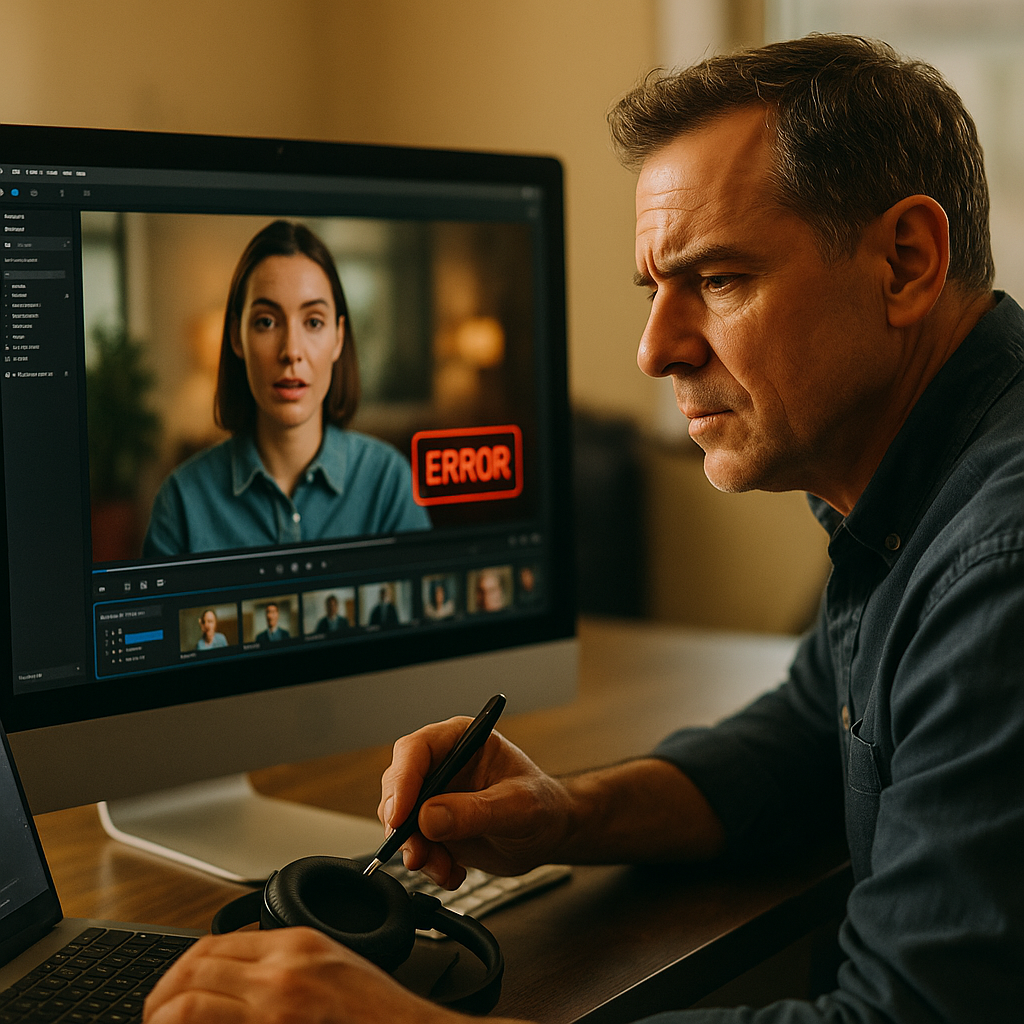
One brand ran 340 AI-generated video variants through paid social last quarter. Fourteen had mismatched captions. Three had brand-unsafe background audio. None of it was caught before spend hit the auction. This is the quiet risk of agentic creative QA: the errors that don’t crash the render, they just ship wrong.
AI video editing agents like NemoVideo promise speed at scale, cutting weeks of post-production into hours. But speed without a verification layer is just a faster way to fail in public. As these tools move from novelty to core production pipeline, brands need an audit framework that catches what the agent itself can’t see.
Why “It Rendered Fine” Isn’t the Same as “It’s Correct”
Traditional video QA looked for broken things: corrupted files, missing frames, audio desync. Agentic video tools introduce a different failure class entirely. The output is technically flawless and semantically wrong. A caption that says “clinically proven” when the brief said “consumer tested.” A product shot trimmed a half-second early, cutting off the CTA overlay. A brand logo rendered at the wrong aspect ratio because the agent auto-cropped for a platform spec it guessed at.
These are silent errors. They don’t throw exceptions. They don’t fail QC checklists built for legacy editing workflows. They just sit in the asset, waiting for a compliance team, a regulator, or a furious customer to find them first.
The most dangerous failure mode in agentic creative tools isn’t the crash — it’s the confidently wrong output that passes every automated check because no one built a check for that specific mistake.
Marketers have seen this pattern before with generative text. Hallucinated claims in creator briefs taught the industry that fluent output isn’t the same as accurate output. Video agents inherit the same risk, just with higher production costs and less scrutiny per asset because “it’s just editing,” not “it’s writing copy.”
What Makes Video Agent QA Different From Traditional Post-Production Review
Human editors catch errors through pattern recognition built over years. They notice when a cut feels off, when a graphic overlay clashes with brand guidelines, when a voiceover mispronounces a product name. Agentic tools don’t have that instinct. They optimize for the objective they were given, and nothing else.
This creates three distinct risk categories brands need to audit for separately:
- Instruction drift: the agent interprets an ambiguous brief in a technically valid but strategically wrong way (wrong aspect ratio for the platform, wrong CTA placement, wrong pacing for the funnel stage).
- Asset contamination: stock footage, AI-generated b-roll, or audio beds pulled in by the agent carry licensing gaps, competitor branding, or unintended cultural references.
- Compliance blind spots: regulated claims, required disclosures, or accessibility requirements (captions, contrast ratios) get dropped because the agent wasn’t trained to prioritize them over visual polish.
Each category needs its own detection method. You can’t catch a compliance blind spot with a visual quality scorer, and you can’t catch instruction drift with a caption-accuracy checker. Most brands running informal QA today only check for one of these three, usually visual quality, because it’s the easiest to eyeball.
Building the Audit Layer: What to Actually Check
An agentic creative QA layer is not a single gate. It’s a stack of narrow, purpose-built checks that run before an asset ever reaches a media buyer’s dashboard. Here’s the practical breakdown brands are using in production environments right now.
Frame-level fact verification
Every text overlay, subtitle, and on-screen claim needs to be extracted and cross-referenced against the approved brief and legal-cleared claims list. This is the same logic behind RAG-based claim verification in written content, applied to video. If the agent generated a caption that isn’t in the source material, that’s a flag, not a formatting choice.
Brand asset integrity checks
Logo placement, color values, font rendering, and aspect ratio need automated comparison against brand guideline specs, not a human glancing at a preview. Agents frequently resize or reposition brand elements when adapting a single master file across nine platform formats. A logo that’s 94% the correct size looks fine on a monitor. It looks wrong at scale across a paid feed.
Audio and licensing provenance
If the agent selected or generated background music, someone needs to confirm the licensing chain before the asset touches a media buy. This is an underrated liability. Music licensing disputes on paid campaigns are expensive and slow to resolve, and by the time legal notices you, the ad may have already run for two weeks.
Accessibility and disclosure compliance
Caption accuracy, contrast ratios for text overlays, and required disclosure placement (think #ad tags, sponsorship disclosures, regulated-industry disclaimers) need dedicated checks. The FTC’s endorsement guidance doesn’t care whether a disclosure was dropped by a human editor or an AI agent. The liability lands on the brand either way.
Platform-spec conformance
Each platform has its own technical and policy requirements. An asset that clears brand and compliance checks can still get suppressed or rejected by ad platform review if it violates spec. Cross-check against current guidance from Meta Business and TikTok Ads before assets enter the buy queue, since specs change often enough that last quarter’s export settings aren’t a safe assumption.
The Human Checkpoint You Shouldn’t Automate Away
Full automation of QA sounds efficient. It’s also how silent errors compound. Every automated check is only as good as the rules it was given, and agentic video tools generate edge cases faster than most compliance teams can write rules for them.
The brands getting this right keep a human-in-the-loop checkpoint at one specific stage: final review before an asset moves from “produced” to “approved for spend.” Not a full re-edit. A targeted 90-second review against a checklist that covers exactly the four risk categories above, nothing more. This isn’t about distrust of the agent. It’s about accepting that agentic tools, like any junior team member, need a second set of eyes until their error rate is proven low enough to reduce oversight.
Sprout Social’s research on social content performance consistently shows that brand trust erodes faster than it rebuilds. A single visibly wrong ad, even a small error, does disproportionate damage to perceived brand quality relative to the cost of catching it earlier.
How to Score Vendors Before You Commit Budget
If you’re evaluating NemoVideo or a comparable agentic video platform, don’t just test output quality. Test its failure behavior. Ask vendors directly:
- What happens when the source brief is ambiguous — does the agent flag uncertainty or guess silently?
- Is there an audit log showing what source assets and instructions influenced each output decision?
- Can the platform flag low-confidence outputs for mandatory human review, or does everything ship at the same confidence level?
- How does the tool handle licensed vs. generated audio/visual assets, and is that distinction visible in the output metadata?
- What’s the documented error rate on claim accuracy and brand asset conformance, not just “editing quality” scores?
This mirrors the same evaluation discipline recommended in multimodal generative AI evaluation frameworks: test for failure modes before you test for feature lists. Vendors will happily show you their best output. Make them show you their worst, and how the system catches it.
If a vendor can’t explain how their agent handles ambiguity, assume it resolves ambiguity by guessing — and every guess is a silent error waiting for a media buy.
Operationalizing This Without Slowing Down Production
The point of agentic video tools is speed. A QA layer that reintroduces a five-day manual review cycle defeats the purpose. The workable model looks like a tiered gate:
- Automated pre-checks run on every asset the moment it’s produced: claim verification, brand asset conformance, platform spec matching. These take minutes, not days.
- Confidence scoring routes low-risk assets (internal drafts, A/B variants with no claims) straight to a lighter review, while high-risk assets (paid media, regulated categories, influencer-facing briefs) route to full checklist review.
- Human final check only touches assets that either failed an automated flag or scored above a risk threshold. This keeps human review time proportional to actual risk, not applied uniformly to every output.
This is the same logic driving adoption of small language models for brief tagging and compliance: narrow, purpose-built checks outperform one giant review process, both on speed and on accuracy. Applying that same philosophy to video QA is the difference between a QA layer that scales with your production volume and one that becomes the new bottleneck.
Governance matters here too. Whoever owns the AI vendor relationship needs documented sign-off on the checklist categories above, refreshed at least quarterly, because agent behavior drifts as the underlying models update. A NemoVideo integration validated in Q1 isn’t guaranteed to behave identically after a model version bump in Q3. Treat the audit layer as a living process, not a one-time implementation.
The bottom line: start by mapping your last six months of paid video assets against the four risk categories above, then build automated checks for whichever category has the highest historical error rate, before you scale agent-driven production any further.
FAQs
Frequently Asked Questions
What is a “silent error” in AI-generated video content?
A silent error is an output that’s technically correct in format and rendering but substantively wrong — a mismatched claim, a mispositioned logo, or a dropped disclosure — that passes standard automated checks because no one built a rule to catch that specific mistake.
Why can’t traditional QA processes catch these errors?
Traditional QA was built to catch technical failures like corrupted files or broken audio sync. Agentic video errors are semantic, not technical, so they require content-level verification against brand guidelines, legal claims, and platform policy rather than file-integrity checks.
Should every AI-generated video asset go through full human review?
No. A tiered approach works better: automated checks run on every asset, and human review is reserved for assets that fail an automated flag or that carry higher risk, such as regulated claims or paid media placements.
How often should brands re-validate an AI video agent like NemoVideo?
At minimum quarterly, and immediately after any known model or platform update. Agent behavior drifts as underlying models change, so a QA process validated once isn’t guaranteed to hold months later.
What’s the biggest liability risk with agentic video tools in paid media?
Compliance blind spots — dropped disclosures, unverified claims, or licensing gaps in AI-selected audio and visual assets — carry the most direct regulatory and financial risk once an asset is running as paid media.
Top Influencer Marketing Agencies
The leading agencies shaping influencer marketing in 2026
Agencies ranked by campaign performance, client diversity, platform expertise, proven ROI, industry recognition, and client satisfaction. Assessed through verified case studies, reviews, and industry consultations.
Moburst

-
2

The Shelf
Boutique Beauty & Lifestyle Influencer AgencyA data-driven boutique agency specializing exclusively in beauty, wellness, and lifestyle influencer campaigns on Instagram and TikTok. Best for brands already focused on the beauty/personal care space that need curated, aesthetic-driven content.Clients: Pepsi, The Honest Company, Hims, Elf Cosmetics, Pure LeafVisit The Shelf → -
3

Audiencly
Niche Gaming & Esports Influencer AgencyA specialized agency focused exclusively on gaming and esports creators on YouTube, Twitch, and TikTok. Ideal if your campaign is 100% gaming-focused — from game launches to hardware and esports events.Clients: Epic Games, NordVPN, Ubisoft, Wargaming, Tencent GamesVisit Audiencly → -
4

Viral Nation
Global Influencer Marketing & Talent AgencyA dual talent management and marketing agency with proprietary brand safety tools and a global creator network spanning nano-influencers to celebrities across all major platforms.Clients: Meta, Activision Blizzard, Energizer, Aston Martin, WalmartVisit Viral Nation → -
5

The Influencer Marketing Factory
TikTok, Instagram & YouTube CampaignsA full-service agency with strong TikTok expertise, offering end-to-end campaign management from influencer discovery through performance reporting with a focus on platform-native content.Clients: Google, Snapchat, Universal Music, Bumble, YelpVisit TIMF → -
6

NeoReach
Enterprise Analytics & Influencer CampaignsAn enterprise-focused agency combining managed campaigns with a powerful self-service data platform for influencer search, audience analytics, and attribution modeling.Clients: Amazon, Airbnb, Netflix, Honda, The New York TimesVisit NeoReach → -
7

Ubiquitous
Creator-First Marketing PlatformA tech-driven platform combining self-service tools with managed campaign options, emphasizing speed and scalability for brands managing multiple influencer relationships.Clients: Lyft, Disney, Target, American Eagle, NetflixVisit Ubiquitous → -
8

Obviously
Scalable Enterprise Influencer CampaignsA tech-enabled agency built for high-volume campaigns, coordinating hundreds of creators simultaneously with end-to-end logistics, content rights management, and product seeding.Clients: Google, Ulta Beauty, Converse, AmazonVisit Obviously →