


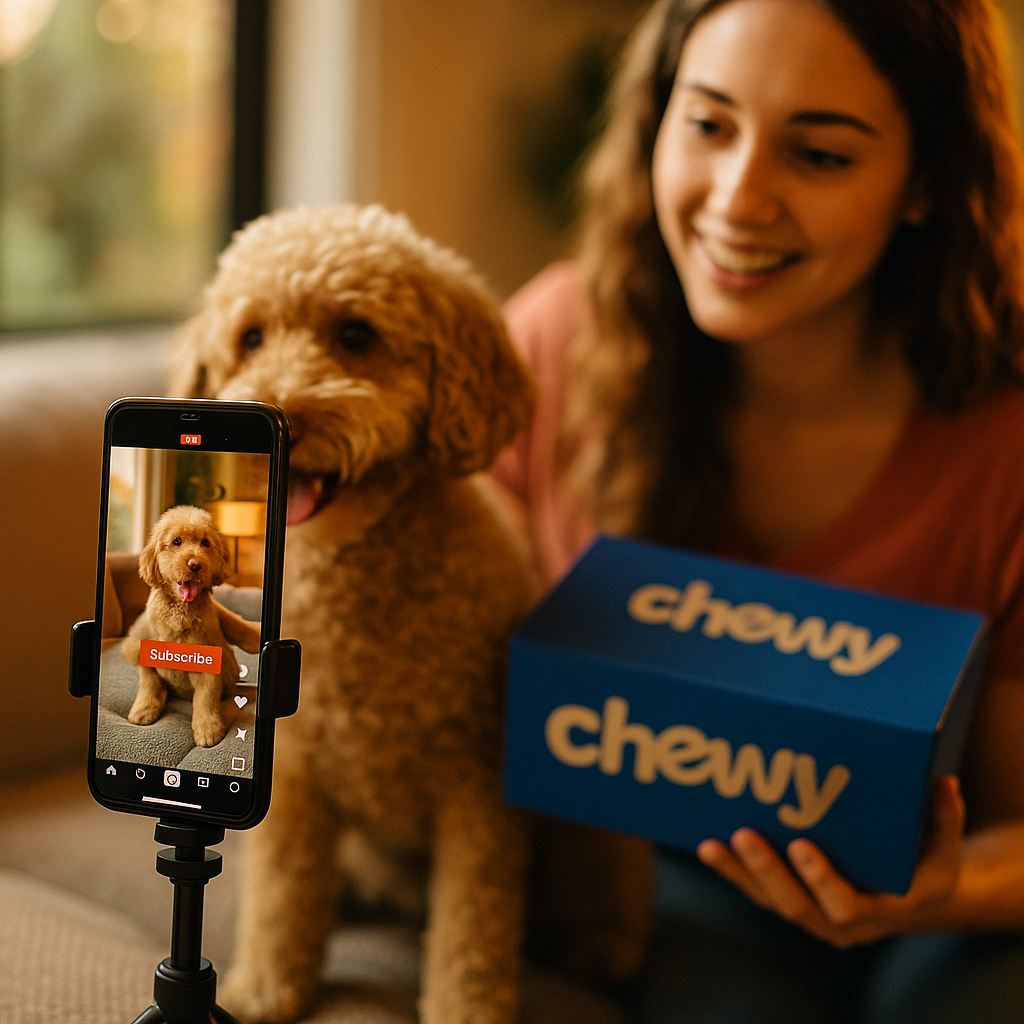
Chewy’s Autoship subscribers now account for more than 78% of net sales, and a good chunk of that growth traces back to an unglamorous corner of TikTok: pet owners filming unboxings in their kitchens. No celebrity endorsements. No six-figure creator contracts. Just a Chewy TikTok pet influencer program built almost entirely on nano-creators with a few thousand followers and a very loyal dog. This is the case study every subscription brand should be studying right now.
The Problem With Subscription Marketing on Social
Subscription products are a hard sell on short-form video. Nobody wants to watch a 15-second ad about recurring billing. Chewy’s marketing team understood this early: the pitch couldn’t be “subscribe and save,” it had to be “look how much my dog loves this.” That distinction matters more than it sounds.
Autoship, Chewy’s subscription mechanism, isn’t a discount gimmick. It’s a logistics promise — the right food, the right treats, the right flea medication, arriving before you run out. That’s a retention story, not an acquisition hook. And retention stories are notoriously hard to dramatize in fifteen seconds of video. So Chewy stopped trying to sell the subscription directly and started selling the relationship between pet and product.
Why Nano-Creators, Not Celebrity Pet Influencers?
Chewy could have gone the traditional route: partner with a handful of Instagram-famous golden retrievers boasting six-figure followings. Instead, it built a program around thousands of small creators, many with under 20,000 followers, each posting genuine content about their own pets’ routines.
The logic is simple once you see it. Pet ownership is intensely personal and endlessly diverse — a chihuahua owner and a Great Dane owner have almost nothing in common except the Chewy box on their porch. A single celebrity influencer, however big, can’t represent that range. A network of nano-creators can. Each one speaks credibly to a narrow audience that trusts them precisely because they aren’t famous.
Nano-creators converted better on subscription sign-ups than any celebrity partnership Chewy tested, largely because their audiences saw the content as advice from a fellow pet owner, not an ad.
This mirrors what we’ve documented in other categories. Chamberlain Coffee’s retail push and Solo Stove’s seeding engine both leaned on the same insight: small creators aggregate into something more powerful than any single big name, provided the operational infrastructure can handle the volume.
How the Program Actually Works
Chewy didn’t stumble into this. The program runs on a fairly disciplined operating model, even if the content looks spontaneous.
- Product-first seeding. Creators receive actual Chewy products, often tied to a pet’s specific need (senior dog joint supplements, kitten starter kits, prescription diet food), not generic gift boxes.
- Autoship-triggered content prompts. Creators are encouraged to document the unboxing moment when a recurring shipment arrives, which naturally showcases the subscription mechanic without narrating it.
- Vet and specialist crossover. A subset of creators are veterinary technicians or trainers, lending credibility to health and nutrition claims without Chewy having to make them directly.
- Light-touch briefs. Instead of scripts, creators get a simple prompt: show the delivery, show the reaction, mention why you stay subscribed. Everything else is improvised.
That last point is the operational unlock. Heavy briefs kill authenticity, and pet content authenticity is brutally easy to fake-detect. Audiences can tell within seconds whether a dog is actually excited about a treat or performing for a camera. Chewy’s brief structure protects that spontaneity while still guiding creators toward the commercial message: recurring delivery, reliability, savings.
The Subscription Flywheel
Here’s where it gets interesting from a growth-marketing lens. Chewy isn’t just using nano-creators for top-of-funnel awareness. The content is engineered to hit three distinct funnel stages simultaneously:
- Discovery: A pet owner scrolling TikTok sees a relatable creator with a similar-breed pet facing a similar problem (shedding, allergies, picky eating).
- Consideration: The comments section becomes an organic FAQ, with creators answering questions about pricing, delivery windows, and whether Autoship can be paused.
- Retention reinforcement: Existing Chewy subscribers see the same content and feel validated in their own subscription choice, reducing churn risk.
That third stage is the part most brands miss. Influencer content usually gets evaluated purely as an acquisition tool. Chewy treats it as a retention asset too, feeding existing customers proof that other pet owners are having the same positive experience. It’s a subtle but important reframing of what influencer content is even for.
The Numbers Behind the Strategy
Chewy has been public about its Autoship penetration rate climbing steadily year over year, a trend the company attributes partly to organic and creator-driven content rather than paid acquisition alone. Independent research supports the broader thesis: eMarketer has repeatedly flagged nano and micro-influencers as delivering stronger engagement rates than mega-influencers across nearly every consumer category, and pet care is no exception.
Sprout Social’s own influencer research points in the same direction — audiences rank authenticity and relatability above production value when deciding whether to trust a recommendation, a pattern documented at Sprout Social. For a brand selling a recurring, trust-dependent service like automated pet supply delivery, that’s not a nice-to-have. It’s the entire mechanism.
Chewy’s category also benefits from one structural advantage: pet content performs exceptionally well on TikTok regardless of brand involvement. That means the marginal cost of getting a creator to talk about their pet is low, they were probably going to post that content anyway. Chewy’s job was simply to make sure the product showed up naturally in that content, and to make participation easy enough that thousands of small creators would bother.
What Other Subscription Brands Get Wrong
Most subscription brands over-index on discount-driven influencer deals: promo codes, referral links, “use my code for 20% off.” Chewy largely avoids this. Discount codes commoditize the relationship and train audiences to wait for the next deal instead of trusting the product on its own merits.
Compare this to Shoezone’s approach to Gen Z on TikTok Shop or Chubbies’ discount-free comedy strategy — both prove that non-discount creator content can drive stronger long-term brand equity than promo-code churn. Chewy’s version of this same principle is arguably higher-stakes, because a subscription business lives or dies on retention economics, not one-time conversion.
There’s also a compliance angle brands frequently underweight. The FTC’s endorsement guidelines require clear disclosure when creators receive free product, even nano-creators with small followings. Chewy’s program builds disclosure into the creator agreement from day one, which matters given how easily pet content blurs the line between genuine enthusiasm and paid promotion. Brands running similar seeding programs at scale should treat disclosure compliance as a non-negotiable line item, not an afterthought — regulatory risk scales with creator volume just as fast as reach does.
Vetting at Scale: The Operational Bottleneck
Running a nano-creator program with thousands of participants creates a vetting problem most brands aren’t prepared for. Who gets product? How do you verify they actually own the pet, or the pet exists, or the account isn’t a bot-inflated farm? Chewy’s team reportedly leans on a mix of manual review and platform-level engagement data rather than follower count alone, prioritizing comment quality and repeat engagement over raw reach.
This is the same operational challenge covered in supplement brands using AI-driven creator vetting. As programs scale into the thousands, manual vetting stops being feasible, and brands that skip this step risk repeating mistakes like the ones outlined in Sephora’s creator vetting failures, where insufficient screening led directly to brand-safety blowback.
For Chewy, the stakes of poor vetting are arguably higher than in beauty or apparel. Pet health claims carry real consequences if a creator misrepresents dosage, ingredients, or safety information. That’s likely why the program leans so heavily on light-touch briefs paired with tight product categorization, rather than giving creators free rein to make health claims unsupervised.
What This Means for Brands Outside Pet Care
The Chewy model translates surprisingly well beyond pet products. Any subscription business selling something habitual, recurring, and emotionally tied to daily routine (supplements, meal kits, grooming products) can borrow this playbook almost directly. HelloFresh’s dual-strategy model, which blends large campaigns with affiliate-style nano-creator activity, is arguably the closest analog outside the pet category.
The common thread across all these case studies: subscription growth isn’t won through a single viral moment. It’s won through hundreds of small, credible, repeatable moments that compound over months. Chewy didn’t need one video to hit ten million views. It needed ten thousand videos to hit ten thousand living rooms.
FAQs
What made Chewy’s TikTok pet influencer program different from typical influencer marketing?
Chewy prioritized volume and authenticity over reach, working with thousands of nano-creators instead of a handful of celebrity pet accounts. The program focused on showcasing the Autoship subscription experience organically rather than pushing discount codes.
Why do nano-creators work better than macro-influencers for subscription products?
Subscription products rely on trust and habitual behavior, which nano-creators communicate more credibly because their audiences see them as peers rather than paid spokespeople. Higher engagement rates among smaller creators also translate into stronger consideration and retention signals.
How does Chewy handle FTC disclosure requirements across thousands of creators?
Chewy builds disclosure requirements into creator agreements from the outset, treating compliance as a baseline requirement regardless of creator size. This reduces regulatory risk as the program scales into thousands of participants.
Can this nano-creator strategy work for non-pet subscription brands?
Yes. Any subscription brand selling recurring, routine-based products such as meal kits, supplements, or personal care items can apply the same model: seed product, encourage light-touch authentic content, and avoid over-reliance on discount-driven messaging.
What’s the biggest operational challenge in scaling a nano-creator program?
Vetting. Brands need reliable ways to verify creator authenticity and engagement quality at scale, since manual review becomes impractical once a program grows into the thousands of participants.
FAQs
The takeaway for brand teams: stop treating nano-creator programs as a cheaper substitute for celebrity influencers, and start treating them as a dedicated retention channel with its own budget, vetting process, and success metrics. Build the operational infrastructure first — disclosure compliance, product seeding logistics, engagement-based vetting — then let the content stay unscripted.
Top Influencer Marketing Agencies
The leading agencies shaping influencer marketing in 2026
Agencies ranked by campaign performance, client diversity, platform expertise, proven ROI, industry recognition, and client satisfaction. Assessed through verified case studies, reviews, and industry consultations.
Moburst

-
2

The Shelf
Boutique Beauty & Lifestyle Influencer AgencyA data-driven boutique agency specializing exclusively in beauty, wellness, and lifestyle influencer campaigns on Instagram and TikTok. Best for brands already focused on the beauty/personal care space that need curated, aesthetic-driven content.Clients: Pepsi, The Honest Company, Hims, Elf Cosmetics, Pure LeafVisit The Shelf → -
3

Audiencly
Niche Gaming & Esports Influencer AgencyA specialized agency focused exclusively on gaming and esports creators on YouTube, Twitch, and TikTok. Ideal if your campaign is 100% gaming-focused — from game launches to hardware and esports events.Clients: Epic Games, NordVPN, Ubisoft, Wargaming, Tencent GamesVisit Audiencly → -
4

Viral Nation
Global Influencer Marketing & Talent AgencyA dual talent management and marketing agency with proprietary brand safety tools and a global creator network spanning nano-influencers to celebrities across all major platforms.Clients: Meta, Activision Blizzard, Energizer, Aston Martin, WalmartVisit Viral Nation → -
5

The Influencer Marketing Factory
TikTok, Instagram & YouTube CampaignsA full-service agency with strong TikTok expertise, offering end-to-end campaign management from influencer discovery through performance reporting with a focus on platform-native content.Clients: Google, Snapchat, Universal Music, Bumble, YelpVisit TIMF → -
6

NeoReach
Enterprise Analytics & Influencer CampaignsAn enterprise-focused agency combining managed campaigns with a powerful self-service data platform for influencer search, audience analytics, and attribution modeling.Clients: Amazon, Airbnb, Netflix, Honda, The New York TimesVisit NeoReach → -
7

Ubiquitous
Creator-First Marketing PlatformA tech-driven platform combining self-service tools with managed campaign options, emphasizing speed and scalability for brands managing multiple influencer relationships.Clients: Lyft, Disney, Target, American Eagle, NetflixVisit Ubiquitous → -
8

Obviously
Scalable Enterprise Influencer CampaignsA tech-enabled agency built for high-volume campaigns, coordinating hundreds of creators simultaneously with end-to-end logistics, content rights management, and product seeding.Clients: Google, Ulta Beauty, Converse, AmazonVisit Obviously →