


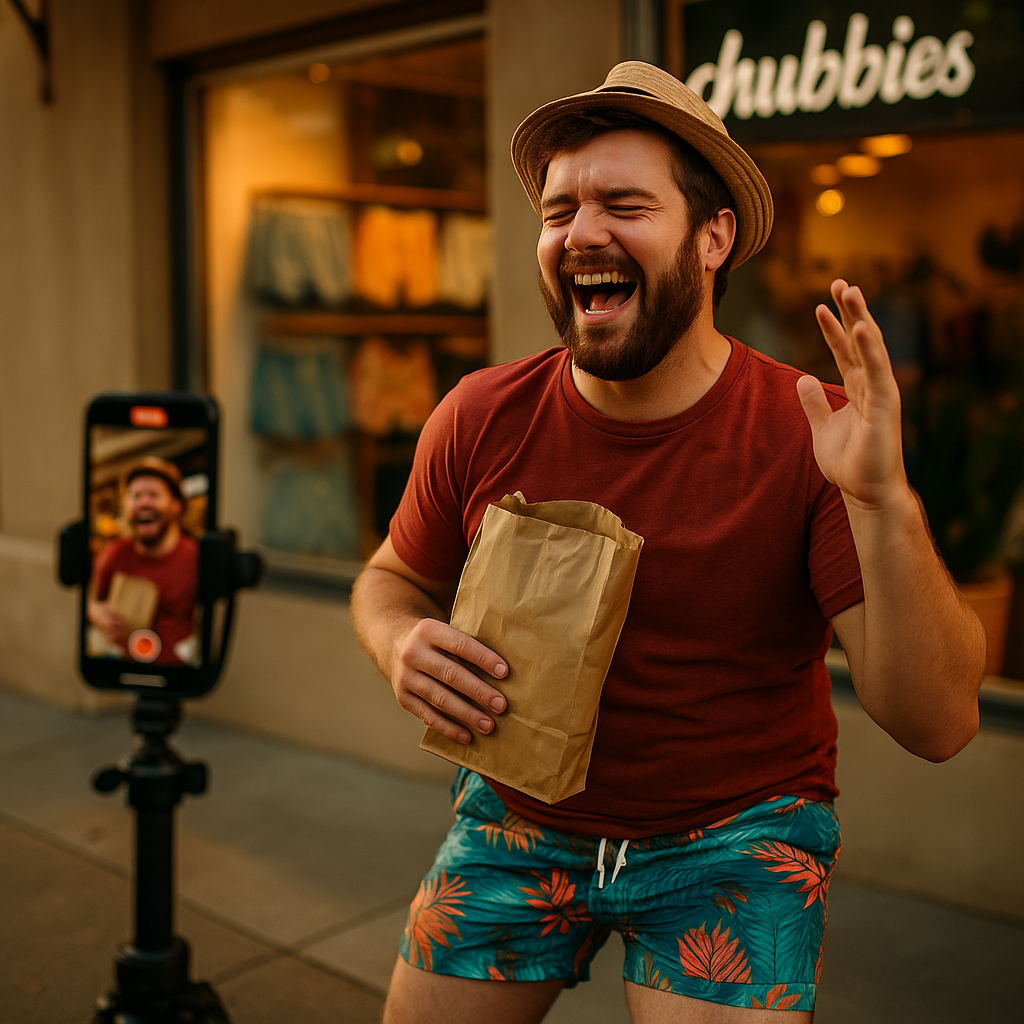
Chubbies has never run a sitewide discount bigger than a novelty “Golden Weekend” promo, yet it built one of retail’s most loyal fanbases on the back of men’s shorts. No influencer marketing playbook explains that. The brand’s secret isn’t math — it’s comedy, delivered by nano-creators who never once had to mention a coupon code.
While competitors chase margin-killing discount cycles to move inventory, Chubbies proved something uncomfortable for performance marketers: humor retains pricing power better than promo codes do. This case study breaks down how.
The Discount Trap Most Apparel Brands Fall Into
Apparel is a discount-addicted category. Data from eMarketer has repeatedly shown that a large share of US apparel purchases happen during promotional windows, training shoppers to wait out full-price periods. Brands respond by discounting more, which erodes margin and trains customers further. It’s a flywheel nobody wants to be on.
Chubbies opted out. Founded on a bit — American flag shorts, aggressively short inseams, a tone that reads like a fraternity president wrote the brand deck — the company built its identity around not taking itself seriously. That tone became the moat. You can copy a product. You can’t copy a comedic voice that’s been refined for over a decade.
Chubbies rarely discounts because its content does the conversion work that markdowns usually do elsewhere — it manufactures urgency and desire through absurdity, not price.
Why Nano-Creators, Not Celebrities, Carry the Bit
Here’s the counterintuitive part: Chubbies’ comedy doesn’t come primarily from polished agency productions or celebrity ambassadors. It comes from a wide bench of nano and micro-creators — guys with 3,000 to 60,000 followers — riffing on the brand’s absurdist premise in their own backyards, boats, and beer-league softball games.
Why nano, specifically? A few operational reasons brand teams should care about:
- Authenticity reads better at small scale. A guy with 8,000 followers cracking a joke about “thigh-brows” feels like a friend, not an ad. Comedy dies the moment it feels corporate.
- Volume enables joke-testing. Chubbies can seed dozens of creators with the same premise and see which punchlines land, then double down on what works organically before spending media dollars.
- Cost efficiency compounds. Nano-creator gifting and flat-fee deals cost a fraction of a single celebrity campaign, letting the brand run comedy as a continuous content engine rather than a seasonal push.
- Niche relevance. A dad-humor creator, a golf-bro creator, and a beach-town creator each carry the same bit into different subcultures without diluting the voice.
This mirrors a pattern Influencers Time has tracked across categories. Ryobi turned nano-creator seeding into its top channel, and Liquid Death built a billion-dollar brand on nano-creators using a similarly irreverent tone. Chubbies just applies the model to comedy sketches instead of stunt marketing.
The Content Formula: Absurdity With a Product Cameo
Watch enough Chubbies-tagged content and a formula emerges. It’s not a jump-cut UGC review or a “get ready with me” video. It’s a mini-sketch: an exaggerated scenario (grilling competitions, backyard Olympics, a guy negotiating with a raccoon) where the shorts are present but rarely the explicit subject.
The product doesn’t need to be the hero of every frame. It just needs to be visually inseparable from the brand’s world.
That’s a deliberate departure from most influencer briefs, which obsess over product-in-hand shots and feature call-outs. Chubbies briefs, by contrast, protect the joke first. Compliance and legal language, product specs, discount codes — all secondary. If the sketch isn’t funny, the brief failed, regardless of how many times the fabric technology got mentioned.
This is worth noting for brand teams building creator guidelines: over-scripting kills comedic timing. Chubbies reportedly gives creators loose scenario prompts and lets them run the joke their own way, closer to writers’ room notes than legal-approved talking points.
What This Means for Brief Design
If your creator briefs read like a legal document with a mood board attached, you’re optimizing for compliance, not comedy. Brands hoping to replicate this need three things: a tone guide instead of a script, creative freedom within brand-safe boundaries, and a willingness to greenlight content that doesn’t mention the product by name in the first three seconds.
That’s a hard sell to a CFO used to feature-benefit messaging. It’s an easier sell once you see the retention numbers a strong brand voice produces.
No Discounts, No Problem: How the Business Model Holds Up
Skeptics will ask the obvious question: does comedy actually replace discounting as a demand driver, or is this just brand-building fluff that doesn’t move revenue? Chubbies’ answer is its limited-drop model. Products launch in tight batches, sell out, and don’t restock on a predictable cadence. Scarcity plus humor plus nano-creator amplification creates a purchase trigger that doesn’t require a price cut.
Influencers Time covered a similar mechanic in how Chubbies sold out shorts in 48 hours with nano-creators — proof that the comedic seeding strategy converts, not just entertains.
Compare that to Rhode’s approach, which Influencers Time examined in how Rhode sells out every launch with zero warehouse seeding. Different tone, same underlying principle: scarcity and creator-driven storytelling can substitute for markdown-driven urgency.
When creators generate genuine anticipation, brands don’t need a 20%-off code to create urgency — the drop itself becomes the event.
Risk Mitigation: What Could Go Wrong With Comedy-First Seeding
Comedy is high-reward, high-risk. Brand safety teams should be honest about the downside before greenlighting an absurdist creator strategy:
- Jokes age poorly or misfire culturally. What reads as harmless bro-humor in one market can land badly in another. Regional and cultural review matters before scaling a bit across a diverse creator roster.
- Disclosure compliance still applies. Comedic framing doesn’t exempt creators from clear material-connection disclosures. The FTC’s endorsement guidance applies whether the content is a sketch or a straight review, and UK-based campaigns need to account for ICO and CAP code expectations around influencer transparency.
- Off-brand improvisation. Giving creators loose creative latitude means occasionally getting content that’s funny but off-message. Brands need a fast review-and-reject workflow, not a rigid pre-approval bottleneck that kills spontaneity.
- Inconsistent quality at scale. Not every nano-creator is naturally funny. Casting for comedic timing, not just follower count or niche fit, becomes a core competency the brand team has to build in-house or via an agency partner.
None of this is a reason to avoid the strategy. It’s a reason to build the guardrails before scaling it. Brands like Dude Wipes have run a similar playbook successfully — Influencers Time broke down how Dude Wipes used comedy to win influencer marketing — and the common thread is disciplined brand-safety review paired with loose creative execution, not the absence of oversight.
Measuring Comedy: The Metrics That Actually Matter
How do you prove a joke drove revenue? Chubbies-style programs typically track a different metric mix than standard influencer campaigns:
- Watch-through and replay rate over simple view counts, since comedic content lives or dies on whether people watch the punchline.
- Share and duet/remix rate as a proxy for whether the bit has cultural legs beyond the original creator’s audience.
- Branded search lift during and immediately after a content wave, since comedy drives curiosity-based search rather than direct-response clicks.
- Sell-through velocity on limited drops, tying content cadence directly to inventory movement instead of attributing everything to last-click ads.
Platforms like Sprout Social and native analytics from TikTok Ads Manager make watch-through and engagement-quality tracking accessible even for mid-sized teams without an in-house data science function. The technology isn’t the barrier here. The willingness to measure brand sentiment as seriously as CPA is.
Applying the Model Beyond Apparel
Marketers in other categories often assume absurdist comedy only works for casual apparel or beverage brands with built-in permission to be silly. That’s a limiting belief. Duolingo proved a mascot-driven, unhinged tone can work for an education app — see Duolingo’s owl strategy — and Fly By Jing built cult demand for a condiment through irreverent seeding, detailed in how Fly By Jing built a cult brand with chili crisp seeding.
The category doesn’t determine whether comedy works. The brand’s tolerance for creative risk does.
If you’re building a similar model, start small: pick one comedic premise, seed it to a dozen nano-creators with loose creative freedom, and measure watch-through before scaling spend. Resist the urge to add a discount code just because it feels safer — the whole point is proving the joke can carry the sale on its own.
Frequently Asked Questions
Why does Chubbies avoid discounting compared to other apparel brands?
Chubbies relies on limited-batch product drops and comedic nano-creator content to generate urgency, which reduces its dependency on markdowns to drive conversion. Discounting frequently would also undercut the premium-adjacent, cult-brand positioning the comedy strategy has built over time.
What makes nano-creators effective for comedic brand campaigns?
Nano-creators bring authenticity and niche audience trust that comedy depends on, and their lower cost per collaboration lets brands test multiple jokes or scenarios simultaneously before scaling the ones that resonate.
How do you brief a creator for comedy instead of a standard product review?
Effective comedy briefs provide a scenario or tone guide rather than a rigid script, giving creators room to run the joke in their own voice while still protecting core brand-safety and disclosure requirements.
Is absurdist comedy marketing compliant with FTC disclosure rules?
Yes, but comedic framing doesn’t remove the disclosure obligation. Creators still need clear, conspicuous disclosure of any material connection to the brand, regardless of how the content is styled.
Can comedy-driven creator marketing work outside apparel and food brands?
Yes. Categories like education technology and cybersecurity have used humor-driven creator content successfully, showing that audience tolerance for comedy is less about industry and more about brand risk appetite and execution discipline.
Frequently Asked Questions
Why does Chubbies avoid discounting compared to other apparel brands?
Chubbies relies on limited-batch product drops and comedic nano-creator content to generate urgency, which reduces its dependency on markdowns to drive conversion. Discounting frequently would also undercut the premium-adjacent, cult-brand positioning the comedy strategy has built over time.
What makes nano-creators effective for comedic brand campaigns?
Nano-creators bring authenticity and niche audience trust that comedy depends on, and their lower cost per collaboration lets brands test multiple jokes or scenarios simultaneously before scaling the ones that resonate.
How do you brief a creator for comedy instead of a standard product review?
Effective comedy briefs provide a scenario or tone guide rather than a rigid script, giving creators room to run the joke in their own voice while still protecting core brand-safety and disclosure requirements.
Is absurdist comedy marketing compliant with FTC disclosure rules?
Yes, but comedic framing doesn’t remove the disclosure obligation. Creators still need clear, conspicuous disclosure of any material connection to the brand, regardless of how the content is styled.
Can comedy-driven creator marketing work outside apparel and food brands?
Yes. Categories like education technology and cybersecurity have used humor-driven creator content successfully, showing that audience tolerance for comedy is less about industry and more about brand risk appetite and execution discipline.
The takeaway for brand teams: pick a comedic premise you can defend in a legal review, hand it to ten nano-creators with real creative latitude, and track watch-through before you ever touch a discount code.
Top Influencer Marketing Agencies
The leading agencies shaping influencer marketing in 2026
Agencies ranked by campaign performance, client diversity, platform expertise, proven ROI, industry recognition, and client satisfaction. Assessed through verified case studies, reviews, and industry consultations.
Moburst

-
2

The Shelf
Boutique Beauty & Lifestyle Influencer AgencyA data-driven boutique agency specializing exclusively in beauty, wellness, and lifestyle influencer campaigns on Instagram and TikTok. Best for brands already focused on the beauty/personal care space that need curated, aesthetic-driven content.Clients: Pepsi, The Honest Company, Hims, Elf Cosmetics, Pure LeafVisit The Shelf → -
3

Audiencly
Niche Gaming & Esports Influencer AgencyA specialized agency focused exclusively on gaming and esports creators on YouTube, Twitch, and TikTok. Ideal if your campaign is 100% gaming-focused — from game launches to hardware and esports events.Clients: Epic Games, NordVPN, Ubisoft, Wargaming, Tencent GamesVisit Audiencly → -
4

Viral Nation
Global Influencer Marketing & Talent AgencyA dual talent management and marketing agency with proprietary brand safety tools and a global creator network spanning nano-influencers to celebrities across all major platforms.Clients: Meta, Activision Blizzard, Energizer, Aston Martin, WalmartVisit Viral Nation → -
5

The Influencer Marketing Factory
TikTok, Instagram & YouTube CampaignsA full-service agency with strong TikTok expertise, offering end-to-end campaign management from influencer discovery through performance reporting with a focus on platform-native content.Clients: Google, Snapchat, Universal Music, Bumble, YelpVisit TIMF → -
6

NeoReach
Enterprise Analytics & Influencer CampaignsAn enterprise-focused agency combining managed campaigns with a powerful self-service data platform for influencer search, audience analytics, and attribution modeling.Clients: Amazon, Airbnb, Netflix, Honda, The New York TimesVisit NeoReach → -
7

Ubiquitous
Creator-First Marketing PlatformA tech-driven platform combining self-service tools with managed campaign options, emphasizing speed and scalability for brands managing multiple influencer relationships.Clients: Lyft, Disney, Target, American Eagle, NetflixVisit Ubiquitous → -
8

Obviously
Scalable Enterprise Influencer CampaignsA tech-enabled agency built for high-volume campaigns, coordinating hundreds of creators simultaneously with end-to-end logistics, content rights management, and product seeding.Clients: Google, Ulta Beauty, Converse, AmazonVisit Obviously →