


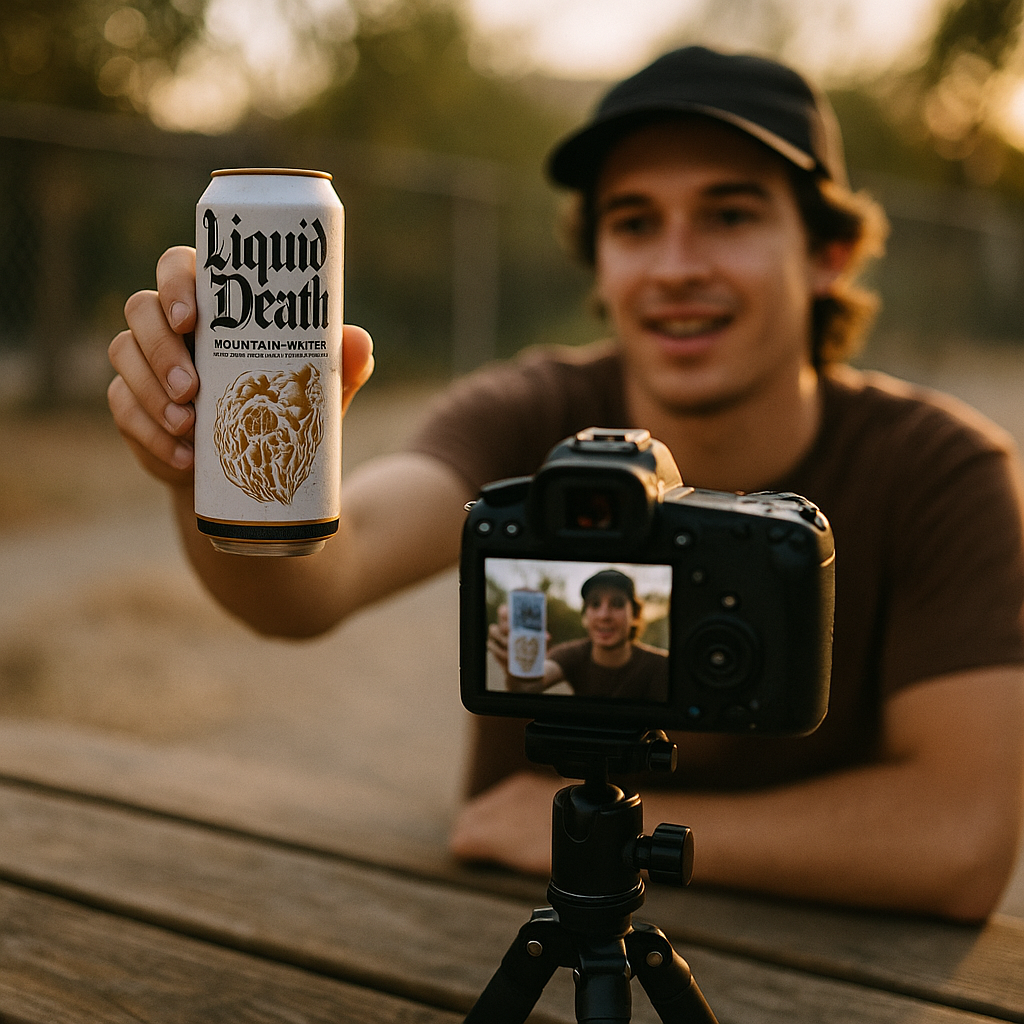
Liquid Death sells canned water for the price of a light beer and still hit a $1.4 billion valuation. No Super Bowl spot. No celebrity endorsement deal until the brand was already famous. Just absurdist, unhinged content and a nano-creator strategy that most CMOs would’ve killed in the first board meeting. What can brands actually steal from the Liquid Death case study, and what’s just heavy metal cosplay that only works once?
The Premise Nobody Approved in a Boardroom
Liquid Death launched in 2019 selling something absurd on its face: canned mountain water, branded like a death metal energy drink, with the tagline “Murder Your Thirst.” Founder Mike Cessario, a former ad creative, built the entire positioning around a joke — that health-conscious beverages didn’t have to look boring to be taken seriously.
That joke became the strategy. Instead of a traditional media plan, Liquid Death poured its early budget into content that looked nothing like beverage advertising. Heavy metal parody videos. Mocked-up “band merch” that wasn’t for a band. A country album called “Greatest Hits” made entirely from hate comments. It was built to be shared, not skipped.
The brand’s own research team claims Liquid Death generates more engagement per dollar than nearly any beverage competitor on social platforms — and independent estimates from eMarketer have repeatedly flagged the brand as an outlier in organic reach relative to media spend. For a category built on multi-million-dollar Super Bowl buys, that’s a direct challenge to conventional wisdom.
Nano-Creators Did the Heavy Lifting, Not Celebrities
Here’s the part most trend pieces skip: Liquid Death’s comedy didn’t come primarily from big-name comedians or macro-influencers. It came from an army of smaller creators making fan content, parody reviews, and “reaction” videos that the brand amplified rather than commissioned from scratch.
This matters because it’s replicable. You don’t need a $200,000 celebrity contract to seed absurdist content — you need a clear enough brand voice that random creators want to riff on it. Liquid Death made its cans, its merch, and its social presence so tonally distinct that nano-creators had something to actually play with.
Liquid Death didn’t pay for comedy. It built a brand voice so distinct that unpaid creators wanted to make the jokes themselves — and then it amplified the best ones.
That’s a fundamentally different cost structure than paid celebrity endorsement. It’s closer to what Dude Wipes did with comedy-first influencer marketing — lean into a category nobody wants to talk about seriously, then let creators do the talking for you. Both brands prove the same point: absurdity plus consistency beats polish plus budget.
Why “No Traditional Advertising” Is a Slight Exaggeration (And Why That’s Fine)
Let’s be precise, because “no advertising” gets thrown around loosely in case studies like this one. Liquid Death has run paid social campaigns, sponsored athlete and creator content, and even dabbled in out-of-home stunts. What it has largely avoided is traditional broadcast advertising and the media-buy-first model that dominates CPG marketing.
The distinction matters for anyone trying to apply this playbook. Liquid Death didn’t skip marketing spend — it redirected it. Instead of funding a 30-second national TV spot, the budget went into content production, creator relationships, and merch drops designed to generate their own press cycle. The company reportedly treats merchandise (its infamous “Convicted Fan Club” gear and skate decks) as a marketing line item, not a revenue center.
That reallocation is the real lesson. It’s not “spend zero,” it’s “stop spending on formats that don’t compound.” A TV ad disappears the moment the buy ends. A viral nano-creator video, a piece of merch someone wears for years, or a parody song that lives on Spotify keeps working long after the campaign budget is gone.
What the Content Actually Looked Like
- Parody horror/metal videos that mocked energy drink marketing tropes rather than beverage marketing conventions.
- Hate-comment merch — turning negative social comments into apparel, which drove organic sharing from the very people who left the comments.
- Creator-made “field tests” and reaction content that framed the product as a lifestyle joke, not a health beverage.
- Collaborations with musicians and skaters who had built-in absurdist or countercultural audiences already primed for the tone.
None of this required Super Bowl money. It required a willingness to look ridiculous in a category that takes itself far too seriously.
The Retail and Distribution Reality Behind the Meme
Comedy content doesn’t sell cans by itself — distribution does. Liquid Death’s growth wasn’t just a social media phenomenon; it was paired with an aggressive retail push into convenience stores, gyms, and big-box retailers, which is where impulse purchases of flavored and still water actually convert. The brand’s social presence built awareness and shareability; retail placement converted that awareness into repeat purchase behavior.
This is the piece brand strategists most often underweight when they try to copy the model. A hilarious TikTok doesn’t matter if the product isn’t on a shelf within arm’s reach of the person who just watched it. Liquid Death’s team reportedly prioritized velocity data from retailers to decide where to double down on both content and shelf space — a pattern similar to how Feastables used nano-creators to win retail shelf space, treating creator content as a proof point for buyers, not just a consumer-facing tactic.
What Brands Get Wrong When They Try to Copy This
Every category now has a brand trying to be “the Liquid Death of X.” Most fail. Why? Because they copy the tone without doing the operational work underneath it.
A few recurring mistakes:
- Treating absurdity as a one-off campaign instead of a sustained voice. Liquid Death has been consistently unhinged for years. A single edgy TikTok doesn’t build brand equity; repetition does.
- Skipping the product differentiation. Canned water in a metal-branded can is still a genuinely different physical product on shelf. The joke works because the packaging itself is part of the bit.
- Underinvesting in the creator relationships that fuel the content. Comedy-first influencer marketing still requires briefing, rights management, and a system for spotting which nano-creators are worth amplifying. It’s not “just let it happen.”
- Ignoring compliance basics. Any brand running creator-driven parody or comedic content still has to manage disclosure requirements under FTC endorsement guidelines, especially when creators are compensated with product, merch, or fees rather than cash.
That last point gets overlooked constantly in “look how viral this was” case studies. Absurdist content is still commercial content. If a nano-creator got free product or payment to make that parody metal video, it needs a disclosure, full stop. Brands that skip this step because the tone feels “organic” are taking on real regulatory risk, not just a stylistic one.
The Metric That Actually Matters
Liquid Death’s team has talked publicly about tracking “engagement per dollar” and brand mention volume more closely than traditional reach and frequency metrics. That’s a meaningful shift for any brand evaluating whether a comedy-first, nano-creator-heavy strategy is working.
Reach tells you how many people saw something. It doesn’t tell you whether they made a joke about it to their friends, made their own version of it, or bought merch because of it. Brands trying to replicate this model need measurement frameworks that account for earned amplification, not just paid impressions — something platforms like Sprout Social and HubSpot have both built reporting tools around as brand teams shift budget toward organic and creator-led content.
It’s a similar measurement philosophy to what’s worked for Poppi’s kitchen-table content strategy and Crumbl’s weekly flavor drop marketing — both brands that treat shareability itself as the KPI, not just a byproduct of good content.
Is This Repeatable Outside Beverages?
Partially. The mechanics — nano-creator seeding, distinct brand voice, merch-as-marketing, retail-content alignment — transfer to almost any category. The specific tone doesn’t. A B2B software company probably shouldn’t launch a death metal parody campaign; the audience mismatch would be immediate and damaging.
What transfers cleanly is the underlying discipline: build something distinct enough that creators want to make content about it unprompted, then have the operational infrastructure (retail, fulfillment, compliance, measurement) to capture the demand that content generates. Brands like Wyze building a cult camera brand through nano-creators and Fly By Jing’s chili crisp seeding strategy prove the framework works well outside beverages, even when the tone is completely different from Liquid Death’s.
Takeaway
Liquid Death didn’t get big because it was funny. It got big because it built a distinct enough identity that nano-creators found it worth joking about for free, then backed that content with retail distribution and disciplined measurement. Brands chasing this playbook should start with voice and shelf strategy, not with hiring a comedy writer.
FAQs
Did Liquid Death really spend nothing on traditional advertising?
Not literally nothing, but the brand avoided large broadcast and traditional media buys, redirecting that budget into content production, nano-creator relationships, and merchandise designed to generate organic sharing and press coverage.
How did nano-creators contribute to Liquid Death’s growth?
Nano-creators produced parody videos, reaction content, and fan-made material that riffed on the brand’s absurdist tone. Liquid Death amplified the strongest content rather than commissioning most of it directly, keeping costs low relative to reach.
Can a smaller or B2B brand realistically copy this strategy?
The core mechanics — distinct brand voice, nano-creator seeding, merch-as-marketing, retail alignment — transfer across categories. The specific comedic tone typically does not, especially for B2B or highly regulated industries where the audience expects a different register.
What compliance risks come with comedy-first influencer content?
Any compensated or product-seeded creator content, including parody or absurdist formats, still falls under FTC endorsement disclosure rules. Brands need clear disclosure guidance for creators even when content feels organic or unscripted.
What metrics should brands track instead of standard reach and frequency?
Engagement per dollar spent, brand mention volume, and earned amplification (creators making unprompted content) are more relevant indicators for comedy-first, nano-creator-driven strategies than traditional reach and frequency benchmarks.
Top Influencer Marketing Agencies
The leading agencies shaping influencer marketing in 2026
Agencies ranked by campaign performance, client diversity, platform expertise, proven ROI, industry recognition, and client satisfaction. Assessed through verified case studies, reviews, and industry consultations.
Moburst

-
2

The Shelf
Boutique Beauty & Lifestyle Influencer AgencyA data-driven boutique agency specializing exclusively in beauty, wellness, and lifestyle influencer campaigns on Instagram and TikTok. Best for brands already focused on the beauty/personal care space that need curated, aesthetic-driven content.Clients: Pepsi, The Honest Company, Hims, Elf Cosmetics, Pure LeafVisit The Shelf → -
3

Audiencly
Niche Gaming & Esports Influencer AgencyA specialized agency focused exclusively on gaming and esports creators on YouTube, Twitch, and TikTok. Ideal if your campaign is 100% gaming-focused — from game launches to hardware and esports events.Clients: Epic Games, NordVPN, Ubisoft, Wargaming, Tencent GamesVisit Audiencly → -
4

Viral Nation
Global Influencer Marketing & Talent AgencyA dual talent management and marketing agency with proprietary brand safety tools and a global creator network spanning nano-influencers to celebrities across all major platforms.Clients: Meta, Activision Blizzard, Energizer, Aston Martin, WalmartVisit Viral Nation → -
5

The Influencer Marketing Factory
TikTok, Instagram & YouTube CampaignsA full-service agency with strong TikTok expertise, offering end-to-end campaign management from influencer discovery through performance reporting with a focus on platform-native content.Clients: Google, Snapchat, Universal Music, Bumble, YelpVisit TIMF → -
6

NeoReach
Enterprise Analytics & Influencer CampaignsAn enterprise-focused agency combining managed campaigns with a powerful self-service data platform for influencer search, audience analytics, and attribution modeling.Clients: Amazon, Airbnb, Netflix, Honda, The New York TimesVisit NeoReach → -
7

Ubiquitous
Creator-First Marketing PlatformA tech-driven platform combining self-service tools with managed campaign options, emphasizing speed and scalability for brands managing multiple influencer relationships.Clients: Lyft, Disney, Target, American Eagle, NetflixVisit Ubiquitous → -
8

Obviously
Scalable Enterprise Influencer CampaignsA tech-enabled agency built for high-volume campaigns, coordinating hundreds of creators simultaneously with end-to-end logistics, content rights management, and product seeding.Clients: Google, Ulta Beauty, Converse, AmazonVisit Obviously →