


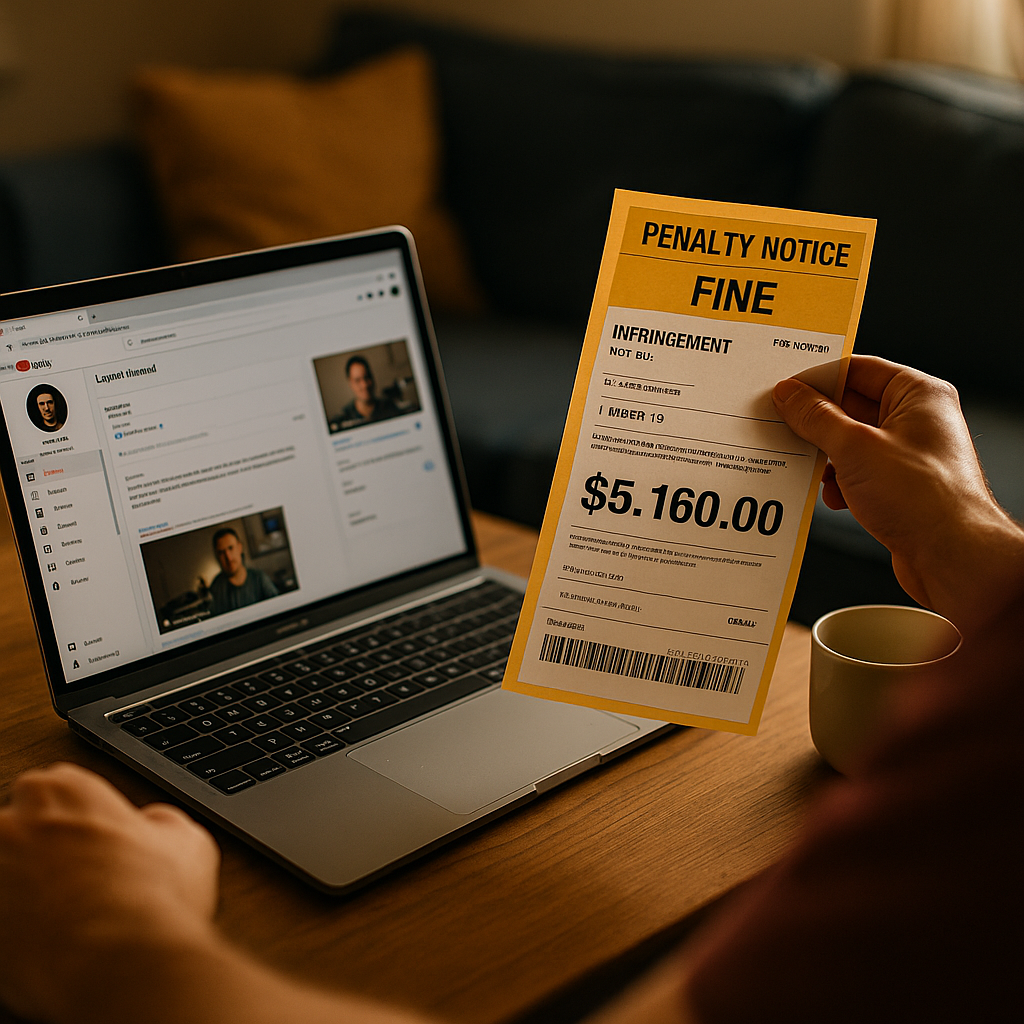
Australia just doubled the maximum penalty for platforms that let under-16s hold accounts, pushing fines toward AUD $50 million per breach. That’s not a platform problem anymore. It’s a brand problem, because your influencer contracts almost certainly rely on those same platforms’ age gates to prove compliance. If your Australia under-16 social media penalties clause hasn’t been touched since the original Online Safety Act updates, you’re exposed.
Marketing leaders love to treat regulatory shifts as legal’s job. This one isn’t. It touches media planning, creator vetting, and the indemnification language sitting quietly in every influencer agreement you’ve signed for the ANZ market.
What Actually Changed, in Plain English
The Australian eSafety Commissioner’s under-16 social media ban, originally enforced through the Online Safety Amendment (Social Media Minimum Age) Act, carried civil penalties platforms treated as a cost of doing business. Regulators noticed. The revised penalty structure roughly doubles the maximum civil penalty tier for systemic non-compliance, and it extends liability exposure to entities that “materially benefit” from underage engagement on a platform, not just the platform operator itself.
That second part is the sleeper clause. Brands running paid partnerships, gifting programs, or affiliate codes that drive measurable engagement from underage accounts could now be pulled into scrutiny, even if the platform is the primary target of enforcement. Nobody’s suggesting Coca-Cola gets fined because a 14-year-old liked a TikTok post. But class actions and regulatory inquiries rarely stay narrow once penalty ceilings double and political pressure builds.
Doubling the penalty didn’t just raise the stakes for platforms — it quietly widened the net of who counts as a responsible party when underage engagement drives commercial value.
The Contract Clause Nobody Re-Reads
Most brand-creator agreements written in the past two years include some version of an age-verification warranty: the creator attests their audience skews appropriately, or the platform’s own age-gating satisfies the brand’s compliance obligation. That language was drafted when the penalty exposure was modest and the enforcement pattern was untested. It assumed platforms would absorb regulatory risk.
Under the doubled penalty regime, that assumption is shakier. If a platform’s age-verification system is later found systemically deficient, and your contract merely references “compliance with platform age policies” rather than requiring an independent verification standard, you’ve outsourced your risk assessment to a system regulators just said wasn’t working well enough.
Compare this to how the FTC treats disclosure obligations in the US: a paid partnership label alone doesn’t satisfy the substance of the rule, only the form. The same logic applies here. Paid partnership labels alone no longer satisfy FTC rules, and platform age-gates alone won’t satisfy an Australian regulator asking why a campaign’s engagement data shows a meaningful cluster of underage interaction.
Three Gaps to Check This Quarter
- Verification standard ambiguity: Does the clause specify a verification method (ID-based, AI age-estimation, parental consent) or just reference “platform compliance” generically?
- Audience data reporting cadence: Are creators contractually required to share audience demographic breakdowns, and how often?
- Indemnification scope: Does the indemnity cover regulatory penalties triggered by platform-level age-verification failure, or only creator misrepresentation?
If you answered “unclear” to any of those, you have a contract gap. Not a hypothetical one, a live one, given the new penalty ceiling.
Reconciling the Two Regimes Without Rewriting Every Contract
Full contract renegotiation across an active creator roster isn’t realistic in most quarters. Compliance teams need a triage approach. Here’s the sequence that actually works.
Step one: segment by platform risk exposure. Not every platform faces the same enforcement pressure under the amended penalty scheme. Platforms with weaker historical age-verification infrastructure (and a documented pattern of underage account leakage) carry more contract-refresh urgency than platforms with mandatory ID-linked verification already live. Audit your ANZ creator roster by platform first, not by creator tier or spend.
Step two: add a verification-standard rider, not a full rewrite. Most existing agreements can absorb a short addendum specifying that age-verification must meet a defined minimum standard (referencing eSafety Commissioner guidance directly, rather than “platform policy” in the abstract). This is faster to execute than renegotiating full terms and closes the biggest liability gap.
Step three: align indemnification language with the new penalty tier. If your indemnification clause caps creator liability at a dollar figure set before the penalty doubling, that cap may now be economically meaningless relative to actual regulatory exposure. This is worth reviewing alongside how other AI-and-liability contract work has evolved, similar to the reasoning in indemnification clauses for AI media-buying agent errors, where liability caps had to be resized once error exposure changed materially.
A liability cap written for yesterday’s penalty regime isn’t cautious, it’s obsolete. Resize it or the clause is decorative.
Where This Intersects With Existing Age-Verification Work
If your team already built an age-verification compliance workflow for UK Online Safety Act obligations, you have a head start. The structural logic is similar: define a verification standard independent of platform self-certification, document it contractually, and build an audit trail. Teams that used the UK and Australia age verification compliance matrix as a baseline should treat the doubled penalty as a trigger to re-run that matrix, not build a parallel one.
The same applies to the broader age-verification compliance checklist for creator campaigns many brands adopted for general youth-adjacent risk. That checklist likely needs an Australia-specific penalty-tier annex now. Small addition, meaningful risk reduction.
Global brands juggling UK, EU, Australian, and US youth-safety rules simultaneously are increasingly asking the same question: why maintain five regional compliance frameworks instead of one baseline that exceeds all of them? That’s the argument laid out in one global standard for youth-adjacent creator compliance, and Australia’s penalty increase is another data point supporting that consolidation, not another reason to build a bespoke local process.
What Compliance Teams Should Ask Legal Right Now
Rather than waiting for a legal memo that may take weeks, marketing compliance leads should walk into the next legal sync with specific questions:
- Does our current indemnification cap reflect the doubled penalty ceiling, or the prior one?
- Are we relying on platform self-certification of age compliance, or an independently documented standard?
- Do we have audience demographic reporting obligations built into creator contracts for ANZ campaigns?
- Who owns the audit trail if eSafety requests evidence of our due diligence?
- Does our media-buying process flag underage-skewed audience segments before spend commits, not after?
That last question matters more than it sounds. Reactive compliance (finding out after a campaign ran) satisfies nobody, least of all a regulator with a doubled penalty and a point to prove. Building age-risk flags into pre-campaign media planning, the way brands already flag deceptive urgency tactics before launch, is the operationally sound move.
Industry data backs the urgency. Research from eMarketer shows youth engagement on short-form platforms remains high despite age restrictions, meaning the gap between stated policy and actual usage patterns is exactly where regulators are now looking. Brands that treat platform-reported audience age data as gospel, without an independent verification layer, are betting on data quality that regulators have publicly said isn’t reliable enough.
The Operational Fix: Build a Standing Review Trigger
The real lesson from Australia’s penalty increase isn’t the specific dollar figure. It’s that penalty regimes for youth safety are moving targets, and contract language written once and left alone becomes stale fast. Compliance teams should build a standing quarterly trigger: any time a covered jurisdiction adjusts penalty thresholds for youth-platform compliance, indemnification and verification clauses get an automatic review, not a discretionary one.
This mirrors how many brands now handle synthetic media and AI-disclosure risk, where regulatory pace outstrips annual contract cycles. The same review-trigger logic used for state synthetic performer laws tracking against evolving EU rules applies cleanly here. Build the muscle once, reuse it across every fast-moving regulatory category.
Practical tools help too. Contract management platforms with clause-tagging (searchable by jurisdiction and topic) let compliance teams pull every ANZ age-verification clause in minutes rather than days. If you’re still searching contracts manually in a document repository, that’s the first fix, before you even touch clause language.
FAQs
Frequently Asked Questions
What triggered Australia’s doubled under-16 social media penalties?
The Australian government revised civil penalty ceilings under the Online Safety Amendment framework after regulators found the original penalty tier insufficient to change platform behavior around underage account access. The revision roughly doubles the maximum penalty for systemic non-compliance.
Do brands face direct liability under the new penalty regime?
Primary enforcement targets platforms, but the amended framework extends scrutiny to entities that materially benefit from underage engagement, which can include brands running paid partnerships or affiliate campaigns with measurable underage audience interaction.
What should change in our creator contracts first?
Start with the age-verification warranty clause. Replace vague references to “platform compliance” with a defined verification standard, and confirm your indemnification cap reflects the new penalty ceiling rather than the prior, lower one.
Can we rely on platform-reported audience age data as our compliance evidence?
Not exclusively. Regulators have signaled that platform self-certification of age data isn’t reliable enough on its own, so brands should build an independent documentation layer, such as contractual audience reporting obligations and periodic audits.
How often should we review these clauses going forward?
Set a standing quarterly review trigger tied to regulatory changes in covered jurisdictions, rather than waiting for annual contract renewal cycles. Penalty thresholds and verification standards are moving faster than typical contract cycles account for.
Next step: Pull every active ANZ creator contract this week, flag any age-verification clause that references “platform compliance” without a defined standard, and route those for an indemnification-cap review before your next campaign brief goes out.
Top Influencer Marketing Agencies
The leading agencies shaping influencer marketing in 2026
Agencies ranked by campaign performance, client diversity, platform expertise, proven ROI, industry recognition, and client satisfaction. Assessed through verified case studies, reviews, and industry consultations.
Moburst

-
2

The Shelf
Boutique Beauty & Lifestyle Influencer AgencyA data-driven boutique agency specializing exclusively in beauty, wellness, and lifestyle influencer campaigns on Instagram and TikTok. Best for brands already focused on the beauty/personal care space that need curated, aesthetic-driven content.Clients: Pepsi, The Honest Company, Hims, Elf Cosmetics, Pure LeafVisit The Shelf → -
3

Audiencly
Niche Gaming & Esports Influencer AgencyA specialized agency focused exclusively on gaming and esports creators on YouTube, Twitch, and TikTok. Ideal if your campaign is 100% gaming-focused — from game launches to hardware and esports events.Clients: Epic Games, NordVPN, Ubisoft, Wargaming, Tencent GamesVisit Audiencly → -
4

Viral Nation
Global Influencer Marketing & Talent AgencyA dual talent management and marketing agency with proprietary brand safety tools and a global creator network spanning nano-influencers to celebrities across all major platforms.Clients: Meta, Activision Blizzard, Energizer, Aston Martin, WalmartVisit Viral Nation → -
5

The Influencer Marketing Factory
TikTok, Instagram & YouTube CampaignsA full-service agency with strong TikTok expertise, offering end-to-end campaign management from influencer discovery through performance reporting with a focus on platform-native content.Clients: Google, Snapchat, Universal Music, Bumble, YelpVisit TIMF → -
6

NeoReach
Enterprise Analytics & Influencer CampaignsAn enterprise-focused agency combining managed campaigns with a powerful self-service data platform for influencer search, audience analytics, and attribution modeling.Clients: Amazon, Airbnb, Netflix, Honda, The New York TimesVisit NeoReach → -
7

Ubiquitous
Creator-First Marketing PlatformA tech-driven platform combining self-service tools with managed campaign options, emphasizing speed and scalability for brands managing multiple influencer relationships.Clients: Lyft, Disney, Target, American Eagle, NetflixVisit Ubiquitous → -
8

Obviously
Scalable Enterprise Influencer CampaignsA tech-enabled agency built for high-volume campaigns, coordinating hundreds of creators simultaneously with end-to-end logistics, content rights management, and product seeding.Clients: Google, Ulta Beauty, Converse, AmazonVisit Obviously →