


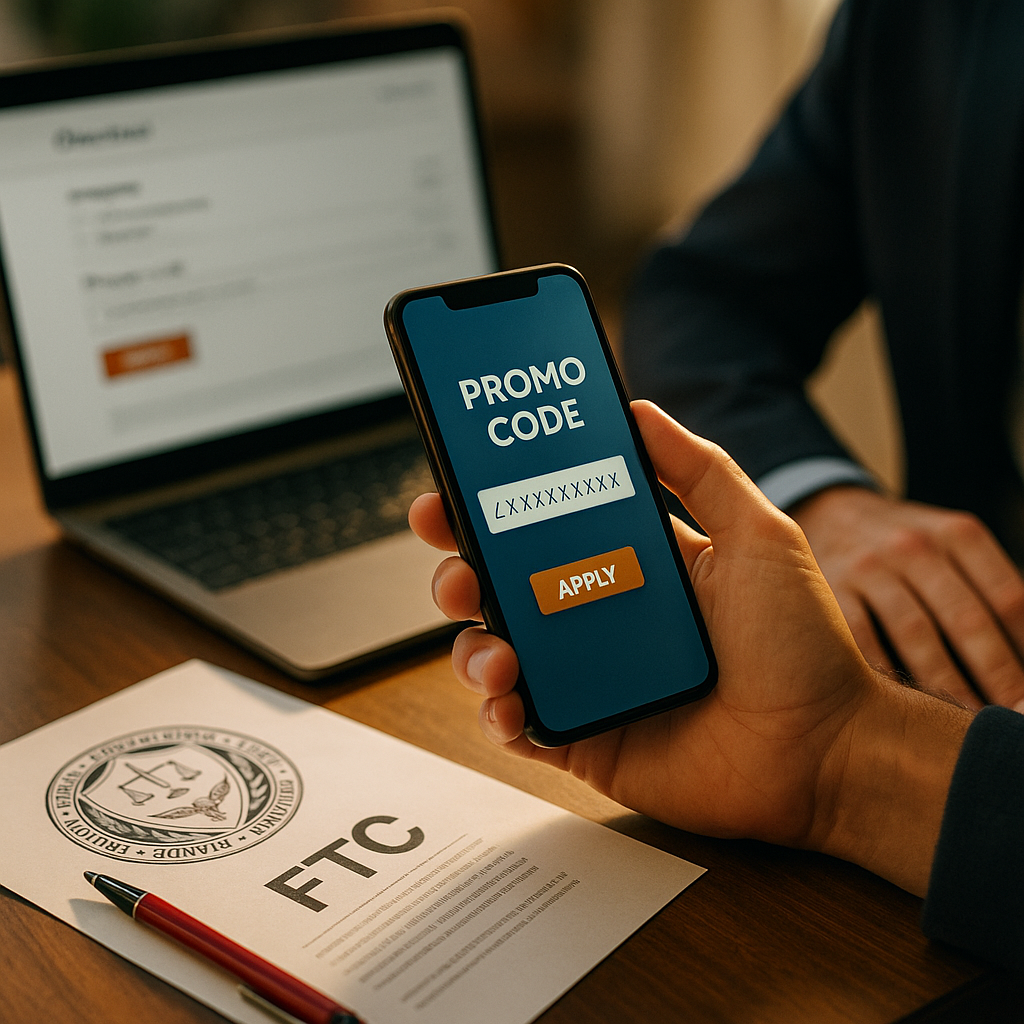
A single unlabeled promo code cost one wellness brand $600,000 in FTC penalties last year. Not a fake review. Not a deepfake endorsement. Just a discount code shared without a clear “ad” disclosure. Promo code compliance has quietly become one of the FTC’s favorite enforcement levers, and most affiliate programs still treat codes as a marketing tool rather than a regulated disclosure mechanism.
The FTC’s New Playbook for Promo Codes
For years, brands assumed a unique discount code was self-explanatory. If a creator’s audience sees “SAVE20WITHJESS,” surely they understand Jess has some kind of relationship with the brand, right? The Federal Trade Commission has said, repeatedly and pointedly, that this assumption is wrong.
Under the current Endorsement Guides, a personalized promo code is itself a form of endorsement. It signals a material connection between the creator and the brand, whether or not the word “sponsored” ever appears. The FTC’s position is straightforward: if the code exists because of a commercial relationship, that relationship must be disclosed clearly and conspicuously, every single time the code is shared, not just once in a bio link buried three scrolls deep.
What changed recently isn’t the rule itself. It’s the enforcement posture. The agency has moved from warning letters to actual settlements, and it’s naming both the creator and the brand in complaints. That second part matters more than most marketing teams realize.
Brands are no longer bystanders when a creator’s promo code disclosure fails. The FTC treats the company that issued the code as a co-responsible party, which means your legal exposure doesn’t end at the affiliate agreement.
Why “Link in Bio” Doesn’t Cut It Anymore
Here’s the pattern the FTC keeps flagging: a creator mentions a discount code verbally in a TikTok video, tells followers to “check the link,” and the actual disclosure lives only in a caption or a swipe-up that half the audience never sees. That’s a compliance gap, not a technicality.
The standard now is disclosure at the point of exposure. If the code is spoken aloud, the disclosure needs to be spoken or shown on screen at that moment. If it’s written in a caption, the disclosure needs to sit above the fold, not after fifteen hashtags. Our earlier breakdown of disclosure placement rules covers the platform-by-platform mechanics, but the underlying principle is simple: proximity and clarity, every time.
Unique Codes Are a Paper Trail, Not a Shield
A lot of brand teams still think a vanity code protects them. It doesn’t, at least not on its own. A promo code creates an obvious, traceable connection between creator and brand, which actually raises the bar for disclosure rather than lowering it. Regulators can point to the code itself as evidence that a material connection existed, then ask why nobody disclosed it properly.
This is where affiliate compliance gets operationally messy. Most brands issue codes through an affiliate network or a shopping platform (think ShareASale, Impact, or TikTok Shop’s creator tools), and the brand rarely sees the actual content until it’s live, if ever. That lag between code issuance and disclosure verification is exactly where enforcement risk accumulates.
Consider the numbers: eMarketer estimates affiliate and creator commerce spend continues climbing into the tens of billions annually in the US alone. Every dollar routed through a promo code is a dollar tied to a disclosure obligation. Scale that across a roster of fifty, a hundred, or a thousand creators, and the audit burden becomes real, not theoretical.
Where Brands Actually Get Caught
Enforcement rarely starts with a random audit. It starts with a complaint, a competitor tip, or a journalist doing a quick spot check. The FTC’s own investigators have shown they’ll simply search a discount code on social platforms and see what comes up.
- Stale disclosure language. Creators reuse old captions across dozens of posts, and the disclosure either disappears or gets buried under new hashtags.
- Livestream and Shop drops. Real-time selling formats move too fast for static disclosure habits, and codes get shouted out with zero on-screen labeling.
- Sub-affiliate chains. A macro-influencer’s code gets shared by smaller accounts in their community, none of whom have any contract with the brand or awareness of disclosure duties.
- Employee and micro-influencer gaps. Internal ambassador programs assume staff “know better,” but informal employee codes are just as regulated as paid creator deals.
That third bullet deserves its own conversation. Multi-tier commission structures have exploded alongside affiliate platforms that let creators recruit sub-affiliates. Our piece on sub-affiliate disclosure gaps digs into why brands often have zero visibility into who’s actually promoting their codes three or four layers down the chain.
Building a Compliance Audit Trail Before the FTC Asks For One
Reactive compliance is expensive compliance. Waiting for a complaint means you’re already explaining yourself to an investigator instead of showing them a clean process. The brands avoiding penalties right now share a few operational habits.
First, they bake disclosure requirements directly into affiliate onboarding, not as a boilerplate clause but as a checklist with screenshots of acceptable and unacceptable examples. Second, they run periodic spot checks on live content tied to active codes, not just at campaign launch. Third, they document everything: contracts, disclosure guidance sent to creators, and dated screenshots of actual posts. If an investigator ever asks “what did you do to ensure compliance,” a folder of timestamped evidence is worth more than any policy document.
This is also where verification rights in creator contracts matter. Brands that reserved the right to audit creator content and require correction of noncompliant posts have a much stronger defense than those relying on good faith. We covered the contract language that makes this enforceable in our guide to FTC compliance audit rights.
An audit trail isn’t paperwork for its own sake. It’s the difference between a warning letter and a six-figure settlement when regulators come asking questions.
The Tax and Payout Angle Nobody Talks About
Promo code compliance isn’t purely a disclosure issue. It intersects with payout reporting too. Every commission tied to a promo code redemption is taxable income for the creator, and brands issuing 1099s need clean records showing which codes generated which payouts. Sloppy tracking here creates a second compliance headache layered on top of the disclosure one. Our earlier coverage of promo code payout reporting walks through how finance and legal teams should be reconciling this data, and it’s worth cross-referencing against your disclosure audit so the two processes aren’t running in silos.
Multi-tier commission chains complicate this further, since a single sale might trigger payouts to a creator and their sub-affiliate simultaneously. Tracking disclosure compliance and payout accuracy across that chain requires the kind of systematic approach outlined in our analysis of sub-affiliate audit gaps.
Practical Steps for the Next Quarter
None of this requires a total program overhaul. It requires discipline in a few specific places.
- Audit every active promo code campaign for disclosure placement, not just presence.
- Update creator contracts to include explicit disclosure requirements per platform format (livestream, Shop, static post, Stories).
- Require creators to tag or label sub-affiliates who use the same code, closing visibility gaps.
- Run quarterly spot checks and log the results with dated screenshots.
- Align legal, finance, and marketing on a shared record of code issuance, disclosure guidance sent, and payout data.
Tools that help here range from social listening platforms like Sprout Social for monitoring live disclosure compliance, to affiliate management systems that timestamp content review. Whatever stack you use, the goal is the same: a searchable, exportable record that proves your program took disclosure seriously before anyone asked.
According to Statista, influencer marketing spend keeps growing year over year, which means the volume of promo codes in circulation grows right alongside it. Regulatory scrutiny scales with market size. That’s not a coincidence, it’s a pattern brands should plan around rather than react to.
FAQs
What counts as a promo code disclosure violation under FTC rules?
A violation occurs when a creator shares a personalized discount code without clearly and conspicuously disclosing the material connection to the brand at the point where the code appears, whether that’s a caption, a spoken mention, or an on-screen graphic.
Can a brand be held liable for a creator’s missing disclosure?
Yes. The FTC has named brands alongside creators in enforcement actions, treating the company that issued the promo code as jointly responsible for ensuring proper disclosure occurred.
Does a unique promo code automatically satisfy FTC disclosure requirements?
No. A unique code actually raises the disclosure bar because it proves a material connection exists. The code itself is not a disclosure and must be paired with clear language identifying the relationship.
How often should brands audit affiliate and creator content for compliance?
Quarterly spot checks at minimum, with additional review at campaign launch and whenever a creator significantly changes content format, such as moving from static posts to livestream selling.
What documentation should brands keep to defend against an FTC inquiry?
Dated screenshots of live content, copies of disclosure guidance sent to creators, signed contracts with verification rights, and payout records tied to each promo code redemption.
FAQs
What counts as a promo code disclosure violation under FTC rules?
A violation occurs when a creator shares a personalized discount code without clearly and conspicuously disclosing the material connection to the brand at the point where the code appears, whether that’s a caption, a spoken mention, or an on-screen graphic.
Can a brand be held liable for a creator’s missing disclosure?
Yes. The FTC has named brands alongside creators in enforcement actions, treating the company that issued the promo code as jointly responsible for ensuring proper disclosure occurred.
Does a unique promo code automatically satisfy FTC disclosure requirements?
No. A unique code actually raises the disclosure bar because it proves a material connection exists. The code itself is not a disclosure and must be paired with clear language identifying the relationship.
How often should brands audit affiliate and creator content for compliance?
Quarterly spot checks at minimum, with additional review at campaign launch and whenever a creator significantly changes content format, such as moving from static posts to livestream selling.
What documentation should brands keep to defend against an FTC inquiry?
Dated screenshots of live content, copies of disclosure guidance sent to creators, signed contracts with verification rights, and payout records tied to each promo code redemption.
The FTC isn’t slowing down on promo code enforcement, and neither should your compliance process. Pull your active affiliate codes this week, check disclosure placement against current content, and fix the gaps before an investigator finds them for you.
Top Influencer Marketing Agencies
The leading agencies shaping influencer marketing in 2026
Agencies ranked by campaign performance, client diversity, platform expertise, proven ROI, industry recognition, and client satisfaction. Assessed through verified case studies, reviews, and industry consultations.
Moburst

-
2

The Shelf
Boutique Beauty & Lifestyle Influencer AgencyA data-driven boutique agency specializing exclusively in beauty, wellness, and lifestyle influencer campaigns on Instagram and TikTok. Best for brands already focused on the beauty/personal care space that need curated, aesthetic-driven content.Clients: Pepsi, The Honest Company, Hims, Elf Cosmetics, Pure LeafVisit The Shelf → -
3

Audiencly
Niche Gaming & Esports Influencer AgencyA specialized agency focused exclusively on gaming and esports creators on YouTube, Twitch, and TikTok. Ideal if your campaign is 100% gaming-focused — from game launches to hardware and esports events.Clients: Epic Games, NordVPN, Ubisoft, Wargaming, Tencent GamesVisit Audiencly → -
4

Viral Nation
Global Influencer Marketing & Talent AgencyA dual talent management and marketing agency with proprietary brand safety tools and a global creator network spanning nano-influencers to celebrities across all major platforms.Clients: Meta, Activision Blizzard, Energizer, Aston Martin, WalmartVisit Viral Nation → -
5

The Influencer Marketing Factory
TikTok, Instagram & YouTube CampaignsA full-service agency with strong TikTok expertise, offering end-to-end campaign management from influencer discovery through performance reporting with a focus on platform-native content.Clients: Google, Snapchat, Universal Music, Bumble, YelpVisit TIMF → -
6

NeoReach
Enterprise Analytics & Influencer CampaignsAn enterprise-focused agency combining managed campaigns with a powerful self-service data platform for influencer search, audience analytics, and attribution modeling.Clients: Amazon, Airbnb, Netflix, Honda, The New York TimesVisit NeoReach → -
7

Ubiquitous
Creator-First Marketing PlatformA tech-driven platform combining self-service tools with managed campaign options, emphasizing speed and scalability for brands managing multiple influencer relationships.Clients: Lyft, Disney, Target, American Eagle, NetflixVisit Ubiquitous → -
8

Obviously
Scalable Enterprise Influencer CampaignsA tech-enabled agency built for high-volume campaigns, coordinating hundreds of creators simultaneously with end-to-end logistics, content rights management, and product seeding.Clients: Google, Ulta Beauty, Converse, AmazonVisit Obviously →