


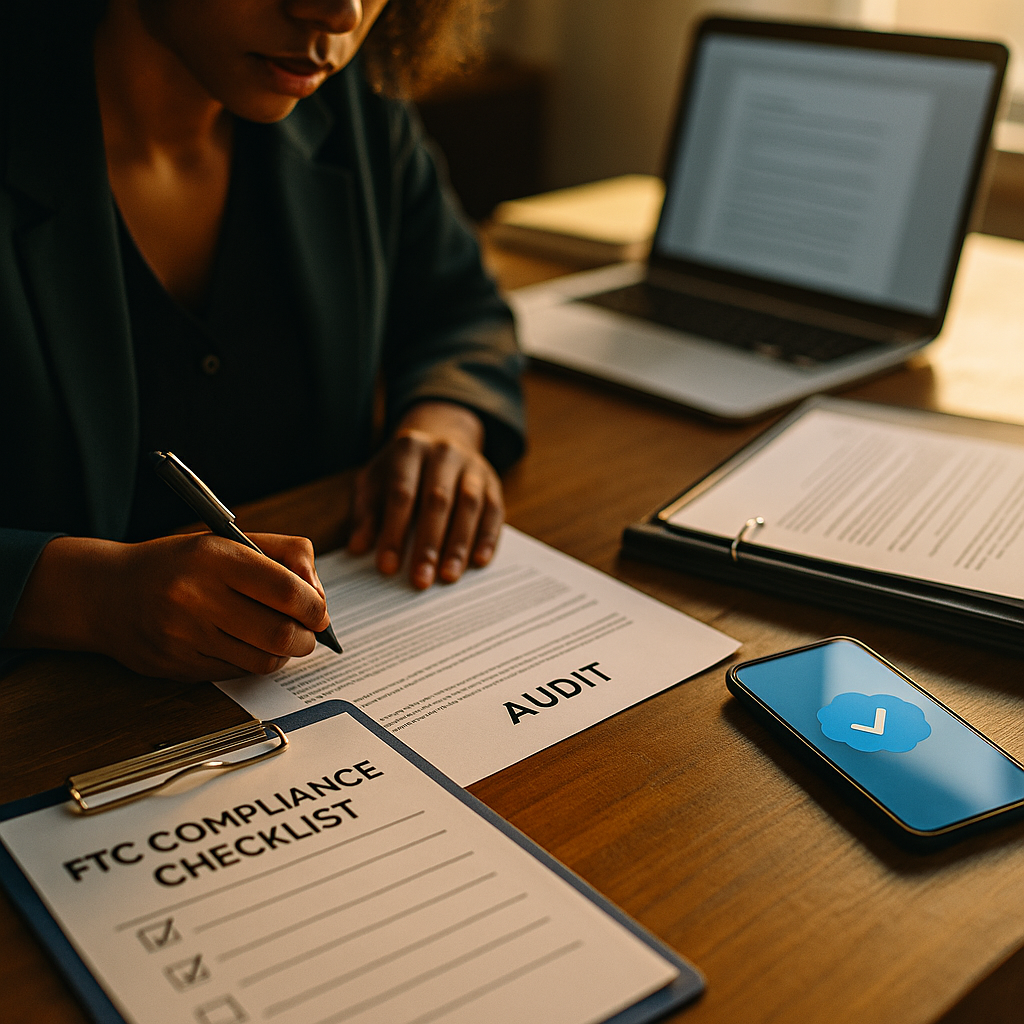
The FTC closed out its most recent enforcement sweep having sent warning letters to dozens of influencers and brands, and the agency’s own data shows disclosure violations remain rampant across sponsored content. Here’s the uncomfortable part: most brands have no contractual mechanism to actually check whether a creator disclosed properly before the post goes live. Creator FTC compliance audits only work if the contract gives you the legal right to look. Without that clause, you’re trusting, not verifying.
Why “Trust the Creator” Isn’t a Compliance Strategy
Most influencer agreements still treat FTC compliance as a boilerplate line item: “Creator agrees to comply with all applicable FTC guidelines.” That sentence feels protective. It isn’t. It shifts obligation onto the creator but gives the brand zero operational ability to confirm compliance actually happened before liability attaches.
Here’s the legal reality marketers keep missing: the FTC can and does pursue brands directly, not just creators, when disclosure fails. A generic compliance clause doesn’t shield you from that exposure. It just documents that you asked nicely.
A compliance clause without a verification right is a wish, not a control. If you can’t audit it, you can’t defend it.
Compare that to a manufacturing contract, where buyers routinely reserve inspection rights before accepting a shipment. Influencer contracts rarely include the equivalent: pre-publication review rights, screenshot requirements, or audit access to a creator’s posting history. That gap is exactly what smart legal and marketing teams are closing now.
What Contractual Verification Rights Actually Look Like
A verification right is a specific, enforceable clause that gives the brand (or its agency, or a third-party compliance vendor) the ability to inspect, confirm, and if necessary halt content before or after publication. It’s not a vague “best efforts” promise. It’s operational language with teeth.
Strong verification clauses typically include:
- Pre-publication review windows. A defined period (24 to 72 hours is common) during which the brand can review draft captions, video cuts, or story frames before they go live.
- Disclosure placement audits. Explicit requirements that hashtags like #ad appear in the first three lines of a caption, not buried after 400 words, and that platform-native disclosure tools (branded content labels, paid partnership tags) are activated, not just written text.
- Screenshot and archive obligations. Creators must retain and submit dated screenshots or platform analytics proving the disclosure label was live at time of posting, not added and removed.
- Third-party audit access. Language allowing the brand or a designated compliance vendor to pull posting history, story archives, or platform-level metadata on request, not just at the creator’s convenience.
- Remediation timelines. A specific number of hours (often 24) within which a creator must fix a disclosure error once flagged, with escalating penalties for non-compliance.
None of this is exotic. It mirrors how brands already audit paid media placements or ad verification through tools like Sprout Social or Integral Ad Science. The difference is that creator content has largely escaped that same rigor, mostly because contracts never asked for it.
The Pre-Publication Review Clause: Your First Line of Defense
If you only add one verification mechanism this quarter, make it pre-publication review. It’s the cheapest, fastest way to catch a missing disclosure before it becomes a public record the FTC can screenshot.
The clause should specify: what gets reviewed (draft copy, video rough cut, story sequence), who reviews it (named brand contact or agency compliance lead), turnaround time, and what happens if the creator posts without waiting for sign-off. That last part matters. Without a penalty for skipping review, the clause is decorative.
Brands running TikTok Shop programs have particular reason to tighten this. The platform’s Shop Now tag creates a commerce layer that muddies disclosure expectations further, since viewers may not register a shoppable tag as equivalent to a paid endorsement. Pre-publication review catches that gap before it ships.
Auditing After the Fact: Why Post-Publication Rights Still Matter
Pre-publication review won’t catch everything. Creators edit captions after posting, disclosure labels get stripped during reposts or dark posting campaigns, and platform algorithms sometimes fail to carry labels through to paid amplification. That’s why your contract also needs post-publication audit rights.
This means the brand can request, at any point during the campaign term and for a defined period after (90 days is a reasonable standard), access to the live post, its edit history where the platform provides one, and any paid boost or dark ad version derived from it. YouTube’s auto detection systems for undisclosed brand deals are a useful reference point here: they flag mismatches between contract terms and public disclosure behavior, and your audit clause should give you the contractual standing to act on those flags.
Dark posting is a particular blind spot. Once a creator’s organic post is turned into a paid dark ad, the disclosure label frequently doesn’t carry over automatically, and disclosure labels get stripped in the conversion. A verification clause that only covers the organic post misses the exposure that actually shows up in ad spend reporting.
Building the Audit Trail Into the Workflow, Not Just the Contract
A verification right on paper is only as good as the process behind it. If your team has no system for actually collecting screenshots, timestamps, and consent records, the clause becomes unenforceable in practice even if it’s airtight on paper.
This is where consent logging and audit trail systems earn their keep. Every disclosure confirmation, every reviewed draft, every approved caption should generate a timestamped record stored somewhere your legal team can pull in minutes, not weeks, if the FTC or a state AG comes asking.
Build this into your creator CRM or campaign management platform rather than relying on email threads and Slack screenshots. If your creator CRM access setup doesn’t already capture this data, that’s a gap worth closing before your next campaign cycle, not after an enforcement letter arrives.
An audit clause without a data trail is just a promise you can’t prove. Documentation is the difference between “we required disclosure” and “we can show you exactly when and how it happened.”
Where Brands Get This Wrong
A few recurring mistakes show up across contract reviews:
- Treating the clause as one-size-fits-all. A nano-creator posting one Instagram Reel needs lighter verification than an ambassador running a 12-month retainer across five platforms. Scale the audit rights to the relationship, referencing frameworks used in long term ambassador retainers.
- Ignoring platform-specific disclosure mechanics. A clause written for Instagram doesn’t automatically cover TikTok Shop, YouTube’s paid promotion toggle, or a CTV spot. Recent FTC enforcement rulings have made clear that “adequate disclosure” is platform and context specific, so your audit language needs to be too.
- No enforcement teeth. A verification right without a defined remedy (withheld payment, right to require reposting, termination for repeated violations) is just a suggestion.
- Forgetting usage rights overlap. If a creator’s content gets repurposed into paid social, CTV, or a UGC-to-CTV licensing arrangement, the disclosure requirement travels with the content. Your audit clause should explicitly extend to repurposed versions, not just the original post.
There’s also a classification wrinkle worth flagging. The more control a brand exerts through pre-publication review, mandatory edits, and continuous audit access, the closer that relationship can drift toward employee-like control in some state tests. This doesn’t mean avoid verification rights, it means pair them with clear language preserving creator independence on creative execution, a balance covered in more depth in exclusive creator contract reviews.
What Regulators and Ad Bodies Expect Right Now
The FTC’s Endorsement Guides place responsibility on both the endorser and the brand behind the campaign. Industry self-regulatory bodies reinforce the same standard. The BBB National Programs monitoring reports consistently flag brands that had no documented compliance process as more likely to face repeat violations, even when individual creators were the ones posting.
Marketing teams benchmarking their own maturity against industry norms can also look at broader creator economy spend data from eMarketer, which continues to show influencer budgets growing faster than compliance headcount, a mismatch that makes contractual controls more important, not less.
None of this requires a legal department the size of a law firm. It requires contract templates that build in the right, and a workflow that actually uses it.
Next Step
Pull your current creator agreement template and check for one thing: does it give you an enforceable right to review, audit, and remediate disclosure before and after publication, with documented proof? If the answer is no, that’s the clause to fix before your next campaign brief goes out, not after your next warning letter arrives.
FAQs
What is a contractual verification right in an influencer agreement?
It’s a specific clause giving the brand or its agent the legal ability to review, audit, and request proof of a creator’s FTC disclosure compliance, both before and after content is published, rather than relying on a general promise to follow the rules.
Can brands be held liable even if only the creator failed to disclose?
Yes. The FTC has pursued brands directly in multiple enforcement actions, treating them as jointly responsible for endorsement disclosure, regardless of whether the failure originated with the creator or the brand’s own oversight process.
How long should a pre-publication review window be?
Most brands set 24 to 72 hours, balancing the need for meaningful review against a creator’s posting schedule and platform trend cycles. Shorter windows work for simple static posts, longer ones for video content requiring edits.
Do verification rights create employee misclassification risk?
They can, if written too broadly. Pairing audit and review rights with clear language preserving creative independence, and limiting control to disclosure compliance rather than overall content direction, helps maintain contractor status while still protecting against FTC exposure.
Does a verification clause need to cover dark posts and paid amplification?
It should. Disclosure labels frequently don’t carry over when organic content is converted into a paid dark ad, so audit rights limited to the original organic post leave a significant compliance gap.
FAQs
What is a contractual verification right in an influencer agreement?
It’s a specific clause giving the brand or its agent the legal ability to review, audit, and request proof of a creator’s FTC disclosure compliance, both before and after content is published, rather than relying on a general promise to follow the rules.
Can brands be held liable even if only the creator failed to disclose?
Yes. The FTC has pursued brands directly in multiple enforcement actions, treating them as jointly responsible for endorsement disclosure, regardless of whether the failure originated with the creator or the brand’s own oversight process.
How long should a pre-publication review window be?
Most brands set 24 to 72 hours, balancing the need for meaningful review against a creator’s posting schedule and platform trend cycles. Shorter windows work for simple static posts, longer ones for video content requiring edits.
Do verification rights create employee misclassification risk?
They can, if written too broadly. Pairing audit and review rights with clear language preserving creative independence, and limiting control to disclosure compliance rather than overall content direction, helps maintain contractor status while still protecting against FTC exposure.
Does a verification clause need to cover dark posts and paid amplification?
It should. Disclosure labels frequently don’t carry over when organic content is converted into a paid dark ad, so audit rights limited to the original organic post leave a significant compliance gap.
Top Influencer Marketing Agencies
The leading agencies shaping influencer marketing in 2026
Agencies ranked by campaign performance, client diversity, platform expertise, proven ROI, industry recognition, and client satisfaction. Assessed through verified case studies, reviews, and industry consultations.
Moburst

-
2

The Shelf
Boutique Beauty & Lifestyle Influencer AgencyA data-driven boutique agency specializing exclusively in beauty, wellness, and lifestyle influencer campaigns on Instagram and TikTok. Best for brands already focused on the beauty/personal care space that need curated, aesthetic-driven content.Clients: Pepsi, The Honest Company, Hims, Elf Cosmetics, Pure LeafVisit The Shelf → -
3

Audiencly
Niche Gaming & Esports Influencer AgencyA specialized agency focused exclusively on gaming and esports creators on YouTube, Twitch, and TikTok. Ideal if your campaign is 100% gaming-focused — from game launches to hardware and esports events.Clients: Epic Games, NordVPN, Ubisoft, Wargaming, Tencent GamesVisit Audiencly → -
4

Viral Nation
Global Influencer Marketing & Talent AgencyA dual talent management and marketing agency with proprietary brand safety tools and a global creator network spanning nano-influencers to celebrities across all major platforms.Clients: Meta, Activision Blizzard, Energizer, Aston Martin, WalmartVisit Viral Nation → -
5

The Influencer Marketing Factory
TikTok, Instagram & YouTube CampaignsA full-service agency with strong TikTok expertise, offering end-to-end campaign management from influencer discovery through performance reporting with a focus on platform-native content.Clients: Google, Snapchat, Universal Music, Bumble, YelpVisit TIMF → -
6

NeoReach
Enterprise Analytics & Influencer CampaignsAn enterprise-focused agency combining managed campaigns with a powerful self-service data platform for influencer search, audience analytics, and attribution modeling.Clients: Amazon, Airbnb, Netflix, Honda, The New York TimesVisit NeoReach → -
7

Ubiquitous
Creator-First Marketing PlatformA tech-driven platform combining self-service tools with managed campaign options, emphasizing speed and scalability for brands managing multiple influencer relationships.Clients: Lyft, Disney, Target, American Eagle, NetflixVisit Ubiquitous → -
8

Obviously
Scalable Enterprise Influencer CampaignsA tech-enabled agency built for high-volume campaigns, coordinating hundreds of creators simultaneously with end-to-end logistics, content rights management, and product seeding.Clients: Google, Ulta Beauty, Converse, AmazonVisit Obviously →