


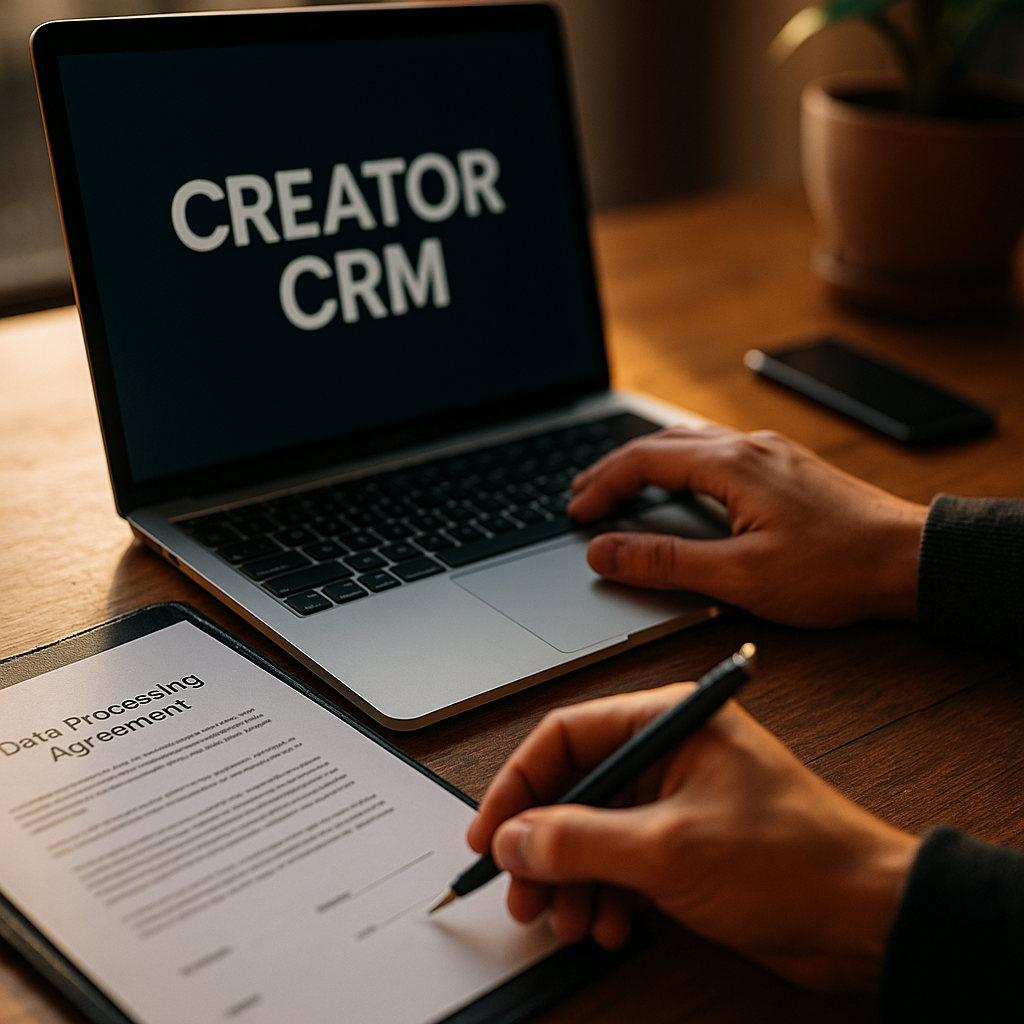
Would you hand a stranger the keys to your customer database? Because that’s effectively what happens every time a brand grants a creator CRM access for an affiliate program, a gifting campaign, or a co-branded email push, without a signed data processing agreement in place. No contract governing how that data gets stored, who can see it, or what happens when the partnership ends. Just access, and a handshake.
That gap is no longer a technicality. It’s a liability sitting in your marketing stack.
The CRM Access Nobody Documents
Here’s how it usually happens. A creator program manager needs an ambassador to see which of their referred customers actually converted. Maybe the creator needs visibility into loyalty tier status to personalize their content, or access to a shared spreadsheet exported straight from Salesforce or HubSpot. Someone shares a login. Someone else builds an integration through a tool like HubSpot‘s partner portal. Nobody loops in legal.
This isn’t rare. It’s the default operating mode for mid-market influencer programs, especially ambassador and affiliate structures where creators are treated more like sales reps than vendors. The problem is that once a creator can view customer names, emails, purchase history, or loyalty data, that creator is functionally a data processor under most privacy frameworks. And processors need a contract.
If a creator can see, export, or manipulate customer data, your brand is the data controller and the creator is a processor, whether or not anyone wrote that down.
What a Data Processing Agreement Actually Covers
A data processing agreement, or DPA, is a legal document that defines how a party handling personal data on your behalf is allowed to use it. Under UK GDPR guidance and comparable US state privacy laws, controllers (your brand) are required to have this documentation in place before sharing personal data with any processor, including a creator, an agency, or a platform vendor.
A DPA for creators is not the same as your standard influencer contract. Your ambassador agreement covers deliverables, usage rights, and payment. The DPA covers something narrower and higher-stakes: what happens to the customer data itself.
Without one, you’re exposed on three fronts. First, regulatory: state attorneys general and the FTC have both signaled increased scrutiny of how brands manage third-party data access, and “we didn’t have a contract” is not a defense. Second, contractual: if a creator misuses data and you have no DPA, you have almost no legal recourse to claw back damages. Third, reputational: a data leak traced back to an influencer’s laptop is still your brand’s headline.
Five Clauses Your Creator DPA Cannot Skip
Not every creator relationship needs a fifteen-page compliance document. But if a creator touches CRM data in any form, these five elements are non-negotiable.
- Scope of processing. Specify exactly what data the creator can access (email, purchase history, tier status) and what they’re allowed to do with it (view only, export, segment, contact directly).
- Retention and deletion. Set a hard deadline for when creator access is revoked and data is deleted after a campaign ends, ideally automated through your CRM’s permission settings rather than left to the creator’s memory.
- Sub-processor restrictions. Many creators use their own tools, a Notion board, a Google Sheet, a third-party link tracker. Your DPA needs to name or prohibit these sub-processors explicitly.
- Breach notification timeline. Require the creator to notify your brand within a set window (48 to 72 hours is standard) if they suspect any data exposure, loss, or unauthorized access.
- Audit rights. Reserve the right to request logs or documentation showing how the creator accessed or stored the data, particularly important for affiliate and loyalty programs running at scale.
None of this is exotic. It’s the same language your legal team already negotiates with SaaS vendors and outsourced call centers. Creators just haven’t historically been treated the same way, and that inconsistency is exactly what regulators are starting to flag.
Where Brands Get This Wrong
Three patterns show up repeatedly in creator programs that skip the DPA step.
The first is scale creep. A program starts with five creators and a shared spreadsheet. It grows to fifty creators across three platforms, and the access controls never get rebuilt to match. Nobody revisits the original informal setup because it “worked fine” at the smaller size.
The second is tool sprawl. Affiliate platforms, link-in-bio tools, and pixel-based attribution systems all create secondary data trails that brands don’t always map. This is closely related to the exposure covered in pixel data tracking practices, where the same “who actually controls this data” question applies to on-platform tracking as much as CRM access.
The third, and most common, is treating the DPA as a legal afterthought bolted onto a finished contract rather than a design requirement built in from day one.
A DPA drafted after a creator already has CRM login credentials is a cleanup exercise, not a protection. Sequence matters as much as substance.
Building This Into Onboarding, Not Bolting It On
The fix is operational, not just legal. Data processing terms need to be part of the standard onboarding packet for any creator who will touch customer data, sitting alongside the usage rights and disclosure language already standard in most ambassador deals. Brands that have tightened up ambassador contract language around usage rights should apply the same discipline here.
Practically, this means:
- Tiering CRM access by role, so a nano-creator running a discount code has a different data footprint than an ambassador managing a dedicated landing page.
- Using role-based permissions inside your CRM (most platforms, including Salesforce and HubSpot, support granular access controls) rather than shared logins.
- Building the DPA into your creator management platform’s contract template, so it’s signed automatically before access is provisioned, not after.
- Auditing access quarterly, especially for long-running ambassador relationships where scope tends to expand informally over time. This is a familiar pattern from long-term ambassador retainer structures, where control and classification risk both creep upward the longer a relationship runs.
There’s also a classification angle worth flagging. The more control a brand exerts over how a creator handles data, including mandated tools, required reporting formats, and audit access, the closer that relationship can drift toward an employment-like arrangement. That’s the same dynamic explored in managed creator program oversight, and it’s worth having your legal team review DPA language alongside worker classification exposure, not in isolation.
The Regulatory Backdrop Is Only Getting Stricter
State privacy laws modeled on California’s framework are expanding, and enforcement bodies are increasingly comfortable naming brands, not just platforms, in data mishandling cases. Meanwhile, affiliate and commission-based programs, already under scrutiny for tax and reporting compliance, are exactly the kind of arrangement where CRM access gets shared loosely because everyone’s focused on conversion tracking, not data governance.
Industry data from eMarketer shows affiliate and creator commerce spend continuing to climb year over year, which means more creators, more CRM touchpoints, and more surface area for a data incident. The DPA isn’t paperwork for paperwork’s sake. It’s the control that scales with the program.
None of this requires reinventing your legal stack. It requires treating creators the way you already treat every other vendor who touches customer data: with a signed agreement before access, not after.
Next step: Pull a list of every creator with active CRM or customer data access right now, and check how many have a signed DPA on file. If the number surprises you, that’s your Monday morning priority.
FAQs
What is a data processing agreement in the context of influencer marketing?
A data processing agreement is a legal contract that defines how a creator, acting as a data processor, is permitted to access, store, and use customer data on behalf of a brand, which acts as the data controller. It covers scope of access, retention periods, sub-processors, breach notification, and audit rights.
Do micro-influencers need a DPA too, or only major ambassadors?
Any creator who can view, export, or otherwise handle personal customer data needs a DPA, regardless of follower count. A nano-creator managing a discount code with visibility into customer emails carries the same data risk exposure as a major ambassador, just at a smaller scale.
What happens if a brand shares CRM access without a signed DPA?
The brand carries full liability as the data controller with no documented processor obligations in place. This creates exposure to regulatory penalties under state privacy laws, weakens any contractual recourse if the creator misuses or leaks data, and increases reputational risk if a breach is traced back to a creator relationship.
How is a data processing agreement different from a standard influencer contract?
An influencer or ambassador contract typically covers deliverables, compensation, and usage rights for content. A DPA is narrower and specifically governs personal data handling: what data the creator can access, how long they can retain it, what tools they can use to process it, and what happens to it once the campaign ends.
Should the DPA be a separate document or part of the main contract?
Either works legally, but many brands attach the DPA as a schedule or addendum to the main creator agreement so both documents are signed in the same workflow. What matters more than format is timing: the DPA needs to be executed before CRM access is granted, not after.
FAQs
What is a data processing agreement in the context of influencer marketing?
A data processing agreement is a legal contract that defines how a creator, acting as a data processor, is permitted to access, store, and use customer data on behalf of a brand, which acts as the data controller. It covers scope of access, retention periods, sub-processors, breach notification, and audit rights.
Do micro-influencers need a DPA too, or only major ambassadors?
Any creator who can view, export, or otherwise handle personal customer data needs a DPA, regardless of follower count. A nano-creator managing a discount code with visibility into customer emails carries the same data risk exposure as a major ambassador, just at a smaller scale.
What happens if a brand shares CRM access without a signed DPA?
The brand carries full liability as the data controller with no documented processor obligations in place. This creates exposure to regulatory penalties under state privacy laws, weakens any contractual recourse if the creator misuses or leaks data, and increases reputational risk if a breach is traced back to a creator relationship.
How is a data processing agreement different from a standard influencer contract?
An influencer or ambassador contract typically covers deliverables, compensation, and usage rights for content. A DPA is narrower and specifically governs personal data handling: what data the creator can access, how long they can retain it, what tools they can use to process it, and what happens to it once the campaign ends.
Should the DPA be a separate document or part of the main contract?
Either works legally, but many brands attach the DPA as a schedule or addendum to the main creator agreement so both documents are signed in the same workflow. What matters more than format is timing: the DPA needs to be executed before CRM access is granted, not after.
Top Influencer Marketing Agencies
The leading agencies shaping influencer marketing in 2026
Agencies ranked by campaign performance, client diversity, platform expertise, proven ROI, industry recognition, and client satisfaction. Assessed through verified case studies, reviews, and industry consultations.
Moburst

-
2

The Shelf
Boutique Beauty & Lifestyle Influencer AgencyA data-driven boutique agency specializing exclusively in beauty, wellness, and lifestyle influencer campaigns on Instagram and TikTok. Best for brands already focused on the beauty/personal care space that need curated, aesthetic-driven content.Clients: Pepsi, The Honest Company, Hims, Elf Cosmetics, Pure LeafVisit The Shelf → -
3

Audiencly
Niche Gaming & Esports Influencer AgencyA specialized agency focused exclusively on gaming and esports creators on YouTube, Twitch, and TikTok. Ideal if your campaign is 100% gaming-focused — from game launches to hardware and esports events.Clients: Epic Games, NordVPN, Ubisoft, Wargaming, Tencent GamesVisit Audiencly → -
4

Viral Nation
Global Influencer Marketing & Talent AgencyA dual talent management and marketing agency with proprietary brand safety tools and a global creator network spanning nano-influencers to celebrities across all major platforms.Clients: Meta, Activision Blizzard, Energizer, Aston Martin, WalmartVisit Viral Nation → -
5

The Influencer Marketing Factory
TikTok, Instagram & YouTube CampaignsA full-service agency with strong TikTok expertise, offering end-to-end campaign management from influencer discovery through performance reporting with a focus on platform-native content.Clients: Google, Snapchat, Universal Music, Bumble, YelpVisit TIMF → -
6

NeoReach
Enterprise Analytics & Influencer CampaignsAn enterprise-focused agency combining managed campaigns with a powerful self-service data platform for influencer search, audience analytics, and attribution modeling.Clients: Amazon, Airbnb, Netflix, Honda, The New York TimesVisit NeoReach → -
7

Ubiquitous
Creator-First Marketing PlatformA tech-driven platform combining self-service tools with managed campaign options, emphasizing speed and scalability for brands managing multiple influencer relationships.Clients: Lyft, Disney, Target, American Eagle, NetflixVisit Ubiquitous → -
8

Obviously
Scalable Enterprise Influencer CampaignsA tech-enabled agency built for high-volume campaigns, coordinating hundreds of creators simultaneously with end-to-end logistics, content rights management, and product seeding.Clients: Google, Ulta Beauty, Converse, AmazonVisit Obviously →