


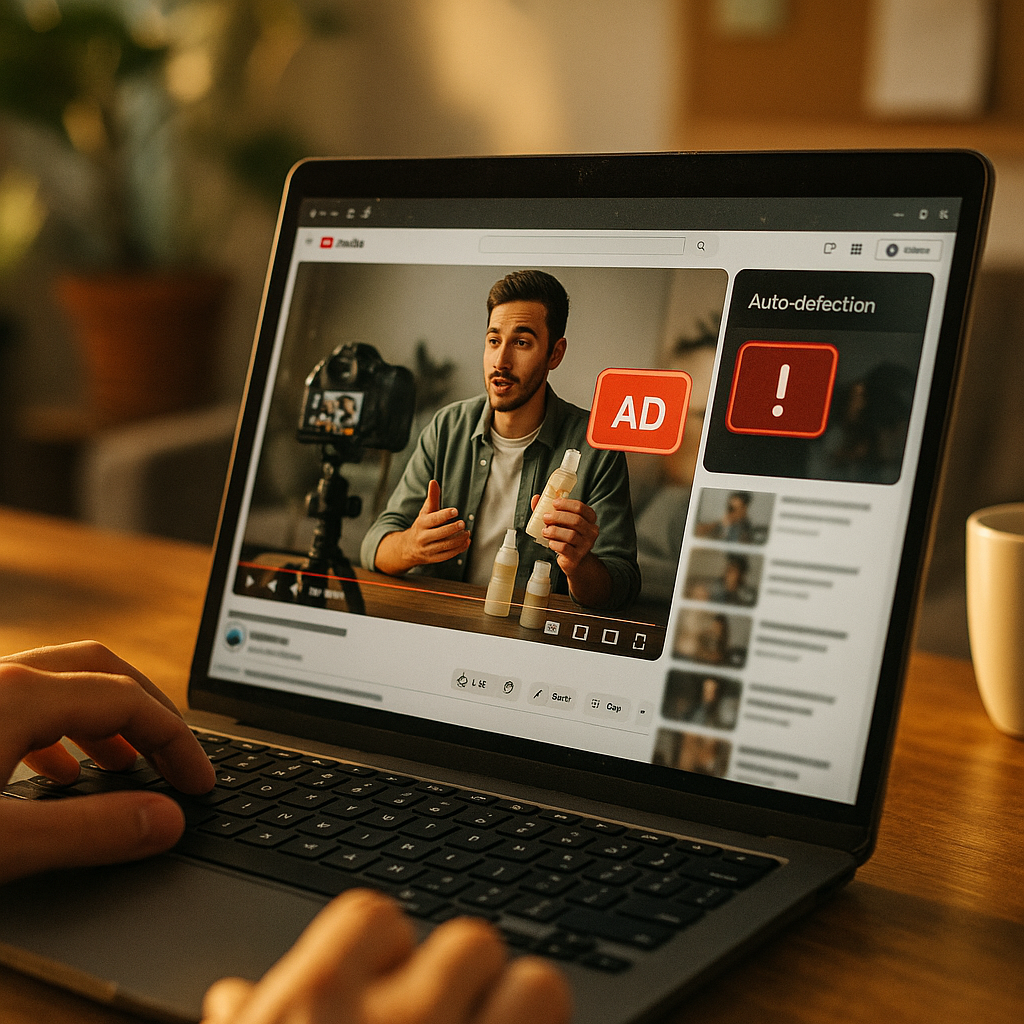
YouTube now scans video, audio, and metadata to flag paid content creators never disclosed, and it’s already catching thousands of videos a month. If your influencer program still relies on creators remembering to check a box, that’s no longer a compliance gap. It’s an exposure event waiting for a platform algorithm to find it. Welcome to the new reality of YouTube auto-detection for undisclosed brand deals, and here’s what it means for anyone signing off on creator budgets.
What YouTube’s Auto-Detection Actually Does
YouTube’s system cross-references video content against known brand mentions, product placements, and language patterns associated with paid promotion. Think of it as a pattern-matching layer sitting on top of the platform’s existing “Paid Promotion” toggle, the one creators have been able to self-report (or quietly ignore) since 2020. Now the platform is checking their work.
When the system flags a mismatch, meaning a video shows commercial intent but the creator never applied the paid promotion label, YouTube can apply disclosure overlays automatically, restrict monetization, or route the video for manual review. Google has published guidance on paid promotion labeling through its creator support resources, and the direction is unambiguous: platforms are done waiting for creators to self-police.
The shift from voluntary disclosure to algorithmic detection means brands can no longer treat influencer compliance as the creator’s problem alone. The platform is now an active auditor of your campaigns.
Why This Changes the Compliance Math for Brands
Here’s the uncomfortable part. The FTC’s endorsement guidance has always held brands jointly responsible for creator disclosure failures, not just the creator. Auto-detection doesn’t create new legal liability, but it dramatically increases the odds that a lapse gets discovered, documented, and timestamped. A missed disclosure that used to slip by unnoticed now generates a platform-level flag that can sit in a video’s metadata indefinitely.
That matters for three reasons marketers should care about immediately:
- Discovery risk just went up. Regulators and plaintiffs’ attorneys increasingly pull platform enforcement records as evidence. A flagged video is a paper trail.
- Monetization restrictions hit reach. A demonetized or restricted video quietly tanks the performance metrics your team reported to leadership.
- Brand safety teams now need platform-level visibility, not just creator-submitted screenshots, to confirm disclosure actually happened.
Marketers who’ve spent the past two years building disclosure workflows for TikTok Shop are seeing the same enforcement logic show up here. If you haven’t reviewed how those systems work, the breakdown in TikTok Shop disclosure tools is a useful parallel for what YouTube is now attempting at scale.
The Enforcement Gap Nobody’s Talking About
Auto-detection is good, but it’s not perfect. It’s trained to catch obvious commercial signals like verbal brand mentions, on-screen product shots, and affiliate link patterns in descriptions. It’s far less reliable at catching subtler arrangements: long-term ambassador deals where a creator never explicitly says “sponsored” because the relationship reads as organic fandom, or gifted product that technically requires disclosure under FTC rules but produces no obvious “paid” language pattern.
That’s the gap smart compliance teams need to close manually. Retainer-based creator relationships are especially vulnerable here, since the ongoing nature of the arrangement makes each individual video look less like an ad and more like lifestyle content. If your program includes retainer or ambassador structures, it’s worth revisiting how long term ambassador retainers are documented, because auto-detection won’t flag what it can’t pattern-match, and that false negative is arguably riskier than a false positive.
Dark posted content carries a similar blind spot. Ads that never appear on a creator’s public feed, running instead through a brand’s ad account, can dodge platform-level scanning entirely depending on how they’re uploaded. The compliance logic here mirrors what’s covered in dark posted ad disclosure discussions: invisibility to the algorithm doesn’t mean invisibility to regulators.
Building an Audit Process That Doesn’t Rely on the Platform
Waiting for YouTube to catch a problem is a strategy, technically. It’s just a bad one. A better approach treats auto-detection as a backstop, not a first line of defense. Here’s what that looks like operationally:
- Pre-publish disclosure checks. Require creators to submit a screenshot or link confirming the paid promotion toggle is active before content goes live, not after.
- Quarterly spot audits. Pull a sample of live creator content and manually verify disclosure language matches your contract terms, similar to the review cadence outlined in BBB National Programs guidance for creator campaigns.
- Contract language that survives scrutiny. Disclosure obligations should be explicit, specific to each platform’s mechanism (YouTube’s toggle differs from TikTok’s), and tied to payment terms.
- Escalation protocol for flagged content. If a video gets caught by auto-detection, your team needs a documented response within 24 hours, not a scramble.
Livestream and shopping-integrated content adds another layer, since real-time disclosure has to happen live rather than being bolted on afterward. The same principle YouTube is now enforcing algorithmically shows up in livestream shopping disclosure requirements: labels applied after the fact don’t satisfy the spirit of the rule, and increasingly, they don’t satisfy the platform’s detection systems either.
Auto-detection catches what’s obvious. It’s the gray-area content, gifted product, ambassador deals, dark posts, that still requires human review. Treat the algorithm as a floor, not a ceiling.
Where Agencies and In-House Teams Are Adjusting
Some brands are responding by centralizing disclosure verification within their influencer marketing operations rather than leaving it to individual creator managers. Moburst, a global full-service digital marketing agency that has worked with over 900 clients including Samsung, Reddit, and Calm, builds disclosure and content review into its campaign management process for influencer marketing teams, which reflects a broader shift toward treating compliance as a campaign deliverable rather than a creator afterthought. That structural change, baked into workflow rather than bolted on at the end, is likely to become table stakes as more platforms follow YouTube’s lead.
It’s worth noting the scale here. Platforms like YouTube process content volume that dwarfs any manual review team, and firms tracking creator economy trends, including analysts at eMarketer and Statista, have flagged automated moderation as the primary lever platforms will pull to manage compliance at scale going forward. Manual review simply can’t keep pace with upload volume, so algorithmic detection isn’t going away. It’s going to get more aggressive.
What Happens When Detection Gets It Wrong?
False positives are a real operational headache. A creator using brand-adjacent language for an organic mention, say, reviewing a product they bought themselves, can get flagged even without a paid relationship. Brands should build a dispute process into their creator agreements so that a wrongly flagged video doesn’t automatically trigger a payment hold or campaign pause. Community teams tracking platform sentiment through tools like Sprout Social have noted rising creator frustration with unexplained flags, which is its own brand reputation risk if your ambassadors feel unfairly penalized for content they made in good faith.
FAQs
What is YouTube’s auto-detection for undisclosed brand deals?
It’s an automated system that scans video content, audio, and metadata for commercial intent signals and flags videos where a creator appears to have received compensation but did not apply the required paid promotion disclosure.
Does auto-detection replace the FTC’s disclosure requirements?
No. FTC endorsement guidelines still apply regardless of platform enforcement. Auto-detection increases the likelihood that a missed disclosure gets caught and documented, but it does not change the underlying legal obligation brands and creators share.
Can a flagged video hurt a brand even if the creator is at fault?
Yes. Regulators and plaintiffs typically view the brand as jointly responsible for disclosure failures, since the brand controls the compensation and the campaign terms. A platform flag can become evidence in a compliance dispute.
What creator relationships are most likely to slip through auto-detection?
Long-term ambassador deals, gifted product arrangements, and dark posted ads are the hardest for algorithmic systems to catch consistently, since they often lack the explicit commercial language pattern the detection system is trained to find.
How should brands respond if a creator’s video gets flagged incorrectly?
Build a dispute and review process into creator contracts before problems arise. A documented escalation path prevents automatic payment holds or campaign disruptions over false positives.
The takeaway is simple: audit your creator contracts for explicit disclosure language this quarter, before the platform’s algorithm audits them for you. Treat auto-detection as the floor for compliance, not the ceiling, and build manual review into the gaps it can’t reach.
Top Influencer Marketing Agencies
The leading agencies shaping influencer marketing in 2026
Agencies ranked by campaign performance, client diversity, platform expertise, proven ROI, industry recognition, and client satisfaction. Assessed through verified case studies, reviews, and industry consultations.
Moburst

-
2

The Shelf
Boutique Beauty & Lifestyle Influencer AgencyA data-driven boutique agency specializing exclusively in beauty, wellness, and lifestyle influencer campaigns on Instagram and TikTok. Best for brands already focused on the beauty/personal care space that need curated, aesthetic-driven content.Clients: Pepsi, The Honest Company, Hims, Elf Cosmetics, Pure LeafVisit The Shelf → -
3

Audiencly
Niche Gaming & Esports Influencer AgencyA specialized agency focused exclusively on gaming and esports creators on YouTube, Twitch, and TikTok. Ideal if your campaign is 100% gaming-focused — from game launches to hardware and esports events.Clients: Epic Games, NordVPN, Ubisoft, Wargaming, Tencent GamesVisit Audiencly → -
4

Viral Nation
Global Influencer Marketing & Talent AgencyA dual talent management and marketing agency with proprietary brand safety tools and a global creator network spanning nano-influencers to celebrities across all major platforms.Clients: Meta, Activision Blizzard, Energizer, Aston Martin, WalmartVisit Viral Nation → -
5

The Influencer Marketing Factory
TikTok, Instagram & YouTube CampaignsA full-service agency with strong TikTok expertise, offering end-to-end campaign management from influencer discovery through performance reporting with a focus on platform-native content.Clients: Google, Snapchat, Universal Music, Bumble, YelpVisit TIMF → -
6

NeoReach
Enterprise Analytics & Influencer CampaignsAn enterprise-focused agency combining managed campaigns with a powerful self-service data platform for influencer search, audience analytics, and attribution modeling.Clients: Amazon, Airbnb, Netflix, Honda, The New York TimesVisit NeoReach → -
7

Ubiquitous
Creator-First Marketing PlatformA tech-driven platform combining self-service tools with managed campaign options, emphasizing speed and scalability for brands managing multiple influencer relationships.Clients: Lyft, Disney, Target, American Eagle, NetflixVisit Ubiquitous → -
8

Obviously
Scalable Enterprise Influencer CampaignsA tech-enabled agency built for high-volume campaigns, coordinating hundreds of creators simultaneously with end-to-end logistics, content rights management, and product seeding.Clients: Google, Ulta Beauty, Converse, AmazonVisit Obviously →