


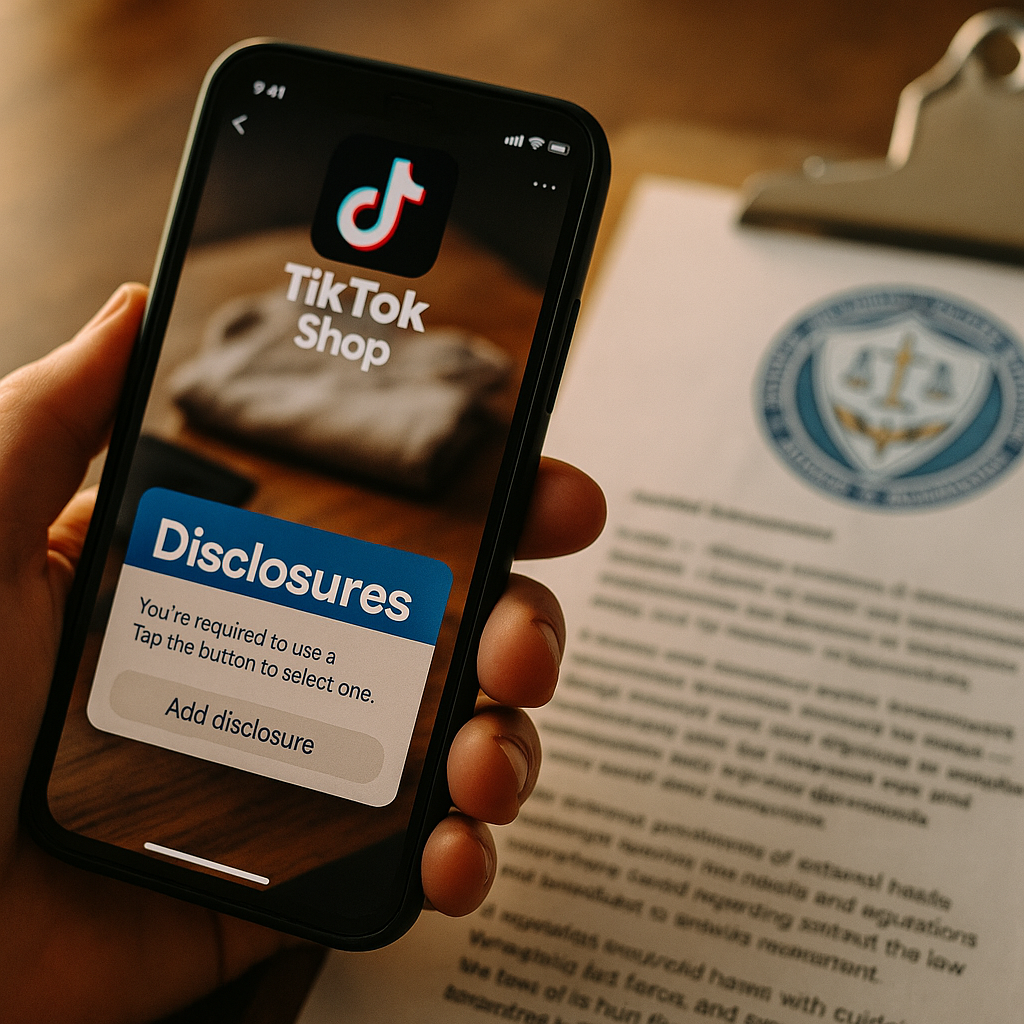
Only 24% of sponsored TikTok Shop content correctly discloses material connections when creators rely solely on the platform’s built-in tools, according to compliance audits circulating among agency legal teams. That gap should terrify any brand treating TikTok Shop’s automated disclosure feature as a compliance checkbox. It isn’t one. It was never designed to be.
The Feature Brands Think Protects Them
TikTok Shop’s “Paid Partnership” label and its automated affiliate disclosure toggle feel like a gift to compliance teams. Flip a switch, tag a brand, done. No more chasing creators to write “#ad” in the first three lines of a caption. No more manual audits of hundreds of livestream clips.
Except the FTC doesn’t grade on effort. It grades on whether the average consumer, scrolling at 1.5x speed with sound off, actually understood they were looking at an ad. TikTok’s tool solves a labeling problem. The FTC’s Endorsement Guides require a disclosure problem to be solved: clear, conspicuous, unavoidable.
Where Automated Labels Fall Short of “Clear and Conspicuous”
Three structural issues keep surfacing in enforcement discussions and agency post-mortems.
- Placement is platform-controlled, not context-aware. The Paid Partnership badge appears in a fixed location, often small, often gray-on-gray, regardless of video content, background color, or whether the creator is mid-demo covering that corner of the screen.
- Livestream is the biggest blind spot. A static label shown once at stream start doesn’t persist through a 90-minute session where viewers join mid-way. Someone who taps into a livestream at minute 40 never saw the disclosure at all. We covered this exact failure mode in live shopping disclosure placement standards, and the pattern repeats constantly in TikTok Shop’s live sales format.
- Affiliate links get weaker treatment than paid partnerships. TikTok’s system distinguishes between brand-sponsored content and creator-initiated affiliate posts, but the FTC doesn’t care about that internal taxonomy. A commission is a material connection either way. Dark posted ads compound this because the automated label frequently doesn’t carry over when content gets repurposed into paid media.
An automated badge tells the algorithm this is commercial content. It does not tell a human viewer, in a way they’ll actually notice, that money changed hands. Those are two very different compliance standards, and only one of them satisfies the FTC.
What the FTC Actually Requires (And Why “TikTok Said It’s Fine” Isn’t a Defense)
The Endorsement Guides don’t mention TikTok, Instagram, or any specific platform tool. They set a standard: disclosures must be unavoidable, in language ordinary consumers understand, and not buried, hashtag-stuffed, or dependent on a “see more” click. TikTok’s automated label satisfies none of these criteria by default. It can, if creators layer verbal disclosure on top, but the tool alone doesn’t force that behavior.
This matters because liability doesn’t stop at the creator. FTC enforcement actions have repeatedly named brands and agencies alongside creators, treating the brand’s compliance program (or absence of one) as evidence of intent. Relying on a platform default, without a documented review process, reads to regulators as willful blindness rather than good faith effort.
Compare this to how BBB National Programs approaches disclosure review: manual, contextual, checked against actual viewer experience, not platform metadata. That’s the bar. TikTok’s tool doesn’t clear it alone.
The Affiliate Link Problem Nobody’s Solving
TikTok Shop’s affiliate program generates enormous volume, and volume is exactly where automated disclosure tools break down fastest. A creator running fifty affiliate links across a week of content isn’t manually verifying disclosure language on each post. They’re relying on the platform’s default tagging, which flags the post as shoppable content, not necessarily as sponsored or compensated content in FTC-compliant terms.
Brands running large-scale affiliate programs need audit trails, not trust in defaults. If you’re managing commission structures at volume, the reporting gap runs deeper than disclosure alone. Our coverage of creator affiliate commission reporting shows how disclosure failures and tax reporting failures often originate from the same root cause: nobody owns the compliance layer once volume scales past manual review capacity.
Livestream Shopping: The Format Where This Breaks Hardest
Static posts are relatively easy. A badge, a caption line, done. Livestream shopping on TikTok Shop is a different animal entirely, and it’s also where TikTok is pushing the most commerce volume.
Viewers drift in and out. Products get tagged and untagged in real time. A single stream might feature a dozen different brand partnerships, each with different disclosure obligations, and the automated on-screen label doesn’t refresh or repeat with the frequency the FTC would consider “conspicuous” for a viewer who just joined. We’ve documented this exact failure pattern in real-time livestream disclosure analysis, and the fix isn’t a better badge. It’s verbal disclosure repeated at intervals, something no automated tool currently enforces.
TikTok Shop live sales carry another wrinkle brands underestimate: they can trigger state tax nexus obligations independent of disclosure compliance entirely, a separate risk layer covered in TikTok Shop live sales tax nexus reporting. Disclosure and tax exposure aren’t related legally, but operationally they surface from the same unmanaged livestream program.
What a Real Compliance Layer Looks Like
None of this means brands should abandon TikTok’s tools. Use them. They’re a floor, not a ceiling. Build on top of them.
- Contractual disclosure language, not platform defaults. Every creator agreement should specify exact disclosure wording and placement, independent of whatever TikTok’s tool does automatically.
- Manual spot-checks on a rolling sample. Pick 10-15% of live content weekly and actually watch it as a consumer would, sound on, full speed.
- Verbal disclosure requirements for livestream. Contractually require creators to state the partnership aloud at stream start and at regular intervals, not just rely on the badge.
- Document the review process itself. Regulators care as much about process as outcome. A dated compliance log matters if an FTC inquiry ever lands.
Brands running managed creator programs at scale should also look at how control over content and disclosure enforcement intersects with worker classification risk. Heavy-handed disclosure mandates can shift a creator relationship closer to employee territory, a tension explored in managed creator program structures. Compliance and classification risk aren’t separate conversations anymore.
Industry benchmarking from eMarketer and platform-side guidance from TikTok’s advertising resources are useful starting points, but neither substitutes for a brand-specific compliance workflow reviewed by counsel familiar with current FTC enforcement priorities.
The Bottom Line on Automation and Liability
Automated tools scale labeling. They don’t scale judgment. The FTC’s standard has always been about what the consumer actually perceives, not what metadata sits behind the post. TikTok Shop’s tools are a convenience layer, useful for consistency, terrible as a legal shield.
Frequently Asked Questions
Does TikTok Shop’s automated disclosure label meet FTC requirements on its own?
Not reliably. The FTC requires disclosures to be clear, conspicuous, and unavoidable to an average consumer. TikTok’s automated badge can be small, easy to miss, or absent during mid-stream joins in livestream formats, which falls short of that standard without additional verbal or contextual disclosure.
Are brands liable if a creator relies only on TikTok’s built-in tools and gets it wrong?
Yes. FTC enforcement has repeatedly named brands and agencies alongside creators. Relying solely on a platform default without a documented compliance review process can be treated as evidence of insufficient oversight.
Does the affiliate link disclosure requirement differ from paid partnership disclosure?
Legally, no. Any material connection, whether a flat sponsorship fee or an affiliate commission, requires disclosure under the FTC Endorsement Guides. TikTok’s platform may treat these categories differently for tagging purposes, but that distinction has no bearing on FTC obligations.
What’s the biggest disclosure risk specific to TikTok Shop livestreams?
Viewers joining mid-stream never see an opening disclosure, and static on-screen badges don’t repeat frequently enough to count as conspicuous for late arrivals. Verbal disclosure repeated at intervals is the more defensible practice.
How often should brands audit creator disclosure compliance on TikTok Shop?
A rolling weekly sample of 10 to 15 percent of live content, reviewed as an actual consumer would experience it, is a reasonable baseline for most mid-size to large creator programs.
Top Influencer Marketing Agencies
The leading agencies shaping influencer marketing in 2026
Agencies ranked by campaign performance, client diversity, platform expertise, proven ROI, industry recognition, and client satisfaction. Assessed through verified case studies, reviews, and industry consultations.
Moburst

-
2

The Shelf
Boutique Beauty & Lifestyle Influencer AgencyA data-driven boutique agency specializing exclusively in beauty, wellness, and lifestyle influencer campaigns on Instagram and TikTok. Best for brands already focused on the beauty/personal care space that need curated, aesthetic-driven content.Clients: Pepsi, The Honest Company, Hims, Elf Cosmetics, Pure LeafVisit The Shelf → -
3

Audiencly
Niche Gaming & Esports Influencer AgencyA specialized agency focused exclusively on gaming and esports creators on YouTube, Twitch, and TikTok. Ideal if your campaign is 100% gaming-focused — from game launches to hardware and esports events.Clients: Epic Games, NordVPN, Ubisoft, Wargaming, Tencent GamesVisit Audiencly → -
4

Viral Nation
Global Influencer Marketing & Talent AgencyA dual talent management and marketing agency with proprietary brand safety tools and a global creator network spanning nano-influencers to celebrities across all major platforms.Clients: Meta, Activision Blizzard, Energizer, Aston Martin, WalmartVisit Viral Nation → -
5

The Influencer Marketing Factory
TikTok, Instagram & YouTube CampaignsA full-service agency with strong TikTok expertise, offering end-to-end campaign management from influencer discovery through performance reporting with a focus on platform-native content.Clients: Google, Snapchat, Universal Music, Bumble, YelpVisit TIMF → -
6

NeoReach
Enterprise Analytics & Influencer CampaignsAn enterprise-focused agency combining managed campaigns with a powerful self-service data platform for influencer search, audience analytics, and attribution modeling.Clients: Amazon, Airbnb, Netflix, Honda, The New York TimesVisit NeoReach → -
7

Ubiquitous
Creator-First Marketing PlatformA tech-driven platform combining self-service tools with managed campaign options, emphasizing speed and scalability for brands managing multiple influencer relationships.Clients: Lyft, Disney, Target, American Eagle, NetflixVisit Ubiquitous → -
8

Obviously
Scalable Enterprise Influencer CampaignsA tech-enabled agency built for high-volume campaigns, coordinating hundreds of creators simultaneously with end-to-end logistics, content rights management, and product seeding.Clients: Google, Ulta Beauty, Converse, AmazonVisit Obviously →