


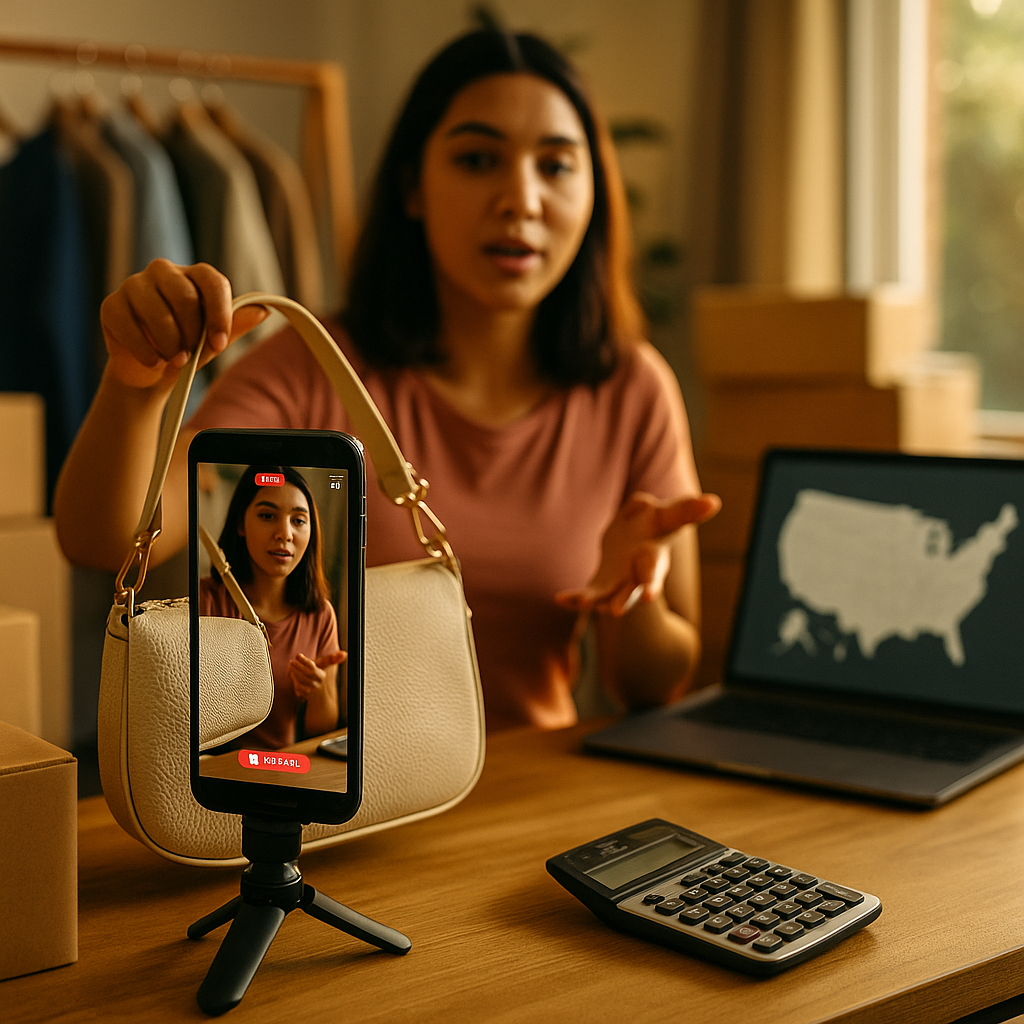
Forty six states now claim economic nexus rights over remote sellers, and TikTok Shop’s live commerce boom is quietly pulling brands into tax jurisdictions they’ve never registered in. One flash sale, one viral livestream, one creator hitting six figures in GMV overnight, and suddenly a brand has a filing obligation in a state it never planned to operate in. State sales tax exposure in TikTok Shop live commerce transactions is the compliance headache nobody budgeted for, and finance teams are finding out the hard way.
Why Live Commerce Breaks the Old Tax Playbook
Traditional ecommerce tax compliance assumed a relatively stable pattern: a brand sells through its own site or a handful of marketplaces, tracks order volume by state, and registers once it crosses each state’s economic nexus threshold (usually $100,000 in sales or 200 transactions annually). That model was built for predictable, channel-controlled selling.
Live commerce doesn’t play by those rules. A single TikTok Shop livestream can generate more revenue in ninety minutes than a brand’s entire quarter on its own DTC site, and that revenue can land disproportionately in one or two states depending on who’s watching, who shares the stream, and which creator’s audience shows up. Nexus thresholds that used to take a year to trigger can now trigger in a weekend.
Add to that the sheer volume of SKUs moving through affiliate and creator-led shopping carts, and you’ve got a reconciliation nightmare. Most finance teams are still mapping tax exposure by channel (Shopify, Amazon, retail), not by creator or livestream event. That gap is exactly where liability accumulates unnoticed.
A brand can cross economic nexus thresholds in a new state during a single viral TikTok Shop livestream, long before its finance team even knows the sale happened.
Who Actually Collects the Tax on a TikTok Shop Sale?
This is the question that trips up most brand operators. TikTok Shop functions as a marketplace facilitator in the U.S., which means the platform is generally responsible for calculating, collecting, and remitting sales tax on transactions that flow through its checkout. That sounds like it solves the problem. It doesn’t, not entirely.
Marketplace facilitator laws vary by state, and they typically cover sales tax collection on the transaction itself. They don’t necessarily shield the brand from other tax obligations tied to physical presence, inventory storage, or affiliate nexus rules that some states still enforce independently. If a brand stores inventory in a third party fulfillment center located in a state with strict nexus rules, or runs paid creator partnerships that count as in state agents under an older affiliate nexus statute, the marketplace facilitator collection doesn’t necessarily erase that separate exposure.
There’s also the question of non marketplace sales. Brands running live commerce across TikTok Shop, their own Shopify store, and Amazon simultaneously often assume the platform handles it all. It doesn’t. Every channel outside the marketplace facilitator umbrella still needs its own nexus tracking, registration, and remittance process.
Where Brands Get Caught Off Guard
- Fulfillment center nexus: Storing inventory in a third party warehouse (including TikTok Shop’s own fulfillment partners) can create physical nexus independent of sales volume.
- Affiliate and click through nexus: A handful of states still apply affiliate nexus rules to in state creators or influencers who drive traffic for commission, even on marketplace facilitated platforms.
- Product taxability mismatches: Clothing, food, supplements, and digital goods are taxed differently state to state. A single SKU can be exempt in one state and fully taxable in another, and TikTok Shop’s tax engine doesn’t always reflect brand specific product classifications accurately.
- Multi channel blending: Finance teams reconciling TikTok Shop GMV with direct site sales sometimes double count or under count taxable revenue when pulling from disconnected reporting dashboards.
The Live Commerce Volume Problem
Live commerce isn’t just fast, it’s lumpy. Sales cluster around specific creators, specific drops, specific moments of virality. That clustering matters for tax purposes because economic nexus thresholds are cumulative and state specific. A brand might sit comfortably under every state’s threshold for months, then blow past three or four thresholds in a single week because a mid tier creator’s livestream got picked up by TikTok’s algorithm and reached an unexpected regional audience.
According to eMarketer, live commerce in the U.S. has grown from a niche experiment to a meaningful share of social commerce revenue, and TikTok Shop is driving much of that growth through creator led livestreams rather than brand owned broadcasts. That creator dependency is exactly what makes tax exposure harder to forecast. Brands don’t control when a stream goes viral, and they often don’t have real time visibility into which states are driving the spike until well after the fact.
This is where the operational risk compounds the tax risk. Compliance teams already dealing with live shopping disclosure requirements now have to layer tax nexus monitoring on top of FTC compliance, creator contract review, and payout reconciliation. It’s a lot to track in real time during a fast moving livestream event.
Product Taxability Is Its Own Minefield
Sales tax rates get most of the attention, but taxability classification is where brands actually lose money on audit. Apparel is exempt from sales tax in a handful of states below certain price thresholds. Supplements and food products are taxed inconsistently depending on whether they’re classified as grocery items or specialty goods. Digital products, bundled offers, and limited edition collabs often don’t fit cleanly into any existing tax category, and TikTok Shop’s default tax settings apply broad classifications that may not match a brand’s actual product mix.
When a brand runs a livestream bundling a physical product with a digital add on (a recipe guide, an app subscription, a virtual meet and greet), the combined transaction can trigger different tax treatment than either item would individually. Most brands never audit this at the SKU level until a state tax authority does it for them.
Building a Real Nexus Monitoring Process
Waiting for a state notice is the most expensive way to discover exposure. Penalties, interest, and back taxes accumulate fast, and some states allow lookback periods of three to four years once nexus is established retroactively. A proactive process beats a reactive scramble every time.
- Centralize sales data across channels. Pull TikTok Shop GMV, direct site sales, and marketplace sales into a single dashboard broken out by ship to state, not just total revenue.
- Set threshold alerts, not annual reviews. Economic nexus can trigger mid quarter now. Monthly or even weekly threshold checks are more realistic given live commerce volatility.
- Audit product taxability by state at least twice a year. Product mix changes, promotional bundles, and new SKUs all shift taxability classifications.
- Clarify fulfillment center locations in writing. Know exactly where TikTok Shop and any third party logistics partners are storing inventory, and confirm whether that creates independent physical nexus.
- Loop tax counsel into creator contract review. Affiliate nexus clauses, commission structures, and in state creator activity should be reviewed alongside the FTC and IP language legal teams already scrutinize.
States with lookback periods can assess three to four years of back taxes once nexus is established, which means a single overlooked livestream today can generate a five figure liability years later.
Most tools built for this problem (HubSpot for CRM level revenue tracking, dedicated sales tax automation platforms for nexus calculation) weren’t designed with live commerce’s transaction velocity in mind. Brands running heavy TikTok Shop programs increasingly need a tax automation layer that ingests marketplace data feeds directly rather than relying on manual monthly exports.
Where This Intersects With Broader Compliance Risk
Tax exposure rarely travels alone. Brands dealing with sloppy nexus tracking often have similarly loose processes around creator payment structures, and that overlap creates compounding risk. The same operational gaps that let sales tax exposure slip through often show up in creator payment classification issues and inconsistent storefront data reconciliation. If finance, legal, and marketing teams aren’t sharing a unified view of TikTok Shop transaction data, tax exposure is just one of several blind spots.
Cross border programs add another layer. Brands running TikTok Shop internationally alongside U.S. operations should also review how cross border payout withholding rules interact with domestic sales tax obligations, since the two are often managed by entirely different teams that rarely compare notes.
For official guidance on marketplace facilitator obligations and consumer protection expectations around live shopping, the Federal Trade Commission remains the primary federal reference point, though state departments of revenue are where the actual tax enforcement happens.
Frequently Asked Questions
Does TikTok Shop collect sales tax automatically on every transaction?
TikTok Shop generally acts as a marketplace facilitator in the U.S. and collects sales tax on transactions processed through its checkout in most states. However, this doesn’t cover every tax obligation a brand might have, including nexus created by inventory storage or affiliate relationships outside the platform.
Can a single viral livestream create sales tax nexus in a new state?
Yes. Economic nexus thresholds are cumulative and state specific, and a large spike in sales from one livestream can push a brand over a state’s threshold well before the end of the measurement period, sometimes within days.
Do brands still need to register for sales tax if TikTok Shop collects it?
In many states, marketplace facilitator collection satisfies the transaction level tax obligation, but brands may still need to register if they have independent nexus through warehousing, affiliate activity, or non marketplace sales channels.
How far back can states audit for unpaid sales tax?
Lookback periods vary by state, but three to four years is common once nexus is established. Some states allow longer lookback periods in cases of unregistered sellers with clear nexus indicators.
What’s the biggest mistake brands make with TikTok Shop tax compliance?
Assuming the platform handles everything. Product taxability classification, fulfillment center nexus, and multi channel sales reconciliation all fall outside marketplace facilitator collection and require separate brand level monitoring.
The brands that avoid nasty state tax notices are the ones treating TikTok Shop like a separate revenue channel requiring its own nexus tracking, not an extension of their existing ecommerce tax setup. Get finance, legal, and marketing looking at the same live commerce data before the next viral stream, not after the audit letter arrives.
Top Influencer Marketing Agencies
The leading agencies shaping influencer marketing in 2026
Agencies ranked by campaign performance, client diversity, platform expertise, proven ROI, industry recognition, and client satisfaction. Assessed through verified case studies, reviews, and industry consultations.
Moburst

-
2

The Shelf
Boutique Beauty & Lifestyle Influencer AgencyA data-driven boutique agency specializing exclusively in beauty, wellness, and lifestyle influencer campaigns on Instagram and TikTok. Best for brands already focused on the beauty/personal care space that need curated, aesthetic-driven content.Clients: Pepsi, The Honest Company, Hims, Elf Cosmetics, Pure LeafVisit The Shelf → -
3

Audiencly
Niche Gaming & Esports Influencer AgencyA specialized agency focused exclusively on gaming and esports creators on YouTube, Twitch, and TikTok. Ideal if your campaign is 100% gaming-focused — from game launches to hardware and esports events.Clients: Epic Games, NordVPN, Ubisoft, Wargaming, Tencent GamesVisit Audiencly → -
4

Viral Nation
Global Influencer Marketing & Talent AgencyA dual talent management and marketing agency with proprietary brand safety tools and a global creator network spanning nano-influencers to celebrities across all major platforms.Clients: Meta, Activision Blizzard, Energizer, Aston Martin, WalmartVisit Viral Nation → -
5

The Influencer Marketing Factory
TikTok, Instagram & YouTube CampaignsA full-service agency with strong TikTok expertise, offering end-to-end campaign management from influencer discovery through performance reporting with a focus on platform-native content.Clients: Google, Snapchat, Universal Music, Bumble, YelpVisit TIMF → -
6

NeoReach
Enterprise Analytics & Influencer CampaignsAn enterprise-focused agency combining managed campaigns with a powerful self-service data platform for influencer search, audience analytics, and attribution modeling.Clients: Amazon, Airbnb, Netflix, Honda, The New York TimesVisit NeoReach → -
7

Ubiquitous
Creator-First Marketing PlatformA tech-driven platform combining self-service tools with managed campaign options, emphasizing speed and scalability for brands managing multiple influencer relationships.Clients: Lyft, Disney, Target, American Eagle, NetflixVisit Ubiquitous → -
8

Obviously
Scalable Enterprise Influencer CampaignsA tech-enabled agency built for high-volume campaigns, coordinating hundreds of creators simultaneously with end-to-end logistics, content rights management, and product seeding.Clients: Google, Ulta Beauty, Converse, AmazonVisit Obviously →