


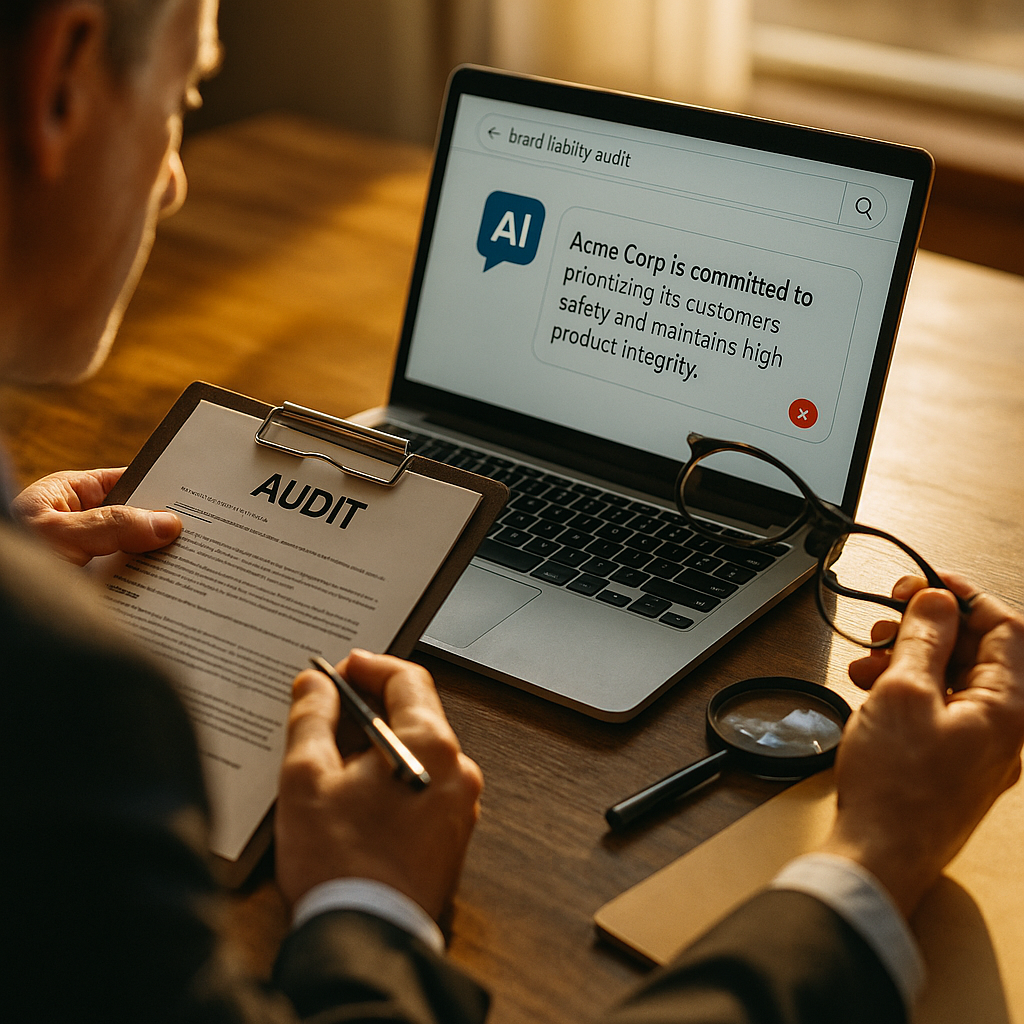
Ask ChatGPT who makes the “best” running shoe and it might confidently name a brand that never paid for that claim, never verified it, and never agreed to be quoted that way. A recent Statista-backed survey on generative AI adoption found more than half of consumers now use AI answer engines for product research before they hit a search engine. That shift has created a new liability category most legal and marketing teams haven’t budgeted for: AI answer engine misattribution.
What Is AI Answer Engine Misattribution, Exactly?
It’s what happens when tools like ChatGPT, Perplexity, Gemini, or Google’s AI Overviews attribute a claim, quote, review, or endorsement to your brand that you never made, never approved, or actively contradict. Sometimes it’s benign, a summary that slightly overstates a product benefit. Sometimes it’s not: a synthesized “review” that invents a health claim, a fabricated executive quote, or a competitor’s data point wrongly credited to you.
This isn’t hypothetical anymore. Journalists have documented AI models attributing quotes to publications that never ran the story. Brands have found chatbots citing pricing, guarantees, or ingredient claims lifted from outdated pages, discontinued products, or a competitor entirely. The model doesn’t know it’s wrong. It just sounds confident.
Why This Is Different From a Bad Google Snippet
Featured snippets pull directly from a page and link to the source. Generative answer engines synthesize across dozens of sources, blend them, and often skip the link entirely. There’s no click-through to correct the record, no easy way for a consumer to verify where the claim came from. The brand becomes the presumed source of record whether or not it said any of it.
If an AI answer engine tells a consumer your product “cures” something, prevents something, or was “recommended by doctors,” and you never made that claim, you’re still the name attached to it in the transcript. Regulators don’t care that a language model wrote the sentence.
Why GEO Made This Everyone’s Problem
Generative Engine Optimization (GEO) exists because brands want to show up favorably when AI tools answer questions about their category. Fair enough, that’s the new SEO. But the same optimization tactics that get you cited also increase your exposure to being misquoted. The more structured data, FAQ schema, and citation-friendly content you publish, the more raw material these models have to remix, sometimes accurately, sometimes not.
Add to that the fact that most brands have zero monitoring in place for how they’re being represented inside AI-generated answers. Marketing teams track share of voice on social, sentiment on review sites, and rankings on Google. Almost nobody has a process for auditing what ChatGPT says about them on a rolling basis. That gap is the whole problem.
The Liability Stack: Four Ways Misattribution Bites Brands
- FTC exposure. If an answer engine attributes an unsubstantiated claim to your brand and you don’t correct it, disclose it, or push back, you can inherit deceptive advertising risk under FTC guidance on endorsements and claims, even if you never wrote the sentence yourself.
- Defamation and false light. Misattributed quotes, especially ones invented wholesale and credited to a spokesperson, can expose you to reputational harm claims from the person supposedly quoted, and expose your brand if you amplify or fail to correct it.
- Competitive misattribution. Your competitor’s product spec, pricing, or claim gets credited to you (or vice versa). Consumers make purchase decisions on bad information, and you’re left explaining a discrepancy you didn’t create.
- Contractual spillover. If a creator partnership, ambassador quote, or influencer testimonial gets scraped, paraphrased, and reattributed by an AI tool in a way that violates the original usage terms, you’re back in derivative reuse clause territory, except now the “derivative” wasn’t made by anyone you hired.
Where Brands Are Already Getting Burned
Creator marketing has already run into a version of this problem. Growth metrics that creators self-report get pulled into AI-generated brand summaries as verified fact, echoing the same FTC deception risk around growth claims that regulators have flagged in influencer contexts. Sustainability language is another hot zone. AI tools summarizing “eco-friendly” brands frequently overstate or misquote sourcing claims, landing brands in the same territory covered by greenwashing risk in sponsored content, except the exaggeration originated from a chatbot summary, not a creator’s caption.
Disclosure labeling has a parallel problem too. Just as platforms have started auto-flagging sponsored content in ways brands didn’t fully control (see the ongoing fallout from YouTube’s auto disclosure labels), AI answer engines are now auto-generating brand summaries with zero brand sign-off. The pattern is the same: an automated system makes a representation on your behalf, and you own the consequences even though you never touched the output.
Building the Audit: A Practical Playbook
You can’t sue your way out of this, and you can’t file a takedown request with an LLM the way you can with a search index. What you can do is build a monitoring and response process, the same way brands already monitor review sites and social sentiment.
- Query your own brand monthly, across models. Run a standard set of prompts (product claims, pricing, comparisons, executive quotes) through ChatGPT, Gemini, Perplexity, and Google AI Overviews. Log the answers. Flag anything factually wrong or unattributed.
- Establish a correction workflow. Most platforms have feedback mechanisms for flagging inaccurate outputs. Google’s support resources and OpenAI’s feedback tools exist precisely for this. Assign ownership, someone on your team needs to submit corrections routinely, not just when a crisis hits.
- Audit your source content for ambiguity. A lot of misattribution starts with your own pages: outdated claims, unclear pricing tiers, discontinued product pages still indexed. Clean source material reduces the raw material available for bad synthesis.
- Add an AI misattribution clause to PR and legal escalation protocols. Treat a fabricated executive quote the same way you’d treat a misquote in a news article: documented, escalated, and corrected through the appropriate channel, quickly.
- Loop in identity and provenance tooling. The consent and attribution problems showing up in AI answer engines mirror what’s already happening with identity resolution vendors and consent provenance gaps in creator data. The same governance thinking applies: know where your brand’s “identity” is being represented, and who’s responsible for verifying it.
Brands spend six figures a year on SEO monitoring and social listening. Almost none of them have a line item for auditing what generative AI says about them. That’s the gap GEO-era risk teams need to close first.
Who Owns This Risk Internally?
This is the uncomfortable part. Marketing owns GEO strategy because it wants visibility in AI answers. Legal owns liability because misattribution can trigger deceptive advertising or defamation exposure. Comms owns the correction because it’s fundamentally a reputation and accuracy issue. Most companies have no single owner, which means nobody’s monitoring it until a customer screenshots a bad AI answer and posts it.
The fix isn’t complicated organizationally, it’s a cross-functional working group, the same model brands have started applying to other AI governance issues, like the framework laid out in AI content governance playbooks for synthetic and AI-assisted content. Answer engine monitoring should sit inside that same governance structure, not as an afterthought bolted onto SEO.
Agencies and brand safety vendors are starting to build tooling for this, and platforms like Sprout Social and eMarketer’s research arm have both started tracking generative answer engine visibility as a metric. Expect dedicated “AI answer monitoring” categories to emerge the way social listening did a decade ago. Until then, brands are largely on their own to build the process manually.
The Bottom Line
Start with a quarterly audit, not a crisis response. Pull your top twenty brand and product queries through the major answer engines this week, document what comes back, and assign one person to own corrections. The brands that build this muscle now will spend a lot less time explaining a fabricated quote to a reporter later.
Frequently Asked Questions
What is AI answer engine misattribution?
It’s when a generative AI tool like ChatGPT, Gemini, or Perplexity attributes a claim, quote, statistic, or endorsement to a brand that the brand never made or approved, often by blending or misreading source material during synthesis.
Can a brand be held liable for what an AI chatbot says about it?
Potentially, yes. If a brand becomes aware of a false or unsubstantiated claim being attributed to it and fails to correct it, that can factor into deceptive advertising exposure under FTC guidance, particularly if the brand benefits commercially from the misattributed claim.
How can brands monitor what AI answer engines say about them?
Run a consistent set of brand and product queries across major AI platforms on a recurring schedule, log the responses, and flag inaccuracies for correction. Some social listening and brand safety vendors are beginning to offer dedicated tooling for this.
Is this different from traditional SEO reputation management?
Yes. Traditional SEO reputation management deals with ranked links and snippets that point back to a source. Generative answer engines synthesize information across many sources and often present it without a clear citation trail, making corrections harder to trace and issue.
Who inside a company should own AI answer engine monitoring?
It works best as a cross-functional responsibility spanning marketing (which drives GEO strategy), legal (which assesses liability), and communications (which manages correction and reputation response), coordinated through a shared governance process.
Top Influencer Marketing Agencies
The leading agencies shaping influencer marketing in 2026
Agencies ranked by campaign performance, client diversity, platform expertise, proven ROI, industry recognition, and client satisfaction. Assessed through verified case studies, reviews, and industry consultations.
Moburst

-
2

The Shelf
Boutique Beauty & Lifestyle Influencer AgencyA data-driven boutique agency specializing exclusively in beauty, wellness, and lifestyle influencer campaigns on Instagram and TikTok. Best for brands already focused on the beauty/personal care space that need curated, aesthetic-driven content.Clients: Pepsi, The Honest Company, Hims, Elf Cosmetics, Pure LeafVisit The Shelf → -
3

Audiencly
Niche Gaming & Esports Influencer AgencyA specialized agency focused exclusively on gaming and esports creators on YouTube, Twitch, and TikTok. Ideal if your campaign is 100% gaming-focused — from game launches to hardware and esports events.Clients: Epic Games, NordVPN, Ubisoft, Wargaming, Tencent GamesVisit Audiencly → -
4

Viral Nation
Global Influencer Marketing & Talent AgencyA dual talent management and marketing agency with proprietary brand safety tools and a global creator network spanning nano-influencers to celebrities across all major platforms.Clients: Meta, Activision Blizzard, Energizer, Aston Martin, WalmartVisit Viral Nation → -
5

The Influencer Marketing Factory
TikTok, Instagram & YouTube CampaignsA full-service agency with strong TikTok expertise, offering end-to-end campaign management from influencer discovery through performance reporting with a focus on platform-native content.Clients: Google, Snapchat, Universal Music, Bumble, YelpVisit TIMF → -
6

NeoReach
Enterprise Analytics & Influencer CampaignsAn enterprise-focused agency combining managed campaigns with a powerful self-service data platform for influencer search, audience analytics, and attribution modeling.Clients: Amazon, Airbnb, Netflix, Honda, The New York TimesVisit NeoReach → -
7

Ubiquitous
Creator-First Marketing PlatformA tech-driven platform combining self-service tools with managed campaign options, emphasizing speed and scalability for brands managing multiple influencer relationships.Clients: Lyft, Disney, Target, American Eagle, NetflixVisit Ubiquitous → -
8

Obviously
Scalable Enterprise Influencer CampaignsA tech-enabled agency built for high-volume campaigns, coordinating hundreds of creators simultaneously with end-to-end logistics, content rights management, and product seeding.Clients: Google, Ulta Beauty, Converse, AmazonVisit Obviously →