


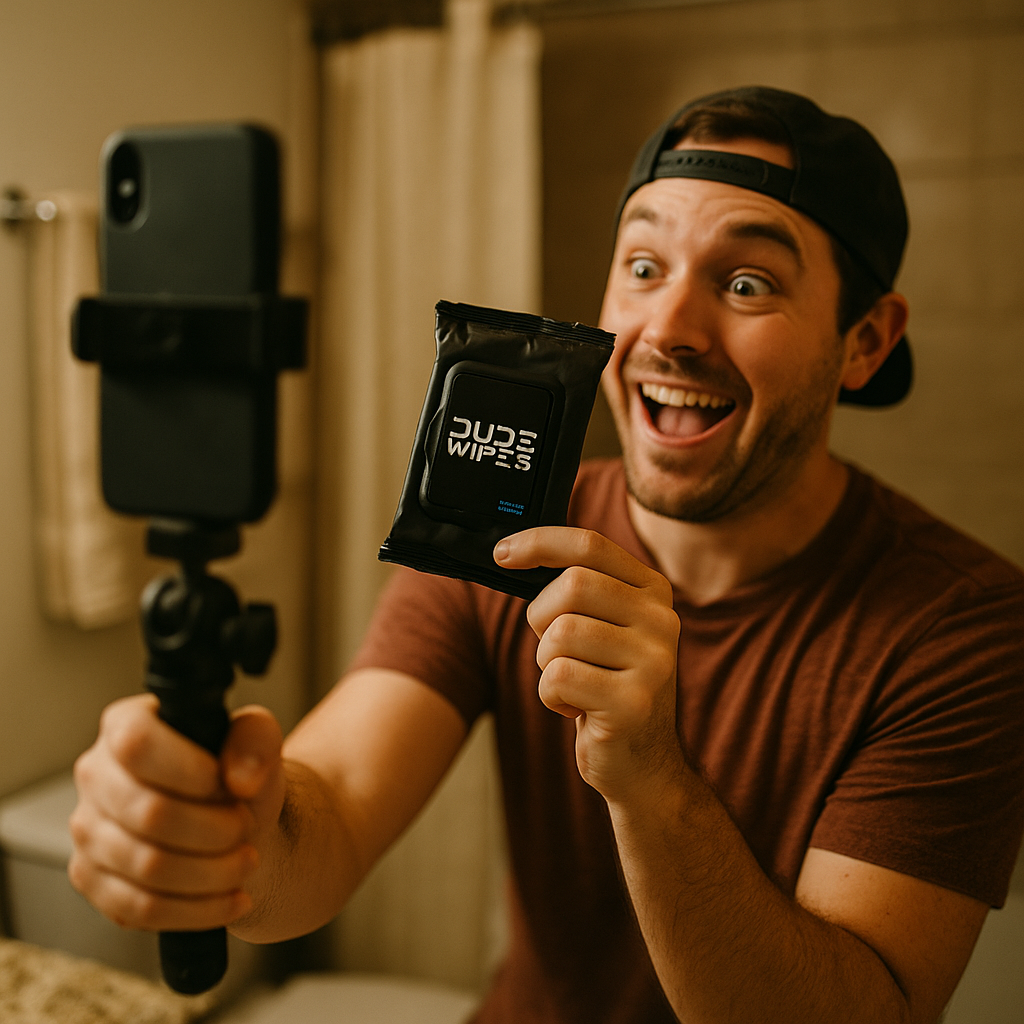
Who wants to talk about butt wipes? Nobody. And that’s exactly why Dude Wipes built a marketing engine that made a taboo, low-interest category impossible to scroll past. This case study on Dude Wipes influencer marketing breaks down how absurdist creator comedy turned a bathroom product into a recurring cultural moment, and what brands stuck in “boring” categories can steal from the playbook.
The Category Problem Nobody Wants to Solve
Personal care products built around bodily functions face a marketing dilemma most CMOs never have to think about: the product works because of a problem people don’t want to discuss. Toilet paper, wipes, digestive health, hemorrhoid cream. These categories rely almost entirely on functional messaging, because brands assume humor or personality will feel disrespectful, or worse, unmemorable in the wrong way.
Dude Wipes bet against that assumption. Instead of leaning into clinical language or vague “freshness” claims, the brand built its entire identity around leaning into the absurdity of the product itself. Flushable wipes for men, marketed with the confidence of an energy drink brand. It shouldn’t work. It does.
Dude Wipes proved that in low-interest categories, the biggest risk isn’t being too weird — it’s being forgettable.
Absurdist Comedy as a Brand Operating System
The core insight behind Dude Wipes’ creator strategy wasn’t just “be funny.” Plenty of brands try comedy and land flat because they treat it as a campaign layer rather than an operating system. Dude Wipes built comedy into the product’s entire creative brief: exaggerated masculinity tropes, deadpan delivery, and scenarios so over-the-top they loop back into being relatable.
Think NFL sponsorship activations paired with TikTok skits about tailgate emergencies. Think creator collaborations that treat bathroom humor with the seriousness of a Super Bowl ad pitch. The tone stayed consistent whether the format was a 15-second Reel or a stadium billboard, which matters more than most brands realize. Consistency is what lets audiences recognize the brand instantly, even mid-scroll.
This is where the strategy differs from typical influencer marketing playbooks. Most brands brief creators to demonstrate product benefits. Dude Wipes briefed creators to perform a bit — and let the product exist inside the joke rather than as the punchline’s setup.
Why Comedy Beats Testimonials in Taboo Categories
Traditional influencer marketing in personal care leans heavily on testimonial-style content: “Here’s why I switched,” “Here’s what changed for me.” That format works fine for skincare or supplements, where audiences want proof points. It falls flat for a product tied to bathroom habits, because nobody wants an authentic, heartfelt testimonial about wiping.
Comedy sidesteps the awkwardness entirely. A joke about camping disasters or gym bag emergencies lets the audience laugh first and register the product benefit second, almost subconsciously. According to Sprout Social’s consumer research, humor consistently ranks among the top content types that drive social shares, ahead of product education or discount promotions. Dude Wipes built its entire creator brief around that exact insight before it became a common talking point in brand strategy decks.
Picking Creators Who Already Owned the Bit
Casting mattered as much as scripting. Dude Wipes didn’t chase the biggest follower counts. It chased comedic timing and a specific brand of self-aware masculinity: guys who could sell mock bravado without ever winking too hard at the camera. Micro and mid-tier comedic creators, sports parody accounts, and dad-humor personalities became the backbone of the roster.
This mirrors a pattern seen across other successful creator programs: brands that win in unusual categories tend to prioritize fit over reach. Chomps built a meat stick category the same way, using creators whose existing content style matched the brand’s voice rather than forcing a script onto an unrelated audience. Dude Wipes applied the same logic to comedy instead of fitness credibility.
The brand also avoided over-scripting. Creators were given premises and boundaries, not word-for-word dialogue. That looseness let jokes land differently across TikTok, Instagram, and YouTube Shorts, which matters because comedic timing rarely translates identically across platforms.
The NFL Partnership: Absurdity Meets Mainstream Distribution
Dude Wipes’ sponsorship of NFL teams and stadium activations gave the brand something rare in influencer marketing: a legitimate, high-visibility stage to extend the joke beyond social feeds. Creator content referencing tailgates, locker rooms, and game-day disasters didn’t feel like forced product placement, because the sponsorship context made the humor plausible.
This cross-channel consistency is a lesson brands in “unsexy” categories often skip. It’s tempting to treat influencer content and traditional sponsorship as separate budget lines with separate creative teams. Dude Wipes ran them as one narrative, which reinforced brand recall across touchpoints instead of splintering it.
When comedic tone stays consistent across sponsorships, organic content, and paid creator work, audiences build faster brand recall — even in categories they’d rather not think about.
What the Data Suggests About Humor-Led Growth
Category discomfort typically suppresses engagement rates. Personal care and health-adjacent products often see lower organic interaction because people don’t want to be seen liking or commenting on the content publicly. Dude Wipes largely neutralized that stigma by making the content shareable as comedy first, product marketing second.
This mirrors broader trends tracked by eMarketer, which has repeatedly found that entertainment value now outperforms direct product messaging as a driver of organic reach across short-form video platforms. Brands optimizing purely for conversion-focused creative are increasingly competing against creators, meme accounts, and comedy pages for the same attention span — and often losing.
For marketers benchmarking creator ROI, this case reinforces a pattern also seen in Poppi’s micro-creator seeding strategy: earned trust and organic shares compound faster than one-off paid placements, especially when the content itself is genuinely rewatchable.
Risk Management: How Far Is Too Far?
Absurdist comedy in a bodily-function category carries real brand safety risk. One miscalibrated joke and a brand can shift from “cheeky” to “gross” in the eyes of a mainstream audience, or worse, invite unwanted attention from regulators around disclosure and claims. Dude Wipes managed this by keeping the humor situational rather than graphic. Jokes centered on relatable scenarios (road trips, gym bags, family gatherings) rather than explicit bodily detail.
Brand and agency teams building similar programs should build review checkpoints into the creative process, not after the fact. That means:
- Setting clear tone boundaries in creator briefs before content is filmed
- Reviewing scripts or concepts, not just final cuts, for categories with reputational sensitivity
- Maintaining disclosure compliance per FTC endorsement guidelines even when content is styled as comedic rather than promotional
- Testing humor concepts with a small creator cohort before scaling briefs across a full roster
Comedy doesn’t exempt a brand from disclosure rules or platform compliance standards. If anything, humor-driven content needs tighter internal review, since jokes travel and get remixed in ways straightforward testimonials rarely do.
Lessons for Brands Stuck in “Boring” Categories
The takeaway here isn’t “add jokes to your ads.” It’s that categories considered low-interest or embarrassing often have the most room to differentiate through tone, precisely because competitors default to safe, clinical messaging. When every competitor sounds the same, personality becomes the actual point of differentiation, not a nice-to-have layer on top of product benefits.
Brands in insurance, cybersecurity, financial services, and health categories have started applying similar logic. Duo Security made cybersecurity content shareable on LinkedIn by applying a comparable principle: take a category nobody wants to engage with organically, and build content people actually want to watch or read. The category doesn’t have to be exciting. The content strategy just has to refuse to be boring about it.
For creator marketing leads evaluating whether a comedic approach fits their category, the honest test is simple: would this content survive without the product mentioned at all? If the joke or scenario is genuinely entertaining on its own, the brand integration becomes a bonus rather than a tax the audience has to pay for the content.
Next Steps for Brands Considering This Approach
Start small. Test absurdist or comedic creator briefs with a limited cohort before committing full budget, track share rate and comment sentiment (not just views), and build FTC-compliant disclosure language into the humor rather than around it. Categories don’t have to be exciting to build an audience — they just need a brand willing to be the first one funny enough to notice.
FAQs
Why did Dude Wipes use comedy instead of traditional product marketing?
Because the category carries built-in social awkwardness, testimonial-style content underperforms. Comedy lets audiences engage without feeling exposed for liking or sharing content about a taboo product.
What type of creators worked best for Dude Wipes’ strategy?
Comedic and mid-tier creators with strong timing and a consistent persona, rather than the largest-follower influencers. Fit with the brand’s tone mattered more than raw reach.
Is absurdist humor risky for brand safety?
Yes, if left unmanaged. Dude Wipes mitigated risk by keeping jokes situational rather than graphic, and by reviewing creative concepts before production rather than after content was filmed.
Can this strategy work outside personal care categories?
Yes. Brands in cybersecurity, insurance, and financial services have applied similar humor-led or personality-driven creator strategies to break through category apathy.
How should brands measure success for comedic creator campaigns?
Track share rate, comment sentiment, and repeat engagement alongside standard reach metrics. Entertainment-driven content often outperforms on shareability even when initial view counts look similar to standard campaigns.
FAQs
Why did Dude Wipes use comedy instead of traditional product marketing?
Because the category carries built-in social awkwardness, testimonial-style content underperforms. Comedy lets audiences engage without feeling exposed for liking or sharing content about a taboo product.
What type of creators worked best for Dude Wipes’ strategy?
Comedic and mid-tier creators with strong timing and a consistent persona, rather than the largest-follower influencers. Fit with the brand’s tone mattered more than raw reach.
Is absurdist humor risky for brand safety?
Yes, if left unmanaged. Dude Wipes mitigated risk by keeping jokes situational rather than graphic, and by reviewing creative concepts before production rather than after content was filmed.
Can this strategy work outside personal care categories?
Yes. Brands in cybersecurity, insurance, and financial services have applied similar humor-led or personality-driven creator strategies to break through category apathy.
How should brands measure success for comedic creator campaigns?
Track share rate, comment sentiment, and repeat engagement alongside standard reach metrics. Entertainment-driven content often outperforms on shareability even when initial view counts look similar to standard campaigns.
Top Influencer Marketing Agencies
The leading agencies shaping influencer marketing in 2026
Agencies ranked by campaign performance, client diversity, platform expertise, proven ROI, industry recognition, and client satisfaction. Assessed through verified case studies, reviews, and industry consultations.
Moburst

-
2

The Shelf
Boutique Beauty & Lifestyle Influencer AgencyA data-driven boutique agency specializing exclusively in beauty, wellness, and lifestyle influencer campaigns on Instagram and TikTok. Best for brands already focused on the beauty/personal care space that need curated, aesthetic-driven content.Clients: Pepsi, The Honest Company, Hims, Elf Cosmetics, Pure LeafVisit The Shelf → -
3

Audiencly
Niche Gaming & Esports Influencer AgencyA specialized agency focused exclusively on gaming and esports creators on YouTube, Twitch, and TikTok. Ideal if your campaign is 100% gaming-focused — from game launches to hardware and esports events.Clients: Epic Games, NordVPN, Ubisoft, Wargaming, Tencent GamesVisit Audiencly → -
4

Viral Nation
Global Influencer Marketing & Talent AgencyA dual talent management and marketing agency with proprietary brand safety tools and a global creator network spanning nano-influencers to celebrities across all major platforms.Clients: Meta, Activision Blizzard, Energizer, Aston Martin, WalmartVisit Viral Nation → -
5

The Influencer Marketing Factory
TikTok, Instagram & YouTube CampaignsA full-service agency with strong TikTok expertise, offering end-to-end campaign management from influencer discovery through performance reporting with a focus on platform-native content.Clients: Google, Snapchat, Universal Music, Bumble, YelpVisit TIMF → -
6

NeoReach
Enterprise Analytics & Influencer CampaignsAn enterprise-focused agency combining managed campaigns with a powerful self-service data platform for influencer search, audience analytics, and attribution modeling.Clients: Amazon, Airbnb, Netflix, Honda, The New York TimesVisit NeoReach → -
7

Ubiquitous
Creator-First Marketing PlatformA tech-driven platform combining self-service tools with managed campaign options, emphasizing speed and scalability for brands managing multiple influencer relationships.Clients: Lyft, Disney, Target, American Eagle, NetflixVisit Ubiquitous → -
8

Obviously
Scalable Enterprise Influencer CampaignsA tech-enabled agency built for high-volume campaigns, coordinating hundreds of creators simultaneously with end-to-end logistics, content rights management, and product seeding.Clients: Google, Ulta Beauty, Converse, AmazonVisit Obviously →