


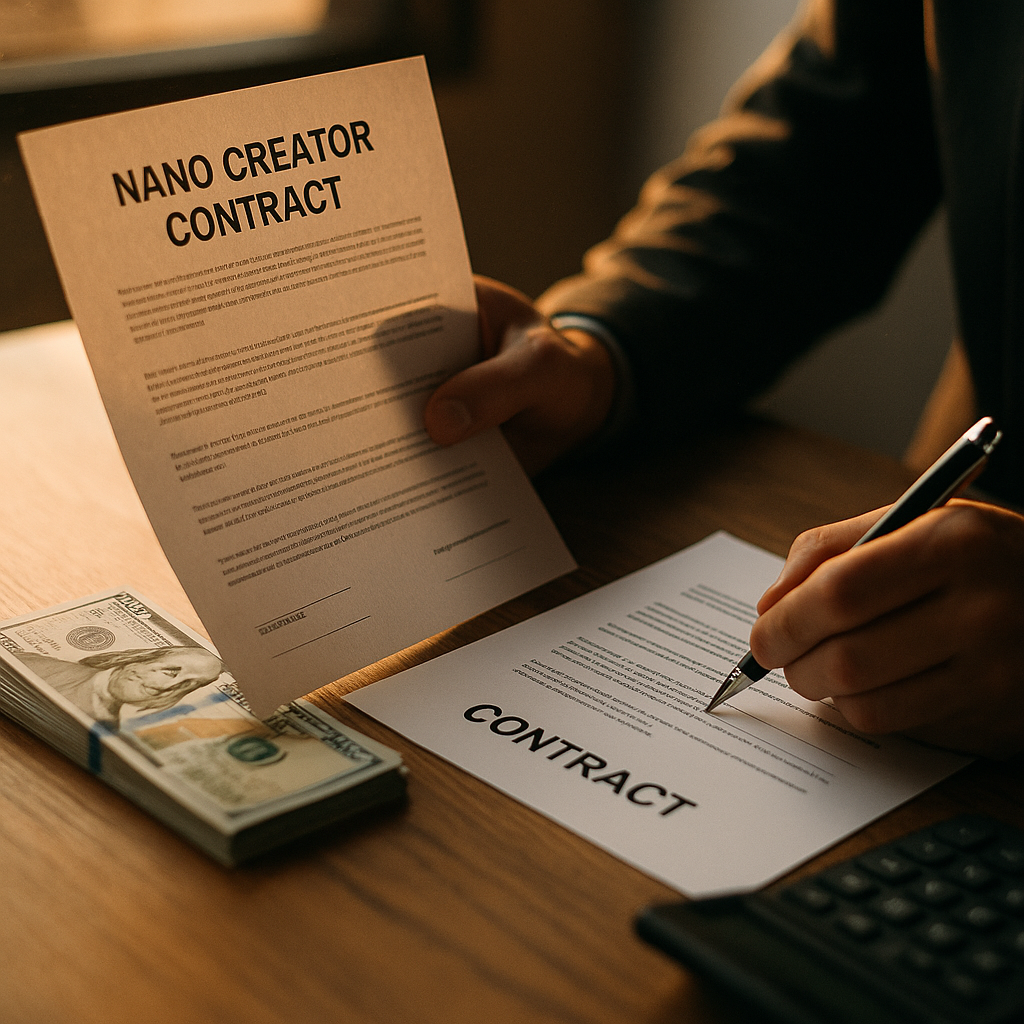
Brands spend an average of $2,500 to $10,000 on legal review for a single influencer contract, yet the nano creator getting paid $150 for a TikTok often signs the exact same boilerplate. That mismatch is quietly costing marketing teams money, time, and leverage. If you’re running a program with hundreds of sub 10K follower talent, a nano creator contract built for a six figure celebrity deal is the wrong tool for the job.
Nano creators (typically defined as accounts under 10,000 followers) now make up the fastest growing segment of brand partnership rosters. They’re cheap, authentic, and scalable. But scale is exactly where sloppy contracting turns into risk. This piece breaks down how to structure nano creator agreements that protect your brand without burying a $200 deal in $2,000 worth of legal overhead.
Why Nano Contracts Can’t Just Be Shrunk Down Celebrity Deals
The instinct is understandable: take your existing influencer agreement, cut the fee, and reuse it. Resist that instinct. Celebrity and macro creator contracts are built around exclusivity windows, morals clauses, and complex usage buyouts because the stakes per deal are high. Nano deals have different risk profiles entirely. The per creator dollar exposure is tiny, but the aggregate exposure across 300 nano partners running the same campaign is not.
Think about it from an operational lens. If your legal team needs 45 minutes to review each contract and you’re running 500 nano deals a quarter, that’s 375 hours of legal time for creators who might be earning $100 to $500 each. The math doesn’t work. You need a template that’s legally sound but requires near zero customization per creator.
A nano creator contract should take a creator under two minutes to read and a brand’s legal team zero minutes to individually review once the template is approved.
The Core Terms That Actually Matter at This Tier
Strip out anything that assumes a creator has an agent, a lawyer, or a business manager. Most nano talent are managing this deal between a day job and a content calendar. Your contract needs to be self-explanatory and enforceable without a negotiation cycle.
- Deliverables, stated in plain numbers. “One Instagram Reel, minimum 30 seconds, posted between the agreed dates” beats vague language like “promotional content.” Nano creators frequently underdeliver simply because expectations were fuzzy, not because they’re acting in bad faith.
- Usage rights, scoped tightly and priced separately. Organic-only usage should be the default. If you want paid amplification or whitelisting rights, that’s a separate line item with its own fee, even if it’s small. Bundling broad usage into a flat $150 fee is how brands end up with free ad inventory they didn’t actually pay for, and it’s also how creators feel shortchanged later.
- FTC disclosure requirements, spelled out explicitly. Don’t assume a nano creator knows the rules. State that #ad or #sponsored must appear in the first three lines of caption or burned into video, per FTC endorsement guidelines. This single clause prevents the majority of compliance headaches at this tier.
- Payment terms and method, with no ambiguity. Net 30 via PayPal or direct deposit, timestamped to content approval, not campaign end date. Nano creators churn fast when payment is slow or unclear.
- Revision limits. Cap it at one round of revisions included in the base fee. Anything beyond that is either a kill fee or an added cost. Without this, nano deals become an endless back and forth that eats margin in account management time.
Usage Rights: Where Most Nano Deals Quietly Overpay or Underpay
This is the clause that trips up brands most often. Usage rights at the nano tier are frequently either wildly overpriced (paying full whitelisting rates for a creator with 3,000 followers) or dangerously underpriced (getting broad usage rights baked into a flat fee with no separate compensation, which invites disputes down the line).
The fix is a tiered usage menu. Base fee covers organic posting only, for a defined period (commonly 12 to 18 months). Add-ons cover paid social amplification, website or email usage, and any cross-platform reposting. Price each add-on as a percentage of base fee rather than a flat dollar amount so it scales sensibly whether you’re working with a $100 nano deal or a $1,000 mid-nano deal.
If your program is shifting spend toward affiliate or performance based structures instead of flat fees, the usage rights conversation changes shape entirely. Worth reviewing how revenue based SLAs reframe what you’re actually paying for.
Deliverable Ambiguity Is the Silent Killer of Nano Programs
Ask any brand running 200+ nano deals a quarter where most disputes originate, and the answer is rarely money. It’s mismatched expectations on what “the content” actually was supposed to be.
Nano creators, unlike agency represented talent, often interpret briefs loosely. A request for “a quick unboxing video” can produce anything from a 15 second Reel to a 4 minute rambling YouTube Short. Your contract needs to reference an attached brief as a binding exhibit, not a suggestion. Language like “Creator agrees to produce content substantially consistent with the attached Brief (Exhibit A)” gives you enforceable footing if deliverables drift wildly off spec.
Set a firm approval window too. Ten business days after content is submitted, silence equals approval. This protects you from a creator claiming a deal fell through because “the brand never responded.”
Payment Structures: Flat Fee, Product Only, or Hybrid?
Nano tier compensation splits into three common structures, and each carries different contractual weight.
- Product only (gifting). Legally, this still requires a contract, even a lightweight one, because you need disclosure language and usage terms regardless of whether cash changed hands. Many brands skip this step, which is a mistake; the FTC doesn’t distinguish between paid and gifted partnerships when it comes to disclosure obligations.
- Flat fee. The most common structure at this tier. Simple, predictable, but make sure the fee explicitly excludes paid usage rights unless stated.
- Hybrid (small fee plus affiliate commission). Increasingly popular as brands try to tie nano spend to actual conversion. If you’re going this route, pair your contract with clear affiliate commission structures so the creator understands exactly how tracking and payout work.
Whichever structure you choose, document it with specificity. “Creator will receive $150 plus 10% commission on tracked sales via unique code for 30 days post-publish” leaves no room for a dispute later.
Templatize, Then Automate the Boring Parts
Once you’ve nailed the core terms, the real ROI unlock is removing humans from the repetitive parts of the process. Most creator relationship management platforms and even basic e-signature tools like HelloSign or DocuSign can auto-populate a locked template with creator name, deliverable count, fee, and dates, then route for signature without legal touching it again.
Build in a variable field structure: name, handle, platform, deliverable count, fee, usage window. Everything else stays fixed. Legal reviews the template once a year (or when platform policies shift), not every single deal.
If your legal team is reviewing individual nano creator contracts line by line, you’ve built a process, not a template. Fix the template.
This is also where staffing intersects with contracting. Programs running high nano volume typically need a dedicated operations role just to manage template compliance and edge cases. If you’re scaling past a couple hundred nano deals a quarter, it might be time to look at creator studio staffing sequences to figure out where that function should live.
Compliance Risk Doesn’t Shrink Just Because the Follower Count Does
There’s a persistent myth that nano creators fly under the FTC’s radar because the reach is small. That’s not how enforcement works. The FTC has explicitly stated that disclosure obligations apply regardless of follower count or compensation size. A $50 product gift to a 2,000 follower account triggers the same disclosure requirement as a $50,000 celebrity deal.
At scale, this risk compounds. Run 400 nano deals without airtight disclosure language, and you’ve got 400 potential compliance gaps, not one. Build the disclosure clause into the contract itself, and back it up with a content checklist creators must confirm before posting. Some brands add a small holdback (5-10% of fee) released only after a compliance check confirms proper disclosure. It’s a low-friction way to enforce accountability without adversarial tone.
For programs vetting talent at scale, pairing contract templates with a formal trust management framework catches most red flags before a contract is even sent.
What This Means for Your Margin
Every hour your legal or ops team spends customizing a nano contract is an hour that should’ve gone into sourcing more creators or analyzing performance data. Tight, templatized contracts aren’t just a legal safeguard, they’re a direct lever on program economics. Brands that have moved to standardized nano agreements report cutting per-deal admin time by more than half, according to internal benchmarking shared across several agency operations teams tracked by HubSpot’s marketing operations research.
If your nano program still runs on contracts adapted from macro influencer deals, you’re paying a hidden operational tax on every single partnership. That tax adds up fast once you’re running hundreds of these a quarter, and it’s one of the more fixable inefficiencies in a creator program’s cost structure. It’s worth benchmarking your current setup against a creator program maturity model to see where contracting sits relative to your program’s overall scale.
FAQs
Frequently Asked Questions
What follower count officially defines a nano creator?
Most industry definitions place nano creators between 1,000 and 10,000 followers, though some brands extend the range down to accounts with a few hundred highly engaged followers. There’s no universal legal threshold, so define it explicitly in your internal creator tiering documents.
Do nano creators need a contract even for product-only gifting deals?
Yes. Gifting still requires disclosure per FTC guidance, and a lightweight agreement protects the brand’s usage rights and sets posting expectations, even when no cash payment occurs.
How long should usage rights last in a nano creator contract?
Twelve to eighteen months for organic usage is standard. Paid amplification or whitelisting rights should be a separate, shorter-term add-on priced independently of the base deliverable fee.
Should nano creators get the same contract as macro or mid-tier influencers?
No. Nano contracts should be simplified, templatized, and require minimal per-deal customization. Applying macro-tier legal complexity to nano deals wastes legal resources and slows down program velocity.
What’s the biggest compliance risk with nano creator programs?
Inconsistent FTC disclosure enforcement across a large volume of creators. Because nano programs run at scale, a small compliance gap multiplies quickly across hundreds of partnerships.
Can nano creator contracts include performance-based pay?
Yes, hybrid structures combining a small flat fee with affiliate commissions are increasingly common. Just make sure tracking mechanisms and commission windows are explicitly stated in the agreement.
Start by auditing your current nano contract for unpriced usage rights and vague deliverable language, those two gaps cause the majority of disputes at this tier. Fix the template once, and every deal after it gets faster, cheaper, and safer.
Top Influencer Marketing Agencies
The leading agencies shaping influencer marketing in 2026
Agencies ranked by campaign performance, client diversity, platform expertise, proven ROI, industry recognition, and client satisfaction. Assessed through verified case studies, reviews, and industry consultations.
Moburst

-
2

The Shelf
Boutique Beauty & Lifestyle Influencer AgencyA data-driven boutique agency specializing exclusively in beauty, wellness, and lifestyle influencer campaigns on Instagram and TikTok. Best for brands already focused on the beauty/personal care space that need curated, aesthetic-driven content.Clients: Pepsi, The Honest Company, Hims, Elf Cosmetics, Pure LeafVisit The Shelf → -
3

Audiencly
Niche Gaming & Esports Influencer AgencyA specialized agency focused exclusively on gaming and esports creators on YouTube, Twitch, and TikTok. Ideal if your campaign is 100% gaming-focused — from game launches to hardware and esports events.Clients: Epic Games, NordVPN, Ubisoft, Wargaming, Tencent GamesVisit Audiencly → -
4

Viral Nation
Global Influencer Marketing & Talent AgencyA dual talent management and marketing agency with proprietary brand safety tools and a global creator network spanning nano-influencers to celebrities across all major platforms.Clients: Meta, Activision Blizzard, Energizer, Aston Martin, WalmartVisit Viral Nation → -
5

The Influencer Marketing Factory
TikTok, Instagram & YouTube CampaignsA full-service agency with strong TikTok expertise, offering end-to-end campaign management from influencer discovery through performance reporting with a focus on platform-native content.Clients: Google, Snapchat, Universal Music, Bumble, YelpVisit TIMF → -
6

NeoReach
Enterprise Analytics & Influencer CampaignsAn enterprise-focused agency combining managed campaigns with a powerful self-service data platform for influencer search, audience analytics, and attribution modeling.Clients: Amazon, Airbnb, Netflix, Honda, The New York TimesVisit NeoReach → -
7

Ubiquitous
Creator-First Marketing PlatformA tech-driven platform combining self-service tools with managed campaign options, emphasizing speed and scalability for brands managing multiple influencer relationships.Clients: Lyft, Disney, Target, American Eagle, NetflixVisit Ubiquitous → -
8

Obviously
Scalable Enterprise Influencer CampaignsA tech-enabled agency built for high-volume campaigns, coordinating hundreds of creators simultaneously with end-to-end logistics, content rights management, and product seeding.Clients: Google, Ulta Beauty, Converse, AmazonVisit Obviously →