


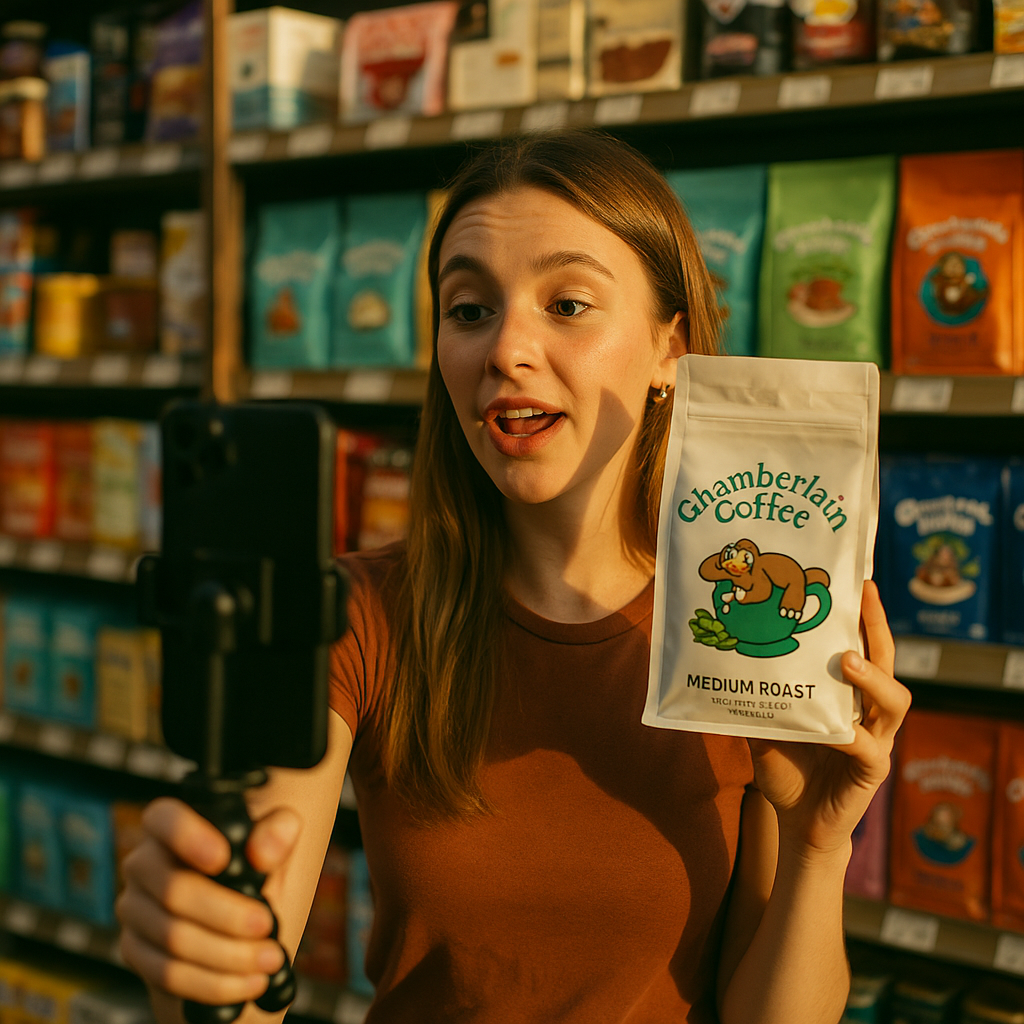
A founder with 13 million Instagram followers should be the easiest marketing hack in retail. Chamberlain Coffee didn’t use it. Instead, the brand leaned on hundreds of nano-creator seeding partnerships on TikTok to prove retail demand, landing shelf space at Target and Kroger without leaning on Emma Chamberlain’s celebrity in the pitch deck. That’s the counterintuitive part worth studying.
The Celebrity-Founder Trap Chamberlain Coffee Avoided
Most brands with a famous founder run the playbook backwards. They front-load campaigns with the founder’s face, treat every retail pitch as a fan-conversion event, and hope the parasocial relationship does the heavy lifting. It works, until it doesn’t. Retail buyers have seen a hundred celebrity CPG lines flame out after year one because the sales curve mirrored the founder’s press cycle, not sustained category demand.
Chamberlain Coffee’s team made a deliberate bet: prove the product could sell on its own merits, driven by ordinary people talking about it on TikTok, before leaning on Emma Chamberlain’s name in trade conversations. Buyers at Target and Kroger don’t just want cultural relevance. They want repeat purchase data, category velocity, and proof that demand isn’t tied to one person’s fame cycle.
Retail buyers increasingly discount celebrity-founder virality unless it’s backed by grassroots, creator-driven proof that ordinary consumers are seeking the product out.
What Nano-Creator Seeding Actually Looked Like
Chamberlain Coffee’s TikTok strategy wasn’t influencer marketing in the traditional sense. There were no six-figure brand deals with mid-tier creators, no polished sponsored posts with disclosure hashtags buried in a wall of text. The approach was seeding: sending product to creators with 1,000 to 50,000 followers, mostly college students, home baristas, and coffee-routine accounts, with no scripted deliverables attached.
The mechanics were simple and, frankly, unglamorous:
- Bulk outbound to niche coffee, lifestyle, and “get ready with me” creators via TikTok’s Creator Marketplace and direct DMs.
- Product boxes built around trial-size bundles, not full-size retail SKUs, to lower the cost per seed.
- Zero script requirements, only a soft ask to show how they actually use the product.
- Rapid iteration based on which flavors, formats, or use cases (iced lattes, oat milk pairings, dorm-room setups) got organic pickup.
This mirrors a pattern Influencers Time has covered extensively in other categories. Stanley’s tumbler seeding strategy and Solo Stove’s year-round seeding engine both relied on volume and authenticity over polish. Chamberlain Coffee applied the same logic to a category, coffee, that’s notoriously hard to differentiate visually.
Why Nano, Not Macro?
The math is straightforward. A single macro-influencer partnership with a 1-million-follower creator might cost $15,000 to $50,000 and produce one piece of content. That same budget seeds 300 to 500 nano-creators, each producing content that reads as organic recommendation rather than paid placement. eMarketer has repeatedly flagged declining engagement rates among top-tier influencers as audiences grow skeptical of obvious sponsorships, while nano and micro tiers hold steadier trust scores.
There’s also a distribution advantage specific to TikTok’s algorithm. The platform doesn’t weight follower count heavily in its For You Page distribution logic. A creator with 4,000 followers can outperform one with 400,000 if the content hits watch-time and completion-rate signals. Chamberlain Coffee’s team understood this and optimized for content that performed well on the algorithm’s terms, not for creator prestige.
Turning UGC Into a Retail Pitch Deck
Here’s the part most case studies skip: what did Chamberlain Coffee actually do with all that nano-creator content once it existed?
The brand compiled TikTok performance data, view counts, comment sentiment, geographic spread of engagement, and search volume spikes on retailer apps, into evidence that consumer demand existed independent of paid media or founder promotion. This is a materially different pitch than “our founder has followers.” It’s closer to: “here’s proof that people outside our owned audience are actively discovering, discussing, and requesting this product.”
Retail buyers respond to that kind of evidence because it de-risks the shelf allocation decision. A product backed by organic, distributed demand signals lower promotional dependency once it’s on shelf. Buyers have watched too many founder-fronted CPG brands need continuous paid support to move units after the initial retail placement.
Nano-creator UGC volume functions as a proxy for organic search and shelf-pull data, the exact signals retail buyers use to de-risk new SKU decisions.
This tactic isn’t unique to coffee. Feastables used a similar nano-creator approach to win retail shelf space, and Chagee applied a related livestream-and-seeding combination to break into a competitive category, as detailed in Influencers Time’s coverage of how Chagee built a US tea category with livestreams and nano-creators.
The Numbers That Mattered to Buyers
Chamberlain Coffee didn’t need viral, million-view moments to make the case. Consistency mattered more than any single breakout post. The brand tracked:
- Volume of unprompted UGC mentions per month, tracking organic tags and duets beyond the initial seeded creators.
- Search interest for “Chamberlain Coffee near me” and retailer-specific app queries, correlated with content spikes.
- Comment sentiment analysis, filtering for purchase intent language (“where can I buy this,” “is this at Target”) rather than vanity engagement.
- Repeat appearance rate: how often creators who received one seed came back and posted again unprompted, without additional product sent.
That last metric is arguably the most important one for any brand running a seeding program. Repeat unprompted mentions signal genuine product-market fit rather than a one-time obligation post. Sprout Social’s research on creator marketing consistently shows that authenticity signals like repeat, unpaid mentions correlate more strongly with purchase intent than one-off sponsored content.
Cost Efficiency Versus Traditional Retail Marketing
Traditional CPG retail launches often burn six figures on in-store demos, end-cap placement fees, and regional paid media to prove velocity. Chamberlain Coffee’s nano-seeding approach ran at a fraction of that cost, largely because product cost (not media spend) was the primary line item. Sending free trial bundles to a few hundred creators costs far less than a single regional TV or out-of-home campaign, and it generates content assets the brand can reuse in paid social, retail marketing co-op materials, and even packaging design testing.
Where This Approach Has Limits
It would be irresponsible to present this as a universal playbook. A few caveats matter:
- Category fit matters. Coffee is a habitual, visually demonstrable, low-cost product. Categories with higher price points or less frequent purchase cycles won’t generate the same volume of organic repeat content.
- Founder fame still helped, indirectly. Even without leading with Emma Chamberlain’s name, her existing audience likely primed early creator interest and lowered the cost of initial outreach acceptance. Brands without any founder profile may see slower creator response rates.
- FTC disclosure compliance is non-negotiable. Seeded content, even unpaid product gifting, often falls under FTC endorsement guidelines when there’s a material connection between brand and creator. Brands running seeding programs at scale need clear disclosure policies and creator education, not just hope that creators self-disclose correctly.
- Retail buyers still want a media plan. Organic proof gets you in the room. Retailers still expect a follow-up marketing commitment to support the SKU post-launch.
Brands running similar vetting and compliance processes at scale should look at how other CPG players have systematized this. Influencers Time’s coverage of a supplement brand cutting discovery costs 40% with AI vetting shows how creator discovery and compliance checks can be automated without losing the organic feel that makes nano-seeding work in the first place.
What Brands Should Take From This
Chamberlain Coffee’s retail breakthrough wasn’t really about TikTok, and it wasn’t really about coffee. It was about using distributed, low-cost creator content as a substitute for expensive traditional proof-of-demand tactics, and having the discipline to let the product’s organic pull, not the founder’s fame, do the talking in front of buyers.
For brands with a well-known founder, the lesson is almost paradoxical: sometimes the strongest retail pitch is proof that you don’t need the famous name at all.
Frequently Asked Questions
What is nano-creator seeding?
Nano-creator seeding is a marketing tactic where brands send free products to creators with roughly 1,000 to 50,000 followers, asking for organic content rather than a scripted sponsored post. It relies on volume and authenticity instead of reach from any single creator.
Why did Chamberlain Coffee avoid using its celebrity founder in retail pitches?
Retail buyers often discount celebrity-driven demand because it can be tied to a single person’s popularity cycle rather than sustained category interest. Chamberlain Coffee used organic nano-creator content on TikTok to demonstrate independent consumer demand, which buyers view as a lower-risk signal for shelf allocation.
How is nano-creator seeding different from influencer marketing?
Traditional influencer marketing typically involves paid partnerships with mid-tier or macro creators and scripted deliverables. Nano-creator seeding focuses on smaller creators, often unpaid beyond the product itself, with minimal creative direction, producing content that reads as genuine recommendation.
Does nano-creator seeding require FTC disclosure?
Yes. Under FTC endorsement guidelines, any material connection between a brand and a creator, including free product, generally requires disclosure. Brands running seeding programs at scale need clear policies and creator education to stay compliant.
Can this strategy work outside the coffee or beverage category?
It works best for habitual, visually demonstrable, lower-cost products where creators can show natural daily use. Higher-priced or infrequently purchased categories may need a different mix of creator tiers and content formats to generate comparable organic volume.
Top Influencer Marketing Agencies
The leading agencies shaping influencer marketing in 2026
Agencies ranked by campaign performance, client diversity, platform expertise, proven ROI, industry recognition, and client satisfaction. Assessed through verified case studies, reviews, and industry consultations.
Moburst

-
2

The Shelf
Boutique Beauty & Lifestyle Influencer AgencyA data-driven boutique agency specializing exclusively in beauty, wellness, and lifestyle influencer campaigns on Instagram and TikTok. Best for brands already focused on the beauty/personal care space that need curated, aesthetic-driven content.Clients: Pepsi, The Honest Company, Hims, Elf Cosmetics, Pure LeafVisit The Shelf → -
3

Audiencly
Niche Gaming & Esports Influencer AgencyA specialized agency focused exclusively on gaming and esports creators on YouTube, Twitch, and TikTok. Ideal if your campaign is 100% gaming-focused — from game launches to hardware and esports events.Clients: Epic Games, NordVPN, Ubisoft, Wargaming, Tencent GamesVisit Audiencly → -
4

Viral Nation
Global Influencer Marketing & Talent AgencyA dual talent management and marketing agency with proprietary brand safety tools and a global creator network spanning nano-influencers to celebrities across all major platforms.Clients: Meta, Activision Blizzard, Energizer, Aston Martin, WalmartVisit Viral Nation → -
5

The Influencer Marketing Factory
TikTok, Instagram & YouTube CampaignsA full-service agency with strong TikTok expertise, offering end-to-end campaign management from influencer discovery through performance reporting with a focus on platform-native content.Clients: Google, Snapchat, Universal Music, Bumble, YelpVisit TIMF → -
6

NeoReach
Enterprise Analytics & Influencer CampaignsAn enterprise-focused agency combining managed campaigns with a powerful self-service data platform for influencer search, audience analytics, and attribution modeling.Clients: Amazon, Airbnb, Netflix, Honda, The New York TimesVisit NeoReach → -
7

Ubiquitous
Creator-First Marketing PlatformA tech-driven platform combining self-service tools with managed campaign options, emphasizing speed and scalability for brands managing multiple influencer relationships.Clients: Lyft, Disney, Target, American Eagle, NetflixVisit Ubiquitous → -
8

Obviously
Scalable Enterprise Influencer CampaignsA tech-enabled agency built for high-volume campaigns, coordinating hundreds of creators simultaneously with end-to-end logistics, content rights management, and product seeding.Clients: Google, Ulta Beauty, Converse, AmazonVisit Obviously →