


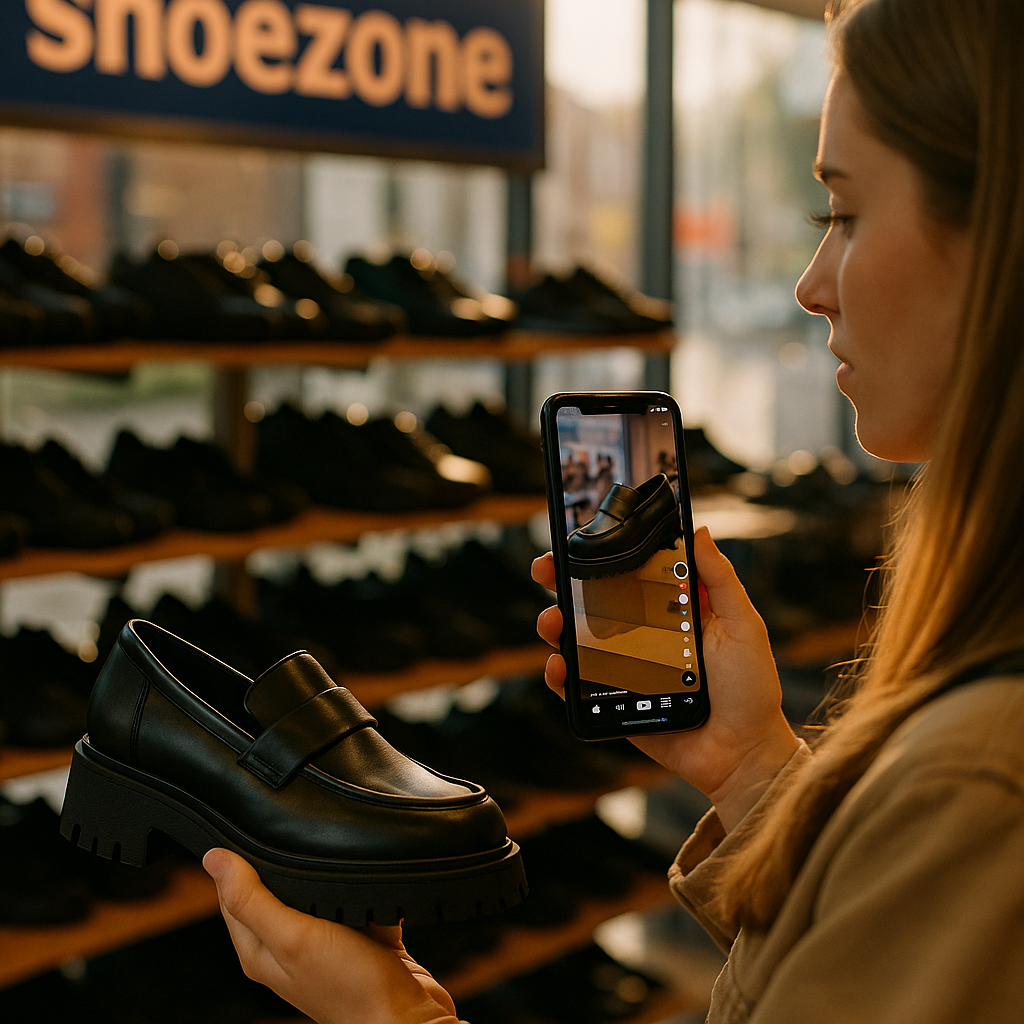
Can a value footwear retailer actually win Gen Z shoppers on TikTok without slashing margins to the bone? Shoezone’s answer was a resounding yes. By swapping polished ad campaigns for unscripted street-interview content, the UK retailer built a TikTok Shop strategy that turned casual scrollers into paying customers, fast.
This case study breaks down exactly how a brand best known for budget school shoes and slippers found its footing with a younger, trend-conscious audience — and what other retail marketers can steal from the playbook.
The Problem: A Legacy Brand With an Image Gap
Shoezone has spent decades as a high-street staple for families hunting affordable footwear. Reliable? Yes. Exciting to a nineteen-year-old scrolling TikTok at midnight? Not historically. That’s the gap most heritage retailers face when they try to court younger shoppers: the product might be fine, but the brand perception feels dated, parental, transactional.
Traditional retail marketing — banner ads, email blasts, in-store signage — wasn’t going to close that gap. Gen Z and younger millennials don’t discover footwear trends from a catalog. They discover them from a stranger on the street getting stopped mid-walk and asked, “Where did you get those shoes?”
That insight became the foundation of Shoezone’s approach. Instead of fighting the format, they built a content strategy entirely around it.
The Street-Interview Format: Why It Works
Street-interview content isn’t new. Creators have been doing “rate my fit” and vox-pop style videos for years. What Shoezone did differently was operationalize it as a sales channel, not just a brand-awareness play. Interviewers approached real people, asked about their shoe choices, reacted authentically, and then pivoted naturally into showing comparable (and cheaper) styles available on Shoezone’s TikTok Shop.
The format works for a few structural reasons that brand marketers should pay attention to:
- It doesn’t look like an ad. The hook is curiosity about a stranger, not a product pitch. Viewers stay for the human moment, not the sales angle.
- It’s inherently social-proof-driven. Real people wearing real shoes are more persuasive than a studio product shot, especially to an audience raised on skepticism toward polished marketing.
- It’s fast and cheap to produce. No sets, no elaborate scripts. A phone, a microphone, and a busy high street is the entire production budget.
- It converts on price contrast. When the format naturally surfaces “this exact look, but £15 instead of £70,” the value proposition sells itself.
The format’s real power wasn’t virality — it was removing the friction between “I like that” and “I can buy that,” collapsing discovery and purchase into a single scroll.
Turning Views Into Direct Sales
Content alone doesn’t move inventory. The commerce layer is what made this case study worth studying: Shoezone tagged relevant products directly in-video through TikTok Shop, letting viewers purchase without leaving the app. That’s a critical distinction from older influencer campaigns that drove traffic to a website and hoped for the best.
TikTok’s own commerce data has consistently shown that in-app checkout reduces drop-off dramatically compared to external link-outs. Retailers who still treat TikTok as a top-of-funnel awareness channel, rather than a closed-loop sales channel, are leaving revenue on the table. Shoezone’s team clearly understood this. They built content that entertained first, but the shoppable tags did the operational work of converting curiosity into carts.
This mirrors a pattern seen across other retail categories. one fashion retailer’s TikTok Shop livestream overhaul similarly found that scheduling content around actual shopper behavior, rather than a static content calendar, produced meaningfully better conversion. Shoezone applied the same logic to short-form street content instead of livestreams.
Who Made the Content — And Why That Mattered
Shoezone didn’t lean on mega-influencers with millions of followers. It leaned on smaller creators and in-house talent who understood the tone of authentic street content and could produce it at volume, consistently, without the brand feeling like it was chasing every algorithm shift.
This is a pattern worth flagging for any brand strategist weighing influencer tiers. Big-name creators bring reach, but they also bring cost, negotiation overhead, and a risk that their audience doesn’t match your customer base. Nano and micro-creators — or trained in-house presenters — bring lower cost, faster iteration, and content that reads as more believable to skeptical younger audiences.
It’s a similar calculus to what worked for Chamberlain Coffee’s nano-creator strategy and Ryobi’s nano-creator seeding approach, both of which prioritized volume and authenticity over reach and polish. Shoezone essentially applied the nano-creator logic to owned, format-repeatable content rather than third-party seeding.
No Discounts Required — Just Better Framing
Here’s the part that should get every CFO’s attention: Shoezone didn’t need to discount aggressively to make this work. The retailer’s everyday pricing was already the pitch. The street-interview format simply reframed “cheap” as “smart” — a subtle but crucial repositioning for a value brand trying to shed a slightly downmarket image.
Compare that to brands that rely on constant promo codes and flash sales to drive TikTok Shop volume. That approach trains customers to wait for discounts and erodes margin over time. Shoezone’s content did the opposite: it made full-price purchases feel like a win because the comparison point was always a pricier alternative, not a competitor’s sale.
This echoes what worked for Chubbies’ discount-free comedy approach and Ridge Wallet’s demo-led, discount-free growth. The common thread across all three: when the content itself demonstrates value, brands don’t need to manufacture urgency through markdowns.
What the Data Suggests About TikTok Shop’s Trajectory
Shoezone’s results sit inside a broader shift in how younger consumers shop. Social commerce continues to grow as a share of total retail, and platforms are racing to close the gap between discovery and checkout. According to eMarketer’s social commerce research, younger shoppers are increasingly comfortable completing purchases without ever leaving a social app, a behavior shift that retailers built around traditional e-commerce funnels are still catching up to.
Statista’s data on social commerce adoption tells a similar story: trust in creator and peer-driven content is outpacing trust in traditional brand advertising among Gen Z and younger millennial cohorts. That’s precisely the trust gap Shoezone’s street-interview format was designed to close.
None of this means every brand should copy the format wholesale. A luxury retailer probably shouldn’t lean on street-interview content the same way a value footwear brand can — the tone has to match brand equity. But the underlying principle transfers across categories: unscripted, socially-proofed content paired with frictionless checkout consistently outperforms polished ads paired with a slow path to purchase.
Risk and Compliance: What Brands Need to Watch
Street-interview content isn’t risk-free. Filming members of the public raises consent questions, and brands operating in the UK need to be mindful of data protection obligations when featuring identifiable individuals in commercial content. Guidance from the Information Commissioner’s Office is a sensible starting point for any UK marketing team building this kind of format at scale.
There’s also a disclosure dimension. Even when content feels organic, if a brand is compensating participants or directing outcomes, transparency expectations from bodies like the FTC still apply for US-facing content, and equivalent UK advertising standards apply domestically. Any brand scaling this format needs a lightweight but real consent and disclosure process, not just a camera operator with good instincts.
Creator vetting failures elsewhere in retail and beauty are a useful cautionary tale here. Sephora’s tween beauty backlash showed how quickly a lack of process around who appears in branded content can turn into a reputational headache. Shoezone’s format may look casual, but the operational discipline behind it — consent, clearances, consistent tone — needs to be anything but.
The Takeaway for Retail Marketers
Shoezone’s TikTok Shop strategy proves that value retailers don’t need celebrity budgets to win younger shoppers — they need formats that feel native to the platform, a shoppable layer that removes friction, and pricing that’s already competitive enough to sell itself. Brands sitting on solid value propositions but outdated content strategies should treat this as a blueprint, not a one-off curiosity.
Frequently Asked Questions
What made Shoezone’s TikTok Shop strategy different from typical influencer campaigns?
It relied on unscripted street-interview content rather than scripted influencer endorsements, pairing that authenticity with direct in-app shopping tags so viewers could purchase without leaving TikTok.
Why did street-interview content perform well with younger shoppers?
The format doesn’t read as an ad. It hooks viewers with genuine curiosity about a stranger’s outfit, then uses social proof and price contrast to make the product pitch feel incidental rather than forced.
Did Shoezone need to discount heavily to drive TikTok Shop sales?
No. The strategy leaned on Shoezone’s already competitive pricing and framed it against pricier alternatives, avoiding the margin erosion that comes with constant promotional discounting.
What compliance considerations apply to street-interview marketing content?
Brands need clear consent from members of the public who appear on camera, plus adherence to relevant data protection and advertising disclosure rules, particularly when compensation or scripting is involved.
Can smaller retail brands replicate this approach without a big budget?
Yes. The format is low-cost to produce, requiring little more than a phone, a presenter, and a busy public location, which makes it accessible to brands without large production budgets.
Frequently Asked Questions
What made Shoezone’s TikTok Shop strategy different from typical influencer campaigns?
It relied on unscripted street-interview content rather than scripted influencer endorsements, pairing that authenticity with direct in-app shopping tags so viewers could purchase without leaving TikTok.
Why did street-interview content perform well with younger shoppers?
The format doesn’t read as an ad. It hooks viewers with genuine curiosity about a stranger’s outfit, then uses social proof and price contrast to make the product pitch feel incidental rather than forced.
Did Shoezone need to discount heavily to drive TikTok Shop sales?
No. The strategy leaned on Shoezone’s already competitive pricing and framed it against pricier alternatives, avoiding the margin erosion that comes with constant promotional discounting.
What compliance considerations apply to street-interview marketing content?
Brands need clear consent from members of the public who appear on camera, plus adherence to relevant data protection and advertising disclosure rules, particularly when compensation or scripting is involved.
Can smaller retail brands replicate this approach without a big budget?
Yes. The format is low-cost to produce, requiring little more than a phone, a presenter, and a busy public location, which makes it accessible to brands without large production budgets.
Top Influencer Marketing Agencies
The leading agencies shaping influencer marketing in 2026
Agencies ranked by campaign performance, client diversity, platform expertise, proven ROI, industry recognition, and client satisfaction. Assessed through verified case studies, reviews, and industry consultations.
Moburst

-
2

The Shelf
Boutique Beauty & Lifestyle Influencer AgencyA data-driven boutique agency specializing exclusively in beauty, wellness, and lifestyle influencer campaigns on Instagram and TikTok. Best for brands already focused on the beauty/personal care space that need curated, aesthetic-driven content.Clients: Pepsi, The Honest Company, Hims, Elf Cosmetics, Pure LeafVisit The Shelf → -
3

Audiencly
Niche Gaming & Esports Influencer AgencyA specialized agency focused exclusively on gaming and esports creators on YouTube, Twitch, and TikTok. Ideal if your campaign is 100% gaming-focused — from game launches to hardware and esports events.Clients: Epic Games, NordVPN, Ubisoft, Wargaming, Tencent GamesVisit Audiencly → -
4

Viral Nation
Global Influencer Marketing & Talent AgencyA dual talent management and marketing agency with proprietary brand safety tools and a global creator network spanning nano-influencers to celebrities across all major platforms.Clients: Meta, Activision Blizzard, Energizer, Aston Martin, WalmartVisit Viral Nation → -
5

The Influencer Marketing Factory
TikTok, Instagram & YouTube CampaignsA full-service agency with strong TikTok expertise, offering end-to-end campaign management from influencer discovery through performance reporting with a focus on platform-native content.Clients: Google, Snapchat, Universal Music, Bumble, YelpVisit TIMF → -
6

NeoReach
Enterprise Analytics & Influencer CampaignsAn enterprise-focused agency combining managed campaigns with a powerful self-service data platform for influencer search, audience analytics, and attribution modeling.Clients: Amazon, Airbnb, Netflix, Honda, The New York TimesVisit NeoReach → -
7

Ubiquitous
Creator-First Marketing PlatformA tech-driven platform combining self-service tools with managed campaign options, emphasizing speed and scalability for brands managing multiple influencer relationships.Clients: Lyft, Disney, Target, American Eagle, NetflixVisit Ubiquitous → -
8

Obviously
Scalable Enterprise Influencer CampaignsA tech-enabled agency built for high-volume campaigns, coordinating hundreds of creators simultaneously with end-to-end logistics, content rights management, and product seeding.Clients: Google, Ulta Beauty, Converse, AmazonVisit Obviously →