


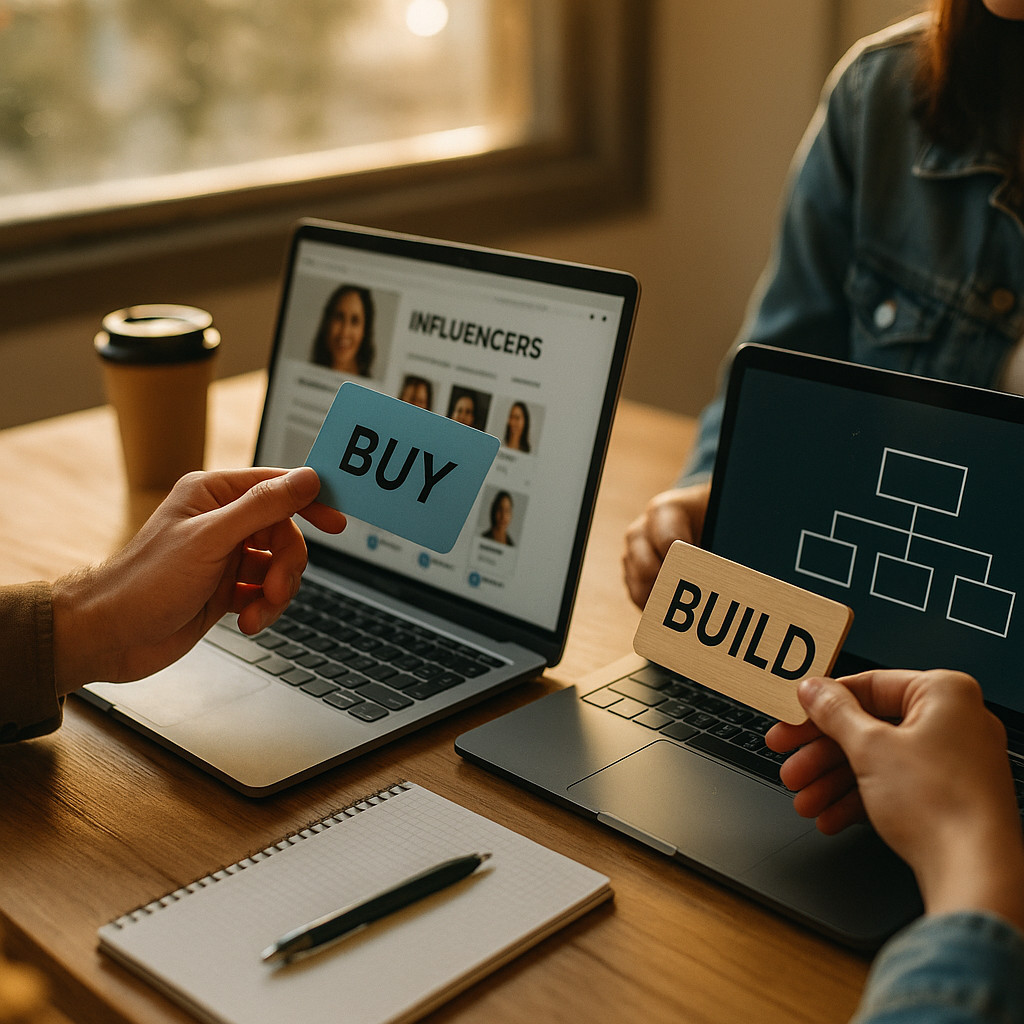
Choosing between buying or building your own influencer platform is a critical decision for brands wanting to maximize their influencer marketing strategies. This article explores the key considerations, from software scalability to data ownership, to help you navigate the “Buy vs. Build” decision. Read on to uncover which path best aligns with your organization’s unique goals and resources.
Key Influencer Platform Features: What Brands Need
Before weighing the buy versus build options, it’s essential to understand what features leading influencer platforms offer in 2025. Brands require platforms that:
- Efficiently discover and vet influencers across major social networks
- Provide campaign management, workflow automation, and performance tracking
- Integrate seamlessly with existing martech stacks such as CRM and analytics tools
- Uphold strict data privacy and compliance requirements (like GDPR and CCPA)
- Offer transparent ROI measurement through real-time reporting dashboards
Identifying these must-have features is vital because your buy or build decision should revolve around how well these requirements can be met, both now and as your influencer marketing programs evolve.
Advantages of Buying an Influencer Platform: Fast Go-to-Market
For many organizations, purchasing a ready-made influencer management platform offers compelling benefits, especially for those seeking rapid deployment and proven reliability. Here’s what buying brings to the table:
- Speed: Licensed platforms can be activated within days, supporting influencer campaigns almost immediately.
- Cost transparency: SaaS pricing models offer predictable expenses and avoid unexpected development overruns.
- Market expertise: Top vendors continuously refine their tools to keep up with social media trends, algorithm updates, and regulatory changes.
- Security and compliance: Established providers invest heavily in data protection, ensuring built-in adherence to privacy regulations.
- Support and updates: Dedicated customer service and regular product enhancements relieve your team of day-to-day maintenance burdens.
However, while buying offers speed, off-the-shelf platforms can come with feature limitations or less flexibility when adapting to unique in-house workflows.
Building Your Own Influencer Platform: Custom Control and Differentiation
For brands with very specific needs or ambitious long-term influencer marketing roadmaps, choosing to build a custom influencer platform can deliver unmatched advantages:
- Tailored functionality: Developing in-house allows teams to address niche use cases, integrate proprietary data, and design user experiences without compromise.
- Full ownership: Organizations maintain control over sensitive influencer and campaign data, minimizing third-party dependency.
- Competitive differentiation: A bespoke solution can reflect proprietary workflows, algorithms, or analytics that set your brand apart in the influencer space.
- Seamless integration: Custom connectors can unify the influencer platform with your business’s entire digital ecosystem, boosting cross-department collaboration.
Building, however, is rarely the cheapest or quickest route: software development demands substantial upfront investment, skilled engineering, regular maintenance, and rigorous QA testing to ensure performance and security at scale.
Cost-Benefit Analysis: Evaluating ROI and TCO
Factoring in both financial and strategic implications is essential. When evaluating whether to buy or build an in-house influencer platform, consider these key cost-related elements:
- Initial costs:
- Buying involves licensing and onboarding fees.
- Building entails product planning, development resources, and infrastructure spend.
- Ongoing costs:
- Buyers pay subscription renewals or usage-based fees.
- Builders account for continuous updates, bug fixes, and server costs.
- Long-term value: Buying offers efficiency and predictable support; building delivers unique IP and data sovereignty, potentially unlocking business value beyond marketing (such as influencer-driven product development).
- Hidden risks: Delays, incomplete features, or poor adoption can erode projected ROI in either scenario.
Research in early 2025 by Martech Today reveals that organizations who underestimated the maintenance and data integration costs of homegrown solutions reported 34% lower satisfaction compared to those who accurately budgeted for third-party platforms or full in-house builds.
Scalability, Compliance, and Future-Proofing Your Influencer Technology
As influencer strategies become more integral to business growth, your platform must support scalability, ongoing security, and adaptability:
- Scaling for growth: Platforms should support higher campaign volumes, global influencer rosters, and expanding social network APIs.
- Regulatory readiness: The platform must adjust swiftly to changing data privacy laws. Off-the-shelf platforms may guarantee compliance, but customized platforms must be vigilantly updated.
- AI and analytics: With AI-driven content analysis and fraud detection emerging in 2025, ensure the platform can incorporate new machine learning modules—whether built or bought.
- Lifecycle support: Consider the ease of onboarding new users, updating workflows, and integrating emerging campaign features.
Prioritize technology that lets your brand respond quickly to market changes and innovate as influencer marketing evolves over the next several years.
Making the Buy vs. Build Decision: Aligning with Business Goals
Ultimately, the right choice depends on your internal resources, strategic priorities, and appetite for customization versus speed. Consider these guiding questions:
- Do we have the technical expertise and bandwidth for a complex software project?
- How urgently do we need to scale influencer campaigns?
- Is unique functionality or data control a source of competitive advantage for us?
- What are the costs—and opportunity costs—of waiting months to launch a homegrown solution?
Engage stakeholders from marketing, IT, and compliance early in the process. Map anticipated workflows, define non-negotiable features, and task teams to perform thorough vendor due diligence or feasibility analysis. Many brands in 2025 adopt a hybrid approach, customizing or extending third-party platforms with API integrations, rather than choosing a single route.
By weighing the tangible trade-offs—cost, control, differentiation, and scalability—your organization can choose the influencer platform path that maximizes ROI while minimizing risk.
FAQs: Buy vs. Build an In-House Influencer Platform
-
What is the main disadvantage of buying an influencer platform?
The biggest drawback is limited flexibility. Off-the-shelf platforms may not support very specific workflows or offer deep customization, which can become a challenge as campaigns grow more sophisticated. -
How long does it take to build a custom influencer platform in 2025?
On average, medium-scope builds take 6-12 months from planning to MVP launch, but advanced features or integrations can extend the timeline, especially when factoring in QA and security compliance. -
Can a small business benefit from building their own influencer tool?
For most small businesses, buying or customizing an existing platform is more cost-effective and manageable. Full custom builds are typically justifiable for enterprise-level needs or highly unique use cases. -
What questions should we ask vendors when considering a platform?
Ask about scalability, API openness, data ownership, compliance with data privacy laws, reporting capabilities, and support processes to ensure alignment with your requirements. -
Is data privacy a bigger concern when building or buying?
Both approaches require rigorous attention to privacy. Buying often brings built-in compliance; building gives you more control but demands ongoing commitment to regulatory changes and security best practices.
Choosing whether to buy or build your influencer platform shapes not just your campaigns, but your brand’s agility and future growth. Assess your business goals, resources, and appetite for customization to select the path that best empowers your influencer marketing strategy in 2025 and beyond.
Top Influencer Marketing Agencies
The leading agencies shaping influencer marketing in 2026
Agencies ranked by campaign performance, client diversity, platform expertise, proven ROI, industry recognition, and client satisfaction. Assessed through verified case studies, reviews, and industry consultations.
Moburst

-
2

The Shelf
Boutique Beauty & Lifestyle Influencer AgencyA data-driven boutique agency specializing exclusively in beauty, wellness, and lifestyle influencer campaigns on Instagram and TikTok. Best for brands already focused on the beauty/personal care space that need curated, aesthetic-driven content.Clients: Pepsi, The Honest Company, Hims, Elf Cosmetics, Pure LeafVisit The Shelf → -
3

Audiencly
Niche Gaming & Esports Influencer AgencyA specialized agency focused exclusively on gaming and esports creators on YouTube, Twitch, and TikTok. Ideal if your campaign is 100% gaming-focused — from game launches to hardware and esports events.Clients: Epic Games, NordVPN, Ubisoft, Wargaming, Tencent GamesVisit Audiencly → -
4

Viral Nation
Global Influencer Marketing & Talent AgencyA dual talent management and marketing agency with proprietary brand safety tools and a global creator network spanning nano-influencers to celebrities across all major platforms.Clients: Meta, Activision Blizzard, Energizer, Aston Martin, WalmartVisit Viral Nation → -
5

The Influencer Marketing Factory
TikTok, Instagram & YouTube CampaignsA full-service agency with strong TikTok expertise, offering end-to-end campaign management from influencer discovery through performance reporting with a focus on platform-native content.Clients: Google, Snapchat, Universal Music, Bumble, YelpVisit TIMF → -
6

NeoReach
Enterprise Analytics & Influencer CampaignsAn enterprise-focused agency combining managed campaigns with a powerful self-service data platform for influencer search, audience analytics, and attribution modeling.Clients: Amazon, Airbnb, Netflix, Honda, The New York TimesVisit NeoReach → -
7

Ubiquitous
Creator-First Marketing PlatformA tech-driven platform combining self-service tools with managed campaign options, emphasizing speed and scalability for brands managing multiple influencer relationships.Clients: Lyft, Disney, Target, American Eagle, NetflixVisit Ubiquitous → -
8

Obviously
Scalable Enterprise Influencer CampaignsA tech-enabled agency built for high-volume campaigns, coordinating hundreds of creators simultaneously with end-to-end logistics, content rights management, and product seeding.Clients: Google, Ulta Beauty, Converse, AmazonVisit Obviously →