


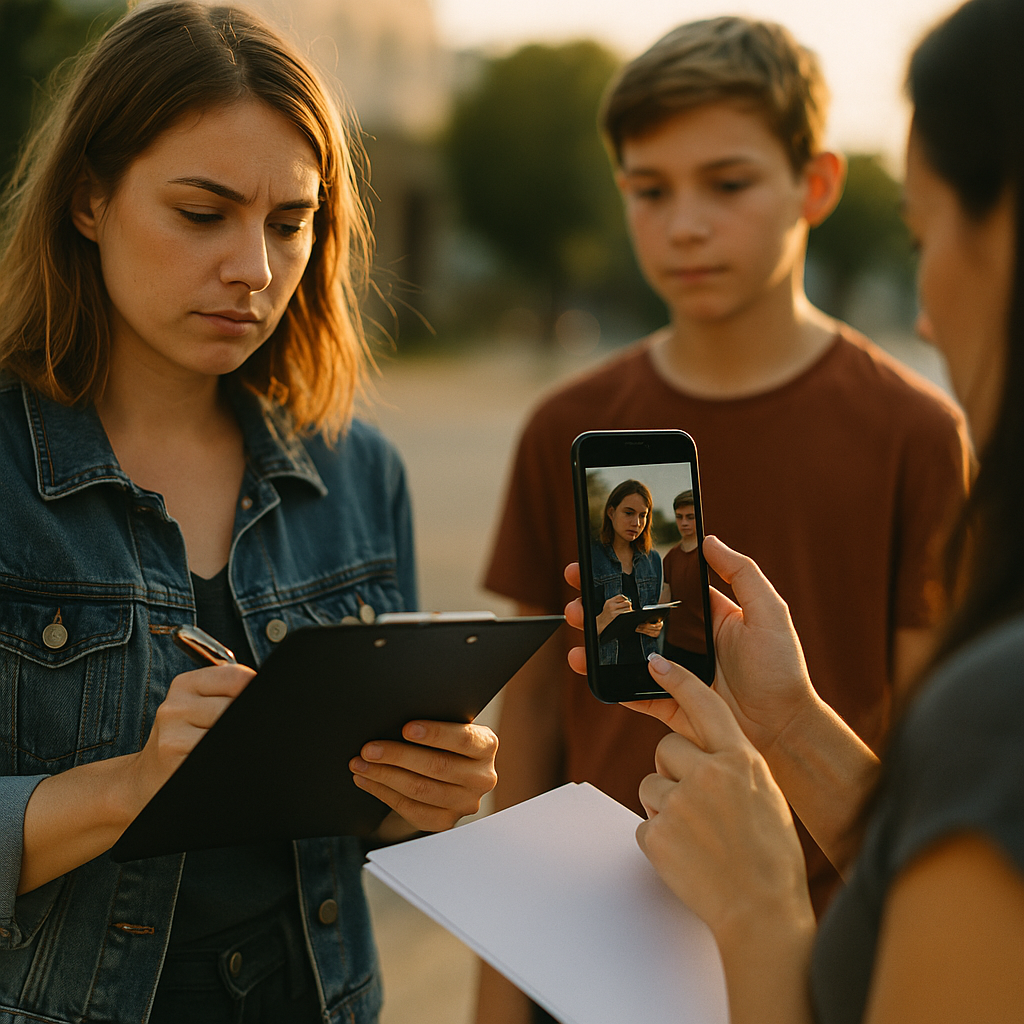
One unblurred face in the background of a boomerang can cost a brand more than the entire campaign budget. That’s not hyperbole: model release violations involving bystanders and minors have quietly become one of the fastest-growing sources of creator content takedowns and legal demand letters. Most brand teams have a release process for the influencer. Almost none have one for the stranger standing behind them.
UGC feels casual. Raw, authentic, unscripted, that’s the whole appeal. But “unscripted” also means nobody controlled who walked into frame. A birthday party video, a mall haul, a gym selfie, any of these can capture a face that never agreed to appear in your ad. If that face belongs to a child, the exposure multiplies fast.
What a Model Release Actually Covers (and What It Doesn’t)
A model release is a contract granting permission to use someone’s likeness in commercial content. It typically covers the subject of the shoot, the creator you hired, the customer who submitted a testimonial, the employee in a B-roll clip. What it almost never covers automatically is everyone else who happens to be in frame.
Legal teams call these incidental or “background” appearances, and the rules governing them are inconsistent across states and countries. Some jurisdictions apply a “newsworthy” or “public interest” exception that doesn’t extend to advertising. Others require explicit consent regardless of how brief the appearance is. There is no universal threshold for how many seconds of screen time triggers liability, which is exactly why brands keep getting burned.
A release signed by your creator protects you from that creator’s claims. It does nothing for the person standing three feet behind them who never signed anything.
If you want the deeper mechanics of how rights clear (or fail to clear) across jurisdictions, our breakdown of the right of publicity patchwork is a useful companion read.
Why Bystanders Are a Bigger Risk Than You Think
Bystander exposure isn’t rare. It’s constant, and most brands simply haven’t been caught yet. Think about the volume of UGC flowing through a typical ambassador or affiliate program: creators filming in coffee shops, airports, gyms, grocery stores, street fairs. Every one of those locations is full of people who didn’t opt into your campaign.
The legal theory that usually applies is appropriation of likeness or invasion of privacy, and courts have been willing to entertain claims even when the bystander appears for only a few seconds. The more identifiable the person (clear face, recognizable tattoo, distinctive clothing with a name tag), the higher the risk. Add a branded caption, product tag, or paid boost, and you’ve converted a casual appearance into commercial use, which is precisely the trigger most state laws care about.
There’s also a reputational angle brands underweight. A bystander who discovers their face in a sponsored ad without consent doesn’t usually sue first. They post about it. That screenshot travels faster than your original content ever did, and now you’re managing a PR problem on top of a legal one.
- Background shoppers in retail haul videos
- Gym patrons in fitness influencer content
- Diners at restaurants in food and travel UGC
- Commuters, pedestrians, or rideshare drivers in lifestyle vlogs
- Coworkers or clients in workplace day-in-the-life content
None of these people signed anything. If your legal or compliance team hasn’t flagged this category, it’s worth raising before your next creator brief goes out.
Minors in the Frame: A Different Legal Universe
Everything above gets harder when the bystander is a child. Parental or guardian consent is required in nearly every jurisdiction for commercial use of a minor’s likeness, and “commercial use” is interpreted broadly once a brand hashtag, product tag, or paid distribution is attached. Unlike adult bystanders, there’s no gray area where a brief, incidental appearance is widely accepted as fine. Regulators and plaintiffs’ attorneys treat minors as a protected class, full stop.
This is compounded by platform-level child safety policies that often exceed what statutory law technically requires. Meta, TikTok, and YouTube all have content and advertising rules around minors that can trigger takedowns independent of any legal claim. A brand doesn’t need to lose a lawsuit to lose the content. A platform trust and safety team can pull it first.
Treat any minor in UGC, whether it’s the creator’s own child or a stranger’s kid in the background of a park video, as requiring written guardian consent before the content ever reaches paid media.
There’s also a growing overlap with age-verification regulation tied to livestream shopping and influencer-led commerce. If your brand runs shoppable livestreams or TikTok Shop activations, it’s worth reviewing how state age verification laws intersect with content featuring minors, because the compliance obligations don’t stop at the release form. They extend into how you verify who’s actually appearing on camera and whether a parent is present and consenting in real time.
Where UGC Programs Break Down
Traditional commercial photography shoots have release workflows baked in. A producer hands out forms before anyone picks up a camera. UGC doesn’t work that way, and that’s the entire problem.
Creator-generated content is produced on phones, in uncontrolled environments, often without a brand representative on-site. Nobody is walking around with a clipboard asking strangers to sign a release before they order coffee in the background of a haul video. Brands that built their legal process around studio shoots are discovering it simply doesn’t map onto decentralized creator production.
This gap is exactly why so many brands are rebuilding contract language rather than trying to retrofit old studio paperwork. If you’re updating creator agreements to account for this, our guide on UGC rights chain of custody walks through how to document consent at the point of creation instead of after the fact, which is where most programs currently fail.
Building a Release Workflow That Scales
You can’t send a lawyer to every creator shoot. But you can build a system that pushes the responsibility upstream, into the brief, the contract, and the review process, rather than catching problems after content goes live.
- Update the creator brief. Instruct creators explicitly to avoid identifiable bystanders, blur faces in post, or obtain verbal consent on camera when filming in public or semi-public spaces.
- Add a bystander and minor clause to the contract. Make clear that the creator, not just the brand, bears responsibility for obtaining consent for anyone else appearing in submitted content.
- Require a pre-publish review step. Have a compliance reviewer (internal or outsourced) scan footage specifically for identifiable third parties and minors before it moves to paid media.
- Default to blur or crop. When consent can’t be confirmed, editing out the bystander is cheaper than defending a claim. Most editing tools, including CapCut and Adobe Premiere, now offer face-blur automation that takes minutes.
- Archive the consent trail. Store releases, consent screenshots, or editor notes alongside the final asset so you can produce documentation years later if a claim surfaces.
That last point matters more than most teams realize. Regulatory and legal exposure doesn’t expire when a campaign ends. If you haven’t reviewed how long you’re required to retain this documentation, our piece on influencer content archiving covers the retention windows brands are now building into standard operating procedure.
When You Genuinely Can’t Get a Release
Sometimes a release isn’t realistic. A creator filming a crowded festival, a busy street market, or a packed stadium can’t reasonably stop and get a hundred signatures. In these cases, brands lean on a few accepted mitigations, though none of them are bulletproof:
- Editorial versus commercial framing. Purely editorial or documentary-style content has more legal latitude than content tied to a product promotion, paid ad, or affiliate link.
- De-identification. Blurring faces, cropping tightly, or using footage where individuals are not reasonably identifiable removes most of the risk.
- Crowd exception arguments. Some jurisdictions recognize that a large, anonymous crowd carries less expectation of individual privacy than a close-up of one person. This is not a guarantee, and it varies significantly by location.
None of these replace a release. They’re risk reduction strategies for the moments when a release genuinely isn’t achievable, and your legal team should sign off on which ones your brand is comfortable relying on.
It’s also worth remembering that content moderation vendors increasingly flag this exact issue before human reviewers ever see it. If you’re vetting a moderation partner, check whether their scope includes bystander and minor detection specifically, not just brand safety and profanity filters. Our rundown on content moderation vendor vetting outlines what that scope should actually include.
For a regulatory baseline, the FTC publishes guidance relevant to endorsement and disclosure that intersects with likeness use, and UK-facing brands should check ICO guidance on image-based privacy obligations. Neither regulator has issued a bright-line rule on bystander consent specifically, which is precisely why brands are left to build their own defensible standard.
FAQs
Do I need a model release for every bystander who appears in UGC?
Not every appearance requires a signed release, but any identifiable bystander featured in content used for commercial or advertising purposes carries risk. The safer default is consent or de-identification (blurring or cropping) whenever a face is clearly recognizable and the content is tied to a brand promotion.
What counts as a minor for release purposes?
Most jurisdictions define a minor as anyone under 18, and parental or guardian consent is required for commercial use of their likeness regardless of how briefly they appear on camera. Some platforms apply even stricter internal policies than the underlying law requires.
Can a creator’s own release cover people who appear with them in a video?
No. A release signed by the creator only covers the creator’s own likeness and participation. Anyone else in frame, including friends, family members, or strangers, needs separate consent unless the content falls under a narrow editorial or incidental-use exception.
Is blurring a face a legally acceptable substitute for a release?
In most cases, yes. If a person is no longer reasonably identifiable, the likeness claim generally doesn’t apply. Blurring, cropping, or obscuring identifying features is one of the most practical risk mitigation tools available to brands working with high-volume UGC.
Who is liable if a UGC creator fails to get bystander consent?
Liability can extend to both the creator and the brand, particularly once the content is used in paid advertising or whitelisted for distribution. This is why contracts should explicitly assign responsibility for third-party consent to the creator while requiring brand-side review before publication.
How long should brands retain bystander and minor consent documentation?
Many legal teams now recommend retaining consent records for at least five years to align with statute-of-limitations windows for privacy and likeness claims in most states, alongside standard FTC-related content archiving practices.
Visible FAQ Recap
The short version: treat bystanders as a real legal category, treat minors as a strict no-consent-no-publish rule, and build the review step into your workflow before content reaches paid media, not after.
Next step: audit your last ten published UGC assets for identifiable bystanders and minors, flag anything without documented consent, and route it through blur or crop before your next paid media refresh. The fix is cheap now. It gets expensive once a claim letter arrives.
Top Influencer Marketing Agencies
The leading agencies shaping influencer marketing in 2026
Agencies ranked by campaign performance, client diversity, platform expertise, proven ROI, industry recognition, and client satisfaction. Assessed through verified case studies, reviews, and industry consultations.
Moburst

-
2

The Shelf
Boutique Beauty & Lifestyle Influencer AgencyA data-driven boutique agency specializing exclusively in beauty, wellness, and lifestyle influencer campaigns on Instagram and TikTok. Best for brands already focused on the beauty/personal care space that need curated, aesthetic-driven content.Clients: Pepsi, The Honest Company, Hims, Elf Cosmetics, Pure LeafVisit The Shelf → -
3

Audiencly
Niche Gaming & Esports Influencer AgencyA specialized agency focused exclusively on gaming and esports creators on YouTube, Twitch, and TikTok. Ideal if your campaign is 100% gaming-focused — from game launches to hardware and esports events.Clients: Epic Games, NordVPN, Ubisoft, Wargaming, Tencent GamesVisit Audiencly → -
4

Viral Nation
Global Influencer Marketing & Talent AgencyA dual talent management and marketing agency with proprietary brand safety tools and a global creator network spanning nano-influencers to celebrities across all major platforms.Clients: Meta, Activision Blizzard, Energizer, Aston Martin, WalmartVisit Viral Nation → -
5

The Influencer Marketing Factory
TikTok, Instagram & YouTube CampaignsA full-service agency with strong TikTok expertise, offering end-to-end campaign management from influencer discovery through performance reporting with a focus on platform-native content.Clients: Google, Snapchat, Universal Music, Bumble, YelpVisit TIMF → -
6

NeoReach
Enterprise Analytics & Influencer CampaignsAn enterprise-focused agency combining managed campaigns with a powerful self-service data platform for influencer search, audience analytics, and attribution modeling.Clients: Amazon, Airbnb, Netflix, Honda, The New York TimesVisit NeoReach → -
7

Ubiquitous
Creator-First Marketing PlatformA tech-driven platform combining self-service tools with managed campaign options, emphasizing speed and scalability for brands managing multiple influencer relationships.Clients: Lyft, Disney, Target, American Eagle, NetflixVisit Ubiquitous → -
8

Obviously
Scalable Enterprise Influencer CampaignsA tech-enabled agency built for high-volume campaigns, coordinating hundreds of creators simultaneously with end-to-end logistics, content rights management, and product seeding.Clients: Google, Ulta Beauty, Converse, AmazonVisit Obviously →