


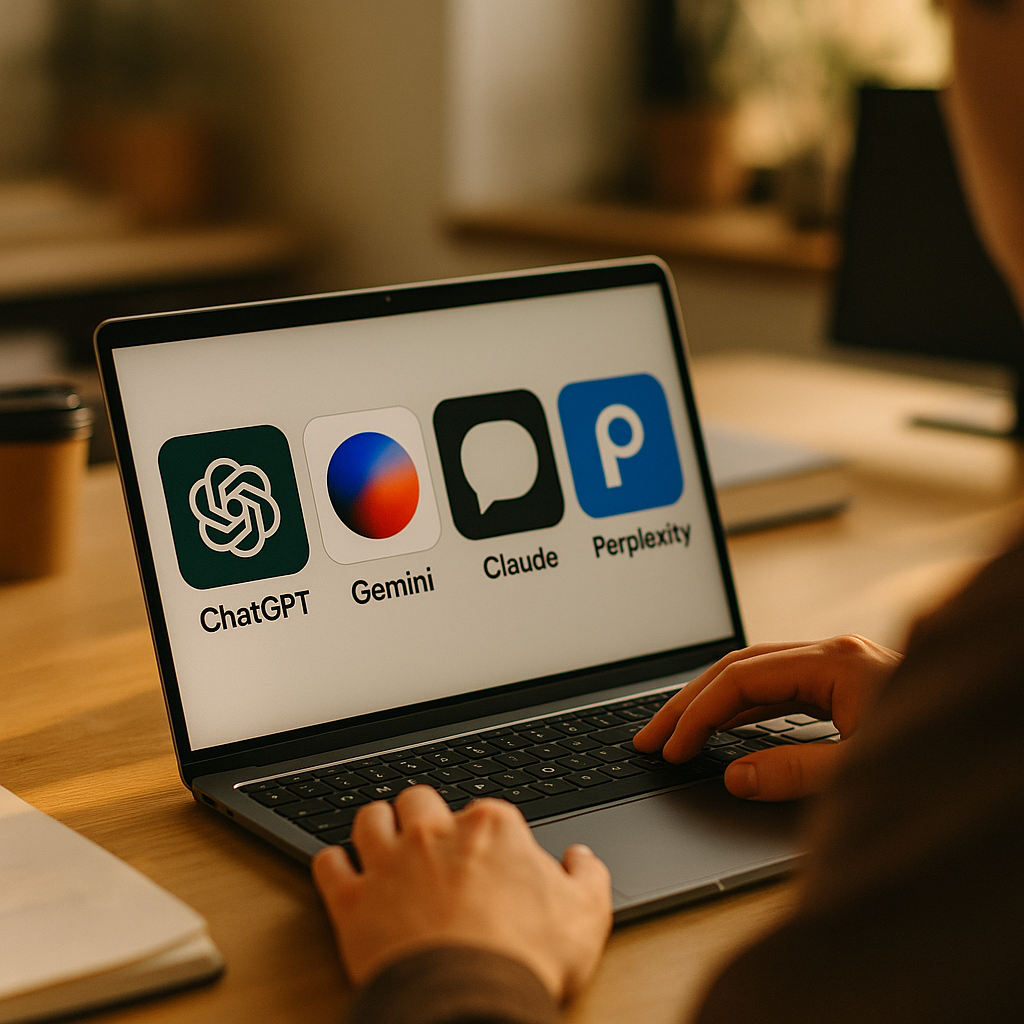
One platform now answers more questions than Google did a decade ago, yet it is already losing share. ChatGPT optimization has become the new SEO buzzword inside marketing teams, but here’s the uncomfortable truth: the generative search landscape is fragmenting faster than most brand strategies can adapt. If your entire AI visibility plan hinges on one chatbot, you are optimizing for yesterday’s map.
Marketers spent the better part of the past two years scrambling to understand how ChatGPT surfaces brands, products, and recommendations. Fair enough, it was the first mover with real consumer scale. But treating it as the permanent center of gravity for generative search is a strategic error with real budget consequences.
ChatGPT Isn’t the Only Doorway to Your Customers
OpenAI’s assistant still commands the largest share of conversational AI usage, but the gap is closing. Google’s AI Overviews now appear across a huge share of search queries, inserting themselves directly into the organic results pages brands have optimized for since the early 2000s. Anthropic’s Claude has carved out a loyal base among professionals and researchers. Perplexity has built an entire product around cited, source-forward answers that skew heavily toward purchase-consideration queries.
Each of these engines pulls from different data sources, weighs signals differently, and surfaces brand mentions through distinct logic. A product that ranks well in ChatGPT’s responses might be invisible in Perplexity’s citations or absent entirely from an AI Overview snippet. We’ve already covered how AI search strategy is forcing teams to split their tool stacks rather than consolidate around one assistant.
Optimizing exclusively for ChatGPT today is the equivalent of optimizing only for Internet Explorer in 2004. The dominant player rarely stays dominant once competitors ship fast enough.
Where the Traffic Is Actually Shifting
Referral data from multiple analytics platforms shows a pattern worth paying attention to. ChatGPT still drives the largest volume of AI-assisted referral traffic for most consumer brands, but its share of that traffic pool has been shrinking month over month as Gemini integration deepens across Android and Workspace, and as Microsoft Copilot gets bundled into enterprise software that millions of knowledge workers already use daily.
Industry research from eMarketer has tracked this shift in AI platform usage, and the direction is consistent: no single generative engine is projected to hold a dominant majority of query volume long term. Meanwhile, Statista survey data on AI assistant adoption shows younger demographics splitting their usage across three or more tools depending on task type, not defaulting to one.
That matters for brands because each engine represents a different acquisition channel with its own ranking signals, citation behavior, and disclosure requirements.
The Single-Platform Bet Nobody Should Make
Here’s the operational risk nobody wants to say out loud: brand teams that built their entire generative search playbook around ChatGPT prompt engineering are now discovering those tactics don’t transfer cleanly. Claude weighs long-form, structured content differently. Perplexity rewards sources with strong citation trails and recent publication dates. Google’s AI Overviews often strip out the very disclosure language that regulators require, a problem we detailed in AI Overviews strip disclosures.
Budget allocation compounds the problem. Teams that poured their entire generative search budget into ChatGPT-specific tooling now face a sunk cost problem. Reallocating mid-cycle is painful, but staying the course on a shrinking share of attention is worse.
There’s also a measurement blind spot. Most attribution stacks still treat “AI referral” as a single bucket rather than breaking it out by engine. That means a brand could be losing visibility in Gemini or Claude for months before anyone notices, because the dashboard only ever reported aggregate numbers. Tools built to trace this at the platform level, like the approach covered in connecting chatbot touchpoints to spend, are becoming table stakes rather than nice-to-haves.
What Diversification Actually Looks Like in Practice
Diversifying generative search strategy doesn’t mean spreading your team thin across every assistant on the market. It means building a visibility framework that accounts for how the top three or four engines actually source and surface brand information, then prioritizing based on where your audience spends time.
- Audit source diversity. Check whether your brand content appears in the training and retrieval sources each engine favors, not just your owned website. Wikipedia, Reddit threads, review aggregators, and trade press all feed different models unevenly.
- Structure content for extraction, not just ranking. Clear headers, direct answers near the top, and well-labeled data points get pulled into generative responses more reliably than dense marketing copy.
- Separate disclosure compliance by platform. FTC guidance on sponsored content doesn’t disappear because an answer came from a chatbot instead of a search results page. Review the FTC’s endorsement guidelines against how each engine renders creator and affiliate content, since stripped disclosures create real legal exposure.
- Track citation frequency per engine, not blended. If Claude cites your brand twice as often as ChatGPT for a given category query, that’s a resourcing signal, not a footnote.
This is also where creator content intersects with generative search risk. A growing share of what large language models cite comes from creator reviews, unboxing videos, and comparison content rather than brand-owned pages. That means influencer partnerships now double as generative search inputs, whether brands planned it that way or not. Our coverage of ChatGPT’s ad pitch and disclosure risk goes deeper into why that overlap is getting messier, not simpler.
Claude’s Rise Changes the Calculus for B2B Brands
If your buyer persona skews toward technical, research-heavy, or enterprise audiences, Claude’s growing footprint deserves more attention than most brand teams currently give it. Anthropic has positioned the assistant around accuracy and nuanced reasoning, which tends to attract exactly the professional users B2B marketers are trying to reach. We broke down how marketers are already rethinking brief strategy around this shift in Claude gains on ChatGPT, and the practical upshot is simple: content written purely to game ChatGPT’s conversational style often underperforms in Claude’s more analytical retrieval pattern.
Ignoring that gap means ceding visibility in exactly the channel where high-value B2B queries increasingly happen.
Measuring Share of Model, Not Just Share of Voice
Traditional share of voice metrics were built for a media landscape with a handful of channels. Generative search demands a new metric entirely, something closer to “share of model,” meaning how consistently your brand gets surfaced, cited, or recommended across the engines your actual customers use.
Building this out requires cross-functional coordination between SEO, PR, and influencer teams that historically operated in silos. Internal AI task auditing matters here too. Research referenced in 61 percent use AI daily found that most organizations use generative tools constantly but rarely audit how those tools are shaping outward-facing content or creator briefs, which creates blind spots exactly where generative search visibility is being won or lost.
Platforms like Sprout Social and HubSpot have both started building AI-mention tracking into their analytics suites, a sign that the martech industry recognizes this measurement gap and is racing to fill it. Brands that wait for a single unified dashboard to solve this will fall behind competitors building manual tracking processes today.
Share of voice told you how loud you were. Share of model tells you whether the machines recommending products to your customers even know you exist.
So What Should Brands Actually Do Next Quarter?
Start with an honest audit. Pull every piece of generative search tooling, prompt library, and content guideline your team has built over the past year and ask: was this built for one platform or for the category? If the answer is one platform, you have work to do.
Reallocate a portion, not all, of ChatGPT-specific optimization budget toward testing visibility in Gemini, Claude, and Perplexity. Small pilot tests reveal a lot quickly. Run the same core content through each engine’s retrieval behavior and compare citation rates. The differences will likely surprise you, and that surprise is the exact signal you need to rebalance spend intelligently.
Frequently Asked Questions
FAQs
What does generative search share mean for brands?
Generative search share refers to how often and how prominently a brand gets mentioned, cited, or recommended across AI assistants like ChatGPT, Gemini, Claude, and Perplexity. It replaces traditional search rankings as the new visibility battleground.
Is ChatGPT optimization still worth doing?
Yes, ChatGPT still drives significant referral traffic and remains the most widely used consumer assistant, but it should be one part of a broader strategy rather than the entire plan. Relying on it exclusively leaves brands exposed as usage shifts to other platforms.
How do I know if my content performs well across different AI engines?
Test the same core content pieces through multiple assistants and track citation frequency, accuracy of brand mentions, and whether disclosures appear correctly. Manual spot checks combined with emerging AI-mention tracking tools in platforms like Sprout Social or HubSpot can help quantify this.
Does influencer content affect generative search visibility?
Yes. Many large language models pull heavily from creator reviews, comparison videos, and third-party content rather than brand-owned pages, meaning influencer partnerships increasingly double as inputs into what AI engines recommend to consumers.
What compliance risks come with generative search diversification?
Different AI engines handle sponsored content disclosures inconsistently, and some strip disclosure language entirely when summarizing content. Brands need to audit each platform separately against FTC endorsement guidelines rather than assuming one compliance check covers all engines.
The brands that win the next phase of generative search won’t be the ones with the cleverest ChatGPT prompts. They’ll be the ones who built measurement and content systems flexible enough to track, and act on, share shifts across every engine their customers actually use.
Top Influencer Marketing Agencies
The leading agencies shaping influencer marketing in 2026
Agencies ranked by campaign performance, client diversity, platform expertise, proven ROI, industry recognition, and client satisfaction. Assessed through verified case studies, reviews, and industry consultations.
Moburst

-
2

The Shelf
Boutique Beauty & Lifestyle Influencer AgencyA data-driven boutique agency specializing exclusively in beauty, wellness, and lifestyle influencer campaigns on Instagram and TikTok. Best for brands already focused on the beauty/personal care space that need curated, aesthetic-driven content.Clients: Pepsi, The Honest Company, Hims, Elf Cosmetics, Pure LeafVisit The Shelf → -
3

Audiencly
Niche Gaming & Esports Influencer AgencyA specialized agency focused exclusively on gaming and esports creators on YouTube, Twitch, and TikTok. Ideal if your campaign is 100% gaming-focused — from game launches to hardware and esports events.Clients: Epic Games, NordVPN, Ubisoft, Wargaming, Tencent GamesVisit Audiencly → -
4

Viral Nation
Global Influencer Marketing & Talent AgencyA dual talent management and marketing agency with proprietary brand safety tools and a global creator network spanning nano-influencers to celebrities across all major platforms.Clients: Meta, Activision Blizzard, Energizer, Aston Martin, WalmartVisit Viral Nation → -
5

The Influencer Marketing Factory
TikTok, Instagram & YouTube CampaignsA full-service agency with strong TikTok expertise, offering end-to-end campaign management from influencer discovery through performance reporting with a focus on platform-native content.Clients: Google, Snapchat, Universal Music, Bumble, YelpVisit TIMF → -
6

NeoReach
Enterprise Analytics & Influencer CampaignsAn enterprise-focused agency combining managed campaigns with a powerful self-service data platform for influencer search, audience analytics, and attribution modeling.Clients: Amazon, Airbnb, Netflix, Honda, The New York TimesVisit NeoReach → -
7

Ubiquitous
Creator-First Marketing PlatformA tech-driven platform combining self-service tools with managed campaign options, emphasizing speed and scalability for brands managing multiple influencer relationships.Clients: Lyft, Disney, Target, American Eagle, NetflixVisit Ubiquitous → -
8

Obviously
Scalable Enterprise Influencer CampaignsA tech-enabled agency built for high-volume campaigns, coordinating hundreds of creators simultaneously with end-to-end logistics, content rights management, and product seeding.Clients: Google, Ulta Beauty, Converse, AmazonVisit Obviously →