


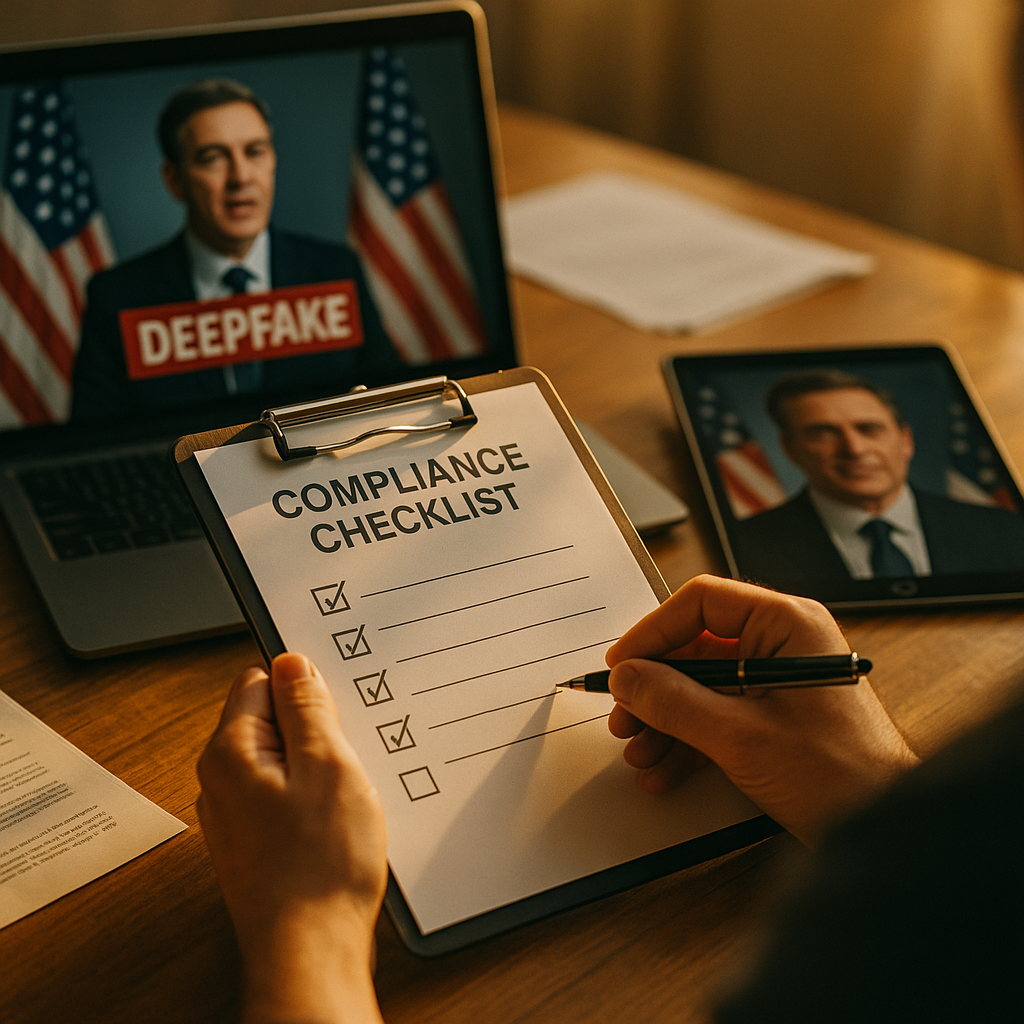
Compliance Rules for Deepfake Disclosure in Advocacy Ads have shifted from niche guidance to front-line risk management in 2025. Advocacy groups, PACs, nonprofits, agencies, and platforms now face overlapping legal, platform, and ethical expectations when synthetic media appears in political or issue advertising. This article translates the rules into practical steps, explains what regulators and voters expect, and highlights pitfalls that trigger complaints, takedowns, and fines—so you can plan confidently before launch.
Deepfake disclosure laws for advocacy advertising
In 2025, the most important reality is that “deepfake” compliance is rarely governed by a single rule. Your obligations can come from election statutes, consumer protection laws, defamation and right-of-publicity principles, and platform policies. The compliance approach should start with a jurisdiction-and-distribution map: where the ad is shown, who is targeted, what the ad depicts, and how it is labeled.
What counts as a deepfake for disclosure purposes? Many rules focus on “materially deceptive” or “synthetic/manipulated” media that would mislead a reasonable viewer about what a real person said or did. That typically includes AI-generated voice clones, face swaps, and fully synthetic video of a candidate or public figure. It can also include heavily edited “cheapfakes” if the edit changes meaning (for example, splicing words to reverse a position).
Why advocacy ads are a special case: Issue advocacy often runs outside traditional candidate committees, moves quickly, and relies on emotionally resonant storytelling. That makes it more likely to use reenactments, dramatizations, or AI narration. Those techniques are legal in many places, but disclosure becomes critical when the content might be interpreted as authentic footage or authentic speech.
Practical compliance baseline:
- Assume disclosure is required when synthetic media depicts identifiable real people in a way that could affect beliefs about facts, endorsements, or conduct.
- Assume stricter scrutiny close to elections, when ad urgency rises and audience attention drops.
- Document intent and process to show you did not aim to deceive and that you used reasonable safeguards.
Answering the common follow-up: “What if we label it as satire?” Satire can reduce risk, but it is not a shield if the ad’s overall impression still misleads a reasonable viewer, or if the satire label is too subtle, too late, or contradicted by the visuals and distribution strategy.
Political ad transparency requirements and disclaimers
Deepfake disclosure sits alongside standard political advertising transparency: who paid for the message, whether it was authorized, and whether it qualifies as electioneering communication or independent expenditure under applicable rules. In 2025, regulators and platforms increasingly expect deepfake labels to be additive to “paid for by” disclaimers, not a substitute.
Core disclosure elements to get right:
- Sponsor identification: clear “Paid for by” (or local equivalent), matching the registered entity name where applicable.
- Authorization status: if required, state whether the message is authorized by a candidate or committee (or note it is not authorized).
- Synthetic media disclosure: a plain-language statement that AI or synthetic techniques were used, placed where the audience will actually notice it.
Placement matters as much as wording. A disclosure in tiny text, flashed for a fraction of a second, or buried in a landing page may fail both legal expectations and platform review. Aim for “clear and conspicuous” as an operational standard:
- Video: on-screen disclosure long enough to read, with strong contrast; also include in audio if the deception risk is primarily auditory (voice cloning).
- Audio-only: spoken disclosure near the beginning or end, at normal speed and volume.
- Static and display: disclosure visible without clicking; avoid placement in hover states or truncation-prone areas.
Follow-up question: “Can we just say ‘Dramatization’?” If the content uses AI to generate or alter a real person’s likeness or voice, “Dramatization” may be insufficient. Use wording that communicates synthetic manipulation plainly, such as “This video includes AI-generated imagery/voice” and add “Dramatization” only if it is also true.
Synthetic media labeling standards for clear disclosure
Because laws and platform rules vary, the safest approach is to adopt a labeling standard that works across contexts and survives hostile scrutiny. That means using language that is specific, unambiguous, and tied to the viewer’s likely takeaway.
Recommended label components (mix and match):
- What: “AI-generated” or “AI-altered.”
- Which element: “voice,” “video,” “image,” or “scene.”
- Purpose/format: “simulation,” “reenactment,” or “dramatization,” when accurate.
- Reality anchor: “Not an authentic recording.”
Example disclosures that tend to perform well:
- “AI-altered video: This footage is manipulated and not an authentic recording.”
- “AI-generated voice: The narration is synthetic.”
- “Simulation: Scenes are AI-generated for illustration.”
Make the label resilient to clipping and reposting. Advocacy ads often get screen-recorded, cropped, or reposted out of context. Place a persistent label (a corner bug or repeated lower-third) so the disclosure survives common edits. If the content may be excerpted as “proof,” add an opening title card plus an end card.
Accessibility is compliance. If the disclosure relies solely on small text, it may not be “clear” to many users. Use readable sizes, contrast, and audio equivalents. Consider captions that include the disclosure and do not auto-hide.
Follow-up question: “Do we need to disclose if we only used AI for color correction or noise reduction?” If the AI use does not materially change meaning or depict someone doing or saying something they did not do, deepfake-style disclosure is usually unnecessary. Still, keep internal records of edits in case of complaints, and never let minor enhancements drift into meaning-changing manipulation without updating labels.
Platform policies for deepfakes and political content
Even where local law is unclear, platform enforcement is immediate and can be stricter than legal minimums. In 2025, major ad platforms commonly require identity verification, political advertiser authorization, ad library transparency, and additional review for manipulated media. A compliant campaign therefore treats platform policy as a first-class rule set.
Operational steps that reduce takedown risk:
- Pre-clearance planning: build extra lead time for manual review, especially near elections and for high-spend accounts.
- Consistency across surfaces: match the disclosure in the creative, the caption, and the landing page; inconsistencies trigger escalations.
- Keep the “raw” and “edit” trail: maintain source files, prompts, generation logs, and edit notes so you can respond to reviewer questions quickly.
- Ad library readiness: assume your ad and targeting metadata will be publicly searchable; avoid wording that looks like stealth persuasion.
Common failure modes:
- Disclosure mismatch: the video says “simulation,” but the caption implies authenticity (or vice versa).
- Implied endorsement: synthetic likeness of a public figure appears to support or oppose an issue without clear disclosure and context.
- Context collapse: the ad is cut into a short clip where the disclosure disappears; platforms may still act if the original is the source.
Follow-up question: “If the platform approves it, are we safe legally?” No. Approval reduces distribution risk but does not immunize you from complaints, regulator inquiries, or civil claims. Treat approval as one checkpoint, not the final one.
Risk management and legal review for AI-generated advocacy ads
Strong compliance is a system, not a label. The groups that avoid crises in 2025 use a repeatable workflow that ties creative decisions to legal and reputational risk.
Build a synthetic media review checklist:
- Materiality test: could this synthetic element change a reasonable viewer’s belief about a real person’s words, actions, or endorsement?
- Identity test: is a person identifiable by face, voice, name, context, or distinctive traits?
- Timing test: are we near an election or high-sensitivity event where special restrictions or heightened scrutiny apply?
- Audience test: are we targeting vulnerable audiences or using microtargeting where deception risk increases?
- Claims test: are factual assertions backed by evidence, and can we produce substantiation quickly?
Rights and permissions: Using a synthetic likeness can implicate right-of-publicity, defamation, false light, and trademark principles. Even if the message is issue-focused, portraying a real person can create litigation exposure. When in doubt:
- Prefer consenting talent (actors) rather than cloning a real person.
- Avoid realistic replicas of private individuals without explicit written permission.
- Be careful with public figures: public status does not eliminate all claims, and it does not remove platform policy constraints.
Internal governance that demonstrates EEAT: Decision-makers should be identifiable and accountable. Create an internal “synthetic media owner” role (often legal/compliance plus creative ops) and require sign-off before publishing. Keep a short “ad fact sheet” that lists sources for claims, what was synthetically generated, and where disclosures appear.
Follow-up question: “What if a vendor created the deepfake?” You remain responsible as the sponsor. Vendor contracts should require disclosure compliance, provide audit rights, and specify who bears costs for takedowns, re-edits, and claims. Require vendors to deliver generation logs and provenance notes as part of the final assets.
Enforcement, penalties, and crisis response for disclosure failures
When deepfake disclosure fails, consequences arrive through multiple channels: platform takedowns, refund denials, loss of verification, regulator inquiries, press scrutiny, and civil litigation. The fastest way to contain damage is to treat deepfake incidents like a communications and compliance emergency, not a creative disagreement.
Common triggers for enforcement:
- Viewer complaints that the ad misrepresents a real person’s speech or actions.
- Opposition monitoring and rapid-response teams flagging synthetic elements to journalists and platforms.
- Inconsistent disclaimers across versions, languages, or placements.
- Missing provenance when asked to prove what was generated and how.
Incident response plan (keep it simple and fast):
- Pause distribution of affected creatives immediately.
- Preserve evidence: save files, ad IDs, spend, targeting, and timestamps; do not overwrite versions.
- Assess harm: determine who is depicted, what claim is implied, and which jurisdictions are involved.
- Remediate: add stronger disclosures, replace synthetic segments, or pull the ad entirely.
- Communicate: if public attention is likely, prepare a direct statement that explains the use of synthetic media and the corrective steps taken.
Clear takeaway for enforcement readiness: The organizations that fare best can quickly show what was synthetic, why it was used, how it was disclosed, and how claims were substantiated.
FAQs: Deepfake disclosure in advocacy ads
Do advocacy ads have to disclose AI-generated content in 2025?
Often yes when the synthetic element is materially deceptive or could mislead viewers about a real person’s words, actions, or endorsement. Even where a statute is unclear, platform policies frequently require clear labeling.
What is the safest wording for a deepfake disclosure?
Use plain language that states both the technique and the implication: “AI-altered video” or “AI-generated voice,” plus “not an authentic recording” when viewers might assume it is real.
Where should the disclosure appear in a video ad?
Place it on-screen in readable text for long enough to be understood, and repeat it if the ad is long or likely to be clipped. Add an audio disclosure if the key risk is voice cloning.
Is “parody” or “satire” enough to avoid disclosure rules?
Not reliably. If the overall impression can still mislead a reasonable viewer, you should disclose synthetic manipulation clearly and early.
Do we need consent to use a public figure’s likeness in a synthetic advocacy ad?
Consent requirements vary and public figure status does not eliminate risk. Even if a claim might be defensible under free-expression principles, you can still face platform enforcement and civil claims. Get legal review before using identifiable likeness or voice.
How can we prove we complied if challenged?
Maintain an audit trail: source footage, generation prompts/logs, edit notes, versions, screenshots showing disclosures, ad platform submission records, and substantiation for factual claims.
Compliance in 2025 requires more than adding fine print after an ad is finished. Treat synthetic media as a design constraint: decide early what will be generated, how it might mislead, and where disclosures will live across every format and placement. Use clear labels, keep provenance records, align with platform rules, and run a structured legal review before launch. Done well, transparency protects both persuasion and credibility.