


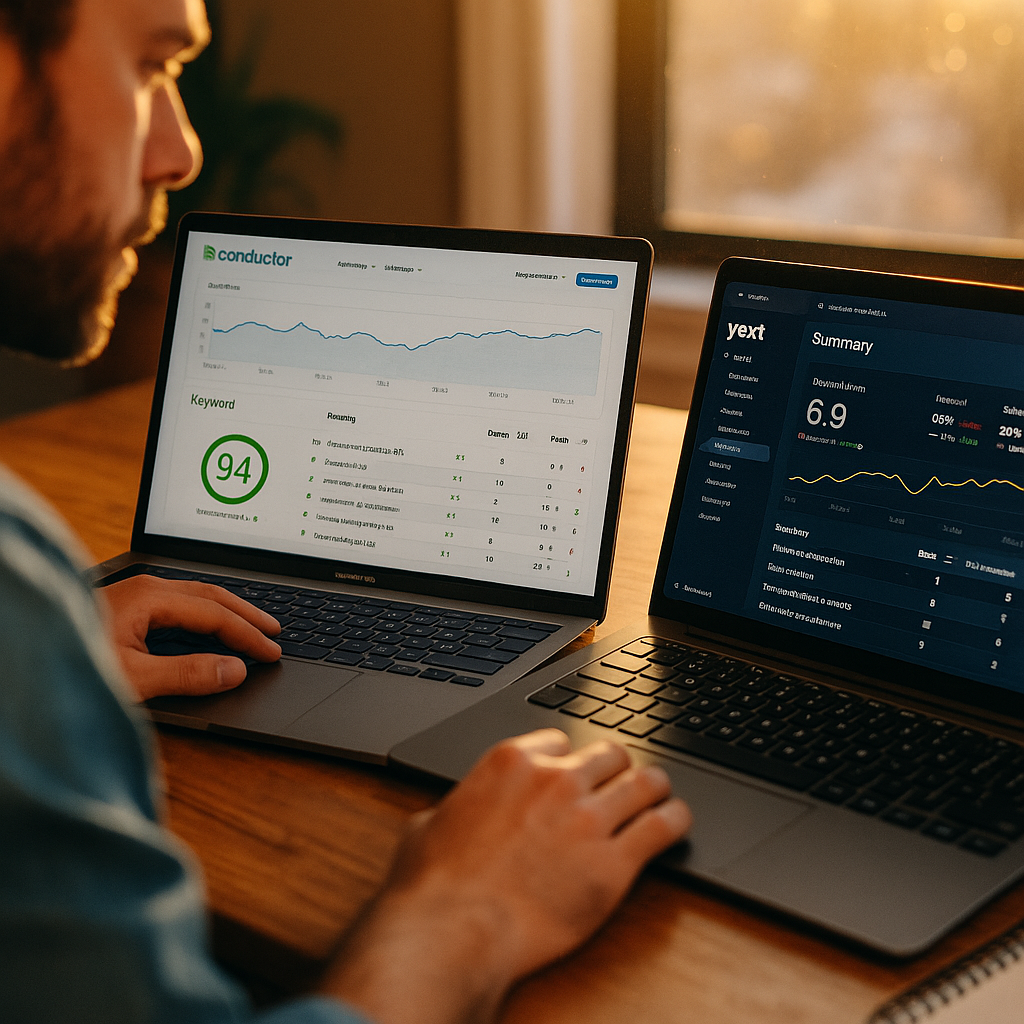
Only 12% of marketing leaders say they can accurately track how often their brand shows up in AI-generated answers, according to recent surveys circulating in enterprise SEO circles. If that number makes your stomach drop, you’re not alone. Answer engine optimization (AEO) monitoring has become the new battleground for visibility, and two platforms keep coming up in every vendor shortlist: Conductor and Yext. But picking one isn’t really the question. The real question is what a complete AEO monitoring stack looks like heading into next year.
Why AEO Monitoring Became Non-Negotiable
Search behavior has shifted. Users ask ChatGPT, Perplexity, and Google’s AI Overviews direct questions instead of typing keyword strings into a search bar. That shift changes everything about how brands earn visibility. Traditional rank tracking tells you where you sit on a results page. It says nothing about whether an AI model cites your brand, misattributes your product claims, or ignores you entirely in favor of a competitor.
Marketing teams that built their reporting stack around organic search rankings are now scrambling. Budgets are shifting, and fast. eMarketer’s research on AI search adoption shows a growing share of consumers starting product research inside conversational AI tools rather than traditional search engines. That’s not a niche behavior anymore. It’s mainstream, and it’s accelerating.
If your brand isn’t showing up in AI-generated answers, it doesn’t matter how well you rank on page one. The customer never sees the page.
Conductor’s Approach: SEO Roots, AEO Bolted On
Conductor built its reputation on enterprise SEO workflow tools, content scoring, technical audits, keyword research at scale. Its AEO suite extends that foundation rather than replacing it. For brand teams already running Conductor for organic search, the AEO layer feels like a natural upgrade path instead of a rip-and-replace decision.
The practical upside: Conductor’s platform ties AI visibility data back into the same content workflows your writers and strategists already use. A content brief that used to optimize purely for search intent now includes prompts for how that content might get surfaced or cited inside an AI answer. That’s a meaningful efficiency gain for teams that don’t want to run two separate toolsets with two separate reporting cadences.
The tradeoff is depth. Conductor’s AEO monitoring is strong on integration but can feel less granular than platforms built AEO-first, especially when you need citation-level detail across multiple AI engines simultaneously. We covered this tension in more detail in our breakdown of the Conductor enterprise AEO suite, and the short version is: expect strong workflow integration, moderate citation granularity.
Yext Bets on the Knowledge Graph
Yext takes a fundamentally different angle. Instead of extending an SEO toolset, Yext leans on its long history in structured data and listings management. The pitch is that AI models pull from structured, verified data sources when generating answers, so the fastest path to citation is feeding those models clean, consistent firmographic and product data at scale.
This shows up clearly in Yext’s Commercial Graph play, which packages firmographic data specifically to make brands more citable inside AI answer engines. We dug into how that mechanism actually works in our piece on turning firmographics into AI citations, and it’s a genuinely different philosophy from Conductor’s content-first approach. Yext is betting that structured data wins the citation war. Conductor is betting that optimized content wins it.
Which bet is correct? Honestly, both are partially right. That’s exactly why most serious monitoring stacks end up using more than one tool.
The Real Comparison Isn’t Feature-by-Feature
Here’s where a lot of vendor comparisons go wrong. They line up feature checklists, Conductor has X, Yext has Y, and declare a winner. That’s the wrong framework for AEO monitoring specifically, because the category is still young and no single vendor has solved citation tracking, sentiment analysis, and structured data optimization in one unified product.
Instead, ask three operational questions:
- Where does your team already have workflow gravity? If your content team lives inside Conductor daily, adding AEO signals there reduces friction. If your data or ops team already manages structured listings through Yext, extending that footprint makes more sense than introducing a parallel system.
- What’s your citation risk profile? B2B brands with complex product catalogs and frequent claims (pricing, specs, compliance language) need tighter structured data hygiene, which favors a Yext-style approach. Content-heavy consumer brands often benefit more from Conductor’s content optimization loop.
- How will you validate the data? Neither platform’s citation counts should be taken at face value. Independent verification matters, which is exactly the gap third-party AEO visibility tools are trying to fill. Our analysis of whether brand citations are real or noise is worth reading before you commit budget to any single vendor’s dashboard.
Building the Full Stack: What’s Actually Required
Neither Conductor nor Yext alone constitutes a complete AEO monitoring stack. Treating either as a one-stop solution is where most brands get burned. A genuinely resilient stack for the year ahead needs four components working together.
Citation tracking across multiple engines. ChatGPT, Perplexity, Gemini, and Google AI Overviews don’t pull from identical sources or weight signals the same way. A stack that only monitors one engine is monitoring a fraction of your actual exposure. Semrush has entered this space aggressively too, and our review of the Semrush AI visibility suite is a useful third data point when you’re weighing Conductor against Yext.
Structured data hygiene. This is table stakes now, not a nice-to-have. Schema markup, consistent NAP data, verified product specs. If your structured data is messy, no amount of content optimization fixes the underlying citation problem.
Content governance. AI models cite content, but they also amplify errors and outdated claims at scale in ways traditional search never did. A single stale pricing page can get quoted verbatim by a chatbot months after you’ve updated it internally. This is why content governance tooling has become part of the AEO conversation rather than a separate discipline. We explored this overlap in our piece on AI content governance for enterprise buyers.
Attribution back to business outcomes. Citations are meaningless if you can’t tie them to pipeline or revenue. This is the piece most vendors gloss over, and it’s arguably the hardest to solve. If a prospect gets your brand recommended inside a ChatGPT conversation and later converts, does anyone in your CRM know that happened? Probably not yet. This is a live problem across the creator and content ecosystem broadly, and it echoes the attribution gaps we’ve documented in creator attribution chaos more generally.
Budget Reality Check
Enterprise AEO tooling isn’t cheap, and stacking multiple platforms compounds that cost quickly. Before signing anything, run the numbers against your actual traffic and revenue exposure to AI-driven discovery. A mid-market brand pulling modest volume from AI search engines doesn’t need the same monitoring depth as an enterprise B2B company where a single missed citation could mean a lost six-figure deal.
This is also where vendor evaluation discipline matters more than brand-name recognition. Conductor and Yext are both credible, well-funded platforms, but “credible” isn’t the same as “right for your specific stack.” If you’re weighing multiple AI-adjacent vendors across your broader marketing operation, not just AEO tools, our AI agent vendor evaluation scorecard lays out a repeatable framework for comparing unified stacks without getting swayed by demo polish.
The brands winning at AEO in the next cycle won’t be the ones with the most tools. They’ll be the ones who can prove which tool actually drove a citation, a click, or a closed deal.
Industry context matters here too. HubSpot’s research on marketing technology adoption consistently shows that tool sprawl, not tool scarcity, is what kills ROI measurement inside marketing orgs. AEO monitoring is at real risk of repeating that pattern if brands buy Conductor, Yext, and three other point solutions without a coherent measurement layer tying them together.
What This Means for Your Team Next Quarter
Start with an audit, not a purchase. Before adding Conductor or Yext to your stack, map where your brand currently appears (or doesn’t) across the major AI answer engines. That baseline tells you which gaps actually need solving. A content-heavy brand with weak structured data has a different problem than a data-rich brand with thin content depth, and the tooling priority flips accordingly.
Then pilot narrow. Run a 90-day test on one platform against a defined set of priority queries or topics rather than a full enterprise rollout. AEO monitoring is evolving fast enough that locking into a three-year contract before you’ve validated citation accuracy is a real risk. The Federal Trade Commission’s guidance on advertising and endorsement disclosures is also worth reviewing if your AEO strategy touches creator or affiliate content, since AI-surfaced claims carry the same compliance exposure as traditional advertising.
FAQs
Frequently Asked Questions
What is AEO monitoring, and how is it different from SEO tracking?
AEO monitoring tracks how often and how accurately a brand gets cited inside AI-generated answers from tools like ChatGPT, Perplexity, and Google AI Overviews. Traditional SEO tracking measures ranking position on a search results page, while AEO monitoring measures citation frequency, sentiment, and accuracy within conversational AI responses.
Should I choose Conductor or Yext for AEO monitoring?
The right choice depends on your existing workflow gravity and citation risk profile. Conductor suits teams already embedded in content-driven SEO workflows, while Yext fits brands prioritizing structured data and firmographic accuracy. Many enterprise teams end up using both alongside a third-party verification layer.
How much does an AEO monitoring stack typically cost?
Costs vary widely based on enterprise tier, number of monitored engines, and query volume. Brands should benchmark platform cost against actual traffic and revenue exposure tied to AI-driven discovery before committing to multi-tool stacks.
Can I rely on a single platform’s citation data as accurate?
No single platform should be treated as the final word on citation accuracy. Independent verification through third-party AEO visibility tools helps confirm whether reported citations reflect real, consistent brand mentions or inflated, one-off data points.
What’s the biggest mistake brands make when building an AEO stack?
Buying multiple overlapping tools without a unified attribution layer. Citation data becomes noise if it can’t be tied back to pipeline or revenue outcomes, which is why governance and attribution matter as much as the monitoring tool itself.
Next step: Audit your current AI citation footprint across at least three major engines before evaluating Conductor or Yext, then pilot whichever platform addresses your biggest gap for one quarter before committing to an enterprise contract.
Top Influencer Marketing Agencies
The leading agencies shaping influencer marketing in 2026
Agencies ranked by campaign performance, client diversity, platform expertise, proven ROI, industry recognition, and client satisfaction. Assessed through verified case studies, reviews, and industry consultations.
Moburst

-
2

The Shelf
Boutique Beauty & Lifestyle Influencer AgencyA data-driven boutique agency specializing exclusively in beauty, wellness, and lifestyle influencer campaigns on Instagram and TikTok. Best for brands already focused on the beauty/personal care space that need curated, aesthetic-driven content.Clients: Pepsi, The Honest Company, Hims, Elf Cosmetics, Pure LeafVisit The Shelf → -
3

Audiencly
Niche Gaming & Esports Influencer AgencyA specialized agency focused exclusively on gaming and esports creators on YouTube, Twitch, and TikTok. Ideal if your campaign is 100% gaming-focused — from game launches to hardware and esports events.Clients: Epic Games, NordVPN, Ubisoft, Wargaming, Tencent GamesVisit Audiencly → -
4

Viral Nation
Global Influencer Marketing & Talent AgencyA dual talent management and marketing agency with proprietary brand safety tools and a global creator network spanning nano-influencers to celebrities across all major platforms.Clients: Meta, Activision Blizzard, Energizer, Aston Martin, WalmartVisit Viral Nation → -
5

The Influencer Marketing Factory
TikTok, Instagram & YouTube CampaignsA full-service agency with strong TikTok expertise, offering end-to-end campaign management from influencer discovery through performance reporting with a focus on platform-native content.Clients: Google, Snapchat, Universal Music, Bumble, YelpVisit TIMF → -
6

NeoReach
Enterprise Analytics & Influencer CampaignsAn enterprise-focused agency combining managed campaigns with a powerful self-service data platform for influencer search, audience analytics, and attribution modeling.Clients: Amazon, Airbnb, Netflix, Honda, The New York TimesVisit NeoReach → -
7

Ubiquitous
Creator-First Marketing PlatformA tech-driven platform combining self-service tools with managed campaign options, emphasizing speed and scalability for brands managing multiple influencer relationships.Clients: Lyft, Disney, Target, American Eagle, NetflixVisit Ubiquitous → -
8

Obviously
Scalable Enterprise Influencer CampaignsA tech-enabled agency built for high-volume campaigns, coordinating hundreds of creators simultaneously with end-to-end logistics, content rights management, and product seeding.Clients: Google, Ulta Beauty, Converse, AmazonVisit Obviously →