


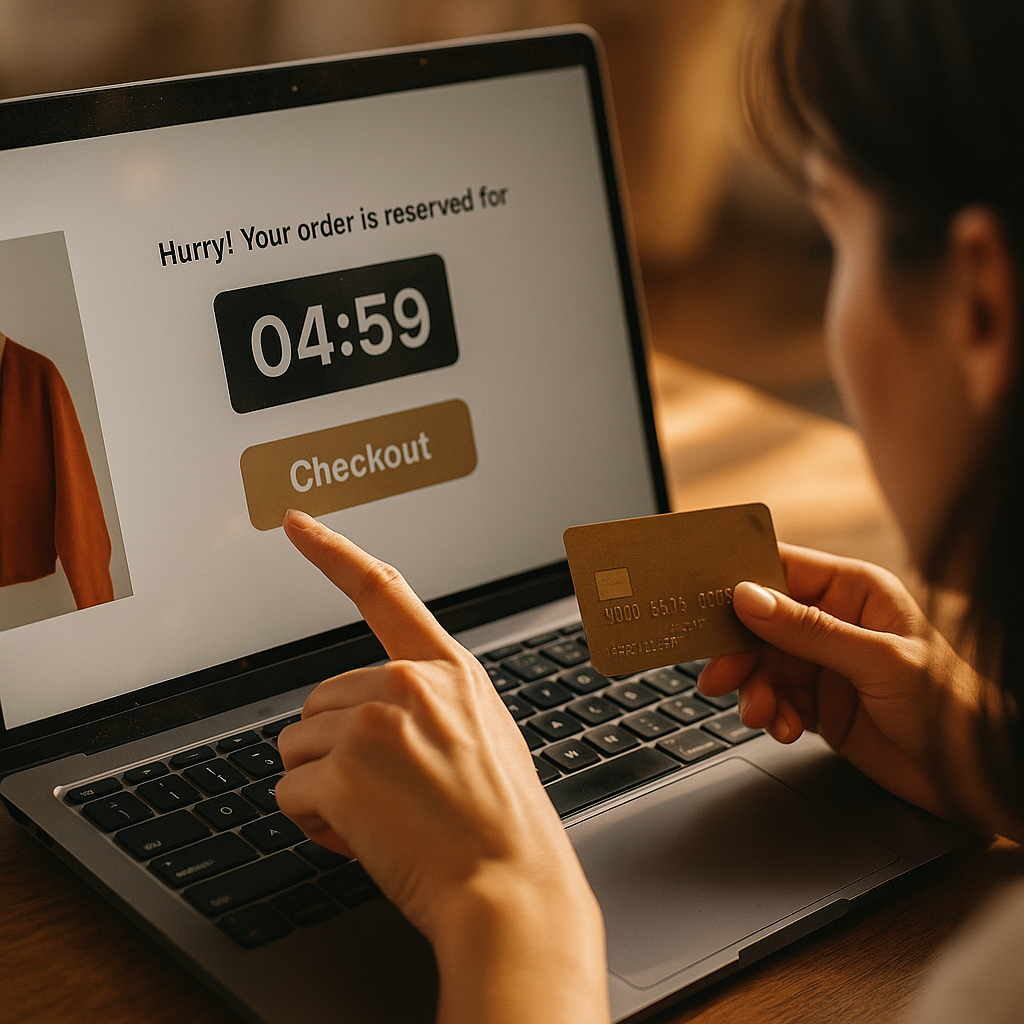
Videos with an on-screen countdown convert shoppable traffic at measurably higher rates than those without one, yet most brands still bolt a timer onto a finished edit as an afterthought. That’s backwards. The countdown hook format, when scripted into the first three seconds and tied to a real constraint, is one of the few urgency tactics that still works on audiences who have been trained to ignore “limited time” banners since 2015. Done wrong, it reads as manipulative. Done right, it’s the difference between a scroll and a checkout.
Why Countdown Hooks Still Work When Everything Else Feels Like Noise
Urgency fatigue is real. Shoppers have seen a thousand “24 hours only” banners and learned to distrust most of them. But a visible, moving countdown inside a video behaves differently than a static badge. It’s kinetic. It demands attention because the brain is wired to track changing numbers, the same reflex that makes a loading bar or a sports clock impossible to ignore.
The format also solves a structural problem in shoppable short-form video: viewers decide whether to keep watching within the first two seconds. A countdown overlay, even a subtle one, signals “something is about to end” before the viewer has processed the product at all. That’s a hook mechanism, not just a sales gimmick, and it pairs naturally with the kind of fast-cut openers covered in discovery feed hook scripting.
A countdown only creates urgency if the viewer believes the clock is real. Fake scarcity gets flagged by audiences faster than it gets flagged by platforms.
The Core Mechanics: Clock, Constraint, Consequence
Every effective countdown hook has three components working together, and skipping any one of them collapses the format into generic hype.
- Clock: A visible, moving timer, either literal (digits ticking down) or implied (a shrinking inventory counter, a diminishing stock bar).
- Constraint: A specific, verifiable limit. Not “while supplies last” but “47 units left” or “offer ends 6pm ET.”
- Consequence: What happens when the clock hits zero. Price reverts, bundle disappears, or the drop sells out. If nothing actually changes, viewers notice, and repeat exposure trains them to ignore your next countdown entirely.
Brands running TikTok Shop and Instagram Shop drops have found that pairing a literal countdown with inventory data pulled live from the backend outperforms a cosmetic timer by a wide margin, mostly because creators can speak to the number with specificity instead of vague filler language.
Scripting the First Three Seconds Around the Countdown
The opening beat should do double duty: establish the product category and plant the clock. A common structural mistake is introducing the countdown after the product demo, which wastes the format’s biggest asset, its ability to stop a scroll before the viewer has fully committed to watching.
A tighter structure looks like this:
- Second 0 to 1: Timer or counter appears on screen, paired with a verbal cue (“this drop ends in…”).
- Second 1 to 3: Product reveal, framed as the reason the clock matters.
- Second 3 to 8: Quick proof point (price, scarcity number, or social proof).
- Second 8 onward: Demo or styling content, with the timer persisting in a corner overlay.
This mirrors the logic behind short form demo hooks scripting the first three seconds, except the countdown replaces curiosity with a harder, time-boxed form of tension. Curiosity asks “what happens next?” A countdown asks “what happens if I don’t act?” Both are hooks, but the countdown version converts faster on shoppable formats because it removes the browsing phase entirely.
Platform Differences Actually Matter Here
TikTok Shop’s live countdown stickers and flash sale widgets are purpose-built for this format, and creators can trigger them directly inside live shopping sessions, which is where most of the heaviest urgency-driven GMV still happens. Instagram and YouTube Shorts lack a native countdown sticker with checkout integration, so brands have to bake the timer into the edit itself, usually as a lower-third graphic or a progress bar animation.
That distinction changes the brief. On TikTok, you’re scripting around a platform-native tool and the creator’s job is mostly verbal reinforcement. On Instagram or YouTube, the countdown has to be designed into the footage, which means it needs a motion graphics pass before publishing, adding a production step that TikTok Shop skips entirely. Check TikTok’s advertising resources for current specs on live shopping countdown widgets, since these change frequently and briefs built on outdated specs tend to underperform.
Countdown Hooks Pair Well With Other Formats, Not in Place of Them
The countdown shouldn’t be the entire creative strategy. It’s a layer that intensifies an existing format. A try-on haul with a countdown overlay still needs the fit-anxiety beats covered in try-on haul scripting. A product explainer with a timer still needs the proof points from product explainer hooks that beat vibes-only content. Strip those elements out and the countdown becomes empty pressure with nothing behind it, which audiences read as desperation rather than scarcity.
Some of the strongest performing shoppable drops combine a countdown with a split-screen reaction structure, where one frame shows the clock and stock count while the other shows a creator actually using the product. The approach borrows directly from the technique detailed in split screen reviews pairing reactions with product proof, and it solves the single biggest weakness of countdown-only content: it gives the viewer a reason to care about the clock beyond raw FOMO.
Measuring Whether the Urgency Actually Converts
Brands tend to track clicks and GMV during the countdown window and declare victory. That’s an incomplete read. The real test is whether conversion rate during the countdown period meaningfully beats the baseline conversion rate for the same creator and product outside a countdown frame. Without that control comparison, you can’t tell if the countdown drove the lift or if the creator, the product, or the audience segment would have converted at similar rates anyway.
A few metrics worth isolating in reporting dashboards:
- Conversion rate in the final 10 percent of the countdown window versus the first 10 percent (a healthy format shows a visible spike near zero).
- Repeat exposure decay, meaning whether the same audience segment converts at a lower rate on the brand’s second or third countdown video.
- Return rate on countdown-driven purchases compared to standard purchases, since impulse-driven urgency buys can skew returns higher if sizing or fit information was rushed.
That last point connects to a broader issue the format tends to create: urgency-driven purchases that aren’t fully informed purchases. Brands running frequent countdown drops should pair them with the kind of transparency shown in returns proof demo videos, which actually reduces the return-rate penalty by setting expectations before checkout rather than after.
Tools like Sprout Social and native platform analytics can isolate time-window performance if UTM parameters are set up correctly before the drop goes live, not retrofitted afterward. This sounds basic. It’s the step most teams skip because the launch is rushed, and then the post-mortem has no clean data to work with.
Compliance: The Part Everyone Skips Until Legal Gets Involved
Countdown hooks sit close to the FTC’s guidance on false scarcity and deceptive urgency claims, and brands running these at scale should treat the compliance review as part of the creative brief, not a final-stage checkbox. The core rule is simple: whatever the timer claims has to be true at the moment the video is published and remain true for as long as the video stays live. If a “sells out in 2 hours” claim is still running on a video posted three weeks ago, that’s a liability, not a marketing asset.
Review the FTC’s guidance on endorsements and advertising claims before building a countdown template into a recurring creator program, especially if multiple creators will reuse the same script across different regions or time zones, where “ends tonight” stops meaning the same thing depending on where the viewer is sitting.
The fastest way to turn a performing format into a compliance incident is letting creators repost an evergreen video with an expired countdown claim still visible.
Build a sunset clause into every countdown brief: a hard date when the video gets pulled or the overlay gets edited out, regardless of how well it’s performing. It’s an extra production step, but it’s cheaper than a regulatory inquiry.
Where This Format Is Headed
Expect countdown mechanics to merge further with live shopping and limited-drop microdrama formats, where the clock becomes part of the narrative rather than a UI element bolted onto commerce footage. The shoppable micro drama approach already borrows cliffhanger pacing from serialized video. A countdown overlay is a natural extension of that, giving the cliffhanger a literal, visible expiration.
Brands that treat the countdown as a scripting discipline, not a graphic template, will keep getting lift from the format even as audiences grow more skeptical of generic urgency language. Those that slap a timer onto whatever footage already exists will see the format’s returns decay fast, probably within two or three cycles, as the same audience segments start recognizing the pattern.
FAQs
Do countdown hooks actually increase conversion rates on shoppable video?
Yes, when the countdown is tied to a verifiable constraint and placed in the opening seconds, brands typically see a measurable lift near the end of the countdown window compared to baseline conversion rates for the same creator and product.
What’s the biggest mistake brands make with countdown formats?
Treating the timer as a cosmetic overlay added after the edit is finished, rather than scripting the product reveal and proof points around the clock from the first second.
Is a countdown hook legally risky?
It can be if the scarcity claim isn’t true or if an evergreen video with an expired countdown stays live. Brands should build a sunset date into every brief and review current FTC guidance before scaling the format across multiple creators.
Which platforms support native countdown tools for shoppable video?
TikTok Shop offers live countdown stickers and flash sale widgets built for checkout flows. Instagram and YouTube Shorts require the timer to be designed into the footage itself, usually as a motion graphics overlay.
Can countdown hooks increase return rates?
They can, since urgency-driven purchases sometimes skip sizing or fit research. Pairing countdown drops with clear returns and sizing information in the same video helps offset this.
Next step: audit your last three countdown-driven drops for one thing only: did the clock’s claim stay true for the entire time the video was live? If any didn’t, fix that before scripting another countdown hook, because the format’s entire value depends on viewers believing the number on screen.
Top Influencer Marketing Agencies
The leading agencies shaping influencer marketing in 2026
Agencies ranked by campaign performance, client diversity, platform expertise, proven ROI, industry recognition, and client satisfaction. Assessed through verified case studies, reviews, and industry consultations.
Moburst

-
2

The Shelf
Boutique Beauty & Lifestyle Influencer AgencyA data-driven boutique agency specializing exclusively in beauty, wellness, and lifestyle influencer campaigns on Instagram and TikTok. Best for brands already focused on the beauty/personal care space that need curated, aesthetic-driven content.Clients: Pepsi, The Honest Company, Hims, Elf Cosmetics, Pure LeafVisit The Shelf → -
3

Audiencly
Niche Gaming & Esports Influencer AgencyA specialized agency focused exclusively on gaming and esports creators on YouTube, Twitch, and TikTok. Ideal if your campaign is 100% gaming-focused — from game launches to hardware and esports events.Clients: Epic Games, NordVPN, Ubisoft, Wargaming, Tencent GamesVisit Audiencly → -
4

Viral Nation
Global Influencer Marketing & Talent AgencyA dual talent management and marketing agency with proprietary brand safety tools and a global creator network spanning nano-influencers to celebrities across all major platforms.Clients: Meta, Activision Blizzard, Energizer, Aston Martin, WalmartVisit Viral Nation → -
5

The Influencer Marketing Factory
TikTok, Instagram & YouTube CampaignsA full-service agency with strong TikTok expertise, offering end-to-end campaign management from influencer discovery through performance reporting with a focus on platform-native content.Clients: Google, Snapchat, Universal Music, Bumble, YelpVisit TIMF → -
6

NeoReach
Enterprise Analytics & Influencer CampaignsAn enterprise-focused agency combining managed campaigns with a powerful self-service data platform for influencer search, audience analytics, and attribution modeling.Clients: Amazon, Airbnb, Netflix, Honda, The New York TimesVisit NeoReach → -
7

Ubiquitous
Creator-First Marketing PlatformA tech-driven platform combining self-service tools with managed campaign options, emphasizing speed and scalability for brands managing multiple influencer relationships.Clients: Lyft, Disney, Target, American Eagle, NetflixVisit Ubiquitous → -
8

Obviously
Scalable Enterprise Influencer CampaignsA tech-enabled agency built for high-volume campaigns, coordinating hundreds of creators simultaneously with end-to-end logistics, content rights management, and product seeding.Clients: Google, Ulta Beauty, Converse, AmazonVisit Obviously →