


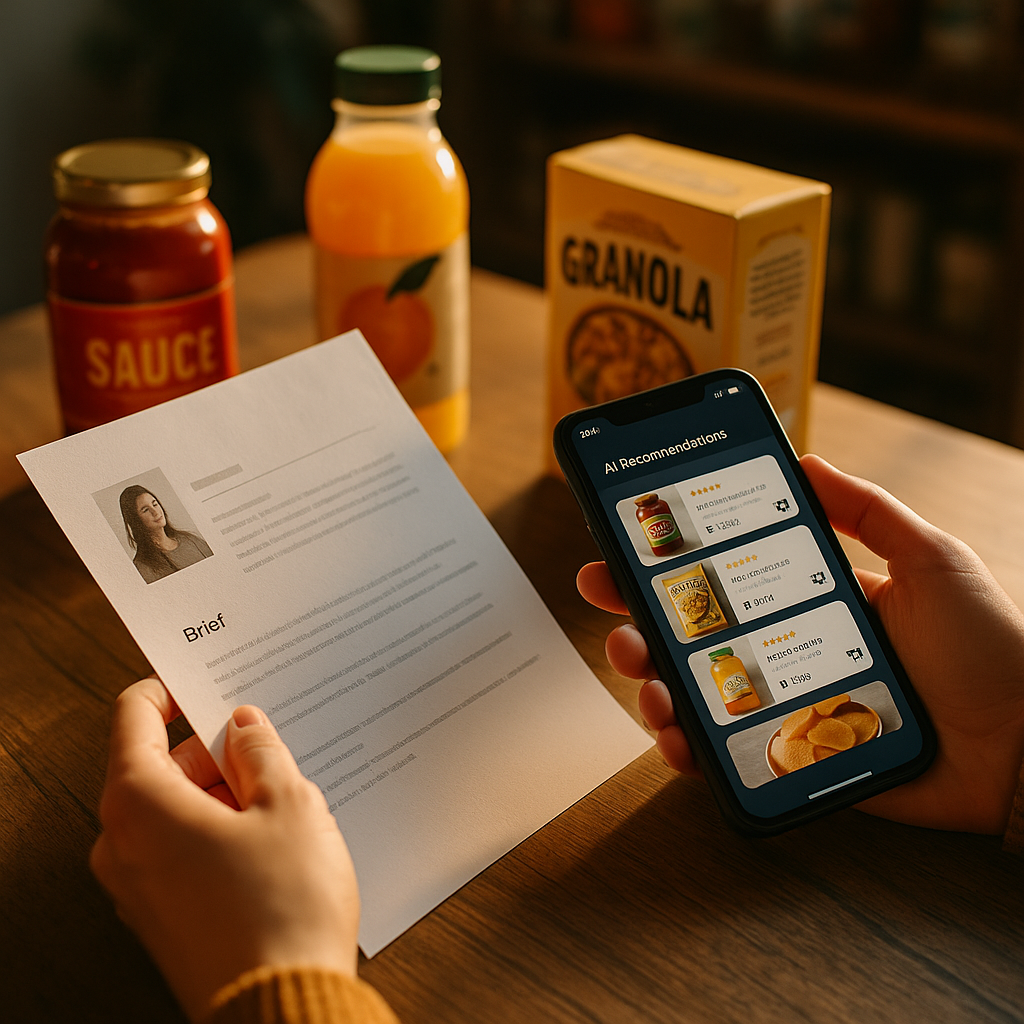
AI Shopping Answers Don’t Know Your Product Exists — Unless Your Creators Said So First
Over 40% of consumers now use AI chat tools as their first stop for product discovery, according to data from Statista. For CPG brands, that single stat should rewrite how you brief creators. GEO content strategy for CPG is no longer optional — it’s the difference between appearing in a ChatGPT shopping recommendation and being invisible to an entire discovery channel.
Why Most CPG Creator Content Fails the AI Retrieval Test
Here’s the uncomfortable truth: most CPG influencer content is optimized for human dopamine, not machine retrieval. A creator saying “obsessed with this serum” is compelling on Reels. It is useless to a large language model trying to answer “what’s the best fragrance-free moisturizer for sensitive skin with ceramides under $25?”
ChatGPT, Gemini, and Perplexity retrieve answers by scanning indexed web content, including blog posts, captions, video transcripts, and review pages. When those sources lack specific, factual, verifiable language about your product’s formulation, certifications, or use cases, the AI simply has nothing to cite. Your brand doesn’t lose; it just never enters the conversation.
The fix isn’t more content. It’s better-structured content with the right information density baked into the creator brief itself. Learn how creator briefs get cited in AI answers and you’ll understand why the brief is the real leverage point.
What “Factual Product Density” Actually Means for a CPG Brief
Factual product density is a term worth defining precisely. It refers to the ratio of verifiable, specific product claims inside a piece of creator content relative to its total length. A 60-second TikTok that mentions one claim (“moisturizes skin”) has low density. The same video that names the active ingredient, the concentration, the dermatologist-tested certification, the scent profile, and the price point has high density.
For CPG teams writing creator direction, this means your brief must supply creators with a structured facts module. Not a brand story paragraph. A facts module — a bulleted list of specific, citable claims that creators are expected to weave into their natural language. Think of it as the raw material an AI will later need to reconstruct an accurate product description in a recommendation answer.
- Ingredient specificity: Name the active ingredients and their function. “Contains 4% niacinamide to visibly minimize pores” outperforms “has skin-smoothing ingredients” every time.
- Concentration and format: “0.5% retinol in an oil-free gel” is indexable. “Powerful retinol formula” is not.
- Certifications and third-party validations: EWG Verified, NSF Certified, USDA Organic, dermatologist-tested. These are the authority signals AI models weight heavily.
- Comparative positioning: “Fragrance-free, paraben-free, suitable for eczema-prone skin” answers the exact query structures users type into AI chat tools.
- Price and availability context: Retail price range and channel (Target, Amazon, DTC) help AI tools qualify your product against user budget queries.
The brands winning AI shopping recommendations aren’t running more creator campaigns. They’re running campaigns where every creator post functions as a structured data deposit that retrieval models can actually use.
Authoritative Claim Structure: The Hierarchy AI Models Trust
Not all claims are created equal in the eyes of a language model. AI retrieval systems assign implicit weight based on specificity, source type, and consistency across indexed content. CPG teams need to brief creators with this hierarchy in mind.
At the top: third-party validated claims. If a dermatologist reviewed the formula, say so explicitly in the brief and instruct creators to state it clearly. If the product has a clinical trial result (“reduces redness in 72 hours, clinically tested”), that claim needs to appear verbatim across creator content, your own DTC product pages, press coverage, and Amazon listings. Consistency across multiple indexed sources is what triggers AI confidence in a claim.
In the middle: specific use-case framing. Creators should articulate not just what the product does but for whom and in what scenario. “For anyone with hormonal breakouts who can’t tolerate heavy acids” is a high-authority contextual claim because it mirrors the natural language of AI queries. Vague claims (“great for all skin types”) rank low in retrieval weight because they match nothing specifically.
At the base: experiential language. Creators can and should share personal experience, but that content alone will not surface your product in a competitive AI recommendation. It needs to sit on top of, not instead of, the factual layer. This layering principle is what separates a GEO-optimized brief from a standard influencer brief. The architecture of a high-performing creator brief applies to AI reach just as it does to algorithmic feed reach.
Writing the GEO-Optimized Section of Your CPG Creator Brief
Practically speaking, your brief should include a dedicated GEO module — a section explicitly labeled for AI search optimization. Most creators have never heard of generative engine optimization, so frame it simply: “These facts need to appear in your caption, video script, or both, because consumers are now finding products by asking AI chatbots direct questions.”
The GEO module should contain:
- The target query: State the actual AI question you want your product to answer. Example: “What’s a clean, fragrance-free sunscreen with SPF 50 that doesn’t pill under makeup?” Creators who internalize the question write content that answers it.
- Required claim set: Five to eight specific, verifiable claims that must appear somewhere in the content. Not exact scripts — required facts. The creator’s voice stays intact; the factual payload is non-negotiable.
- Prohibited vague language: List the generics you do not want. “Natural,” “clean,” “powerful,” and “effective” without qualifiers are disallowed. They dilute density.
- Transcript and caption requirements: For video, the brief must specify that key product claims appear in spoken dialogue (for auto-transcription indexing) and in the caption (for text indexing). Both matter. For deeper context on video-specific structure, see how video briefs get structured for AI citations.
One more operational point: brief your creators to publish long-form companion content where possible. A 60-second Reel backed by a 400-word blog post or YouTube description that includes the full facts module creates a second indexable asset from the same campaign. Statista research confirms that AI tools pull from longer text contexts at higher rates than short captions alone.
The Compliance Layer CPG Teams Can’t Skip
CPG claims are regulated. The FTC governs advertising substantiation, and for food, supplement, and personal care products, the FDA has its own claim categories (structure/function vs. disease claims, nutrient content claims, etc.). Any GEO module you write must go through your legal and regulatory review before it goes into a brief.
This is not a reason to write vague claims. It is a reason to nail the precise, legally approved language once, lock it in, and then replicate it consistently across every creator, every channel, and every owned asset. That consistency is both compliance hygiene and your most powerful GEO signal. AI retrieval models treat repeated, consistent claims across multiple independent sources as evidence of factual reliability.
For compliance-forward briefing frameworks, the principles around FTC compliance in creator briefs apply directly here, even in a GEO context.
Scaling This Across a Creator Roster
The operational challenge is real. CPG brands often run dozens of creators simultaneously across multiple SKUs. Scaling a GEO-optimized brief process requires two things most teams don’t have yet: a centralized product facts library and a brief QA step that checks for GEO density before a brief goes out.
A product facts library is exactly what it sounds like: a master document per SKU that contains every approved specific claim, every certification, every validated use-case statement, and every prohibited generic term. Brand managers pull from it; legal approves updates to it. When a new creator is onboarded, they get the relevant SKU fact sheet as part of their brief package.
Brands that treat creator content as structured data inputs rather than standalone creative outputs will own the AI recommendation layer before most competitors realize it exists.
The brief QA step asks a simple question before sending: if an AI scanned only this creator’s caption and transcript, could it confidently recommend our product for the target query? If the answer is no, the brief goes back for a revision. This single quality gate, added to existing workflows, meaningfully improves GEO performance over a campaign cycle. It also directly improves your ability to brief creators for AI-first discovery across platforms simultaneously.
External tools from HubSpot and platforms like Sprout Social are beginning to incorporate GEO performance tracking, which gives brand teams a feedback loop to measure whether creator-driven content is generating AI citation volume, not just social engagement.
Start this week: take your top three SKUs, draft a GEO module for each using the framework above, and add the AI query target as the first line. Send one brief with the module and one without to two matched creators. The performance gap over 60 days will tell you everything you need to scale.
Frequently Asked Questions
What is GEO content strategy for CPG brands?
GEO stands for generative engine optimization. For CPG brands, it means designing creator content and brand-owned assets so that the factual product information inside them is specific, verifiable, and structured in a way that AI tools like ChatGPT and Gemini can retrieve and cite accurately when users ask product recommendation questions.
Why do AI tools like ChatGPT fail to recommend CPG products accurately?
AI retrieval models can only surface information that exists in their indexed sources. When creator content uses vague, generic language (“moisturizes skin,” “clean formula”) without specific ingredients, certifications, or validated claims, the AI has no factual anchor to match against specific user queries. The product effectively becomes invisible in AI-generated shopping answers.
What should a CPG creator brief include for GEO optimization?
A GEO-optimized CPG creator brief should include a dedicated facts module with: the specific AI query the product should answer, five to eight required verifiable claims (active ingredients, concentrations, certifications, price range, use-case framing), a list of prohibited vague terms, and instructions that key claims must appear in both spoken dialogue and written captions to maximize indexability across multiple retrieval paths.
How does ingredient specificity affect AI shopping recommendations?
Ingredient specificity is one of the highest-weight signals in AI product retrieval because it directly matches the way consumers phrase shopping queries. A user asking “what moisturizer has ceramides and hyaluronic acid under $20” will only get a brand recommendation if a creator’s transcript or caption explicitly names those ingredients and includes a price reference. Vague language cannot be matched to specific queries.
Does FTC compliance conflict with GEO-optimized product claims?
No, but it does require careful sequencing. CPG teams should develop their legally approved, specific claim language first through regulatory review, then lock that language into the brand’s product facts library, and finally distribute it through creator briefs. Legal precision and GEO specificity are aligned goals. Vague claims are a compliance risk and a GEO liability at the same time.
How do CPG brands scale GEO briefing across multiple SKUs and creators?
The most effective operational model is a centralized product facts library — a master document per SKU containing all approved specific claims, certifications, validated use-case language, and prohibited generic terms. Brand managers pull from this library when building creator briefs. A brief QA step that asks whether an AI could recommend the product based solely on the creator’s content ensures GEO density is maintained at scale.
Top Influencer Marketing Agencies
The leading agencies shaping influencer marketing in 2026
Agencies ranked by campaign performance, client diversity, platform expertise, proven ROI, industry recognition, and client satisfaction. Assessed through verified case studies, reviews, and industry consultations.
Moburst

-
2

The Shelf
Boutique Beauty & Lifestyle Influencer AgencyA data-driven boutique agency specializing exclusively in beauty, wellness, and lifestyle influencer campaigns on Instagram and TikTok. Best for brands already focused on the beauty/personal care space that need curated, aesthetic-driven content.Clients: Pepsi, The Honest Company, Hims, Elf Cosmetics, Pure LeafVisit The Shelf → -
3

Audiencly
Niche Gaming & Esports Influencer AgencyA specialized agency focused exclusively on gaming and esports creators on YouTube, Twitch, and TikTok. Ideal if your campaign is 100% gaming-focused — from game launches to hardware and esports events.Clients: Epic Games, NordVPN, Ubisoft, Wargaming, Tencent GamesVisit Audiencly → -
4

Viral Nation
Global Influencer Marketing & Talent AgencyA dual talent management and marketing agency with proprietary brand safety tools and a global creator network spanning nano-influencers to celebrities across all major platforms.Clients: Meta, Activision Blizzard, Energizer, Aston Martin, WalmartVisit Viral Nation → -
5

The Influencer Marketing Factory
TikTok, Instagram & YouTube CampaignsA full-service agency with strong TikTok expertise, offering end-to-end campaign management from influencer discovery through performance reporting with a focus on platform-native content.Clients: Google, Snapchat, Universal Music, Bumble, YelpVisit TIMF → -
6

NeoReach
Enterprise Analytics & Influencer CampaignsAn enterprise-focused agency combining managed campaigns with a powerful self-service data platform for influencer search, audience analytics, and attribution modeling.Clients: Amazon, Airbnb, Netflix, Honda, The New York TimesVisit NeoReach → -
7

Ubiquitous
Creator-First Marketing PlatformA tech-driven platform combining self-service tools with managed campaign options, emphasizing speed and scalability for brands managing multiple influencer relationships.Clients: Lyft, Disney, Target, American Eagle, NetflixVisit Ubiquitous → -
8

Obviously
Scalable Enterprise Influencer CampaignsA tech-enabled agency built for high-volume campaigns, coordinating hundreds of creators simultaneously with end-to-end logistics, content rights management, and product seeding.Clients: Google, Ulta Beauty, Converse, AmazonVisit Obviously →