


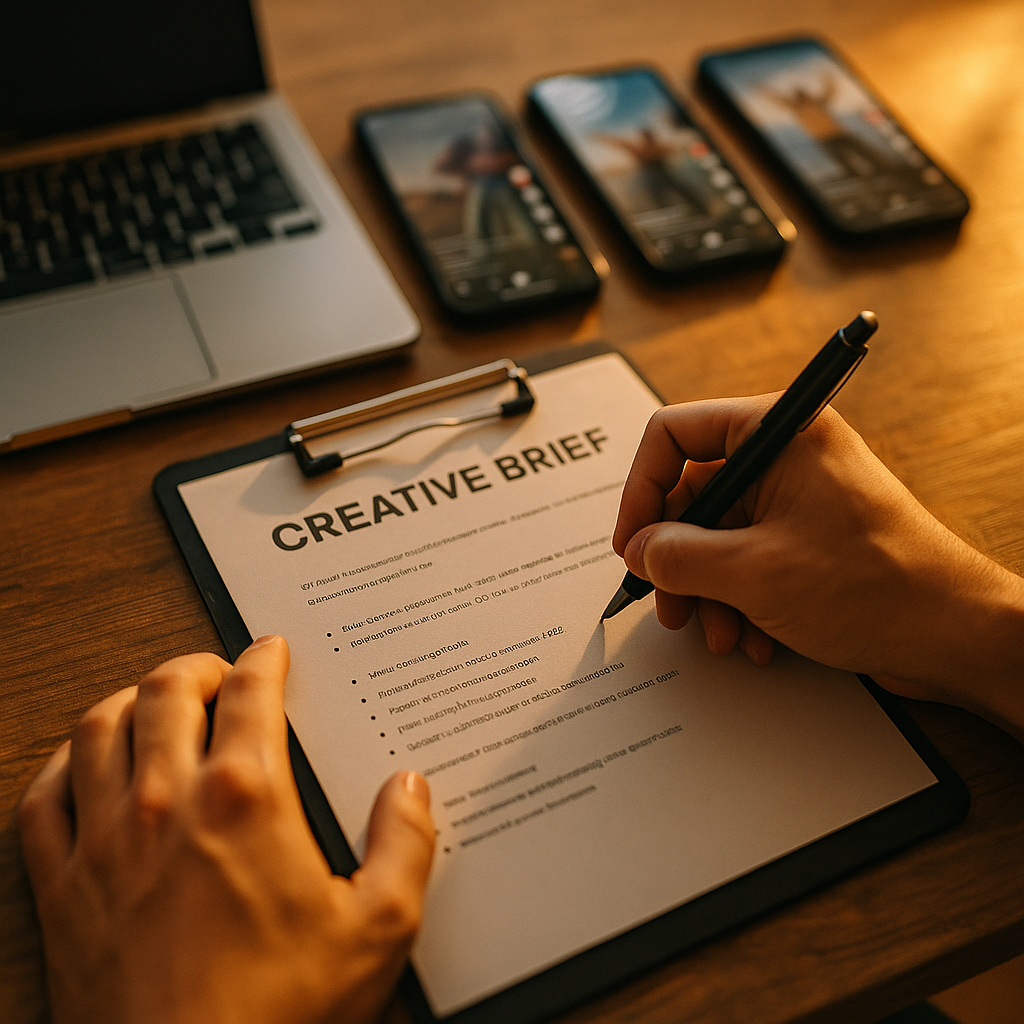
CPMs on short-video platforms have climbed as much as 30% year over year in competitive verticals, according to buyer reports from major agency trading desks. If your creative team is still briefing ads like it’s 2022, you’re paying 2026 prices for 2022 attention spans. The cost-of-1,000-impressions math has changed, and the brief needs to change with it.
This isn’t a platform problem you can media-buy your way out of. It’s a creative production problem, and it starts with how briefs get written.
Why CPMs Keep Climbing Even as Budgets Get Tighter
Short-video inventory looks infinite. It isn’t. Every algorithm on TikTok, Instagram Reels, and YouTube Shorts is optimizing for the same finite resource: a user’s next three seconds of attention. As more brands pile into the same formats (talking-head UGC, unboxing, “POV” hooks) the auction gets more competitive for the exact same eyeballs. eMarketer’s ad spend forecasts keep showing short-video budgets growing faster than the audience base that consumes it. Supply of attention is flat. Demand for it isn’t.
Add platform-side algorithm shifts that increasingly favor paid amplification over organic reach, and you get a structural squeeze. Meta and TikTok have both nudged advertisers toward higher-frequency, higher-spend campaigns just to maintain the reach brands got for less two years ago. Check Meta’s advertising resources or TikTok’s ad platform and you’ll see the same message dressed up differently: pay more, or get seen less.
When CPMs rise industry-wide, the brands that protect margin aren’t the ones who bid harder. They’re the ones whose creative earns more attention per dollar spent.
The Real Lever Isn’t the Bid, It’s the Brief
Media buyers can optimize placements, dayparting, and audience overlap all they want. None of that fixes a fundamentally weak asset. If your ad gets skipped in the first two seconds, no amount of bid strategy saves your cost-of-1,000-impressions number. The algorithm punishes low watch time by making you pay more to reach the same person again.
That’s why the creative brief itself has become the primary cost-control lever in 2026. A brief that forces hook density, pacing discipline, and format variety into the production process is functionally a CPM-reduction tool. Our watch-time-first briefing approach treats the first three seconds as a paid-media asset in its own right, not an afterthought bolted onto a script.
What “High-Impact” Actually Means When Feeds Are Saturated
High-impact used to mean high production value. Not anymore. In saturated feeds, high-impact means the ad doesn’t look like an ad long enough to earn a full watch. Polished, agency-shot spots increasingly underperform against rougher, faster, more native-feeling content, a pattern even luxury publishers have acknowledged as they’ve shifted toward messier, creator-led formats.
Three traits separate high-impact ads from expensive-but-forgettable ones right now:
- Hook velocity: a pattern-interrupt or stakes-setting line inside the first second, not the first three.
- Format-native pacing: cut rhythm that matches the platform’s organic content, not a repurposed TV spot.
- Modular structure: one shoot that yields multiple cuts for multiple placements, reducing cost-per-asset even as CPMs rise.
Format Fatigue Is a Cost Problem, Not Just a Creative One
Audiences develop pattern recognition for ad formats faster than brands develop new ones. The “confessional founder” video worked brilliantly until every DTC brand ran it. The same thing happened to unboxing, to “day in the life,” to the ring-light testimonial. Once a format saturates a feed, its marginal performance drops even if the execution quality stays high, and your effective CPM rises because you’re fighting format blindness on top of algorithmic competition.
The fix isn’t abandoning proven formats. It’s rotating them faster than the market saturates them. Brands running three-episode test arcs before committing budget to a format are catching fatigue signals early, often before CPM data even flags the drop. That’s a meaningfully cheaper way to derisk creative than burning spend on a format that’s already tired.
Modularity helps here too. A single creator shoot restructured into six distinct placements spreads your fixed production cost across more inventory, which directly lowers blended cost-of-1,000-impressions even if the CPM on any individual placement stays flat. Similarly, briefs built for syndication across three platforms from a single production day stretch your budget further without asking creators for more raw footage.
Rising CPMs punish brands that treat each placement as a one-off shoot. They reward brands that treat one shoot as raw material for a dozen placements.
Compliance Risk Is a Hidden CPM Multiplier
Here’s a cost-of-1,000-impressions factor most media plans ignore: legal exposure. An ad pulled mid-flight for an undisclosed partnership, an unsubstantiated claim, or a sweepstakes technicality doesn’t just create legal risk. It torches the spend already put behind it and forces a rebuild under time pressure, which almost always means paying rush rates and losing negotiating leverage on placement.
The FTC’s endorsement guidance hasn’t gotten looser as influencer marketing has scaled, it’s gotten more actively enforced. Brands running urgency-driven campaigns or promotional countdowns need disclosure language baked into the brief itself, not patched in during review. The same goes for testimonial-style content: a brief built around FTC-safe real experience formats avoids the compliance fire drill that eats budget and timeline alike.
Legal review speed is itself a cost variable. Every day a creative sits in review is a day it’s not accumulating impressions against a CPM you already locked in with your buy. Briefs engineered to clear legal review quickly get to market faster and capture cheaper early-flight impressions before competitive bidding pushes rates up mid-campaign.
Building the Brief: A Practical Checklist
Translate all of this into a document your creative team can actually use. A CPM-conscious brief in 2026 should specify:
- A hook requirement tested against at least two alternate openings, not one assumed winner.
- A modularity plan naming every downstream placement the footage needs to serve.
- Disclosure and claims language pre-approved by legal before the shoot, not after.
- A format freshness check against what’s currently saturating the brand’s target feed.
- A defined success threshold tied to watch-time percentage, not just impressions delivered.
Notice what’s missing from that list: production budget as the primary quality signal. It isn’t anymore. A $2,000 creator shoot with a sharp hook and smart modularity plan will consistently beat a $20,000 studio production that ignores both. That’s not a slogan, it’s what CPM data across saturated short-video markets keeps showing.
AI-Assisted Production Is Changing the Math Too
It’s worth acknowledging that AI video tools are entering the CPM conversation from the supply side. Briefs written for AI-generated multi-angle shots or modular AI storyboards can produce placement-specific variants at a fraction of traditional reshoot costs. That doesn’t lower your CPM directly, but it lowers the cost side of the cost-per-1,000-impressions equation by cutting production spend per variant, which is functionally the same win.
Marketers who dismiss AI-assisted production as a novelty are leaving a real efficiency lever on the table. Track performance the same way you would creator-shot content: watch time, drop-off point, and completion rate against spend, referencing tools like HubSpot’s marketing analytics resources or Sprout Social’s reporting benchmarks to keep your internal standards honest.
The brands winning the CPM squeeze right now aren’t the ones with the biggest budgets. They’re the ones who rewrote the brief before the invoice came due.
Next step: Audit your last five briefs for hook specificity, modularity, and pre-cleared compliance language. If any brief is missing two of the three, that’s your CPM leak, and it’s fixable before your next production cycle.
Frequently Asked Questions
Why are CPMs rising on short-video platforms even though ad inventory seems limitless?
Inventory looks unlimited, but attention doesn’t scale the same way. As more advertisers compete for the same viewing windows using similar formats, auction pressure rises even though the number of available impressions hasn’t shrunk.
Does a bigger production budget guarantee a better cost-of-1,000-impressions outcome?
No. Watch-time performance, driven by hook strength and pacing, matters more to platform algorithms than production polish. A lower-budget creator asset with a strong first-second hook regularly outperforms expensive studio productions on effective CPM.
How does creative fatigue affect CPM specifically?
When a format saturates a feed, algorithms detect lower engagement and completion rates from that format, which raises the cost to reach the same audience. Rotating formats before saturation hits keeps effective CPM lower.
What’s the fastest way to lower blended CPM without cutting media spend?
Build briefs for modularity so one shoot produces multiple placement-ready cuts. This spreads fixed production cost across more impressions, lowering your blended cost-of-1,000-impressions without touching the media budget itself.
Can compliance issues actually increase CPM?
Indirectly, yes. Pulled ads, rush-rebuilds, and delayed legal review all mean campaigns launch later or restart mid-flight, missing cheaper early impressions and often forcing rushed, more expensive placements to hit flight deadlines.
Top Influencer Marketing Agencies
The leading agencies shaping influencer marketing in 2026
Agencies ranked by campaign performance, client diversity, platform expertise, proven ROI, industry recognition, and client satisfaction. Assessed through verified case studies, reviews, and industry consultations.
Moburst

-
2

The Shelf
Boutique Beauty & Lifestyle Influencer AgencyA data-driven boutique agency specializing exclusively in beauty, wellness, and lifestyle influencer campaigns on Instagram and TikTok. Best for brands already focused on the beauty/personal care space that need curated, aesthetic-driven content.Clients: Pepsi, The Honest Company, Hims, Elf Cosmetics, Pure LeafVisit The Shelf → -
3

Audiencly
Niche Gaming & Esports Influencer AgencyA specialized agency focused exclusively on gaming and esports creators on YouTube, Twitch, and TikTok. Ideal if your campaign is 100% gaming-focused — from game launches to hardware and esports events.Clients: Epic Games, NordVPN, Ubisoft, Wargaming, Tencent GamesVisit Audiencly → -
4

Viral Nation
Global Influencer Marketing & Talent AgencyA dual talent management and marketing agency with proprietary brand safety tools and a global creator network spanning nano-influencers to celebrities across all major platforms.Clients: Meta, Activision Blizzard, Energizer, Aston Martin, WalmartVisit Viral Nation → -
5

The Influencer Marketing Factory
TikTok, Instagram & YouTube CampaignsA full-service agency with strong TikTok expertise, offering end-to-end campaign management from influencer discovery through performance reporting with a focus on platform-native content.Clients: Google, Snapchat, Universal Music, Bumble, YelpVisit TIMF → -
6

NeoReach
Enterprise Analytics & Influencer CampaignsAn enterprise-focused agency combining managed campaigns with a powerful self-service data platform for influencer search, audience analytics, and attribution modeling.Clients: Amazon, Airbnb, Netflix, Honda, The New York TimesVisit NeoReach → -
7

Ubiquitous
Creator-First Marketing PlatformA tech-driven platform combining self-service tools with managed campaign options, emphasizing speed and scalability for brands managing multiple influencer relationships.Clients: Lyft, Disney, Target, American Eagle, NetflixVisit Ubiquitous → -
8

Obviously
Scalable Enterprise Influencer CampaignsA tech-enabled agency built for high-volume campaigns, coordinating hundreds of creators simultaneously with end-to-end logistics, content rights management, and product seeding.Clients: Google, Ulta Beauty, Converse, AmazonVisit Obviously →