


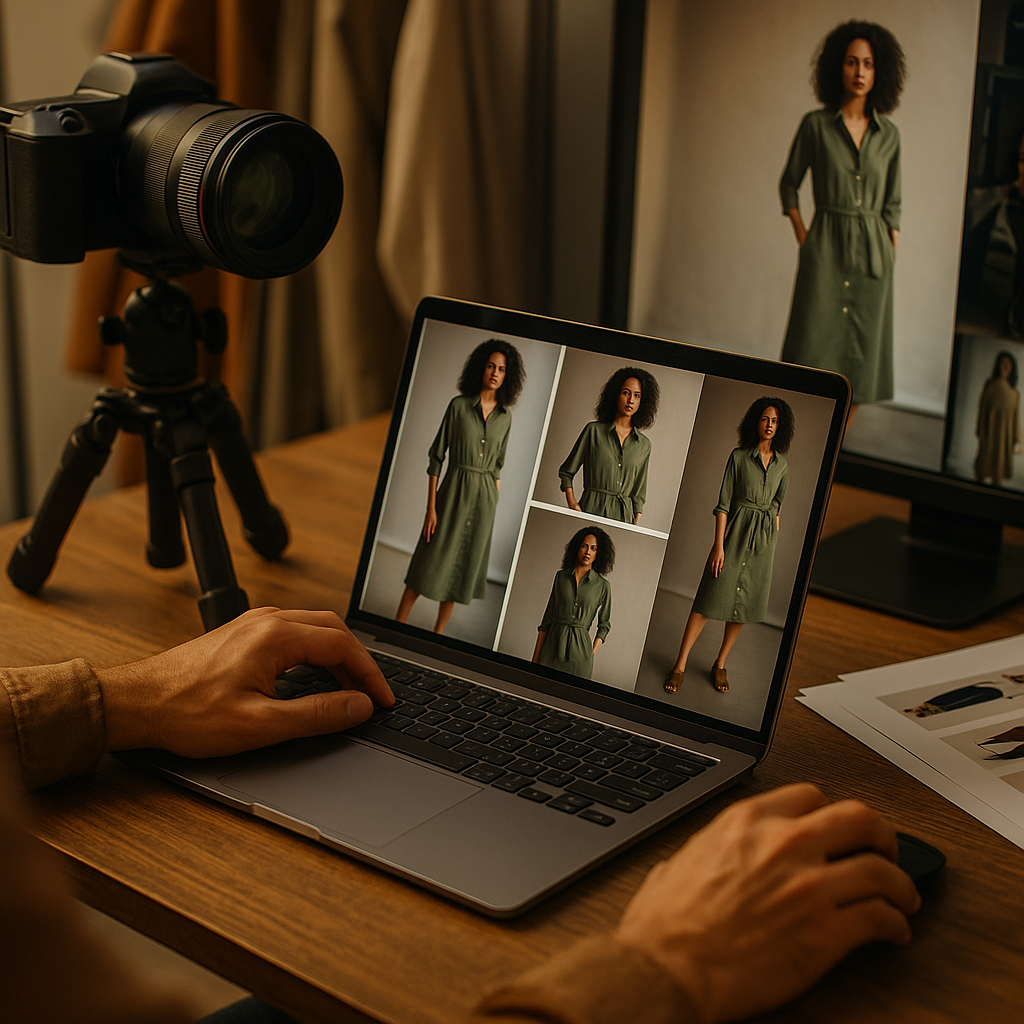
A single SKU shoot can eat 40 minutes of studio time. Multiply that by a catalogue of 800 products and you’re looking at months of production, not days. AI multi-angle shot generation is rewriting that math, letting brands turn one reference image or short clip into a full set of coverage angles without booking a studio at all. The question isn’t whether this works anymore. It’s whether your creative brief is built to direct it properly.
Most teams treat AI video tools like a plug-and-play replacement for a camera operator. That’s the wrong mental model. The tool doesn’t know your brand’s angle preferences, your platform specs, or which shot types actually convert on a product listing versus a paid ad. Your brief has to carry that knowledge. Get it wrong and you’ll generate a thousand technically clean clips that all look slightly off-brand, or worse, inconsistent with each other across the catalogue.
What Multi-Angle Shot Generation Actually Does
Strip away the marketing language and the technology is fairly simple to describe. You feed the system a product image, a 3D scan, or a short reference video. It then synthesizes additional camera angles, movements, and framing options, simulating what a physical shoot would have captured from multiple positions. Think orbit shots, 45-degree hero angles, top-down flat lays, and slow push-ins, all generated from a single source asset.
Tools in this space (Google’s Veo, Runway, and various e-commerce-specific platforms built on top of diffusion and video synthesis models) now handle this at a scale that would have required a full production crew two years ago. Some platforms integrate directly with product information management systems, meaning a new SKU upload can trigger automatic multi-angle video generation as part of the catalogue pipeline.
That’s the promise. The risk is that “automatic” doesn’t mean “unsupervised.” Every angle still needs a brief behind it, even if that brief is a template applied programmatically across thousands of products.
Generating more angles isn’t the win. Generating the right angles, consistently, across a catalogue of thousands, is what actually moves conversion rate.
Why Catalogue-Scale Video Breaks Traditional Briefing
A creative brief written for one hero product doesn’t scale. Write a brief for a single sneaker campaign and you can afford paragraphs of mood-board language, lighting references, and talent notes. Try applying that same document to 3,000 SKUs across five categories and it collapses immediately. Nobody has time to write 3,000 individual briefs, and nobody should.
The fix isn’t fewer instructions. It’s more structured ones. Catalogue-scale AI video needs briefs built like specifications, not stories. Think of it less like a film treatment and more like a technical schema: angle count, rotation degrees, lighting temperature range, background treatment, motion speed, and output resolution, all defined once and applied as variables per product category.
This is the same logic behind modular storyboard design, where one shoot structure gets reused across multiple placements instead of rebuilt from scratch each time. Multi-angle generation just pushes that modularity further, down to the level of individual SKUs.
The Five Elements Every Multi-Angle Brief Needs
- Angle inventory: Define the exact shot list per product type. A skincare bottle might need six angles (front, 45-degree left, 45-degree right, top-down, cap-off detail, in-hand scale shot). A furniture piece might need twelve, including room-context wides.
- Motion parameters: Specify whether angles are static, slow pan, or full 360-degree orbit. Mixing these inconsistently across a catalogue creates a jarring browsing experience.
- Lighting and color consistency rules: AI-generated video can drift in color temperature between generations. Lock in a reference palette and instruct the tool (or the human reviewing output) to flag deviations.
- Platform-specific crop and duration specs: A Shopify PDP video, a TikTok Shop clip, and an Amazon A+ content module all have different aspect ratio and length requirements. Bake these into the brief so one generation pass produces assets for all three.
- Human review checkpoints: Even at scale, someone needs to spot-check for artifacts, mangled logos, or physically impossible product distortions before assets go live.
Skip any of these and you’ll find yourself doing manual cleanup on thousands of assets after the fact, which defeats the entire point of automating the shoot.
Directing at Scale Without Losing Brand Control
Here’s the tension every brand manager feels the first time they run a catalogue through an AI video pipeline: the output is fast, but is it yours? A generic angle set could belong to any brand selling similar products. That’s not a technology failure, it’s a briefing failure.
Brand distinctiveness in generated video comes from constraint, not creativity in the traditional sense. You’re not asking the AI to interpret a mood. You’re telling it exactly how your brand frames a product: always a slight downward camera angle, always warm-toned backgrounds, always a two-second hold before the rotation starts. These become your brand’s visual fingerprint, encoded as generation parameters rather than described in prose.
Compare this to briefing human creators. When brands brief part-time or freelance talent for ongoing content, the challenge is similar: you need consistency without micromanaging every single output. The same instinct applies here. Structured, reusable direction is what makes any distributed content pipeline sustainable, whether the “director” is a person or a model. For a deeper look at that discipline, see briefing part-time creators for a sustainable content cadence.
Where This Fits in the Broader Content Stack
Multi-angle AI video rarely lives in isolation. It’s typically one layer in a larger content operation that also includes creator-generated footage, live commerce clips, and paid social variants. A catalogue video brief should specify how AI-generated angles slot alongside creator content, not compete with it.
For instance, a beauty brand might use AI-generated 360 rotations for every SKU on the PDP, while reserving creator-shot UGC for TikTok and Instagram, where authenticity outperforms polish. That’s the same blended logic covered in blended UGC-plus-influencer briefs: different formats, different jobs, one coordinated brief structure holding it together.
There’s also a reuse dimension worth planning for upfront. If you’re generating multi-angle assets anyway, structure the brief so those same clips can be repurposed across ad placements, marketplace listings, and organic social, rather than generating separate assets for each channel. This mirrors the approach in usage-rights-ready video briefs, where a single shoot is engineered from the start for multi-channel reuse.
The Compliance Angle Nobody Briefs For
Fast, synthetic product video creates a specific risk brands underestimate: visual misrepresentation. If an AI-generated angle subtly distorts proportions, exaggerates texture, or implies a feature that doesn’t exist, that’s not just a quality issue, it’s a potential deceptive advertising problem under FTC guidelines.
Your brief needs an explicit accuracy clause: generated video must represent true-to-life scale, color, and material properties, verified against the physical product or a high-fidelity 3D scan. This isn’t optional legal boilerplate. As AI-generated commercial content faces more scrutiny, brands that can show a documented verification process will be in a far stronger position than those relying on “the tool made it look that way.”
The same caution that applies to AI labeling requirements in ad creative applies here. Disclosure expectations for synthetic media are tightening across platforms, and product video isn’t exempt just because it’s not a “deepfake” in the conventional sense.
A brief that doesn’t include an accuracy verification step isn’t a creative brief. It’s a liability waiting to be discovered by a regulator or a disappointed customer.
Building the Brief Template That Scales
Rather than writing from scratch for every product line, build a master template with variable fields. Here’s a rough structure that works across most e-commerce catalogues:
- Category classification: Group SKUs by shot complexity (flat objects, dimensional objects, wearables, liquids/textures).
- Base angle set per category: Assign the minimum viable angle count and type for each group.
- Brand visual rules: Lighting, color grade, camera height, motion pacing, locked once and referenced by ID.
- Platform output matrix: Map each angle set to required aspect ratios and durations per channel.
- QA and verification pass: Define who reviews, what percentage gets manually checked, and rejection criteria.
- Reuse and tagging protocol: Metadata structure so assets can be pulled into paid, organic, and marketplace campaigns later.
According to eMarketer, retail media and product video spend continue climbing as brands push more budget into on-platform commerce content, which means the volume pressure on catalogue video isn’t easing up anytime soon. Teams that solve the briefing problem now will have a structural advantage over those still shooting SKUs one at a time.
Testing this template before full rollout matters too. Run it against a small batch, maybe 50 SKUs across your most complex category, before committing the whole catalogue. This mirrors the staged approach in multi-creator testing waves, where structure gets validated on a small sample before scaling spend or volume.
What Good Looks Like in Practice
A home goods brand running this well might generate six to eight angles per SKU, cut for three platforms, verified against physical samples, all from a brief document that’s maybe two pages long and reused across an entire product category. Compare that to the old model: individual shot lists, studio bookings, photographer briefs, and weeks of post-production per collection drop. The efficiency gap isn’t marginal. It’s categorical.
None of this replaces judgment, though. Someone still has to decide which angles actually sell the product, and that decision benefits from the same performance data brands already use for creator content, per Sprout Social’s reporting on video engagement patterns. AI generates options. Humans still decide what wins.
Start with one product category, write the structured brief once, and measure conversion lift before rolling it across the full catalogue. The brands winning here aren’t the ones generating the most video, they’re the ones directing it with the same discipline they’d apply to a physical shoot.
FAQs
What is AI multi-angle shot generation?
It’s a video AI capability that takes a single product image or short clip and generates additional camera angles, movements, and framings, simulating a multi-camera shoot without a physical studio session.
How is this different from 3D product rendering?
Traditional 3D rendering requires building a full model from scratch, which is time-intensive and expensive per SKU. AI multi-angle generation works from photographic or video reference, making it faster to deploy across large, varied catalogues.
Does a creative brief still matter if the AI generates the shots automatically?
Yes. Without a structured brief defining angle count, lighting consistency, motion style, and platform specs, generated output will vary in quality and brand alignment across the catalogue, creating more cleanup work than it saves.
What compliance risks come with AI-generated product video?
The main risk is visual misrepresentation, where generated angles distort scale, color, or material properties in ways that could be considered deceptive under FTC advertising guidelines. Brands should build a verification step into every brief.
Can these assets be reused across multiple platforms?
Yes, if the brief is built for it upfront. Specifying aspect ratios, durations, and cropping rules for each target platform during the initial generation pass avoids the need for separate shoots or re-edits later.
FAQs
What is AI multi-angle shot generation?
It’s a video AI capability that takes a single product image or short clip and generates additional camera angles, movements, and framings, simulating a multi-camera shoot without a physical studio session.
How is this different from 3D product rendering?
Traditional 3D rendering requires building a full model from scratch, which is time-intensive and expensive per SKU. AI multi-angle generation works from photographic or video reference, making it faster to deploy across large, varied catalogues.
Does a creative brief still matter if the AI generates the shots automatically?
Yes. Without a structured brief defining angle count, lighting consistency, motion style, and platform specs, generated output will vary in quality and brand alignment across the catalogue, creating more cleanup work than it saves.
What compliance risks come with AI-generated product video?
The main risk is visual misrepresentation, where generated angles distort scale, color, or material properties in ways that could be considered deceptive under FTC advertising guidelines. Brands should build a verification step into every brief.
Can these assets be reused across multiple platforms?
Yes, if the brief is built for it upfront. Specifying aspect ratios, durations, and cropping rules for each target platform during the initial generation pass avoids the need for separate shoots or re-edits later.
Top Influencer Marketing Agencies
The leading agencies shaping influencer marketing in 2026
Agencies ranked by campaign performance, client diversity, platform expertise, proven ROI, industry recognition, and client satisfaction. Assessed through verified case studies, reviews, and industry consultations.
Moburst

-
2

The Shelf
Boutique Beauty & Lifestyle Influencer AgencyA data-driven boutique agency specializing exclusively in beauty, wellness, and lifestyle influencer campaigns on Instagram and TikTok. Best for brands already focused on the beauty/personal care space that need curated, aesthetic-driven content.Clients: Pepsi, The Honest Company, Hims, Elf Cosmetics, Pure LeafVisit The Shelf → -
3

Audiencly
Niche Gaming & Esports Influencer AgencyA specialized agency focused exclusively on gaming and esports creators on YouTube, Twitch, and TikTok. Ideal if your campaign is 100% gaming-focused — from game launches to hardware and esports events.Clients: Epic Games, NordVPN, Ubisoft, Wargaming, Tencent GamesVisit Audiencly → -
4

Viral Nation
Global Influencer Marketing & Talent AgencyA dual talent management and marketing agency with proprietary brand safety tools and a global creator network spanning nano-influencers to celebrities across all major platforms.Clients: Meta, Activision Blizzard, Energizer, Aston Martin, WalmartVisit Viral Nation → -
5

The Influencer Marketing Factory
TikTok, Instagram & YouTube CampaignsA full-service agency with strong TikTok expertise, offering end-to-end campaign management from influencer discovery through performance reporting with a focus on platform-native content.Clients: Google, Snapchat, Universal Music, Bumble, YelpVisit TIMF → -
6

NeoReach
Enterprise Analytics & Influencer CampaignsAn enterprise-focused agency combining managed campaigns with a powerful self-service data platform for influencer search, audience analytics, and attribution modeling.Clients: Amazon, Airbnb, Netflix, Honda, The New York TimesVisit NeoReach → -
7

Ubiquitous
Creator-First Marketing PlatformA tech-driven platform combining self-service tools with managed campaign options, emphasizing speed and scalability for brands managing multiple influencer relationships.Clients: Lyft, Disney, Target, American Eagle, NetflixVisit Ubiquitous → -
8

Obviously
Scalable Enterprise Influencer CampaignsA tech-enabled agency built for high-volume campaigns, coordinating hundreds of creators simultaneously with end-to-end logistics, content rights management, and product seeding.Clients: Google, Ulta Beauty, Converse, AmazonVisit Obviously →