


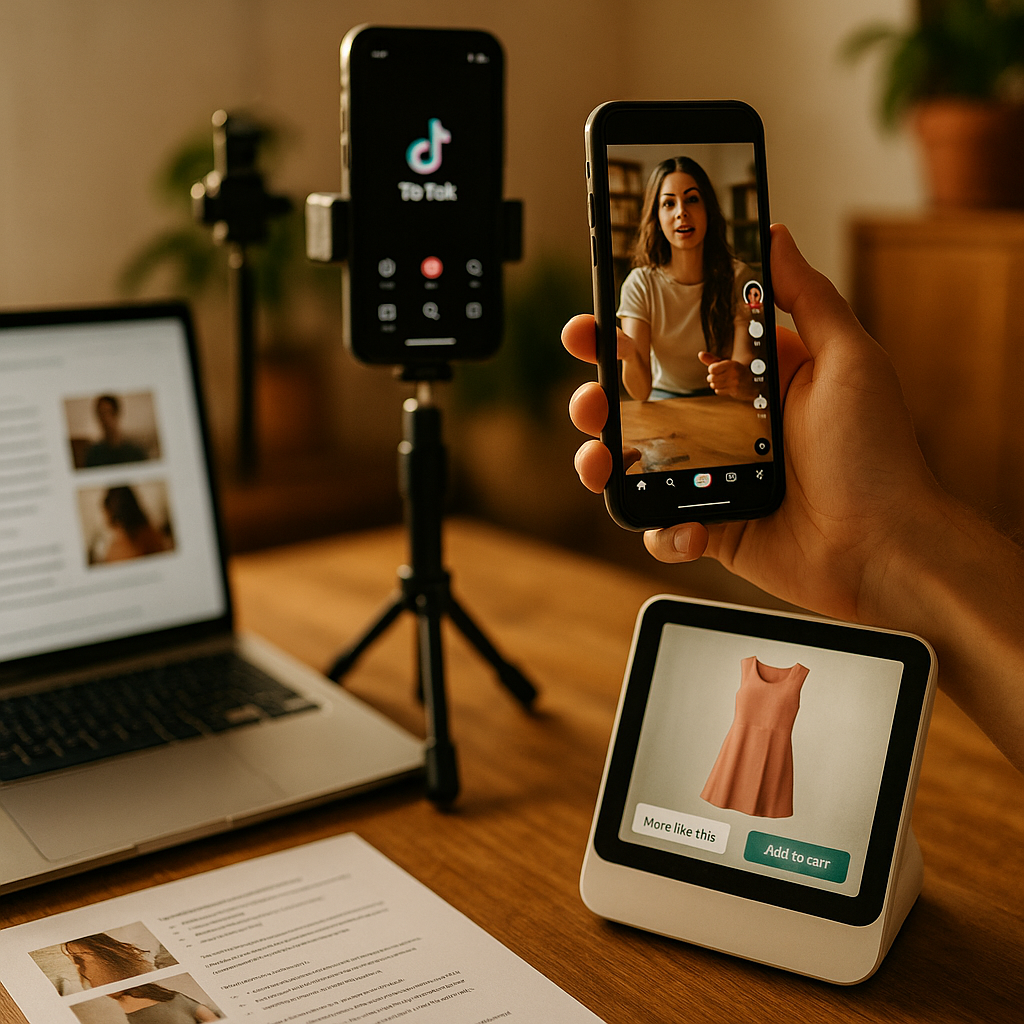
What if every creator video you commission had to satisfy two entirely different audiences simultaneously: a human scrolling at 2x speed and an AI agent deciding whether to recommend your product to someone who never saw the content at all? That’s the brief-writing challenge defining influencer marketing right now, and most brands are only solving half of it.
Two Discovery Layers, One Piece of Content
Short-form video has always juggled human attention and algorithmic amplification. TikTok’s For You Page and Instagram’s Reels recommendation surface both use engagement signals (watch time, replays, shares, saves) to decide distribution. Creators and brand teams have spent years learning how to optimize for those signals.
But a third layer has materialized fast. AI shopping agents, including those built into ChatGPT, Google’s Shopping Graph, Perplexity, and Amazon’s Rufus, now crawl indexed video content, captions, transcripts, and structured metadata to generate product recommendations autonomously. A user asks “what’s the best lightweight SPF for oily skin under $30?” and Perplexity or ChatGPT Shopping surfaces creator content that contains the most factually precise answer. The video with the best hook doesn’t automatically win. The video with the most retrievable, structured product data does.
AI shopping agents don’t watch your creator’s video the way a human does. They parse its transcript, caption, and metadata for specific product attributes — price, SKU, use case, ingredient claims — and rank content by informational completeness, not entertainment value.
The strategic implication: brands need a brief-writing framework that produces content optimized for human engagement and machine retrieval. These goals aren’t mutually exclusive, but they require explicit architecture. Most briefs today leave machine optimization entirely to chance.
Why Standard Creator Briefs Are Structurally Incomplete
A conventional short-form brief tells the creator what to say, how to say it, and what to avoid. It specifies the hook style, the call to action, brand safety guardrails, and maybe a list of key messages. That’s enough to produce a video that performs well in human feeds.
It’s not enough for AI retrieval. Here’s why: AI shopping agents retrieve product information from content the same way search crawlers retrieve page data. They look for specificity. Vague language (“you’ll love this,” “it really works”) carries zero retrieval value. Specific attribute language (“clinically tested at 1% niacinamide concentration,” “compatible with iOS and Android,” “$49 at retail”) is exactly what these agents extract and forward to users making purchase decisions.
Research from eMarketer indicates that AI-assisted commerce touchpoints are now influencing purchasing decisions in a growing share of e-commerce transactions. Brands that treat creator content as purely a human-facing awareness vehicle are leaving an entire acquisition channel unaddressed. For a deeper look at how to structure briefs specifically for this retrieval environment, see this TikTok retrieval brief template.
The Dual-Audience Brief Framework: Four Structural Layers
The framework operates across four distinct layers. Each layer addresses a different output requirement. The brief communicates all four to the creator explicitly.
Layer 1: Hook Architecture for Human Retention
The first three seconds still determine whether a human viewer stays. Brief creators to open with a pattern interrupt tied directly to a specific use case, not a brand name. “The reason your sunscreen is pilling under makeup” outperforms “I partnered with [Brand] to show you this SPF” every single time on TikTok and Reels. Specify the emotional register (curiosity gap, relatability, urgency) and the visual treatment (talking head, B-roll cold open, text-on-screen overlay). This layer is human-only optimization.
For detailed hook construction guidance, the resource on short-form video hook and CTA strategy covers the mechanics thoroughly.
Layer 2: Factual Density Requirements for Machine Retrieval
This is the layer most briefs omit entirely. Specify a mandatory list of product attributes that must appear verbally in the video and in the caption. At minimum: exact product name (as it appears in the product catalog), price point, primary use case stated in plain language, at least two differentiating technical or ingredient claims, and compatibility or fit parameters if relevant.
Why verbal inclusion matters: AI agents can index auto-generated transcripts on both TikTok and Instagram. A product attribute spoken clearly in the video becomes machine-readable even if the caption is incomplete. Brief the creator to state these attributes naturally within the narrative, not as a recitation. “I use exactly two pumps of this, it’s $38 at Target, and it’s the only formula I’ve tried that doesn’t break me out because it’s certified non-comedogenic” hits all the retrieval targets without sounding like a spec sheet.
Layer 3: Caption Metadata Architecture
Captions serve triple duty: they feed TikTok and Instagram’s text-classification systems, they get indexed by external search and AI crawlers, and they provide the structured context that shopping agents use to verify verbal claims. Brief creators to write captions that include the product name, a single-sentence value proposition, the primary use case in question form (“best SPF for oily skin?”), and a price or availability signal.
Hashtag strategy still matters for platform discovery, but the functional text preceding hashtags is where AI retrieval happens. A caption that reads “tried this SPF for three weeks, here’s the honest review” has near-zero retrieval value. “SPF 50 reef-safe sunscreen ($28 at Ulta) — tested it daily for 3 weeks on combination skin. No white cast, non-greasy finish. Full review below.” gives an AI agent everything it needs to recommend this content to a relevant query.
This structural approach connects directly to GEO-optimized creator briefs designed for AI shopping environments.
Layer 4: Platform-Specific Algorithm Signals
TikTok and Instagram weight different signals. TikTok rewards early engagement velocity and shares, making a strong hook and shareable premise non-negotiable. Instagram Reels increasingly weights saves and profile visits, which means the content needs enough depth that viewers want to return or reference it. Brief creators differently for each platform even when the core content is similar.
Practically: a TikTok brief should specify the hook and share trigger. An Instagram Reels brief should specify a save prompt (“save this for your next Sephora run”) and a profile visit incentive (a follow-up promise or series format). Both platforms now use text classification to surface content in search, so the spoken words in the first 30 seconds carry SEO weight on each platform independently.
The Compliance Layer You Can’t Skip
Embedding factual density into creator scripts raises FTC compliance stakes. Any specific claim — ingredient concentrations, clinical study references, comparative performance data — must be substantiated and properly disclosed. The FTC’s updated endorsement guides apply to AI-indexed content the same way they apply to human-facing claims. An AI agent retrieving an unsubstantiated efficacy claim and using it in a purchase recommendation creates liability for the brand, not just the creator.
Build a claim-verification step into the brief process. Before finalizing the factual density requirements in Layer 2, legal or regulatory review should sign off on every specific claim the creator is asked to make. For FTC-compliant brief construction that integrates narrative flow with disclosure requirements, see this guide on FTC-compliant creator briefs.
Operationalizing the Framework at Scale
Running this framework across a roster of 20 or 50 creators requires systematization. Build a brief template with mandatory fields for each layer. Layer 2 (factual density) should include a pre-populated product attribute block that creators slot directly into their scripts. Layer 3 (caption architecture) should include a caption template with fillable fields rather than open-ended instructions.
Review workflow matters too. Add a machine-retrieval QA step before content approval: paste the draft caption and a transcript excerpt into a tool like Perplexity or ChatGPT and ask it to answer a relevant product query using only that content. If the AI can’t answer accurately, the factual density is insufficient. This takes three minutes and surfaces gaps that a standard brand safety review misses entirely.
For brands running integrated campaigns across both short-form and longer formats, the principles in this framework extend naturally. The retrieval optimization logic applies to podcasts, hybrid video formats, and Reels equally. The cross-platform content repurposing framework addresses how to maintain factual density consistency when one shoot produces multiple content versions.
The brands winning AI-assisted discovery aren’t producing more creator content. They’re producing more structured creator content — videos where every spoken product claim is intentional, retrievable, and verified before the shoot.
Creator education is the final operational piece. Most creators know how to optimize for human engagement. Very few have been briefed explicitly on AI retrieval requirements. A 10-minute onboarding document explaining why factual specificity matters for the brand’s AI commerce strategy will produce significantly better compliance than a list of required talking points.
Platforms are already signaling this direction. TikTok’s commerce infrastructure and Meta’s shopping integrations are both moving toward AI-mediated product discovery surfaces. Social listening data from Sprout Social consistently shows that consumers are increasingly using social platforms as search and discovery tools, not just entertainment feeds. The creator content that performs best in this environment is structurally different from content optimized purely for the scroll.
Start with one campaign. Apply all four layers to the brief, run the three-minute AI retrieval QA before approval, and compare performance against your control creative across both human engagement metrics and any AI-driven traffic signals in your attribution stack. The data will make the case for the rest of your program.
Frequently Asked Questions
What is dual-audience creator brief writing?
Dual-audience creator brief writing is a framework that structures short-form video briefs to satisfy both human viewers and AI systems simultaneously. The human layer focuses on hook design, watch time, and engagement signals for TikTok and Instagram algorithms. The machine layer embeds specific product attributes, pricing, use cases, and technical claims that AI shopping agents can retrieve and use when generating autonomous purchase recommendations.
How do AI shopping agents use creator content for product recommendations?
AI shopping agents such as ChatGPT Shopping, Google’s Shopping Graph, Perplexity, and Amazon Rufus index video transcripts, captions, and metadata from creator content. When a user submits a product query, these agents retrieve content containing specific, verifiable product attributes that match the query. Vague or purely emotional content is not retrievable. Content with precise product names, prices, use cases, and differentiating claims is ranked higher and more likely to be surfaced in a purchase recommendation.
Which specific product attributes should a creator mention to optimize for AI retrieval?
At minimum, creators should verbally include the exact product name as it appears in the catalog, the current price point, the primary use case stated in plain language, at least two differentiating technical or ingredient claims, and any compatibility or fit parameters relevant to the product category. These attributes should be stated naturally within the video narrative and mirrored in the caption to maximize both platform indexing and external AI retrieval.
Does optimizing for AI retrieval hurt short-form video performance with human audiences?
Not if the brief is structured correctly. Factual density requirements apply primarily to the mid-section and caption of the video, while hook architecture remains fully optimized for human attention. A creator who opens with a compelling pattern interrupt and then delivers specific product claims conversationally can satisfy both audiences. The conflict arises only when brands force technical language into the hook, which the framework explicitly avoids.
How does this framework handle FTC compliance for specific product claims?
Any specific claim included in the factual density layer (ingredient concentrations, clinical study references, performance comparisons) must be substantiated before the brief is finalized. The framework requires a legal or regulatory review step before creators are asked to state specific claims on camera. FTC endorsement guidelines apply to AI-indexed content the same way they apply to human-facing content, so unsubstantiated claims retrieved and amplified by AI agents create direct liability for the brand.
Can this framework be applied to Instagram Reels and TikTok with the same brief?
The factual density, caption architecture, and compliance layers are consistent across both platforms. The platform-specific algorithm signals in Layer 4 require tailored instructions: TikTok briefs should specify hook strength and share triggers, while Instagram Reels briefs should include save prompts and profile visit incentives. A single core content piece can be adapted for both platforms from one brief if it includes platform-specific appendices covering these signal differences.
Top Influencer Marketing Agencies
The leading agencies shaping influencer marketing in 2026
Agencies ranked by campaign performance, client diversity, platform expertise, proven ROI, industry recognition, and client satisfaction. Assessed through verified case studies, reviews, and industry consultations.
Moburst

-
2

The Shelf
Boutique Beauty & Lifestyle Influencer AgencyA data-driven boutique agency specializing exclusively in beauty, wellness, and lifestyle influencer campaigns on Instagram and TikTok. Best for brands already focused on the beauty/personal care space that need curated, aesthetic-driven content.Clients: Pepsi, The Honest Company, Hims, Elf Cosmetics, Pure LeafVisit The Shelf → -
3

Audiencly
Niche Gaming & Esports Influencer AgencyA specialized agency focused exclusively on gaming and esports creators on YouTube, Twitch, and TikTok. Ideal if your campaign is 100% gaming-focused — from game launches to hardware and esports events.Clients: Epic Games, NordVPN, Ubisoft, Wargaming, Tencent GamesVisit Audiencly → -
4

Viral Nation
Global Influencer Marketing & Talent AgencyA dual talent management and marketing agency with proprietary brand safety tools and a global creator network spanning nano-influencers to celebrities across all major platforms.Clients: Meta, Activision Blizzard, Energizer, Aston Martin, WalmartVisit Viral Nation → -
5

The Influencer Marketing Factory
TikTok, Instagram & YouTube CampaignsA full-service agency with strong TikTok expertise, offering end-to-end campaign management from influencer discovery through performance reporting with a focus on platform-native content.Clients: Google, Snapchat, Universal Music, Bumble, YelpVisit TIMF → -
6

NeoReach
Enterprise Analytics & Influencer CampaignsAn enterprise-focused agency combining managed campaigns with a powerful self-service data platform for influencer search, audience analytics, and attribution modeling.Clients: Amazon, Airbnb, Netflix, Honda, The New York TimesVisit NeoReach → -
7

Ubiquitous
Creator-First Marketing PlatformA tech-driven platform combining self-service tools with managed campaign options, emphasizing speed and scalability for brands managing multiple influencer relationships.Clients: Lyft, Disney, Target, American Eagle, NetflixVisit Ubiquitous → -
8

Obviously
Scalable Enterprise Influencer CampaignsA tech-enabled agency built for high-volume campaigns, coordinating hundreds of creators simultaneously with end-to-end logistics, content rights management, and product seeding.Clients: Google, Ulta Beauty, Converse, AmazonVisit Obviously →