


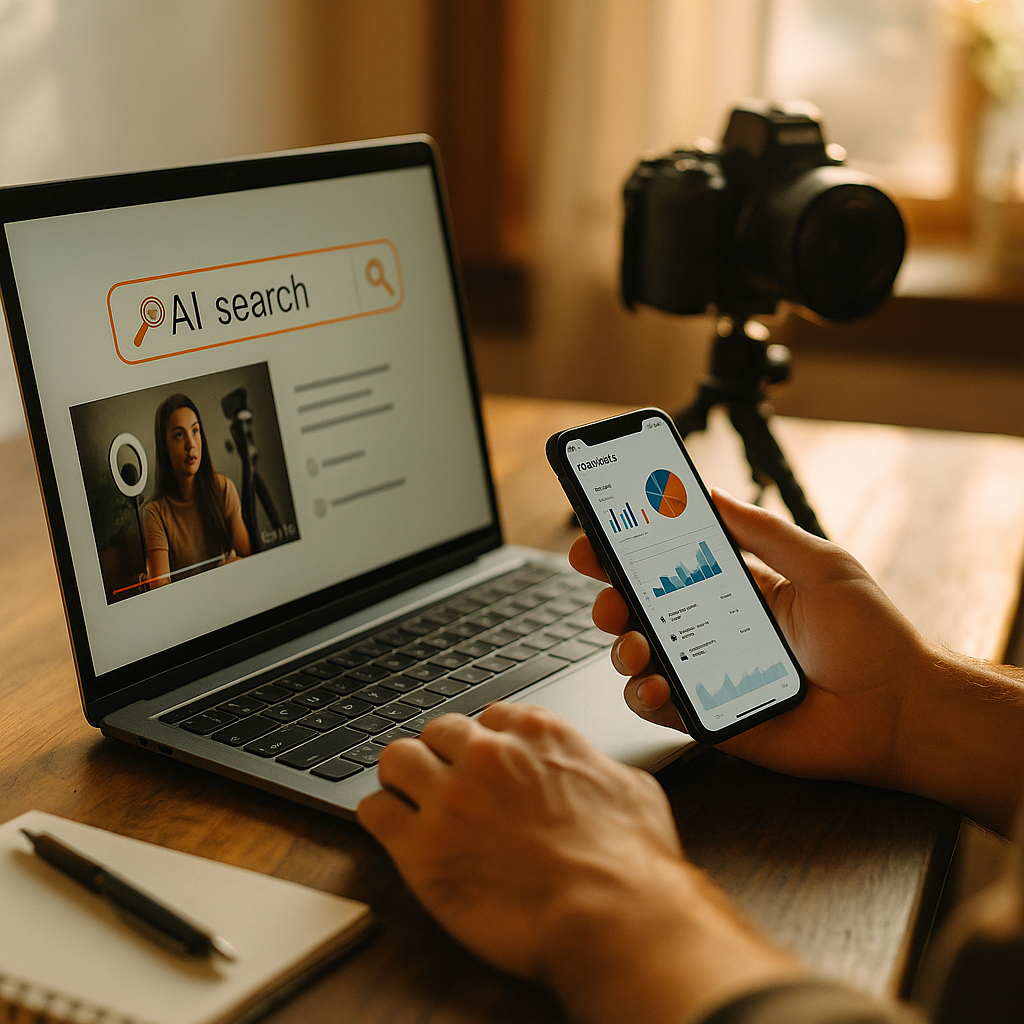
If a traveler asks Google AI Mode “best boutique hotel in Nashville with a rooftop bar,” and Marriott’s content surfaces before competitors, that brand won the search before a single ad dollar was spent. Conversational AI search is already reshaping how creator content gets discovered — and most brands are structuring their programs as if it isn’t.
The Discovery Loop Has Changed. Most Brands Haven’t.
For the better part of a decade, influencer content strategy was built around reach, engagement rate, and platform algorithms. You seeded content, optimized for the feed, and hoped it reached the right person at the right moment. That model assumed a human was doing the scrolling.
Now, the intermediary is a model. Google’s AI Overviews and AI Mode, Perplexity, ChatGPT, and Meta AI are synthesizing answers in response to natural language queries. When someone asks “which hotel chain works best for solo business travel under $200 a night,” an AI is curating a recommendation, not a search results page. The question isn’t whether creator content influences those answers. It does. The question is whether your creator program is producing content that the model can find, parse, and cite.
Generative AI search doesn’t rank ten blue links. It produces one synthesized answer. If your brand isn’t in that answer, you’re not on page two — you don’t exist in that query session at all.
What the Marriott-Google Model Actually Demonstrates
Marriott’s reported collaboration with Google’s generative search infrastructure is instructive less because of the partnership itself and more because of the behavioral insight it validated. When a traveler issues a natural language query, an AI-curated recommendation drives meaningfully higher conversion than a traditional ranked result. The friction reduction is significant: instead of clicking through to a hotel comparison site and then to individual property pages, the user receives a synthesized answer with contextual detail and can act on it immediately.
Three mechanics are at work here:
- Query intent matching: The AI parses conversational language and matches it against content that mirrors that language structure.
- Curated synthesis: The model pulls from multiple credible sources to construct a recommendation. Creator content, reviews, editorial coverage, and brand-owned content are all in scope.
- Conversion proximity: Because the recommendation arrives with context and specificity, the user’s confidence is higher and the next step is shorter.
For brand teams, the operational implication is direct: creator content needs to be written and structured in ways that feed these three mechanics, not just the old engagement funnel. Your creator brief strategy has to account for how AI models read and use content, not just how audiences interact with it.
Why Creator Content Is a Powerful Signal for AI Discovery
AI models are trained on and actively index a wide range of content. Creator content, particularly long-form video transcripts, blog posts, and detailed review content published on indexable platforms, is often more natural-language-rich than brand-owned copy. That’s an asset. A creator describing a hotel stay in authentic, specific language (“the lobby smells like eucalyptus and the check-in took four minutes”) produces exactly the kind of semantic-dense, conversational content that AI models surface in response to natural language queries.
This is why brands like Marriott benefit from a distributed creator content ecosystem rather than a small number of polished brand videos. Volume matters, but structure matters more. GEO-optimized creator briefs that instruct creators on how to address specific query types, include key entity mentions, and structure their content around answerable questions give brands a compounding discovery advantage.
The parallel in hospitality is obvious. But this applies with equal force to consumer electronics brands competing for “best wireless earbuds for remote workers,” beauty brands competing for “moisturizer for combination skin over 40,” or B2B software companies competing for “project management tools for construction teams.” Every natural language query is a discovery opportunity, and every piece of creator content is either positioned to surface in it or it isn’t.
Structuring Creator Programs for AI-Mediated Discovery
The brands winning AI-mediated discovery right now are doing several things differently from the standard influencer brief approach.
Query mapping before creator selection. Instead of identifying creators by audience demographics alone, forward-thinking marketing teams are mapping the natural language queries their target customers are likely to issue, then selecting creators whose content archives already contain relevant semantic signals. A creator who has consistently published detailed, specific content in a category is a better AI discovery asset than a creator with a massive following who posts broadly.
Brief architecture designed for AI parsing. Creator briefs need to specify not just talking points but answerable questions. Instruct creators to structure content around specific use cases: “describe exactly who this product works best for and under what conditions.” That structure mirrors the query intent an AI is trying to satisfy. Detailed guides on briefing creators for Gemini AI Mode offer a concrete starting framework for this shift.
Platform selection based on indexability. Not all creator content gets indexed equally. YouTube video transcripts, long-form blog posts hosted on owned or indexed domains, and content published on platforms with strong crawler access all have higher AI visibility potential than ephemeral Stories or Reels that don’t generate persistent text. This doesn’t mean abandoning short-form social. It means building a content architecture where short-form drives attention and long-form anchors discoverability.
Entity density and specificity. Vague creator content (“this product is amazing”) contributes almost nothing to AI-mediated discovery. Specific entity mentions, location names, product model numbers, use case descriptions, and comparison language all help AI models understand what the content is about and when to surface it. Brand teams need to audit their creator content output for entity density the same way they would audit a product page for SEO.
The Attribution and Measurement Problem
Here’s where many programs stall. Traditional creator attribution models are built around last-click or even multi-touch models that rely on cookies and platform pixels. Neither works reliably in an AI-mediated discovery journey, where a user may encounter a creator’s content via an AI Overview, develop purchase intent, and convert through a completely different session hours later.
Brands need to pair their creator content strategy with attribution infrastructure that can handle this. That means cookieless attribution approaches built for AI search journeys, and signal stacks that can connect creator content exposure to downstream conversion without relying on a clean linear path. The AI signal stack for creator attribution approach is quickly becoming the measurement standard for brands serious about AI-era ROI.
Without this infrastructure, you can’t make a confident case to leadership that your creator program is driving AI-mediated conversion. And without that case, budget allocation decisions default to what’s easiest to measure, not what’s actually working.
Risk, Compliance, and the Content Governance Layer
One underappreciated dimension of this shift: as creator content feeds AI recommendations, it also carries compliance exposure. An AI model surfacing a creator’s product claim as part of a recommendation doesn’t care whether that claim was FTC-compliant when it was posted. The FTC’s disclosure requirements for sponsored content still apply, but the reputational risk now extends to what AI surfaces. Brands need a content governance layer that reviews creator output not just for brand standards but for claim accuracy and compliance durability.
This is especially relevant for health, finance, and travel categories where AI models are actively synthesizing recommendations from creator content and potentially amplifying specific claims to large audiences. See how brands are approaching this with an AI content governance framework built specifically for this environment.
A full picture of how AI search behavior is evolving can be found in research from eMarketer and Statista, both of which track AI search adoption and its impact on content discovery behavior. For brands investing in Google’s AI surfaces specifically, Google’s own documentation on how AI Overviews and AI Mode select and cite content is required reading. And for understanding how LLM training signals affect long-term brand visibility, the contractual and structural considerations outlined at LinkedIn Business are increasingly relevant for B2B-adjacent creator programs.
Creator content is no longer just a social media asset. In an AI-mediated discovery environment, it’s an indexed, synthesizable signal that either qualifies your brand for curated recommendations or silently excludes you from them.
Audit your current creator content library against the three AI discovery mechanics: query intent matching, synthesis readiness, and conversion proximity. Start with the category queries your customers are most likely to ask conversationally, and measure how many of your existing creator assets would plausibly surface in response to them. That gap is your roadmap.
Frequently Asked Questions
What is AI-mediated creator content discovery?
AI-mediated creator content discovery refers to the process by which generative AI systems like Google AI Mode, Perplexity, or ChatGPT surface creator-produced content as part of synthesized answers to natural language queries. Instead of a user clicking through search results and finding creator content organically, the AI itself selects, synthesizes, and presents content-derived recommendations directly in the response. Brands that structure creator content to be parsed and cited by AI systems gain a significant discovery advantage in this environment.
How does the Marriott-Google generative search model apply to non-travel brands?
The core mechanics apply across categories. The Marriott-Google example demonstrates that when creator and brand content is structured to match natural language query intent, AI-curated recommendations produce higher conversion than traditional search results. Any brand competing for category queries — beauty, software, consumer electronics, food and beverage — can apply the same principles: map likely natural language queries, brief creators to produce content that addresses those specific questions, and build content across platforms that AI systems can index and synthesize.
Which content formats are best positioned for AI search discovery?
Long-form content with high entity density and specific language performs best. YouTube video transcripts, long-form creator blog posts, and detailed review content on indexable domains all generate persistent, crawlable text that AI systems can reference. Short-form social content like Stories and Reels has lower AI discoverability because it typically doesn’t generate indexable text. A two-tier content architecture — short-form for attention, long-form for AI discoverability — is the recommended approach for brands optimizing creator programs for AI search.
How should brands measure creator content performance in an AI search environment?
Traditional last-click and platform-pixel attribution models are insufficient because AI-mediated discovery journeys are non-linear. Brands need cookieless attribution infrastructure and AI signal stacks that can connect creator content exposure to downstream conversion across fragmented sessions. Measuring share-of-model — how frequently your brand appears in AI-generated responses to relevant category queries — is an emerging KPI that complements traditional engagement and conversion metrics.
What compliance risks exist when creator content is surfaced by AI systems?
When AI models synthesize and surface creator content as part of recommendations, they can amplify specific product or service claims to large audiences without any indication of the original sponsorship context. FTC disclosure requirements still apply to the original content, but the reputational and regulatory risk extends to what AI surfaces. Brands should audit creator content for claim accuracy, ensure disclosures are durable and clearly embedded in the content itself, and implement a content governance process that reviews creator output specifically for AI amplification risk.
Top Influencer Marketing Agencies
The leading agencies shaping influencer marketing in 2026
Agencies ranked by campaign performance, client diversity, platform expertise, proven ROI, industry recognition, and client satisfaction. Assessed through verified case studies, reviews, and industry consultations.
Moburst

-
2

The Shelf
Boutique Beauty & Lifestyle Influencer AgencyA data-driven boutique agency specializing exclusively in beauty, wellness, and lifestyle influencer campaigns on Instagram and TikTok. Best for brands already focused on the beauty/personal care space that need curated, aesthetic-driven content.Clients: Pepsi, The Honest Company, Hims, Elf Cosmetics, Pure LeafVisit The Shelf → -
3

Audiencly
Niche Gaming & Esports Influencer AgencyA specialized agency focused exclusively on gaming and esports creators on YouTube, Twitch, and TikTok. Ideal if your campaign is 100% gaming-focused — from game launches to hardware and esports events.Clients: Epic Games, NordVPN, Ubisoft, Wargaming, Tencent GamesVisit Audiencly → -
4

Viral Nation
Global Influencer Marketing & Talent AgencyA dual talent management and marketing agency with proprietary brand safety tools and a global creator network spanning nano-influencers to celebrities across all major platforms.Clients: Meta, Activision Blizzard, Energizer, Aston Martin, WalmartVisit Viral Nation → -
5

The Influencer Marketing Factory
TikTok, Instagram & YouTube CampaignsA full-service agency with strong TikTok expertise, offering end-to-end campaign management from influencer discovery through performance reporting with a focus on platform-native content.Clients: Google, Snapchat, Universal Music, Bumble, YelpVisit TIMF → -
6

NeoReach
Enterprise Analytics & Influencer CampaignsAn enterprise-focused agency combining managed campaigns with a powerful self-service data platform for influencer search, audience analytics, and attribution modeling.Clients: Amazon, Airbnb, Netflix, Honda, The New York TimesVisit NeoReach → -
7

Ubiquitous
Creator-First Marketing PlatformA tech-driven platform combining self-service tools with managed campaign options, emphasizing speed and scalability for brands managing multiple influencer relationships.Clients: Lyft, Disney, Target, American Eagle, NetflixVisit Ubiquitous → -
8

Obviously
Scalable Enterprise Influencer CampaignsA tech-enabled agency built for high-volume campaigns, coordinating hundreds of creators simultaneously with end-to-end logistics, content rights management, and product seeding.Clients: Google, Ulta Beauty, Converse, AmazonVisit Obviously →