


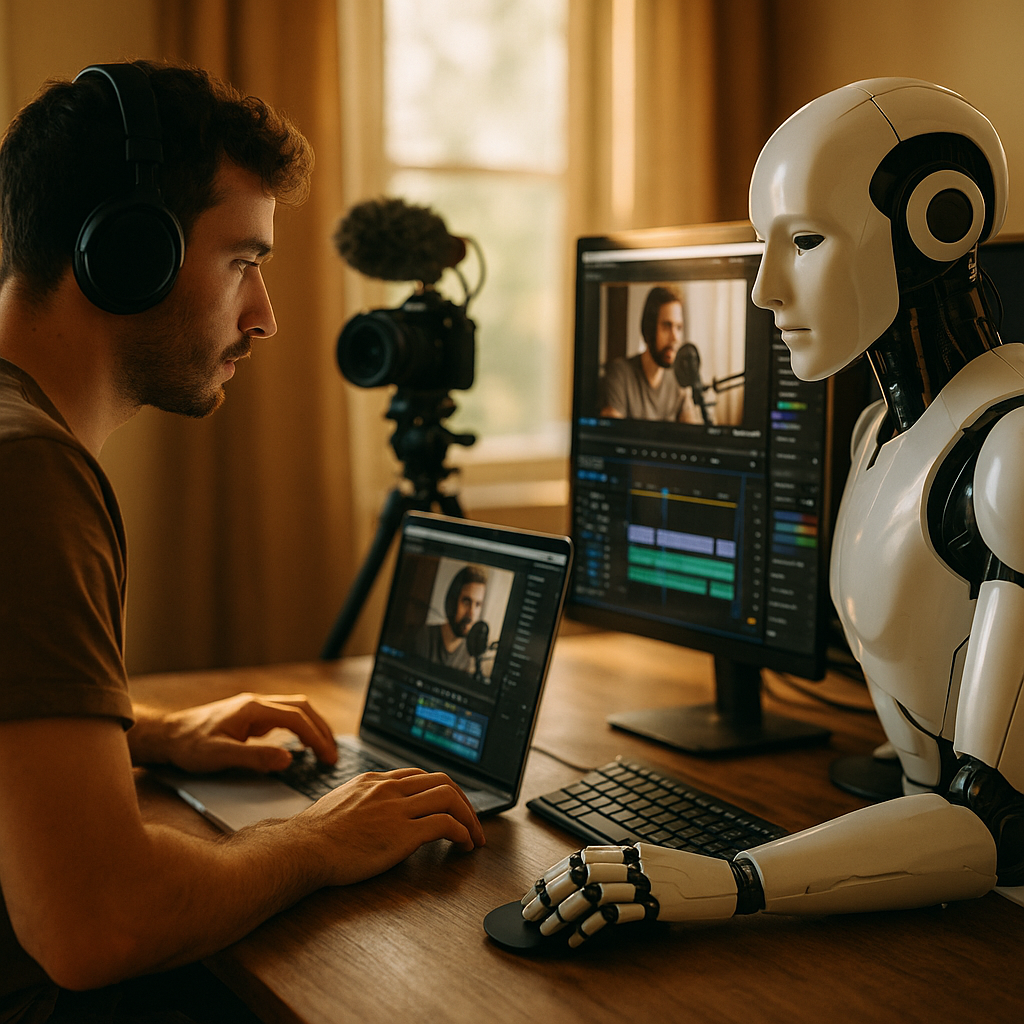
Some brands now turn creator briefs into published content in under six hours. Others still take three weeks. That’s not a workflow quirk — it’s the creator economy’s AI production divide, and it’s quietly becoming the biggest determinant of who wins share of voice in crowded feeds.
The Gap Nobody Budgeted For
Two years ago, “AI in creator marketing” mostly meant a chatbot drafting captions. Now it means end-to-end pipelines: brief generation, creator matching, script review, brand-safety scoring, usage-rights tracking, and performance forecasting, all stitched together with minimal human touch. Brands that adopted these systems early aren’t just saving time. They’re compounding an advantage that manually-run programs can no longer close with more headcount alone.
The uncomfortable truth is that this isn’t a future risk. It’s already showing up in agency pitch decks and quarterly reviews. Marketing leaders who dismissed AI production tooling as “nice to have” eighteen months ago are now explaining to finance why their cost-per-asset is triple that of a competitor running the same campaign tier.
Brands running AI-automated creator workflows are turning briefs into live content in days, not weeks — and the cost-per-asset gap between automated and manual programs is widening every quarter, not narrowing.
Why Manual Programs Can’t Just “Hire Faster”
The instinct at a lot of mid-size brands is to throw more coordinators at the problem. More people reviewing briefs, more people chasing creator approvals, more people manually tagging FTC disclosures. It works, sort of, until scale exposes the ceiling.
Manual creator ops have three structural bottlenecks that no amount of hiring fixes:
- Sequential approval chains. Legal, brand, and client sign-offs happen one after another, not in parallel, because humans need context passed to them.
- Inconsistent brand-safety review. One reviewer catches a compliance issue; another misses it. Quality varies by who’s on shift.
- No compounding learning. A human team’s insights about “what performs” live in someone’s head or a shared doc. AI systems encode that knowledge into the matching and scoring layer itself, so every campaign makes the next one faster.
This is the same dynamic driving the disconnect between rising creator spend and stagnant brand linkage: budgets scale, but the operational infrastructure underneath doesn’t scale with them. AI automation is increasingly the difference between spend that converts into output and spend that just sits in a pipeline.
What the Speed Gap Actually Looks Like in Practice
Talk to ops leads at agencies running both models side by side and the numbers get stark fast. A manually-managed influencer program — brief to live post — typically runs 12 to 21 days for a mid-tier campaign involving 15-30 creators. That includes creator sourcing, negotiation, content review cycles, and legal clearance.
AI-automated pipelines using tools like CreatorIQ’s automated matching, Aspire’s workflow engine, or in-house LLM-based brief generators are compressing that same cycle to 3-6 days in many cases. Some performance-driven programs, particularly in beauty and DTC, report turnaround under 48 hours for reactive, trend-based content.
Cost tells a similar story. Manual campaign management overhead (the labor cost of coordination, not the creator fees themselves) can run 25-35% of total program spend when everything is handled by a human team clicking through spreadsheets and email threads. Automated pipelines push that overhead down toward 8-15%, according to benchmarks circulating among agency operators — freeing budget to go directly to creator payouts or media amplification instead of internal coordination costs.
That’s not a marginal efficiency win. It’s the difference between running four campaign cycles a quarter and running twelve.
It’s Not Just Speed — It’s Compounding Risk Exposure
Here’s the part most cost-benefit conversations miss: manual programs aren’t just slower, they’re riskier, and the risk grows with volume.
Disclosure compliance is the clearest example. As FTC guidance on endorsements gets enforced more aggressively, brands running high creator volume manually are relying on human reviewers to catch missing #ad tags, mismatched claims, or improper comparative statements across dozens of pieces of content a week. That doesn’t scale. AI-driven compliance scoring, by contrast, flags issues automatically before content goes live, checking disclosure placement, claim language, and even regional regulatory variances in near real time.
This matters even more given how fast youth safety and platform disclosure rules are converging globally. Brands still relying on manual spot-checks are effectively betting that nothing slips through — a bet that gets worse odds every quarter creator volume increases. For more on where that regulatory pressure is heading, see how youth safety laws are converging into one global standard, which is reshaping what “compliant creator content” even means across markets.
There’s also brand safety at the AI-generated content layer itself. The backlash against poorly disclosed or obviously synthetic ad content isn’t a hypothetical risk anymore — it’s a demonstrated trust problem, as seen in the fallout covered in recent AI imagery backlash cases. Brands automating production still need human judgment on the final creative call, even if the operational machinery underneath is AI-driven.
Where AI Automation Genuinely Helps (and Where It Doesn’t)
Let’s be fair to the skeptics: not every part of creator ops should be automated, and pretending otherwise creates its own risk.
AI automation earns its keep in:
- Creator discovery and matching — scanning audience overlap, historical performance, and audience authenticity signals far faster than manual vetting.
- Brief generation and localization — producing first-draft briefs, adapting them by region or platform, and standardizing tone guidance.
- Compliance and disclosure scanning — catching FTC and platform policy issues before publish.
- Performance forecasting — predicting likely engagement and brand lift based on historical creator data, reducing wasted spend on underperforming partnerships.
- Contract and payment automation — usage rights tracking, licensing windows, and payout triggers.
Where automation still falls short: creative judgment, nuanced brand voice calibration, and reading the room on culturally sensitive topics. This is where the industry’s broader shift away from vanity metrics matters, too. As covered in Ad Age’s move away from follower counts, the metrics that actually matter — engagement quality, brand lift, sentiment — still require human interpretation even when the data collection is automated.
The smartest programs aren’t “AI-run.” They’re AI-accelerated with human checkpoints at the moments that actually require judgment: final creative approval, crisis-adjacent topics, and any content touching regulated categories like health, finance, or alcohol.
The Budget Conversation CMOs Need to Have Now
If your creator program is still fully manual, the fix isn’t “add AI everywhere at once.” It’s sequencing.
- Start with discovery and matching. This is the lowest-risk, highest-time-savings automation layer, and it doesn’t touch final creative judgment.
- Automate compliance scanning next. The risk reduction alone often justifies the tooling cost within a quarter.
- Keep creative review human, but AI-assisted. Use AI to flag issues and summarize brand-fit scores, but keep a human as the final decision-maker.
- Reallocate the coordination labor savings. Don’t just cut headcount — shift freed-up hours toward creator relationship management and strategic campaign design, the parts of the job AI still can’t do well.
This mirrors a pattern playing out across marketing more broadly. As digital ad spend growth slows, brands are being forced to extract more performance from existing budgets rather than counting on rising spend to cover inefficiency. Creator ops is no exception. The programs winning right now aren’t necessarily spending more — they’re spending the same dollars with dramatically less friction between decision and publish.
Worth noting too: this divide isn’t evenly distributed globally. Budget shifts toward APAC and LATAM creator markets are happening in parallel with automation adoption, meaning brands slow to automate are also losing ground in exactly the regions where creator economics are most favorable right now.
A Quick Reality Check on Vendor Claims
Every platform now claims “AI-powered” workflows. Some of that is real infrastructure; a lot of it is a chatbot bolted onto a CRM. Before signing a new contract, ask vendors for specifics: What percentage of the brief-to-publish workflow is actually automated versus templated? How does the compliance layer handle regional disclosure differences? Can they show cycle-time data from existing clients, not just feature lists?
Platforms like Sprout Social and enterprise creator platforms increasingly publish benchmark data on this — use it to hold vendors accountable rather than taking pitch-deck claims at face value. And keep an eye on how eMarketer’s creator economy spend data tracks against your own program’s growth. If your budget is scaling faster than your throughput, that’s the automation gap showing up in your own numbers.
The programs pulling ahead aren’t the ones with the biggest creator budgets. They’re the ones that turned coordination into infrastructure. Audit your brief-to-publish cycle time this quarter — if it’s still measured in weeks, that’s not a staffing problem, it’s a production architecture problem.
Frequently Asked Questions
What is the AI production divide in the creator economy?
It refers to the widening gap in cost, speed, and compliance reliability between creator marketing programs that use AI-automated workflows (matching, briefing, compliance scanning) and those still managed primarily through manual, human-led processes.
How much faster are AI-automated creator programs compared to manual ones?
Manual programs typically take 12-21 days from brief to live content for a mid-tier campaign. AI-automated pipelines often compress that to 3-6 days, with some reactive, trend-based campaigns turning around in under 48 hours.
Does automating creator workflows increase compliance risk?
Generally the opposite. AI-driven compliance scanning catches disclosure and claim issues consistently at scale, whereas manual review quality varies by reviewer and breaks down as creator volume increases.
Which parts of creator marketing should stay human-led even with AI automation?
Final creative approval, brand voice calibration, and judgment calls on culturally sensitive or regulated content categories should remain human-reviewed, even within an otherwise automated workflow.
How should a brand start automating a manual creator program?
Start with creator discovery and matching, then add compliance scanning, keep creative review human-assisted, and reallocate the time saved toward creator relationship strategy rather than cutting it entirely.
Top Influencer Marketing Agencies
The leading agencies shaping influencer marketing in 2026
Agencies ranked by campaign performance, client diversity, platform expertise, proven ROI, industry recognition, and client satisfaction. Assessed through verified case studies, reviews, and industry consultations.
Moburst

-
2

The Shelf
Boutique Beauty & Lifestyle Influencer AgencyA data-driven boutique agency specializing exclusively in beauty, wellness, and lifestyle influencer campaigns on Instagram and TikTok. Best for brands already focused on the beauty/personal care space that need curated, aesthetic-driven content.Clients: Pepsi, The Honest Company, Hims, Elf Cosmetics, Pure LeafVisit The Shelf → -
3

Audiencly
Niche Gaming & Esports Influencer AgencyA specialized agency focused exclusively on gaming and esports creators on YouTube, Twitch, and TikTok. Ideal if your campaign is 100% gaming-focused — from game launches to hardware and esports events.Clients: Epic Games, NordVPN, Ubisoft, Wargaming, Tencent GamesVisit Audiencly → -
4

Viral Nation
Global Influencer Marketing & Talent AgencyA dual talent management and marketing agency with proprietary brand safety tools and a global creator network spanning nano-influencers to celebrities across all major platforms.Clients: Meta, Activision Blizzard, Energizer, Aston Martin, WalmartVisit Viral Nation → -
5

The Influencer Marketing Factory
TikTok, Instagram & YouTube CampaignsA full-service agency with strong TikTok expertise, offering end-to-end campaign management from influencer discovery through performance reporting with a focus on platform-native content.Clients: Google, Snapchat, Universal Music, Bumble, YelpVisit TIMF → -
6

NeoReach
Enterprise Analytics & Influencer CampaignsAn enterprise-focused agency combining managed campaigns with a powerful self-service data platform for influencer search, audience analytics, and attribution modeling.Clients: Amazon, Airbnb, Netflix, Honda, The New York TimesVisit NeoReach → -
7

Ubiquitous
Creator-First Marketing PlatformA tech-driven platform combining self-service tools with managed campaign options, emphasizing speed and scalability for brands managing multiple influencer relationships.Clients: Lyft, Disney, Target, American Eagle, NetflixVisit Ubiquitous → -
8

Obviously
Scalable Enterprise Influencer CampaignsA tech-enabled agency built for high-volume campaigns, coordinating hundreds of creators simultaneously with end-to-end logistics, content rights management, and product seeding.Clients: Google, Ulta Beauty, Converse, AmazonVisit Obviously →