


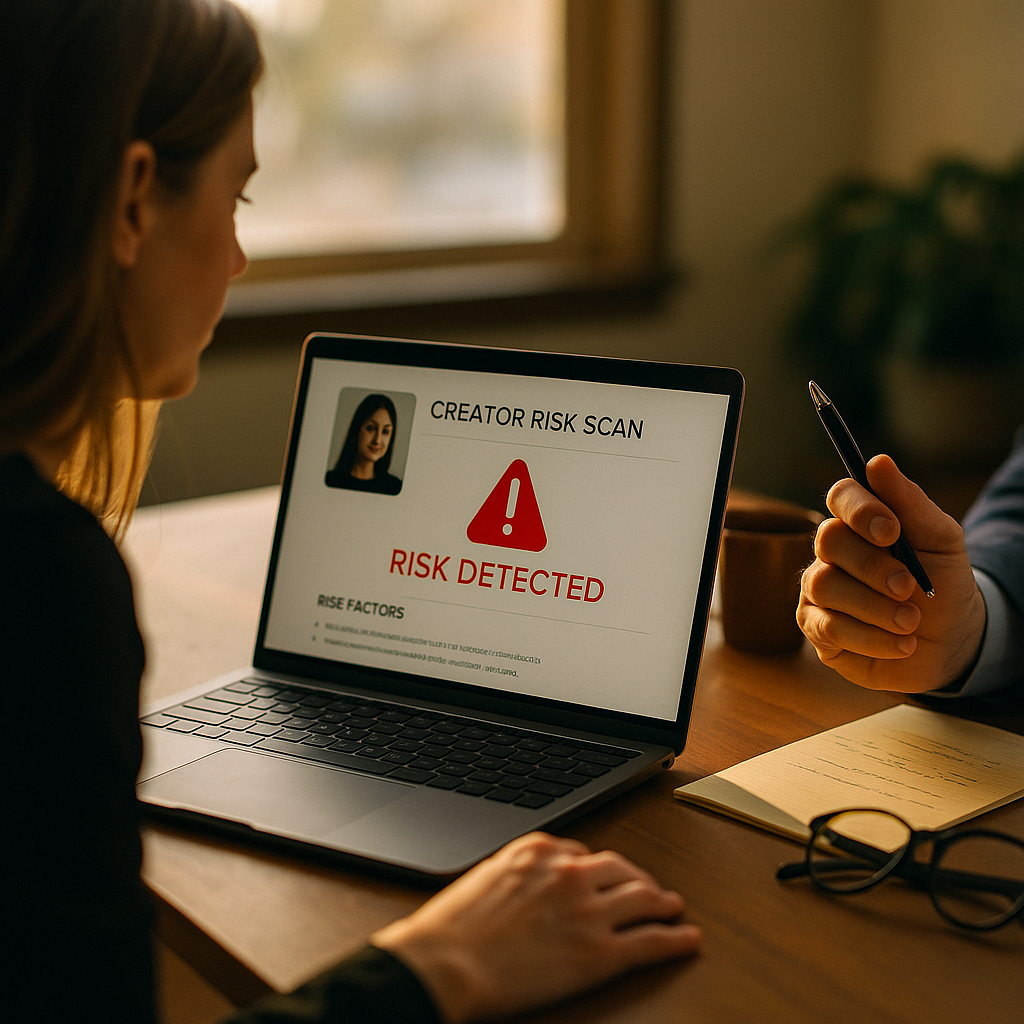
Seventy-one percent of marketers say a single creator scandal has cost them a campaign, a client, or a budget line in the past two years. Yet most brands still sign influencer contracts based on follower count and a quick Google search. AI brand safety scanners promise to change that by flagging problematic content, hate speech, and reputational red flags before ink hits paper. The question is whether these tools actually catch what matters, or just generate a false sense of security.
Why Manual Vetting Stopped Being Enough
Five years ago, a brand safety check meant scrolling a creator’s last thirty posts and skimming comments for slurs. That process worked when creators posted twice a week on one platform. It falls apart when a single mid-tier creator is active across TikTok, Instagram Reels, YouTube Shorts, Twitch, and a podcast feed, generating hundreds of pieces of content monthly.
Agencies tell us the math simply doesn’t work anymore. A compliance analyst reviewing ten creators a week, each with a multi-platform history stretching back three years, cannot realistically surface every problematic clip, deleted tweet, or context-stripped meme. That’s the gap AI scanners are built to fill: ingesting years of multi-platform content and scoring it against risk categories in minutes rather than days.
The real value of an AI brand safety scanner isn’t speed alone. It’s catching the deleted post, the old livestream clip, or the foreign-language comment thread a human reviewer would never think to check.
What These Tools Actually Scan
Not all scanners are built the same, and the marketing copy tends to blur the differences. Broadly, the category splits into three capability tiers:
- Surface-level scanners that check current public posts for profanity, hate speech keywords, and flagged hashtags. Fast, cheap, and prone to missing sarcasm or coded language.
- Deep-history scanners that pull archived content, deleted posts (via cached snapshots), and cross-platform activity going back several years. These catch the “old tweet” problem that blindsides brands mid-campaign.
- Contextual risk scanners that use large language models to assess tone, sentiment drift, and controversy proximity, flagging creators who consistently comment near political or divisive content even without posting it themselves.
The third tier is where the technology gets genuinely interesting, and genuinely risky. LLM-based context scoring can catch nuance a keyword filter misses entirely. It can also hallucinate risk where none exists, flagging satire as hate speech or misreading regional slang as a slur. We covered this accuracy problem in depth when examining accuracy benchmarks for safety scanners, and the findings should temper any brand’s enthusiasm for fully automated sign-off.
The False Positive Problem Nobody Talks About
Here’s an uncomfortable truth: a scanner that flags too aggressively is nearly as costly as one that misses real risk. Legal and compliance teams love a tool that generates lots of flags, because it looks thorough. But if forty percent of those flags are noise, your influencer managers start ignoring the dashboard entirely. That’s how real risk slips through, buried under false positives nobody has time to triage.
One agency partner network compared three scanning vendors on the same roster of 200 creators last quarter. The results varied wildly. One tool flagged 34 creators as “high risk.” Another, scanning the identical roster, flagged 11. The overlap between the two lists was just six creators. That’s not a rounding error, that’s a fundamentally different definition of risk, and it should give any procurement team pause before trusting a single vendor’s score as gospel.
The lesson: treat the risk score as a starting point for human review, not a final verdict. Build an escalation workflow where anything above a moderate threshold gets a manual second look before it kills or approves a deal.
Where Scanners Fit in the Contract Timeline
Timing matters more than most brands realize. Run a scan too early, before a creator’s content history is fully indexed, and you get incomplete results. Run it too late, after verbal terms are agreed, and you’ve created awkward renegotiation friction if something surfaces.
The workflow that seems to work best puts scanning at three checkpoints:
- Shortlist stage: a lightweight scan across your full candidate pool to eliminate obvious disqualifiers early, before anyone invests time in outreach.
- Pre-contract stage: a deep-history scan on finalists, ideally paired with a manual review of the last 90 days of activity across every platform the creator uses.
- Mid-campaign monitoring: ongoing alerts, since a creator who was clean at signing can post something problematic the week your campaign launches.
That third checkpoint is easy to skip and shouldn’t be. Brand safety isn’t a one-time gate, it’s a continuous condition. A campaign that ran for six months without re-scanning is a campaign running on outdated data. This connects directly to broader content risk questions we explored in the Nielsen DoubleVerify creator content risk analysis, where ongoing monitoring proved more predictive of incidents than one-time vetting ever could.
Vendor Evaluation: Questions Procurement Should Actually Ask
Most RFPs for brand safety tools ask about pricing tiers and API access. Few ask the questions that actually predict whether the tool will work for your risk profile. Consider pressing vendors on:
- How far back does content history scanning actually reach, and does it include deleted or archived posts?
- What languages and dialects does the contextual model support beyond English?
- Can you audit a sample of flagged and unflagged content to spot-check the model’s judgment before committing budget?
- How does the tool handle satire, reclaimed language, and regional cultural context?
- What’s the appeals process when a creator disputes a flag, and who reviews it?
That last point matters more than brands expect. Creators increasingly know these scans happen, and some are pushing back on flags they consider unfair or algorithmically biased. A vendor with no dispute process leaves you exposed to both reputational and legal friction, particularly as regulators pay closer attention to automated decision-making. The Federal Trade Commission has signaled growing interest in how brands use automated tools to make consequential decisions about business partners, so a documented human review step isn’t just good practice, it’s a defensible paper trail.
Budget and Operational Reality
Pricing for these tools ranges widely, from per-creator scan fees in the low double digits to enterprise licenses running into six figures annually for agencies scanning thousands of creators monthly. The math generally favors the tool if it prevents even one mid-tier scandal a year. eMarketer estimates brand safety incidents involving creator partners can cost six figures in campaign pause fees, PR response, and lost media value, which makes a five-figure scanning subscription look cheap by comparison.
Operationally, the bigger cost is integration. A scanner that sits outside your existing creator CRM or workflow tool creates yet another login, another export, another manual reconciliation step. Teams evaluating new safety tools should weigh them against how well they plug into systems already discussed in our influencer CRM comparison, because a standalone tool that doesn’t sync with your contracting pipeline just adds friction without adding safety.
Rights and licensing add another wrinkle. A creator can pass every brand safety check and still hand you a licensing headache if usage rights aren’t clearly scoped, particularly for campaigns running across multiple countries. That’s a separate but related risk category we broke down in our multi-market creator rights checklist, worth reviewing alongside any safety scan before final sign-off.
What “Good Enough” Actually Looks Like
No scanner catches everything, and any vendor claiming 100 percent accuracy should be treated with suspicion. The realistic goal is risk reduction, not risk elimination. A tool that catches 80 percent of genuinely problematic content and reduces false positives to a manageable review volume is doing its job. Perfection isn’t the benchmark. Meaningful improvement over manual review is.
Brands that get the most value treat the scanner as one input among several: platform compliance data from Meta Business or TikTok Ads, agency vetting notes, past campaign performance, and yes, a human who actually reads the flagged content before a deal dies or gets approved. Sprout Social’s research on social media risk management reinforces that automated tools work best as a triage layer, not a replacement for editorial judgment.
Next step: before renewing or purchasing a brand safety scanner, run a blind test comparing its flags against a manual review of twenty creators already on your roster. If the overlap is below 70 percent, you’re not buying certainty, you’re buying a second opinion, and you should price and use it accordingly.
Frequently Asked Questions
What exactly does an AI brand safety scanner check for?
Most scanners check public content across social platforms for hate speech, profanity, violent imagery, political extremism, and controversy proximity. More advanced tools also assess deleted or archived posts and score contextual tone using language models.
Can these tools replace manual creator vetting entirely?
No. Even the strongest scanners produce false positives and miss cultural or linguistic nuance. Treat automated scores as a triage layer that flags items for human review, not a final approval or rejection mechanism.
How far back should a pre-contract scan go?
Ideally three to five years, including deleted or archived content where technically accessible. Creators with long histories on multiple platforms carry more hidden risk than newer accounts, so deeper history scanning matters most for established talent.
What happens if a creator disputes a risk flag?
A credible vendor should offer a documented appeals process where a human reviewer reassesses the flagged content. Brands should insist on this before signing a contract with any scanning provider, both for fairness and for defensibility if the decision is ever challenged.
Do brand safety scanners cover mid-campaign monitoring, or just pre-contract checks?
It depends on the vendor. Some tools are built purely for one-time pre-signing scans, while others offer ongoing monitoring with alerts. Given that creator behavior can change after signing, ongoing monitoring is worth prioritizing even at a higher price point.
Top Influencer Marketing Agencies
The leading agencies shaping influencer marketing in 2026
Agencies ranked by campaign performance, client diversity, platform expertise, proven ROI, industry recognition, and client satisfaction. Assessed through verified case studies, reviews, and industry consultations.
Moburst

-
2

The Shelf
Boutique Beauty & Lifestyle Influencer AgencyA data-driven boutique agency specializing exclusively in beauty, wellness, and lifestyle influencer campaigns on Instagram and TikTok. Best for brands already focused on the beauty/personal care space that need curated, aesthetic-driven content.Clients: Pepsi, The Honest Company, Hims, Elf Cosmetics, Pure LeafVisit The Shelf → -
3

Audiencly
Niche Gaming & Esports Influencer AgencyA specialized agency focused exclusively on gaming and esports creators on YouTube, Twitch, and TikTok. Ideal if your campaign is 100% gaming-focused — from game launches to hardware and esports events.Clients: Epic Games, NordVPN, Ubisoft, Wargaming, Tencent GamesVisit Audiencly → -
4

Viral Nation
Global Influencer Marketing & Talent AgencyA dual talent management and marketing agency with proprietary brand safety tools and a global creator network spanning nano-influencers to celebrities across all major platforms.Clients: Meta, Activision Blizzard, Energizer, Aston Martin, WalmartVisit Viral Nation → -
5

The Influencer Marketing Factory
TikTok, Instagram & YouTube CampaignsA full-service agency with strong TikTok expertise, offering end-to-end campaign management from influencer discovery through performance reporting with a focus on platform-native content.Clients: Google, Snapchat, Universal Music, Bumble, YelpVisit TIMF → -
6

NeoReach
Enterprise Analytics & Influencer CampaignsAn enterprise-focused agency combining managed campaigns with a powerful self-service data platform for influencer search, audience analytics, and attribution modeling.Clients: Amazon, Airbnb, Netflix, Honda, The New York TimesVisit NeoReach → -
7

Ubiquitous
Creator-First Marketing PlatformA tech-driven platform combining self-service tools with managed campaign options, emphasizing speed and scalability for brands managing multiple influencer relationships.Clients: Lyft, Disney, Target, American Eagle, NetflixVisit Ubiquitous → -
8

Obviously
Scalable Enterprise Influencer CampaignsA tech-enabled agency built for high-volume campaigns, coordinating hundreds of creators simultaneously with end-to-end logistics, content rights management, and product seeding.Clients: Google, Ulta Beauty, Converse, AmazonVisit Obviously →