


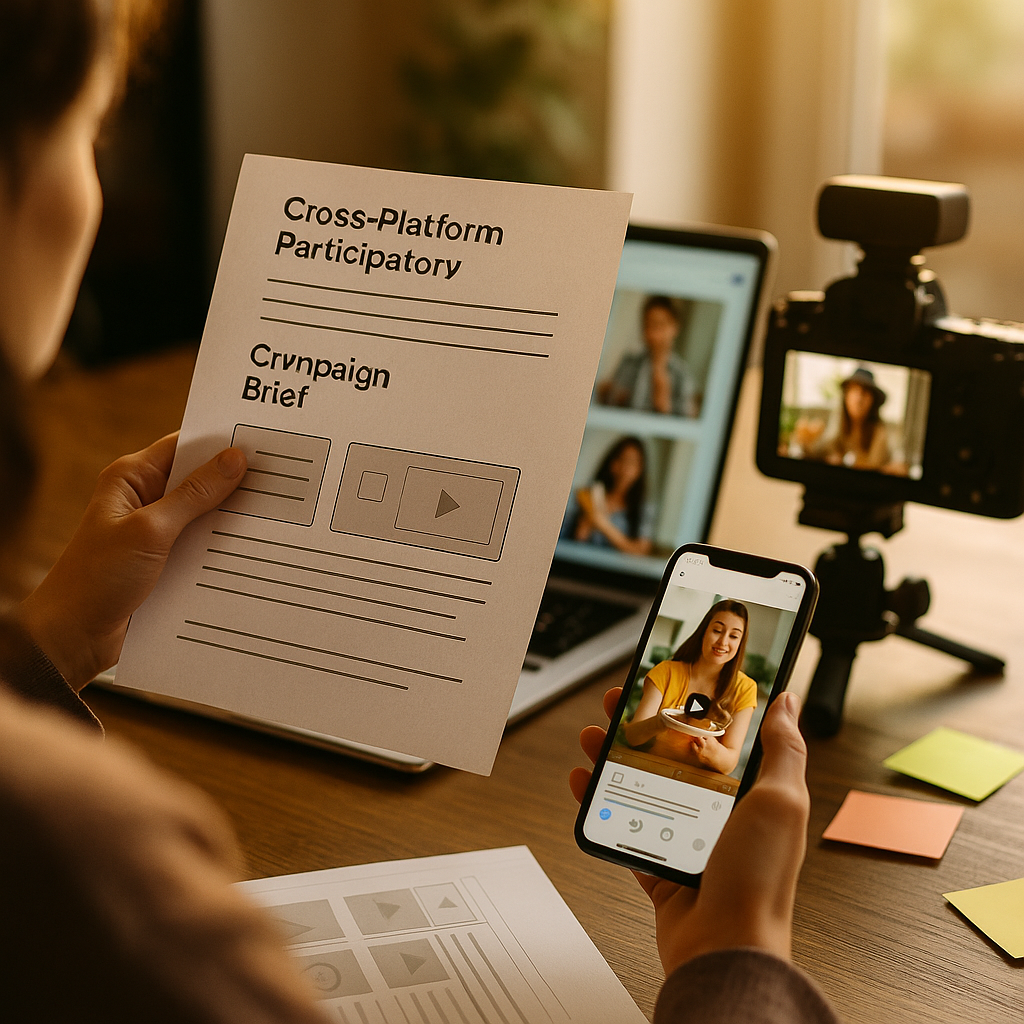
Brands that run the same campaign on four platforms aren’t running a cross-platform campaign. They’re running one campaign four times. There’s a critical difference, and it’s costing brands millions in wasted creator spend. Cross-platform participatory campaign design fixes that by building audience-driven narratives where each platform plays a distinct role and community participation mechanics connect them into a single, self-amplifying story.
Why Most Multi-Platform Briefs Fail Before the First Post Goes Live
The brief is where cross-platform campaigns die. Most brand-side briefs hand creators a platform checklist: “Post a 60-second video on TikTok, a Reel on Instagram, and a YouTube Short.” That’s asset repurposing, not participatory design. The audience has no reason to move between platforms, no contribution to make, and no reason to return.
According to data from Sprout Social, audiences who engage with a brand on three or more platforms demonstrate significantly higher purchase intent than single-platform audiences. The compounding effect is real. But it only kicks in when each platform serves a distinct narrative function that pulls people forward in the story.
The fix starts with a structural brief, not a platform brief. Before you assign deliverables, you need to define: What is the narrative? Where does it begin? How does the audience help it evolve? And where does it resolve or continue? These aren’t creative questions. They’re operational ones, and they belong in the campaign brief.
The Four-Platform Narrative Stack
Think of your four core platforms as a narrative ecosystem, each with a defined job.
TikTok is the ignition layer. Short-form, algorithm-driven, and built for discovery, TikTok is where the narrative spark drops. A creator posts a provocative question, an incomplete reveal, or a challenge that requires audience input. The brief should specify what the open loop is, not how to close it. Open creator briefs that leave genuine interpretive room consistently outperform scripted ones. For reference on how to structure these, see our guide on open-ended briefs for high engagement.
Instagram is the context layer. Stories, carousels, and Close Friends content let creators add depth to what TikTok ignited. This is where audience-submitted content gets surfaced, where polls push the narrative in new directions, and where the brand’s visual identity gets reinforced without killing the organic feel. The brief should specify which audience contributions from TikTok comments get pulled into Instagram Stories explicitly, so creators aren’t guessing.
YouTube is the depth layer. Long-form content, creator vlogs, documentary-style edits, or episodic series give the campaign its weight. This is where the story earns credibility. YouTube content should reference what happened on TikTok and Instagram and give audiences who weren’t there a reason to go back. If you’re running an episodic model, the ROI considerations are different from one-off content; the tradeoffs are worth understanding before you brief.
Discord is the ownership layer. This is the platform most brands underuse and underbrief. Discord is where your most engaged community members become co-authors of the narrative. Brands like Liquid Death, Nike, and several gaming publishers have demonstrated that server-based communities drive UGC volumes that paid campaigns can’t replicate. The brief should assign a creator or brand community manager to Discord with explicit instructions: what decisions does the community get to make? What narrative branches are available to them?
The platforms aren’t channels to fill. They’re narrative roles to cast. Brief each one against its function in the story, not its content format specs.
How to Build Participation Mechanics Into the Brief
Participation mechanics are the specific audience actions that advance the narrative. They need to be designed before the campaign launches, not discovered post-launch when the comment section gets interesting.
Here’s what a participation mechanic looks like in practice. A beverage brand running a mystery flavor campaign briefs a TikTok creator to post a blind taste test and ask followers to name the flavor in the comments. The top three guesses get featured in an Instagram Story the following day. The Discord server votes on which guess is closest. A YouTube video reveals the answer three days later, naming the Discord member whose guess was featured. That’s one mechanic. Four platforms. One narrative thread. The audience contributed, and the brand captured earned media at every stage.
For brands building more complex mystery mechanics into their campaigns, the briefing process requires its own architecture. The approach to briefing creators for interactive mystery campaigns covers the structural elements in detail.
The key rule: participation mechanics must require minimal friction. A TikTok comment is zero friction. A Discord vote is low friction. Filling out a form is high friction and will kill participation rates. Design your mechanics against the platform’s native interaction patterns, not against your campaign tracking needs.
Coordination Across Creators Without Killing Creative Autonomy
Multi-creator cross-platform campaigns introduce a coordination problem that single-platform programs don’t have. If Creator A on TikTok references content that Creator B on YouTube hasn’t posted yet, the narrative breaks. If both creators post the same message on the same day, the audience sees a PR stunt, not a community.
The brief needs a content sequencing calendar that every creator sees before launch. Not a rigid script, but a narrative beat sheet: what happens on which platform, in what order, and what each creator can reference from what already exists. Think of it as a writers’ room document for a scripted series, because that’s essentially what you’re producing.
Creators also need permission parameters. What can they improvise? What audience contributions are they authorized to incorporate in real time? A TikTok creator who sees a genuinely brilliant audience comment at 11 PM shouldn’t need to email a brand manager for approval before responding. The brief should pre-authorize a range of real-time participation responses. This is where your FTC compliance obligations intersect with creative latitude; disclosures need to travel with content regardless of how organically it was generated. The FTC’s endorsement guidelines apply to creator-amplified UGC when the campaign is paid, full stop.
Measurement: What “Cross-Platform Participation” Actually Looks Like in a Dashboard
Standard influencer metrics won’t capture participatory campaign performance. Views and follower reach are lagging indicators of a campaign that already worked. The leading indicators for participatory campaigns are different:
- Cross-platform migration rate: What percentage of TikTok engagers showed up on Instagram or Discord within 48 hours?
- Narrative contribution volume: How many audience submissions, guesses, or community decisions were made across all platforms?
- Earned amplification ratio: For every piece of creator-paid content, how much organic UGC did the participation mechanic generate?
- Discord server growth velocity: New member joins per day during the campaign window, benchmarked against pre-campaign baseline.
- Sequential content consumption rate: Of users who watched the TikTok, what percentage watched the YouTube resolution content?
Tools like Sprinklr and Brandwatch can track cross-platform conversation volumes, but Discord data typically requires a custom integration or a bot-based analytics layer. Build that into your tech stack budget before the campaign launches, not after.
For brands scaling audience participation briefs for earned media, the measurement framework needs to be defined at the brief stage so creators understand what success looks like beyond follower metrics.
If your measurement framework can’t capture whether the audience moved between platforms, you’re measuring content performance, not campaign performance. Those are not the same thing.
Rights, Compliance, and What Happens to UGC
Participatory campaigns generate audience-created content at scale. Before the first post drops, your brief needs to address: What rights does the brand claim to audience submissions featured by creators? How are those rights communicated to participants? What disclosure language applies when a creator re-shares audience content that was generated in response to a paid brief?
This isn’t an edge case. It’s a structural compliance issue. Platform terms vary. FTC disclosure requirements don’t disappear because a user, rather than a paid creator, generated the content that your campaign then amplified. Your legal team needs to review the participation mechanics before you brief creators, and that review should be treated as a campaign dependency, not an afterthought.
For campaigns operating in the UK or EU, ICO data handling rules apply to any personal data collected through participation mechanics, including usernames, comment submissions, or Discord server membership. Build that review into your pre-launch checklist.
Brief Structure: What the Document Actually Needs to Say
A cross-platform participatory brief is longer than a standard influencer brief. Accept that. It should cover: the campaign narrative arc and the open loop that audience participation is meant to close; the platform-specific role for each creator and each platform; the participation mechanics with exact friction levels defined; the content sequencing calendar; pre-authorized improvisation parameters; FTC disclosure language requirements; UGC rights and how creators communicate those to their audience; and the measurement KPIs that define success at the campaign level, not the post level.
For teams building out modular briefs for multi-surface distribution, a modular structure allows you to adapt the core narrative brief to each creator’s platform mix without rebuilding from scratch for every partnership. That efficiency matters at scale.
The brands executing this well, including Fenty, Red Bull, and several mid-size DTC companies that have run Discord-anchored product launch campaigns, all share one operational trait: they treat the brief as a campaign architecture document, not a creative directive. The creative comes from the creators and the community. The architecture is the brand’s job.
Start your next campaign by mapping the narrative beats before you map the deliverables. That single sequencing shift will change what you put in the brief, and what the brief produces.
Frequently Asked Questions
What is cross-platform participatory campaign design?
Cross-platform participatory campaign design is an approach to influencer and creator campaigns where each platform serves a distinct narrative role and audience participation mechanics connect the platforms into a single, evolving story. Unlike repurposing the same content across channels, this model uses TikTok, Instagram, YouTube, and Discord as sequential story layers where the audience helps build the narrative rather than passively consuming it.
How should a brand brief creators differently for a participatory campaign versus a standard influencer campaign?
A standard influencer brief specifies deliverables and brand messaging. A participatory campaign brief specifies narrative architecture: what the open loop is, what participation mechanic the audience is invited into, what the creator can improvise in real time, how cross-platform sequencing works, and what the measurement KPIs are at the campaign level. The brief is longer, more structural, and treats the creator as a narrative co-architect rather than a content producer.
What role does Discord play in a cross-platform participatory campaign?
Discord functions as the community ownership layer. It’s where the most engaged audience members become co-authors of the narrative by making votes, decisions, or contributions that visibly affect the campaign’s direction. Brands that activate Discord effectively see significantly higher UGC volumes and deeper community investment than campaigns that stop at TikTok, Instagram, and YouTube.
How do you measure the success of a cross-platform participatory campaign?
Standard influencer metrics like views and follower reach are insufficient for participatory campaigns. Key performance indicators include cross-platform migration rate (what percentage of TikTok engagers showed up on other platforms), narrative contribution volume, earned amplification ratio, Discord server growth velocity, and sequential content consumption rate. These metrics should be defined at the brief stage and built into the campaign’s tech stack before launch.
What FTC compliance issues apply to audience-generated content in participatory campaigns?
FTC disclosure requirements apply to creator-amplified user-generated content when that content was generated in response to a paid campaign brief. The fact that a user rather than a paid creator produced the content does not remove disclosure obligations when a brand or paid creator re-shares or features it. Brands should review disclosure language requirements with legal counsel before launching participatory campaigns and ensure those requirements are communicated to creators in the brief.
Top Influencer Marketing Agencies
The leading agencies shaping influencer marketing in 2026
Agencies ranked by campaign performance, client diversity, platform expertise, proven ROI, industry recognition, and client satisfaction. Assessed through verified case studies, reviews, and industry consultations.
Moburst

-
2

The Shelf
Boutique Beauty & Lifestyle Influencer AgencyA data-driven boutique agency specializing exclusively in beauty, wellness, and lifestyle influencer campaigns on Instagram and TikTok. Best for brands already focused on the beauty/personal care space that need curated, aesthetic-driven content.Clients: Pepsi, The Honest Company, Hims, Elf Cosmetics, Pure LeafVisit The Shelf → -
3

Audiencly
Niche Gaming & Esports Influencer AgencyA specialized agency focused exclusively on gaming and esports creators on YouTube, Twitch, and TikTok. Ideal if your campaign is 100% gaming-focused — from game launches to hardware and esports events.Clients: Epic Games, NordVPN, Ubisoft, Wargaming, Tencent GamesVisit Audiencly → -
4

Viral Nation
Global Influencer Marketing & Talent AgencyA dual talent management and marketing agency with proprietary brand safety tools and a global creator network spanning nano-influencers to celebrities across all major platforms.Clients: Meta, Activision Blizzard, Energizer, Aston Martin, WalmartVisit Viral Nation → -
5

The Influencer Marketing Factory
TikTok, Instagram & YouTube CampaignsA full-service agency with strong TikTok expertise, offering end-to-end campaign management from influencer discovery through performance reporting with a focus on platform-native content.Clients: Google, Snapchat, Universal Music, Bumble, YelpVisit TIMF → -
6

NeoReach
Enterprise Analytics & Influencer CampaignsAn enterprise-focused agency combining managed campaigns with a powerful self-service data platform for influencer search, audience analytics, and attribution modeling.Clients: Amazon, Airbnb, Netflix, Honda, The New York TimesVisit NeoReach → -
7

Ubiquitous
Creator-First Marketing PlatformA tech-driven platform combining self-service tools with managed campaign options, emphasizing speed and scalability for brands managing multiple influencer relationships.Clients: Lyft, Disney, Target, American Eagle, NetflixVisit Ubiquitous → -
8

Obviously
Scalable Enterprise Influencer CampaignsA tech-enabled agency built for high-volume campaigns, coordinating hundreds of creators simultaneously with end-to-end logistics, content rights management, and product seeding.Clients: Google, Ulta Beauty, Converse, AmazonVisit Obviously →