


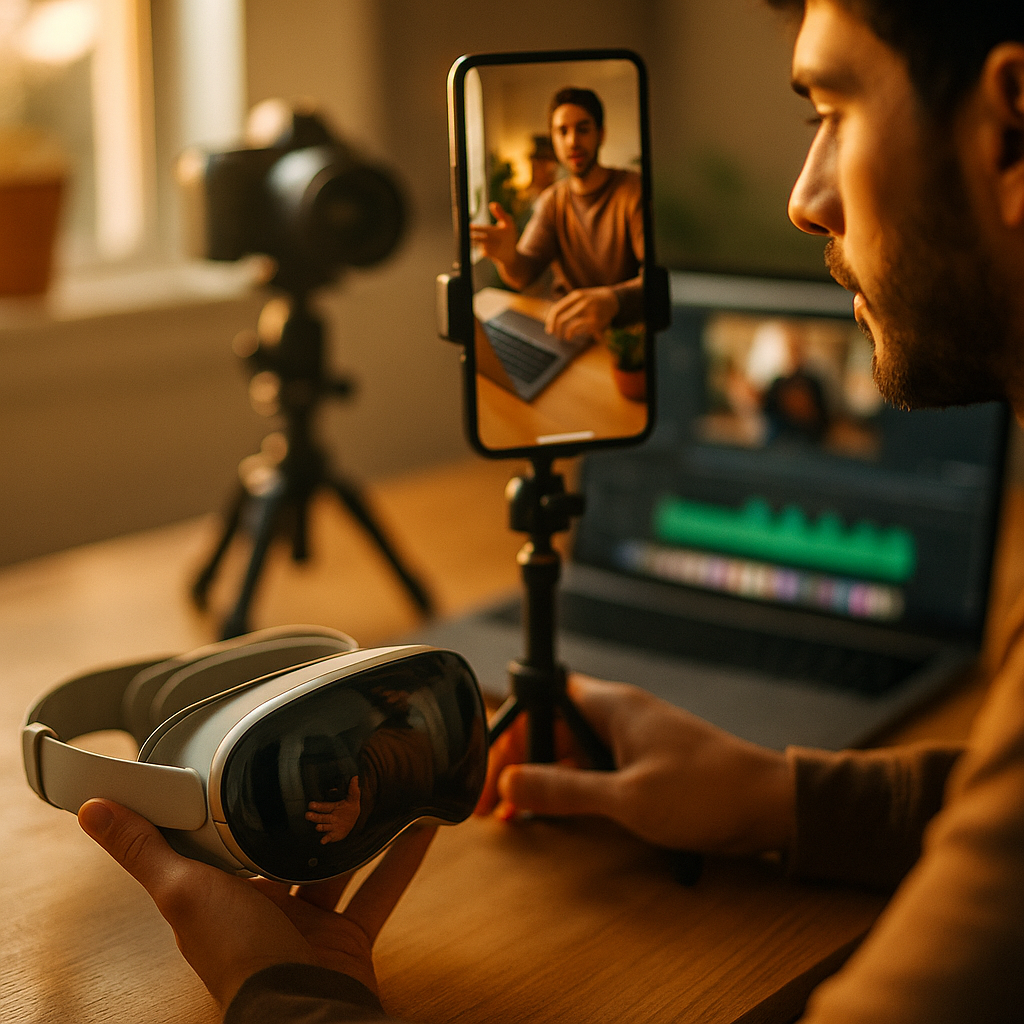
Apple sold roughly a million Vision Pro units in its first year, and Meta’s Ray-Ban smart glasses reportedly outsold the original Quest. Yet ask most CMOs how much of their creator budget went to AR or spatial video last year, and the honest answer is “basically none.” So is the immersive format frontier actually open for business, or is this another case of hardware hype racing ahead of measurable marketing returns?
That gap between adoption headlines and budget lines is the whole story. Let’s dig into where AR and spatial video genuinely earn a place in creator campaigns, and where brands are still paying innovation tax for very little return.
Why the Question Feels Urgent Right Now
Three things converged. Apple’s Vision Pro normalized spatial video capture as a native iPhone feature, not just a headset exclusive. Meta pushed AR effects deeper into Instagram and Reels through its Spark AR successors. And TikTok kept iterating on its AR effect house, giving smaller creators tools that used to require a dev team.
Add in the fact that Gen Z audiences increasingly expect interactivity, not passive video, and you get a genuine strategic question, not just a tech-curiosity one. Brands that ignored short-form video in its early years paid for it later with higher CPMs and playing catch-up on creator relationships. Nobody wants to repeat that mistake with immersive formats.
But timing matters more than enthusiasm. Being early to a format with no measurement infrastructure isn’t visionary, it’s expensive guesswork.
What “Immersive” Actually Means for a Brand Budget
Strip away the marketing buzzwords and immersive creator content splits into three practical buckets:
- AR try-on and filters: Instagram and TikTok effects letting audiences virtually sample products — makeup, glasses, furniture placement. Mature, relatively cheap, well-supported by platform ad tools.
- Spatial video: 3D-captured footage viewable on Vision Pro, Quest 3, or increasingly on flat screens via dimensional rendering. Still niche hardware, but iPhone 15 Pro and later can capture it natively.
- Full AR/VR branded experiences: Custom-built worlds, games, or interactive product demos requiring dedicated development. Expensive, slow, and largely the domain of flagship campaigns from brands like Nike or Samsung.
These three buckets have wildly different readiness levels. Lumping them together under one “immersive” budget line is where a lot of marketing teams go wrong.
AR filters are ready for mainstream creator budgets today. Spatial video is ready for pilot budgets. Full custom AR/VR experiences are still a PR line item, not a scalable media buy.
AR Filters: The Format That’s Already Proven Itself
This is the one bucket where the “is it ready” question is basically settled. Brands have been running creator-driven AR filter campaigns for years, and the data backs continued investment. Meta’s own advertiser resources highlight AR try-on as a proven lever for reducing purchase hesitation, particularly in beauty and eyewear verticals, and platforms like Meta’s business tools now make filter creation accessible without a specialized studio.
The creator economics work too. Micro and mid-tier creators can now build branded AR effects using templated tools, meaning brands don’t need a six-figure production budget to test the format. It sits closer in cost and complexity to our poll-driven and AR deliverables approach than to a Vision Pro shoot.
If your 2026 media plan doesn’t include at least a pilot AR filter campaign for a visually try-on-able product, you’re leaving a mature, low-risk format on the table.
Spatial Video: Promising, But the Audience Isn’t There Yet
Here’s where things get murkier. Spatial video capture is genuinely easy now — most recent iPhones shoot it natively, and creators like MKBHD and various tech reviewers have experimented with spatial b-roll. The production barrier has basically disappeared.
The distribution barrier hasn’t. Vision Pro adoption, while notable for a first-generation $3,500 device, still represents a rounding error compared to TikTok’s billion-plus users. Meta’s Quest line has better volume, but spatial video consumption habits on Quest skew toward gaming and fitness apps, not branded creator content feeds.
So you can capture beautiful spatial footage of a product unboxing or a destination review. But where does it live? Right now, mostly on Vision Pro’s TV app or as a novelty within a creator’s YouTube upload. It’s not embedded in feed algorithms the way standard video is, which means no organic discovery mechanism and no scaled ad placement to amplify it.
That’s not a dealbreaker for every brand. Travel, automotive, real estate, and high-end hospitality brands have obvious use cases: showing a hotel suite or a vehicle interior in spatial video creates a genuine “try before you buy” sensation that flat video can’t match. But treat it as an owned-channel or press-moment tactic for now, not a scalable creator media buy with predictable CPMs.
The Measurement Problem Nobody’s Solved
This is the real reason immersive formats haven’t hit mainstream creator budgets, and it’s rarely stated plainly enough: there’s no standardized attribution model for AR or spatial content yet.
Standard video campaigns give you watch time, completion rate, click-through, and conversion pixels that plug cleanly into a dashboard. AR filter usage gives you impressions and “tries,” which is useful directionally but hard to tie to bottom-funnel revenue without heavy manual analysis. Spatial video, run mostly outside standard ad platforms, often can’t be measured at all beyond vanity view counts on a headset app.
Marketing teams evaluating interactive content tools should apply the same rigor here: ask the vendor exactly what data exports look like before signing a contract, not after the campaign wraps.
Industry analysts, including researchers at eMarketer, have noted that immersive ad formats consistently lag behind adoption in measurement standardization — a pattern that repeated with connected TV and is repeating again here. Budget follows measurable ROI. Until third-party measurement partners build reliable AR/spatial attribution, expect most CFOs to cap these budgets at “test” tier, regardless of how compelling the creative looks in a demo reel.
Compliance Angles Brands Can’t Skip
Immersive formats introduce disclosure wrinkles that a standard sponsored post doesn’t have. If a creator builds a branded AR filter, is the disclosure baked into the filter’s metadata, spoken aloud, or overlaid as text? The FTC’s endorsement guidance doesn’t carve out exceptions for interactive formats — the same “clear and conspicuous” standard applies, but interactive UI makes clarity harder to guarantee.
Consider a filter that gets remixed or duetted by other users; the original sponsorship disclosure can easily get stripped in the process. Brands running AR campaigns should build disclosure directly into the filter asset itself, not rely on the creator’s caption alone. It’s the same lesson we’ve pushed in multi-episode series briefs: compliance has to be engineered into the format, not bolted on afterward.
For spatial video, there’s an added wrinkle around biometric-adjacent capture — some spatial cameras use depth sensors that map physical spaces. Brands operating in regions with strict data rules should loop in legal before creators start capturing spatial footage inside real homes or private venues, and internationally, keep an eye on how bodies like the ICO address depth-mapping data as adoption grows.
What a Sensible Pilot Budget Looks Like
For teams determined to test the water in the coming year, here’s a realistic allocation model based on what’s actually proven versus speculative:
- 60-70% to AR filters and try-on effects with established creators in beauty, fashion, home, or automotive — categories where visual try-on has clear purchase-intent value.
- 20-30% to spatial video pilots in owned channels or press/earned media contexts, paired with one or two creator partnerships purely for content diversity, not scaled distribution.
- Under 10% to experimental full AR/VR builds, treated as R&D or brand-halo spend rather than performance media.
This mirrors the crawl-walk-run logic that’s worked for every emerging format, from Stories to livestream shopping. Brands that rushed budgets disproportionately into unproven formats — remember branded Clubhouse rooms? — tend to regret it within two quarters.
It also pairs well with existing creator content strategies rather than replacing them. A long-form YouTube video can drive the narrative and SEO value, while an AR filter drives the interactive, try-on layer for the same product launch. Immersive shouldn’t be siloed; it should slot into a broader remixable content plan, similar to the logic in remixable asset briefs.
So, Is 2026 the Year?
Partially. AR filters have graduated from experimental to standard-practice for visually try-on-able categories, and any brand still treating them as a novelty is behind, not ahead. Spatial video deserves budget, but pilot-tier budget tied to owned channels and PR value, not scaled creator media spend expecting programmatic ROI. Full custom AR/VR experiences remain a flagship-brand play, reserved for teams with innovation budgets that don’t need to justify themselves against standard CPA benchmarks.
The frontier is real. It’s just not evenly distributed across formats, and treating “immersive” as one monolithic bet is the fastest way to misallocate a creator budget that could otherwise be compounding returns in formats that already work, like video-first sponsored content.
Next step: Audit your last two creator campaigns for a visually try-on-able product and run one AR filter pilot next quarter with clear “tries” and click-through benchmarks before committing further budget to spatial or full AR/VR formats.
FAQs
Are AR filters worth the investment for a small-to-mid-size brand?
Yes, particularly in beauty, eyewear, home goods, or fashion. Templated AR creation tools have lowered production costs significantly, and platforms provide built-in analytics for tries and shares, making it one of the more accessible immersive formats regardless of budget size.
Do brands need Vision Pro-specific content to use spatial video?
Not necessarily. Recent iPhones capture spatial video natively, and some formats render on standard screens with a dimensional effect. However, full immersive playback still requires a headset, which limits reach for now.
How should brands measure AR filter campaign success?
Track filter opens, completion rate, shares, and any linked click-through to product pages. Combine this with post-campaign brand lift surveys since platform-native attribution for downstream purchases is still limited.
What FTC disclosure rules apply to AR-based sponsored content?
The same “clear and conspicuous” standard applies to interactive and AR content as it does to standard posts. Disclosure should be built into the filter or experience itself, not solely dependent on a caption that could be stripped out during remixing.
Is full custom AR/VR content ever worth it for a mid-size brand?
Generally not as a primary media buy. It’s better suited to flagship or halo campaigns with dedicated innovation budgets rather than standard performance-marketing expectations, given high production costs and limited current audience reach.
FAQs
Frequently asked questions about immersive creator formats.
Are AR filters worth the investment for a small-to-mid-size brand?
Yes, particularly in beauty, eyewear, home goods, or fashion. Templated AR creation tools have lowered production costs significantly, and platforms provide built-in analytics for tries and shares, making it one of the more accessible immersive formats regardless of budget size.
Do brands need Vision Pro-specific content to use spatial video?
Not necessarily. Recent iPhones capture spatial video natively, and some formats render on standard screens with a dimensional effect. However, full immersive playback still requires a headset, which limits reach for now.
How should brands measure AR filter campaign success?
Track filter opens, completion rate, shares, and any linked click-through to product pages. Combine this with post-campaign brand lift surveys since platform-native attribution for downstream purchases is still limited.
What FTC disclosure rules apply to AR-based sponsored content?
The same “clear and conspicuous” standard applies to interactive and AR content as it does to standard posts. Disclosure should be built into the filter or experience itself, not solely dependent on a caption that could be stripped out during remixing.
Is full custom AR/VR content ever worth it for a mid-size brand?
Generally not as a primary media buy. It’s better suited to flagship or halo campaigns with dedicated innovation budgets rather than standard performance-marketing expectations, given high production costs and limited current audience reach.
Top Influencer Marketing Agencies
The leading agencies shaping influencer marketing in 2026
Agencies ranked by campaign performance, client diversity, platform expertise, proven ROI, industry recognition, and client satisfaction. Assessed through verified case studies, reviews, and industry consultations.
Moburst

-
2

The Shelf
Boutique Beauty & Lifestyle Influencer AgencyA data-driven boutique agency specializing exclusively in beauty, wellness, and lifestyle influencer campaigns on Instagram and TikTok. Best for brands already focused on the beauty/personal care space that need curated, aesthetic-driven content.Clients: Pepsi, The Honest Company, Hims, Elf Cosmetics, Pure LeafVisit The Shelf → -
3

Audiencly
Niche Gaming & Esports Influencer AgencyA specialized agency focused exclusively on gaming and esports creators on YouTube, Twitch, and TikTok. Ideal if your campaign is 100% gaming-focused — from game launches to hardware and esports events.Clients: Epic Games, NordVPN, Ubisoft, Wargaming, Tencent GamesVisit Audiencly → -
4

Viral Nation
Global Influencer Marketing & Talent AgencyA dual talent management and marketing agency with proprietary brand safety tools and a global creator network spanning nano-influencers to celebrities across all major platforms.Clients: Meta, Activision Blizzard, Energizer, Aston Martin, WalmartVisit Viral Nation → -
5

The Influencer Marketing Factory
TikTok, Instagram & YouTube CampaignsA full-service agency with strong TikTok expertise, offering end-to-end campaign management from influencer discovery through performance reporting with a focus on platform-native content.Clients: Google, Snapchat, Universal Music, Bumble, YelpVisit TIMF → -
6

NeoReach
Enterprise Analytics & Influencer CampaignsAn enterprise-focused agency combining managed campaigns with a powerful self-service data platform for influencer search, audience analytics, and attribution modeling.Clients: Amazon, Airbnb, Netflix, Honda, The New York TimesVisit NeoReach → -
7

Ubiquitous
Creator-First Marketing PlatformA tech-driven platform combining self-service tools with managed campaign options, emphasizing speed and scalability for brands managing multiple influencer relationships.Clients: Lyft, Disney, Target, American Eagle, NetflixVisit Ubiquitous → -
8

Obviously
Scalable Enterprise Influencer CampaignsA tech-enabled agency built for high-volume campaigns, coordinating hundreds of creators simultaneously with end-to-end logistics, content rights management, and product seeding.Clients: Google, Ulta Beauty, Converse, AmazonVisit Obviously →