


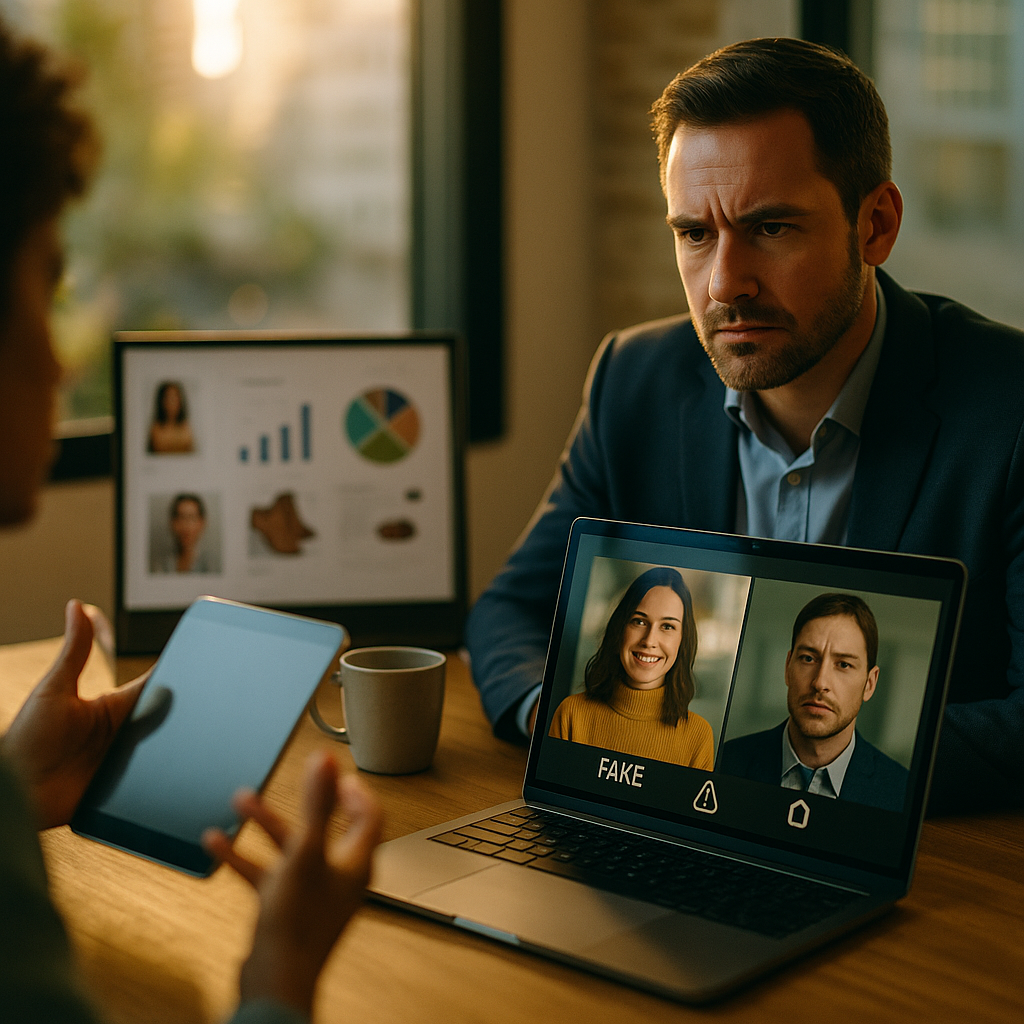
A Journalism Experiment Just Exposed Your Biggest Brand Risk
When the Columbia Journalism Review launched its AI deepfake campaign to demonstrate how easily synthetic video could mimic trusted public figures, it wasn’t aiming at marketers. But the message landed squarely in our laps. According to a Gartner survey, 60% of CMOs expect generative video to be a standard campaign asset by late this year. Meanwhile, fewer than 15% of enterprise brands have a formal synthetic media policy. That gap is where reputational damage, regulatory penalties, and creator lawsuits live. Deepfake governance for brand marketing leaders isn’t a legal department side project anymore—it’s a strategic imperative sitting at the intersection of creative innovation and existential brand risk.
What the CJR Campaign Actually Revealed
The Columbia Journalism Review’s project wasn’t just a provocation. It was a proof-of-concept showing that current detection tools fail more often than they succeed when confronted with high-quality synthetic media. The campaign generated realistic video of recognizable figures delivering fabricated statements—and most viewers couldn’t tell the difference. Neither could several automated detection platforms.
For brand leaders, the lesson isn’t about journalism ethics. It’s operational. If your agency produces a generative video featuring a creator’s likeness—even with their consent—and that asset gets clipped, remixed, or decontextualized, your brand owns the fallout. The CJR campaign proved that the downstream lifecycle of synthetic content is essentially uncontrollable once it enters open distribution.
The CJR deepfake campaign demonstrated that even well-intentioned synthetic media escapes its original context within hours. Brand governance must account for content lifecycle, not just content creation.
This matters because platform capabilities are expanding fast. Meta’s Movie Gen, Runway’s Gen-4, and OpenAI’s Sora have all shipped features enabling brands and creators to generate photorealistic video with minimal input. The creative upside is real. So is the compliance surface area.
Platform Capabilities Are Outrunning Brand Standards
Let’s be specific about what’s changed. TikTok now allows brands to generate synthetic spokesperson content natively within its ad manager. YouTube has rolled out disclosure labels for AI-generated content but enforcement remains inconsistent. Meta requires self-certification for AI-altered ads but doesn’t verify the declarations. And Snap’s generative video tools have quietly become some of the most accessible in the market.
Every one of these platforms is incentivized to make generative video easy. None of them is incentivized to slow your campaign down with governance guardrails.
That responsibility falls on you.
If your brand safety framework was built for static influencer posts and pre-roll display ads, it’s structurally inadequate for a world where a single prompt can generate a 30-second video of a synthetic human endorsing your product. You need to understand AI-generated ad creative liability before you scale any generative video program.
Creator Likeness Protections: The Contract Gap Most Brands Haven’t Closed
Here’s where things get legally dangerous. Most creator contracts—even recently updated ones—don’t address synthetic likeness rights with sufficient specificity. A standard usage clause that grants a brand the right to “use creator’s name, image, and likeness” was written for photography and traditional video. It doesn’t clearly cover AI-generated variations, voice clones, or digital avatars derived from a creator’s biometric data.
Tennessee’s ELVIS Act, California’s AB 2602, and the proposed federal NO FAKES Act are all creating a patchwork of state and federal protections for digital likeness rights. The FTC’s evolving guidance on AI-generated endorsements adds another layer. Brands that don’t proactively update their creator agreements are building campaigns on a legal foundation that’s actively shifting beneath them.
What should updated contracts include?
- Explicit synthetic likeness clauses defining whether AI-generated or AI-modified content using the creator’s face, voice, or mannerisms is permitted
- Scope limitations specifying which platforms, formats, and duration windows apply to synthetic assets
- Revocation rights allowing creators to withdraw consent for synthetic use independently of broader content rights
- Training data prohibitions preventing the brand or its vendors from using creator content to train generative models without separate compensation and consent
If you’re working with AI creator contract addendums, these provisions should be non-negotiable additions for any partnership involving generative content.
Disclosure Frameworks: Beyond the “AI-Generated” Label
Simply slapping an “AI-generated” label on synthetic content isn’t governance. It’s a checkbox. Real disclosure frameworks address three layers simultaneously: regulatory compliance, platform requirements, and audience trust.
Regulatory compliance means tracking the specific requirements of every jurisdiction where your content will appear. The EU AI Act classifies deepfakes as high-risk and mandates disclosure. The FTC has signaled that undisclosed synthetic endorsements constitute deceptive advertising. China’s Deep Synthesis Provisions require watermarking. If your campaigns run globally, your disclosure framework needs jurisdiction-specific protocols.
Platform requirements are a moving target. YouTube’s content labeling policies differ materially from Meta’s self-certification approach. TikTok’s AI content labels are mandatory for some formats and optional for others. Your compliance team needs a platform-by-platform matrix that gets updated quarterly.
Audience trust is the dimension most brands skip. Research from the Edelman Trust Barometer consistently shows that consumers penalize brands more harshly for perceived deception than for actual content quality. A proactive, visible disclosure strategy—”This content was created with AI tools”—actually builds trust when executed transparently rather than buried in metadata.
Disclosure isn’t a compliance burden. It’s a trust signal. Brands that treat synthetic media transparency as a feature—not a footnote—will outperform those that hide behind minimum viable compliance.
For a deeper dive into how FTC expectations specifically apply to remixed creator content, see our coverage of FTC disclosure rules for AI-remixed content.
Building Your Synthetic Media Policy: A Practical Framework
Stop waiting for a single regulatory standard to emerge. It won’t. Instead, build an internal synthetic media policy structured around five pillars:
- Asset classification. Define what counts as synthetic in your organization. AI-enhanced color grading? Probably not. AI-generated spokesperson delivering scripted lines? Absolutely. Draw the line clearly and document it.
- Consent architecture. Map every scenario where a human likeness—creator, employee, customer, or public figure—could be generated or modified by AI. Build consent workflows for each scenario. Assume consent is granular, not blanket.
- Approval workflows. Generative video assets should pass through legal, brand safety, and compliance review before publication. This isn’t optional. If you haven’t yet built content approval workflows for AI content, start there.
- Provenance and audit trails. Every synthetic asset should carry metadata documenting the tools used, the prompts submitted, the source materials referenced, and the approvals obtained. C2PA content credentials are becoming the industry standard—adopt them now.
- Incident response. What happens when a synthetic asset gets misused, taken out of context, or flagged by a platform? You need a playbook that covers takedown requests, public statements, creator notification, and regulatory reporting.
This isn’t theoretical. Brands like Unilever and L’Oréal have already published synthetic media principles. If your competitors have a policy and you don’t, the reputational asymmetry is real.
Why Deepfake Governance Is a Competitive Advantage
The brands that will win the generative video era aren’t the ones using the flashiest tools. They’re the ones that can deploy those tools at scale without creating legal exposure, creator conflicts, or consumer backlash.
Think of deepfake governance the way you think about brand safety in programmatic advertising. A decade ago, brands that invested early in verification and viewability didn’t just avoid scandals—they captured disproportionate market share because agencies and platforms trusted them to spend confidently. The same dynamic is playing out now with synthetic media. Brands with clear policies will get preferred access to creator talent (who increasingly demand likeness protections), smoother platform relationships, and faster campaign velocity because they’ve pre-cleared the compliance questions that slow everyone else down.
The question isn’t whether generative video will transform your campaign production. It will. The question is whether you’ll govern it proactively or reactively clean up the consequences.
Your next step: Assemble a cross-functional working group—legal, brand, creative, compliance, and creator relations—and task them with producing a draft synthetic media policy within 60 days. Use the five-pillar framework above as your starting architecture. The window for getting ahead of this is closing fast.
FAQs
What is deepfake governance for brand marketing leaders?
Deepfake governance for brand marketing leaders refers to the internal policies, disclosure frameworks, contract provisions, and approval workflows that brands establish to manage the risks of using AI-generated or AI-modified synthetic video in marketing campaigns. It covers creator likeness protections, regulatory compliance, platform-specific disclosure requirements, and incident response protocols.
Do brands need creator consent to use AI-generated likenesses in campaigns?
Yes. Multiple state laws including Tennessee’s ELVIS Act and California’s AB 2602 require explicit consent for synthetic use of a person’s likeness. The FTC has also indicated that AI-generated endorsements without proper consent and disclosure may constitute deceptive advertising. Brands should include specific synthetic likeness clauses in all creator contracts.
What disclosure is required for AI-generated marketing content?
Disclosure requirements vary by jurisdiction and platform. The EU AI Act mandates disclosure for deepfake content. The FTC requires that AI-generated endorsements be clearly identified. Major platforms like YouTube, Meta, and TikTok each have their own labeling policies. Brands need a jurisdiction-by-jurisdiction and platform-by-platform disclosure matrix.
How does the Columbia Journalism Review’s deepfake campaign affect brand strategy?
The CJR campaign demonstrated that high-quality synthetic video is nearly indistinguishable from authentic footage and that current detection tools are unreliable. For brands, this means synthetic content can easily be taken out of context or misattributed, making proactive governance policies and content provenance tracking essential before using generative video at scale.
What should a brand’s synthetic media policy include?
A comprehensive synthetic media policy should include five key components: asset classification definitions, a consent architecture for all human likeness usage, approval workflows with legal and compliance review, provenance and audit trail requirements using standards like C2PA, and an incident response playbook for misuse or platform enforcement actions.
Top Influencer Marketing Agencies
The leading agencies shaping influencer marketing in 2026
Agencies ranked by campaign performance, client diversity, platform expertise, proven ROI, industry recognition, and client satisfaction. Assessed through verified case studies, reviews, and industry consultations.
Moburst

-
2

The Shelf
Boutique Beauty & Lifestyle Influencer AgencyA data-driven boutique agency specializing exclusively in beauty, wellness, and lifestyle influencer campaigns on Instagram and TikTok. Best for brands already focused on the beauty/personal care space that need curated, aesthetic-driven content.Clients: Pepsi, The Honest Company, Hims, Elf Cosmetics, Pure LeafVisit The Shelf → -
3

Audiencly
Niche Gaming & Esports Influencer AgencyA specialized agency focused exclusively on gaming and esports creators on YouTube, Twitch, and TikTok. Ideal if your campaign is 100% gaming-focused — from game launches to hardware and esports events.Clients: Epic Games, NordVPN, Ubisoft, Wargaming, Tencent GamesVisit Audiencly → -
4

Viral Nation
Global Influencer Marketing & Talent AgencyA dual talent management and marketing agency with proprietary brand safety tools and a global creator network spanning nano-influencers to celebrities across all major platforms.Clients: Meta, Activision Blizzard, Energizer, Aston Martin, WalmartVisit Viral Nation → -
5

The Influencer Marketing Factory
TikTok, Instagram & YouTube CampaignsA full-service agency with strong TikTok expertise, offering end-to-end campaign management from influencer discovery through performance reporting with a focus on platform-native content.Clients: Google, Snapchat, Universal Music, Bumble, YelpVisit TIMF → -
6

NeoReach
Enterprise Analytics & Influencer CampaignsAn enterprise-focused agency combining managed campaigns with a powerful self-service data platform for influencer search, audience analytics, and attribution modeling.Clients: Amazon, Airbnb, Netflix, Honda, The New York TimesVisit NeoReach → -
7

Ubiquitous
Creator-First Marketing PlatformA tech-driven platform combining self-service tools with managed campaign options, emphasizing speed and scalability for brands managing multiple influencer relationships.Clients: Lyft, Disney, Target, American Eagle, NetflixVisit Ubiquitous → -
8

Obviously
Scalable Enterprise Influencer CampaignsA tech-enabled agency built for high-volume campaigns, coordinating hundreds of creators simultaneously with end-to-end logistics, content rights management, and product seeding.Clients: Google, Ulta Beauty, Converse, AmazonVisit Obviously →