


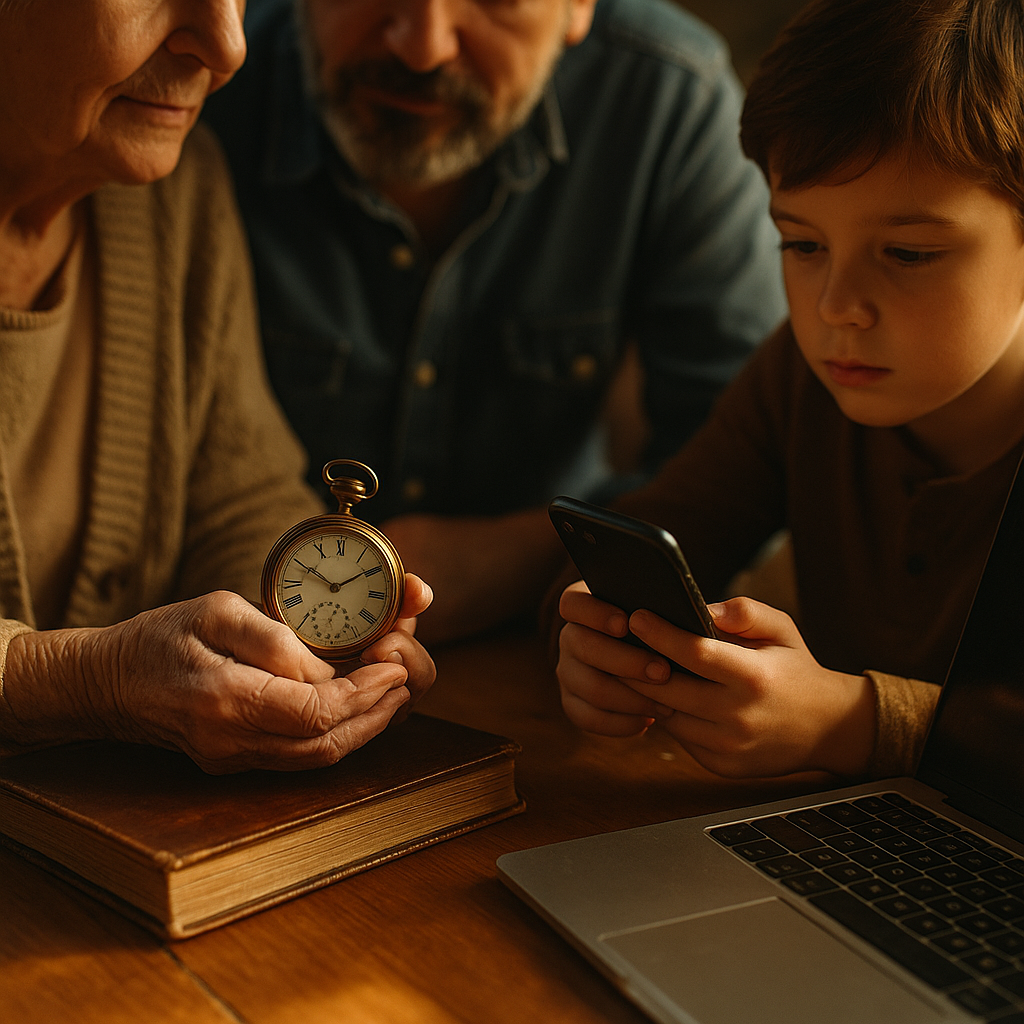
Digital heirloom marketing is reshaping how brands earn trust, premium pricing, and long-term loyalty in a world saturated with disposable content. Instead of chasing short-lived clicks, companies are designing products and messages meant to stay meaningful for decades. In 2025, that means building for longevity, portability, and family transfer. Why are consumers suddenly treating digital goods like heirlooms?
What “digital heirloom” means in 2025 (secondary keyword: digital heirloom products)
Digital heirloom products are experiences, records, and utilities designed to remain valuable, accessible, and emotionally relevant across a long lifespan—often intended to be passed to a partner, child, or beneficiary. They differ from typical digital goods in one critical way: the expected time horizon is measured in decades, not release cycles.
To qualify as a true heirloom, a digital product needs durability across:
- Technology change (file formats, operating systems, device types, cloud vendors)
- Life events (moving, marriage, caregiving, estate planning, bereavement)
- Ownership transfer (permissions, beneficiary access, inheritance workflows)
- Meaning (context, provenance, and storytelling that keeps data from becoming “dead files”)
Common categories include private family archives, legacy photo and video vaults, digital memory books, long-term health and caregiving logs, “in case of emergency” document systems, secure message time-capsules, and creator portfolios that preserve origin, rights, and licensing history. Some brands also extend the concept to “fifty-year” software tools—apps with local-first storage, open export formats, and survivable subscription models.
Consumers do not buy these because they are novel. They buy them because they reduce regret. A wedding video stored only in an app that disappears is not a product failure; it becomes a family loss. That emotional downside changes how people evaluate risk, price, and trust.
Why digital heirloom marketing is rising (secondary keyword: longevity branding)
Longevity branding is growing because the economics of attention are colliding with the realities of personal data. People have more photos, messages, and recordings than ever, yet less confidence that any of it will still be reachable in 20 or 50 years. That tension makes permanence a competitive advantage.
Several market forces are driving the shift:
- Subscription fatigue and tool churn: Consumers are less willing to adopt “yet another app” unless it clearly reduces long-term risk and migration pain.
- Trust as a purchase driver: Buyers increasingly ask: “Will this company still exist?” and “Can I get my data out?” Longevity claims without proof backfire.
- Family documentation has become multi-format: Photos, voice notes, scanned letters, GPS trails, and messages now form a family archive. If a product cannot preserve context across formats, it fails the heirloom test.
- Estate planning is going digital: Password managers, cloud drives, crypto assets, and creator royalties raise practical inheritance questions. Products that simplify transfer earn attention.
From a marketing standpoint, longevity branding also solves a performance problem: acquisition costs are high, but retention becomes powerful when a product is designed around life stages. The moment a family starts centralizing memories, they become less likely to switch. That is not lock-in by friction; it is lock-in by earned confidence and continuity.
Readers often ask whether this is only for “sentimental” products. It is not. Even practical tools—finance trackers, learning journals, personal knowledge bases—become heirlooms when they support exportability, clear ownership, and multi-decade accessibility.
How to design products built for fifty years (secondary keyword: long-term digital preservation)
Long-term digital preservation is a design discipline, not a tagline. If you market a fifty-year promise, your product must survive platform shifts, business changes, and user incapacity. The good news: you can architect for durability with clear, testable choices.
1) Prioritize portability with open exports
Make data export a first-class feature, not an afterthought. Offer human-readable and machine-readable exports, and document them publicly.
- Recommended formats: PDF/A for documents, TIFF or high-quality JPEG for images, WAV/FLAC for audio, MP4 (H.264/H.265) for video, and CSV/JSON for structured data.
- Context files: Include metadata (dates, people tags, locations, captions), provenance (who uploaded it), and consent flags.
2) Build for “offline survivability”
A true heirloom cannot depend entirely on a single cloud. Offer local backups, encrypted archives, and clear restore instructions. If your service is cloud-first, provide automated periodic downloads or a “vault bundle” that a family can store independently.
3) Create inheritance and delegation workflows
Users need beneficiary features that work without improvisation during a crisis.
- Delegated access: Let users assign trusted contacts with tiered permissions.
- Dead-man switch options: Allow timed releases or check-in based access transfer.
- Document packets: Provide printable summaries (accounts, keys, recovery steps) that integrate with estate planning.
4) Security must be durable, not trendy
Heirloom systems attract sensitive information. Use modern encryption at rest and in transit, support multi-factor authentication, and publish a security overview. For EEAT and buyer confidence, explain how keys are managed, what happens if a user loses access, and how you handle breach response.
5) Plan for business continuity
A fifty-year product needs a continuity plan that customers can evaluate.
- Data escrow options: A path for users to retrieve data if the company winds down.
- Transparent pricing logic: Clearly explain how storage and preservation costs are funded long-term.
- Versioned policies: Keep a public record of terms changes and retention commitments.
Follow-up question: “Does this require huge budgets?” Not necessarily. The key is making durability a product requirement from day one. Small teams can ship export tools, clear formats, and continuity policies faster than they can buy trust back later.
Messaging that earns trust (secondary keyword: trust-based marketing)
Trust-based marketing is the engine of digital heirloom growth. The audience is evaluating risk: loss, inaccessibility, or vendor collapse. Your job is to replace vague reassurance with verifiable signals.
Show your work with proof, not poetry
- Publish a preservation spec: List supported formats, export steps, retention behavior, and migration policy.
- Explain failure modes: What happens if a payment fails, a user dies, a device is lost, or an account is compromised?
- Demonstrate reversibility: Provide a sample export and a guide to re-import into common tools.
Use clear, adult language about permanence
Avoid implying “forever” unless you can operationalize it. In 2025, consumers have seen enough shutdowns to distrust grand promises. Better: define what you guarantee, what you do not, and how users can create independent redundancy.
Build narratives around life moments, not features
Heirloom marketing performs when it maps to predictable events: first child, a move, a family death, immigration paperwork, caregiving, retirement planning. Show exactly how the product reduces friction during those moments.
Make privacy part of the value proposition
Many heirloom assets are intimate. State whether you use customer content to train models, how you handle moderation, and what customers can control. If you offer AI features (captioning, face grouping, timeline creation), explain opt-in settings and on-device or private processing options where possible.
Earn third-party credibility
EEAT improves when claims are supported.
- Independent security assessments and summarized results customers can understand
- Partnerships with estate planners, archivists, or digital preservation professionals
- Customer evidence: case studies that show multi-year usage, migrations completed successfully, and data restored after incidents
Follow-up question: “How do we market emotion without manipulation?” Focus on capability and control. Let customers decide what to preserve and who can access it. Emphasize agency: exports, permissions, and documented processes.
Business models that can actually last (secondary keyword: sustainable subscription model)
A sustainable subscription model for heirloom products must fund storage, security, and support over long horizons while keeping customers confident they are not renting access to their own history. The strongest models align revenue with preservation costs and provide an exit that does not feel like punishment.
1) Hybrid pricing: subscription plus ownership options
Offer a subscription for active services (sync, AI indexing, sharing) and an ownership-like tier for cold storage archives that remain accessible with minimal ongoing fees. Customers want a path to “set it and keep it” without fearing a missed payment will erase a family archive.
2) Storage is a cost center—treat it openly
Be transparent about how storage is priced: per GB, per vault, or per family member. Provide tools to manage size (duplicate detection, compression options, selective upload) without degrading original quality unexpectedly.
3) Continuity clauses create confidence
Include a clear wind-down policy: notice periods, bulk export tooling, and support during closure. This is not pessimism; it is responsible stewardship.
4) Avoid “dark patterns” around access
If a user cancels, they should still be able to retrieve their data. If features change, preserve backward compatibility where possible. Trust compounds when customers see you behave responsibly during cancellations, not just renewals.
5) Design for family accounts and governance
Heirlooms are rarely single-user. Support multi-admin family plans, permission tiers, and audit logs. A family archive without governance becomes a conflict generator. With governance, it becomes a shared asset.
Follow-up question: “What about ad-supported models?” They usually conflict with heirloom expectations because ads incentivize engagement over preservation and introduce privacy concerns. If ads exist at all, they must be strictly separated from content analysis and clearly disclosed.
Who is winning—and how to start without overpromising (secondary keyword: legacy content strategy)
Legacy content strategy is how brands educate buyers, reduce anxiety, and create demand for durability. The winners are not only companies selling memory vaults. They include device makers, storage providers, creator platforms, and productivity tools that position themselves as “the place your life’s work can safely live.”
Traits of brands gaining traction
- They operationalize trust: documentation, export demos, and support that can answer hard questions.
- They show longevity by design: local backups, open formats, and clear account recovery paths.
- They market outcomes: “Your family can open this in 30 years,” supported by a plan for how.
How to start, step by step
- Define your “fifty-year promise” precisely: Is it access, integrity, usability, or transferability? Spell it out.
- Create an export standard and publish it: Include sample files and a re-import guide.
- Add a beneficiary feature: Even a simple trusted-contact flow improves credibility.
- Write a continuity policy: What happens if you discontinue a feature or the whole service?
- Build one flagship use case: For example, “Family archive that survives device changes” or “Creator portfolio with rights history.”
Content that answers real buyer questions
- “How do I move my archive if I leave?”
- “What happens if I forget my password?”
- “Can my spouse access this if I’m gone?”
- “Do you train AI on my files?”
- “What formats do you support and why?”
This approach supports EEAT because it demonstrates experience (real workflows), expertise (preservation choices), authoritativeness (clear standards), and trust (transparent policies). It also shortens the sales cycle by handling objections before a customer ever talks to support.
FAQs (secondary keyword: digital legacy planning)
-
What is digital legacy planning, and how does it relate to heirloom products?
Digital legacy planning is the process of organizing digital assets and defining who can access them if you cannot. Heirloom products support this by offering beneficiary access, export tools, recovery steps, and durable storage so a family can retrieve and understand information when it matters.
-
How can a company credibly claim a product is “built for fifty years”?
Credibility comes from specifics: open export formats, documented migration paths, offline backup options, inheritance workflows, security documentation, and a written continuity policy. The claim should describe what is guaranteed (access, integrity, portability) and what customers must do (keep backups, update trusted contacts).
-
Are digital heirloom products only for families and personal memories?
No. They also fit creators, small businesses, researchers, and professionals preserving portfolios, client histories, designs, or intellectual property. Any high-value archive benefits from longevity features like metadata, provenance, and predictable exports.
-
What features should I look for before trusting a digital archive service?
Look for: easy exports, transparent file formats, encryption, multi-factor authentication, account recovery options, beneficiary access, audit logs, and a clear statement about whether your content is used for advertising or AI training. Also check for a wind-down plan that protects your ability to retrieve your data.
-
Can AI help create digital heirlooms safely?
Yes, if AI is deployed with strong privacy controls. Useful features include auto-captioning, timeline creation, transcription, and deduplication. Safe use typically requires opt-in processing, clear data retention rules, and the ability to disable AI or run it in a private environment.
-
What is the biggest mistake brands make when marketing longevity?
Overpromising permanence without a practical plan. Vague “forever” messaging creates skepticism. Strong brands replace it with operational detail: exports, backups, inheritance tools, and continuity commitments that customers can verify.
In 2025, the brands that win are not the loudest; they are the ones that can prove durability. Digital heirloom marketing works because it aligns product design with real human stakes: memory, identity, and responsibility. Build for portability, inheritance, and continuity, then market those specifics with transparency. If your product can survive change, customers will trust it—and keep it.