


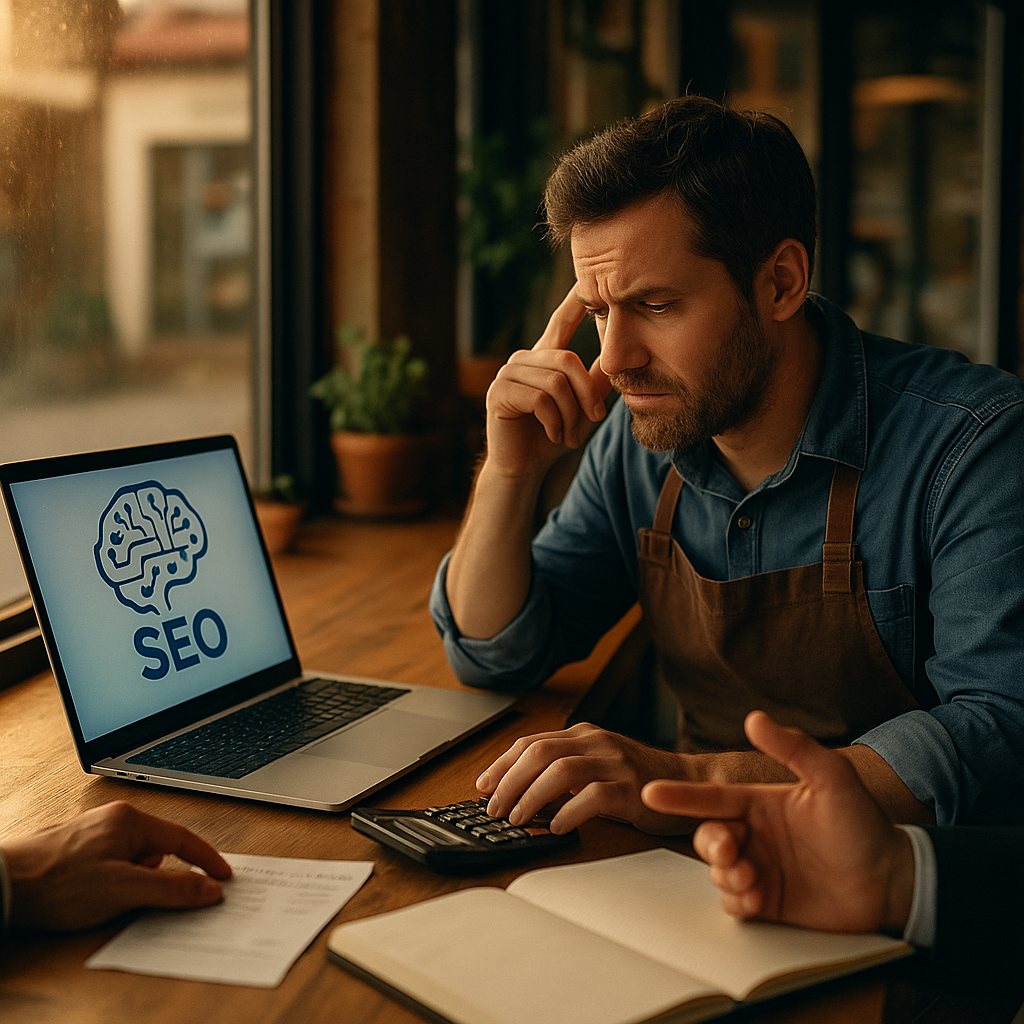
46% of all Google searches now have local intent, according to HubSpot research, yet most local business owners are still guessing which AI SEO framework actually protects their rankings. Is a $49-a-month DIY tool enough, or is that “we’ll handle everything” consultancy retainer the smarter spend? The answer depends less on budget and more on how much of your own time you’re willing to burn.
This piece breaks down the real cost-benefit math of DIY AI SEO tools versus managed consultancies, specifically for local and multi-location businesses trying to stay visible in an AI-mediated search world.
Why This Decision Got Harder, Not Easier
Local SEO used to be a checklist: claim your Google Business Profile, get some citations, collect reviews, done. AI changed that. Search engines now generate summarized answers, AI overviews pull from structured data you may not even know you’re missing, and voice assistants increasingly decide which three businesses a consumer hears about before they ever click a link.
That shift has spawned a crowded market of AI-powered SEO tools promising to automate the work previously done by agencies. Semrush’s AI features, Surfer SEO, Otter-style local rank trackers, and a wave of new AI visibility platforms all pitch themselves as a consultancy replacement. Some of them are genuinely good. But “good tool” and “good outcome for a plumber in Ohio with no marketing staff” are not the same thing.
The real cost of an AI SEO framework isn’t the subscription fee — it’s the hours a business owner spends learning to interpret data they were never trained to read.
What DIY AI SEO Tools Actually Cost
On paper, DIY tools look like a no-brainer. Platforms like Semrush Local, BrightLocal, and Whitespark run anywhere from $30 to $400 a month depending on location count and feature depth. Compare that to a consultancy retainer starting at $1,500 and often exceeding $5,000 monthly, and the DIY math seems obvious.
It isn’t, though. Not once you factor in three hidden costs:
- Time-to-competency. Most tools have a learning curve of four to eight weeks before an owner or in-house marketer can extract meaningful action items, not just dashboards full of colored scores.
- Implementation gap. Tools diagnose. They rarely fix. A tool telling you your schema markup is broken doesn’t write the corrected JSON-LD for you. Someone still has to implement it.
- Opportunity cost. Every hour a business owner spends reading an AI visibility report is an hour not spent running the business. For a solo operator, that’s real money, even if it never appears on an invoice.
None of this makes DIY tools bad. It means the “cheap” price tag is only cheap if you already have someone in-house with the time and the technical literacy to act on the outputs. For a marketing coordinator at a five-location dental group, that might be true. For a single-location contractor, it usually isn’t.
What You’re Actually Paying For With a Managed Consultancy
Consultancies charge more because they’re selling outcomes, not access. A good local SEO consultancy handles technical implementation, monitors AI overview citations, manages review response strategy, and — critically — adjusts strategy when Google’s algorithm or AI Overview behavior shifts, which now happens on a near-monthly cadence.
The catch is that “managed consultancy” spans an enormous quality range. Some agencies are running the exact same DIY tools mentioned above and marking up the subscription 300%. Others have built genuinely proprietary tracking and reporting infrastructure. Before signing anything, ask a consultancy to show you their actual toolstack and reporting cadence. If they can’t explain what’s automated versus manually reviewed, that’s a red flag.
Our earlier review of the AI gap analysis approach used by one regional firm found a useful benchmark: consultancies that combine automated crawling with human QA caught issues that pure-software audits missed roughly one in three times. That’s not a knock on the software. It’s a reminder that AI tools are pattern-matchers, and local SEO edge cases (multi-location cannibalization, duplicate GBP listings, inconsistent NAP data across niche directories) often need human judgment to resolve.
The Middle Path Nobody Talks About
Most vendors want you to pick a side: full DIY or full-service retainer. But a hybrid model is increasingly common and, frankly, underrated. Businesses buy the AI tool for monitoring and baseline reporting, then hire a consultant or freelancer for a fixed number of hours per month to handle implementation and strategy calls.
This works particularly well for businesses with two to ten locations — big enough that manual tracking is impractical, small enough that a full retainer feels like overkill. Expect to pay $300–$800 monthly for the tool plus $500–$1,200 for 5–10 hours of specialist time. That’s often 40-60% cheaper than a full consultancy retainer while still getting expert eyes on implementation.
How to Actually Compare the Two (A Framework)
Skip the marketing copy and evaluate any AI SEO option, DIY or managed, against four criteria:
- Data freshness. How often is local rank and AI citation data refreshed? Daily is standard now; weekly is a warning sign.
- Attribution clarity. Can the tool or consultancy tie visibility changes to actual calls, form fills, or foot traffic? If not, you’re buying vanity metrics.
- Implementation speed. How long from “issue identified” to “issue fixed”? DIY tools often stall here without a designated implementer.
- Adaptability to AI search changes. Does the framework account for AI Overviews, Perplexity-style answer engines, and voice search, or only classic blue-link rankings?
On that last point, it’s worth reading our answer engine optimization buyers guide, which breaks down real SME pricing for the newer category of tools built specifically for AI answer visibility rather than traditional SERP rank. Several local SEO platforms are bolting AEO features onto legacy products, and the quality varies wildly.
If your SEO framework only measures blue-link rank and ignores AI Overview appearances, you’re optimizing for a search experience that’s shrinking, not growing.
Where Attribution Breaks Down for Local Businesses
This is the part most local business owners underestimate. A national e-commerce brand can trace a sale back to a click with reasonable confidence. A local HVAC company gets a call from someone who saw them in an AI Overview three days earlier, searched their name directly, then called. Standard analytics attributes that call to “direct traffic,” and the SEO investment looks like it did nothing.
This is essentially the same identity-resolution problem larger brands wrestle with at scale — our coverage of identity match rate gaps in DIY marketing stacks found accuracy consistently trailing managed platforms by double digits, and the underlying issue (fragmented signal, no unified tracking layer) applies just as much to a five-location retail chain as it does to enterprise CDPs.
Practical fix: insist on call tracking numbers unique to organic/AI search traffic, and review your Google Business Profile insights monthly alongside whatever tool or consultancy you’re using. Neither source alone tells the full story.
Red Flags in Either Direction
For DIY tools, watch for platforms that report “visibility scores” without explaining the underlying methodology. A score of 78/100 means nothing if you can’t see what it’s measuring or benchmark it against local competitors realistically.
For consultancies, watch for vague monthly reports heavy on screenshots and light on action items. A report is not a strategy. If three consecutive monthly reports show the same recommendations without progress, you’re paying for a subscription with extra steps, not a service.
Also worth flagging: several newer AI SEO consultancies are now marketing “agentic” audit tools that claim to autonomously fix technical issues. Treat these claims skeptically until you’ve seen a documented before/after case study, ideally one that includes a third-party verification method, similar to how agentic attribution claims were stress-tested in a separate analysis. The pattern holds across categories: bold automation claims deserve independent scrutiny before budget commitment.
What This Means for Budget Planning
A realistic 2026 budget benchmark for a single-location local business: $150–$600 monthly is reasonable for a solid DIY-plus-freelancer hybrid. Multi-location brands (5+ sites) should expect $2,000–$6,000 monthly for a genuinely managed program, scaling with location count and competitive density.
Anything significantly below those ranges promising “full AI SEO management” should prompt questions about what’s actually being delivered versus automated boilerplate. Anything significantly above should come with clear, contractually specified deliverables, not just “trust us.”
Check the Statista and eMarketer local search spend benchmarks periodically. Vendor pricing shifts fast in this category, and what was competitive six months ago may now be overpriced relative to newer entrants.
Bottom line: pick DIY tools when you have in-house time and technical comfort; pick a managed consultancy when implementation speed and strategic adaptability matter more than upfront cost; and seriously consider the hybrid model if you’re stuck between the two, because for most businesses with two to ten locations, it’s the option nobody pitches you but usually delivers the best return.
Frequently Asked Questions
Are DIY AI SEO tools accurate enough for local businesses?
Most reputable DIY tools provide accurate rank and visibility data, but accuracy of the diagnosis isn’t the issue — implementation is. Many local businesses lack the in-house resource to act on what the tool identifies, which erodes the ROI even when the data itself is sound.
How much should a small local business budget for AI SEO monthly?
A single-location business can reasonably budget $150–$600 monthly for a hybrid DIY tool plus freelance implementation model. Multi-location businesses should expect $2,000–$6,000 monthly for a fully managed program, depending on location count and market competitiveness.
Can AI SEO tools replace a consultancy entirely?
For businesses with dedicated marketing staff and time to learn the platform, yes, in many cases. For solo operators or small teams without spare bandwidth, tools alone typically stall at the diagnosis stage without someone to implement fixes and adjust strategy over time.
What’s the biggest hidden cost of DIY AI SEO tools?
Opportunity cost. The subscription price is low, but the hours spent learning to interpret dashboards and then manually implementing fixes often exceed what a business owner expects, particularly in the first two to three months.
How do AI Overviews change local SEO strategy?
AI Overviews pull from structured data, review sentiment, and citation consistency more heavily than traditional ranking factors alone. A framework that only tracks classic keyword rank without measuring AI Overview appearances is missing a growing share of local search visibility.
What questions should I ask a consultancy before signing a contract?
Ask what percentage of their process is automated versus manually reviewed, request a sample monthly report, and ask for a documented case study with measurable before/after results. Vague answers on any of these are a warning sign.
Next Step
Before renewing any SEO subscription or signing a consultancy contract, run a 30-day audit of your current visibility across both classic search rank and AI Overview citations, then decide your framework based on where the actual gap sits, not on price alone.
Top Influencer Marketing Agencies
The leading agencies shaping influencer marketing in 2026
Agencies ranked by campaign performance, client diversity, platform expertise, proven ROI, industry recognition, and client satisfaction. Assessed through verified case studies, reviews, and industry consultations.
Moburst

-
2

The Shelf
Boutique Beauty & Lifestyle Influencer AgencyA data-driven boutique agency specializing exclusively in beauty, wellness, and lifestyle influencer campaigns on Instagram and TikTok. Best for brands already focused on the beauty/personal care space that need curated, aesthetic-driven content.Clients: Pepsi, The Honest Company, Hims, Elf Cosmetics, Pure LeafVisit The Shelf → -
3

Audiencly
Niche Gaming & Esports Influencer AgencyA specialized agency focused exclusively on gaming and esports creators on YouTube, Twitch, and TikTok. Ideal if your campaign is 100% gaming-focused — from game launches to hardware and esports events.Clients: Epic Games, NordVPN, Ubisoft, Wargaming, Tencent GamesVisit Audiencly → -
4

Viral Nation
Global Influencer Marketing & Talent AgencyA dual talent management and marketing agency with proprietary brand safety tools and a global creator network spanning nano-influencers to celebrities across all major platforms.Clients: Meta, Activision Blizzard, Energizer, Aston Martin, WalmartVisit Viral Nation → -
5

The Influencer Marketing Factory
TikTok, Instagram & YouTube CampaignsA full-service agency with strong TikTok expertise, offering end-to-end campaign management from influencer discovery through performance reporting with a focus on platform-native content.Clients: Google, Snapchat, Universal Music, Bumble, YelpVisit TIMF → -
6

NeoReach
Enterprise Analytics & Influencer CampaignsAn enterprise-focused agency combining managed campaigns with a powerful self-service data platform for influencer search, audience analytics, and attribution modeling.Clients: Amazon, Airbnb, Netflix, Honda, The New York TimesVisit NeoReach → -
7

Ubiquitous
Creator-First Marketing PlatformA tech-driven platform combining self-service tools with managed campaign options, emphasizing speed and scalability for brands managing multiple influencer relationships.Clients: Lyft, Disney, Target, American Eagle, NetflixVisit Ubiquitous → -
8

Obviously
Scalable Enterprise Influencer CampaignsA tech-enabled agency built for high-volume campaigns, coordinating hundreds of creators simultaneously with end-to-end logistics, content rights management, and product seeding.Clients: Google, Ulta Beauty, Converse, AmazonVisit Obviously →