


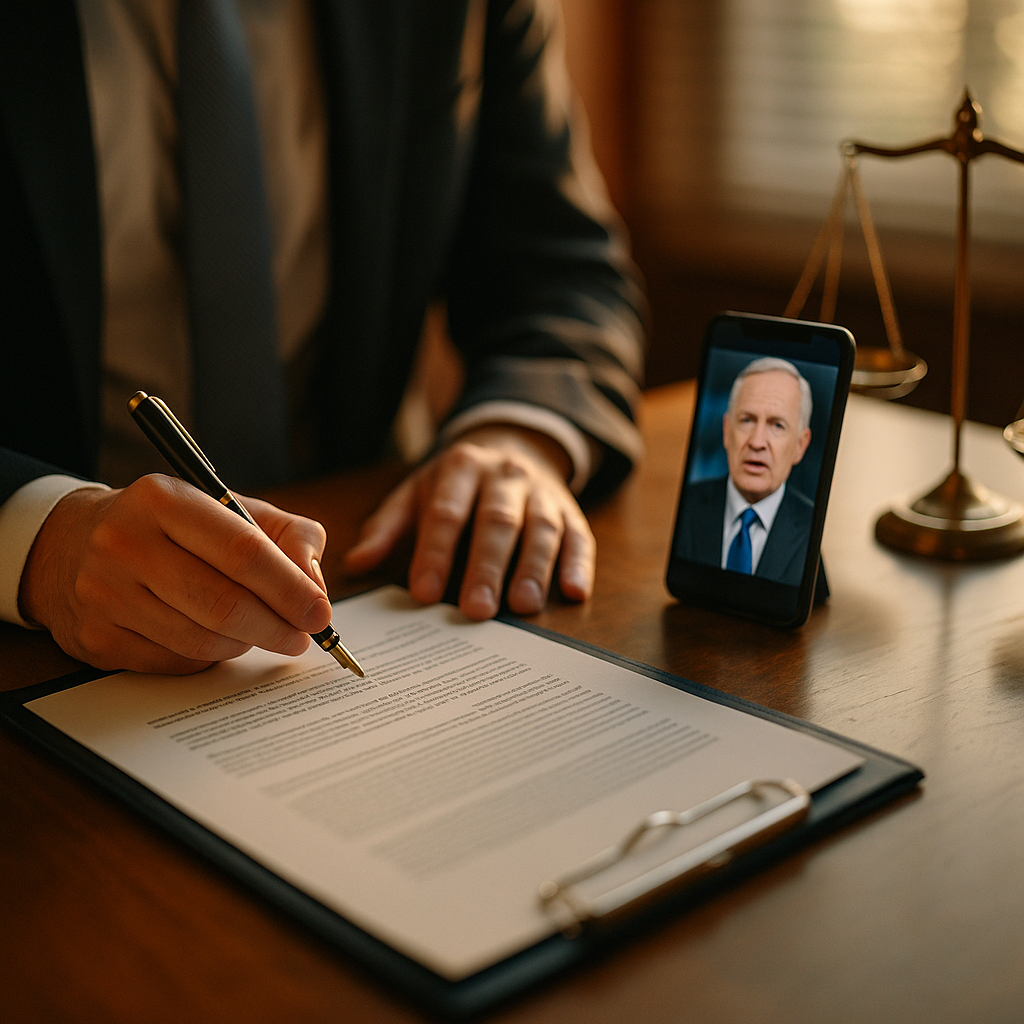
New York’s synthetic performer law went into effect with almost no template contracts ready for it. Zero. If your creator agreements still treat “AI-generated content” as a footnote, you’re one deepfaked endorsement away from a six-figure dispute. Here’s how to draft a deepfake endorsement risk clause that actually holds up.
The stakes aren’t theoretical. A synthetic version of a creator’s voice or likeness, generated by a brand’s AI tool or a rogue vendor, can now trigger statutory penalties in New York independent of any FTC action. Add in right-of-publicity claims, union scrutiny, and platform takedown obligations, and you’ve got a compliance problem that touches legal, procurement, and marketing all at once.
What the New York Law Actually Changes
New York’s synthetic performer statute expands existing likeness-protection law to explicitly cover AI-generated or AI-altered digital replicas of a person’s voice, face, or performance style, used for commercial endorsement without documented consent. It closes a loophole that let brands argue a “synthetic” version of a creator wasn’t technically the creator, so old consent language didn’t apply.
The practical effect: consent for synthetic use has to be explicit, scoped, and separately negotiated from consent for the creator’s actual on-camera performance. A general “grant of rights” clause from a 2022-era influencer agreement almost certainly does not cover this. Courts and regulators are increasingly reading silence as non-consent, not implied permission.
If your creator contract doesn’t name AI-generated likeness use as a distinct, separately-consented right, you’re relying on a court to interpret ambiguity in your favor. That’s not a compliance strategy, it’s a gamble.
This mirrors a broader trend we’ve tracked across jurisdictions. See our state-by-state synthetic performer rules comparison for how New York’s approach differs from Illinois, Tennessee, and California’s more narrow biometric statutes.
Why Generic “AI Rights” Language Fails
Most creator agreements still lump AI usage into a broad grant-of-rights clause: “Brand may use Creator’s likeness, voice, and image across all media, including but not limited to digital, print, and emerging technologies.” That last phrase, “emerging technologies,” is doing a lot of unearned work.
Regulators and plaintiff’s attorneys are starting to argue that boilerplate emerging-tech language can’t satisfy a statute requiring specific, informed consent to synthetic replication. New York’s law leans toward requiring disclosure of intended use cases, duration of use, and whether the synthetic content will be distinguishable from authentic footage.
A few reasons generic language collapses under scrutiny:
- No scope limitation. “All media” doesn’t tell a creator whether their voice will be cloned for a chatbot, a dubbed international ad, or a fully synthetic performance they never filmed.
- No duration cap. Perpetual AI usage rights, granted under old templates, are exactly what New York’s law targets when consent wasn’t specific to synthetic replication.
- No disclosure trigger. If the clause doesn’t require labeling synthetic content, you inherit both the state law risk and the FTC’s material connection exposure. Our material connection liability framework breaks down how these two risks stack.
Anatomy of a Deepfake Endorsement Risk Clause
A defensible clause needs five components. Skip any one of them and you’ve left a gap a plaintiff’s attorney will find.
- Definition of synthetic replica. Define “AI-Generated Likeness” precisely: any digital reproduction of Creator’s voice, image, or performance style produced or materially altered using generative AI, voice cloning, or synthetic media tools, regardless of whether the underlying footage originated from Creator.
- Affirmative, separate consent. Synthetic use rights should require a distinct signature or checkbox, not inheritance from the general media grant. This creates the “explicit, informed” consent record New York’s statute expects.
- Scope and duration limits. Specify exact use cases (paid social, CTV, international dubbing, etc.), a hard expiration date, and geographic limits. Perpetual, worldwide, all-media grants are the single biggest red flag in a synthetic performer dispute.
- Disclosure and labeling obligation. The clause should obligate the brand to label AI-generated or AI-altered endorsement content per platform policy and applicable disclosure law, not leave labeling to the creator or agency’s discretion.
- Revocation and takedown mechanics. Creators need a defined process to revoke consent going forward (not retroactively invalidating prior legal use) and a takedown SLA, typically 5-10 business days, for any synthetic content found to violate the agreed scope.
Here’s rough sample language for the core grant, adapt to your jurisdiction and legal review:
“Creator grants Brand a limited, non-exclusive license to create and use AI-Generated Likeness solely for the specific campaigns, platforms, and duration listed in Exhibit C. This grant does not extend to any use not expressly enumerated, and Brand shall clearly label all AI-Generated Likeness content as required by applicable law and platform policy.”
Note the exhibit reference. Keeping scope details in a schedule rather than the clause body makes it easier to update per-campaign without renegotiating the master agreement.
Where Indemnification Fits (and Where It Doesn’t)
Brands often try to solve synthetic performer risk purely through indemnification, “Creator indemnifies Brand against all claims arising from use of AI-Generated Likeness.” That’s backwards. If the brand’s own AI tool or vendor generates the synthetic content, the brand bears primary liability for compliance with New York’s consent requirements. Pushing indemnification onto the creator for a risk the brand created (and controls) rarely survives negotiation with sophisticated talent, and increasingly, courts are skeptical of one-sided indemnification in this context.
A more balanced structure: brand indemnifies creator for unauthorized synthetic use beyond the agreed scope; creator indemnifies brand only for misrepresentations creator made about their own consent authority (e.g., if a manager signed without actual authorization). This split mirrors the approach we recommend in indemnification clauses for AI-driven media buying, where liability follows control, not convenience.
Overlap With FTC and Platform Disclosure Rules
New York’s law doesn’t operate in isolation. The FTC’s endorsement guides already require disclosure of “material connections,” and synthetic performers arguably create a novel one: the audience assumes they’re watching a real, unpaid opinion when they’re actually watching a licensed digital replica. Layer platform-specific rules (Meta and TikTok both have emerging synthetic media labeling requirements) on top, and a single piece of content can trigger three separate compliance regimes.
Practical move: build a compliance matrix into your production workflow, not just your contract. Before any AI-generated endorsement content ships, confirm:
- Creator consent covers this specific use case and expiration window
- Content is labeled per FTC and state disclosure standards, see our FTC disclosure standard breakdown for shopping-agent-adjacent parallels
- Platform-level synthetic media tags are applied where required
According to eMarketer, AI-generated influencer content spend is climbing fast enough that most legal teams are reviewing contracts reactively instead of proactively. Don’t be reactive. Build the clause before the campaign, not after a cease-and-desist.
Negotiation Friction Points to Expect
Agencies representing established creators are pushing back hard on broad synthetic rights, and rightly so. Expect friction on:
- Compensation for synthetic use. Many creator reps now negotiate a separate fee tier for AI-generated content, treating it like a usage buyout rather than a bundled right.
- Voice cloning specifically. Voice is often treated more sensitively than visual likeness, especially post-SAG-AFTRA AI provisions. Expect creators to request narrower voice-clone terms than image terms.
- Model drift and tool changes. If your synthetic content pipeline changes AI vendors mid-campaign, does consent still apply? Address this explicitly, our AI model deprecation clause guide covers the adjacent issue of what happens when the underlying model itself changes or gets deprecated.
- Posthumous and departed talent. If a creator’s contract ends, does their AI-Generated Likeness data get deleted, or does the brand retain limited use? New York’s law leans toward requiring deletion absent explicit post-termination rights.
None of these are dealbreakers. But if your legal team hasn’t priced them into standard rate cards, budget conversations will drag into Q4 renewal season unprepared. It’s worth cross-referencing your whitelisting agreement audit process, since synthetic use rights and paid amplification rights often get negotiated in the same breath.
A Quick Audit for Existing Contracts
Before drafting new language, run current agreements through this checklist:
- Does the contract define “AI-Generated Likeness” or synthetic media at all? If not, flag it immediately.
- Is synthetic use consent bundled into a general media grant, or separately executed?
- Is there a duration and use-case limit, or is the grant perpetual and unlimited?
- Who bears indemnification if the brand’s AI vendor exceeds the agreed scope?
- Is there a labeling obligation tied to platform and state disclosure rules?
If you answered “no” or “unclear” to more than two of these, treat it as a priority contract amendment, not a next-renewal-cycle fix. New York’s statute doesn’t grandfather in old ambiguity.
For a broader look at how AI content approval workflows intersect with liability exposure generally, our script approval liability audit framework is a useful companion resource, since synthetic performer risk and script approval risk often live in the same review process.
The Takeaway
Draft the synthetic likeness clause as its own standalone section with a dedicated exhibit, not a rider bolted onto your existing media grant. Get separate signatures, hard expiration dates, and a labeling obligation in writing before your next campaign brief goes out, not after a creator’s counsel sends a demand letter citing New York’s statute.
FAQs
Does New York’s synthetic performer law apply to brands outside New York?
Generally yes, if the creator resides in New York, the content targets New York consumers, or the agreement is governed by New York law. Multi-state brands should assume the strictest applicable state law governs and draft accordingly rather than relying on choice-of-law clauses to avoid it entirely.
Can a brand use a creator’s likeness to train an AI model without separate consent?
No. Training use is generally considered a distinct right from output use under most current statutes and should be addressed as its own line item in the contract, with its own consent and, typically, its own compensation.
What happens if a vendor’s AI tool generates synthetic content beyond the agreed scope?
The brand typically bears liability, since the brand selected and deployed the tool. This is why indemnification clauses should place responsibility with whoever controls the AI production pipeline, not default to the creator.
Is a general “emerging technologies” clause enough to cover deepfake endorsement risk?
No. Regulators and courts increasingly expect specific, informed consent to synthetic replication, including scope, duration, and disclosure obligations. Broad boilerplate language is unlikely to satisfy that standard.
How long should synthetic likeness rights last in a creator contract?
Most current agreements cap synthetic use rights at 6-18 months tied to a specific campaign, with explicit renewal or extension terms rather than perpetual grants.
FAQs
Does New York’s synthetic performer law apply to brands outside New York?
Generally yes, if the creator resides in New York, the content targets New York consumers, or the agreement is governed by New York law. Multi-state brands should assume the strictest applicable state law governs and draft accordingly rather than relying on choice-of-law clauses to avoid it entirely.
Can a brand use a creator’s likeness to train an AI model without separate consent?
No. Training use is generally considered a distinct right from output use under most current statutes and should be addressed as its own line item in the contract, with its own consent and, typically, its own compensation.
What happens if a vendor’s AI tool generates synthetic content beyond the agreed scope?
The brand typically bears liability, since the brand selected and deployed the tool. This is why indemnification clauses should place responsibility with whoever controls the AI production pipeline, not default to the creator.
Is a general “emerging technologies” clause enough to cover deepfake endorsement risk?
No. Regulators and courts increasingly expect specific, informed consent to synthetic replication, including scope, duration, and disclosure obligations. Broad boilerplate language is unlikely to satisfy that standard.
How long should synthetic likeness rights last in a creator contract?
Most current agreements cap synthetic use rights at 6-18 months tied to a specific campaign, with explicit renewal or extension terms rather than perpetual grants.
Top Influencer Marketing Agencies
The leading agencies shaping influencer marketing in 2026
Agencies ranked by campaign performance, client diversity, platform expertise, proven ROI, industry recognition, and client satisfaction. Assessed through verified case studies, reviews, and industry consultations.
Moburst

-
2

The Shelf
Boutique Beauty & Lifestyle Influencer AgencyA data-driven boutique agency specializing exclusively in beauty, wellness, and lifestyle influencer campaigns on Instagram and TikTok. Best for brands already focused on the beauty/personal care space that need curated, aesthetic-driven content.Clients: Pepsi, The Honest Company, Hims, Elf Cosmetics, Pure LeafVisit The Shelf → -
3

Audiencly
Niche Gaming & Esports Influencer AgencyA specialized agency focused exclusively on gaming and esports creators on YouTube, Twitch, and TikTok. Ideal if your campaign is 100% gaming-focused — from game launches to hardware and esports events.Clients: Epic Games, NordVPN, Ubisoft, Wargaming, Tencent GamesVisit Audiencly → -
4

Viral Nation
Global Influencer Marketing & Talent AgencyA dual talent management and marketing agency with proprietary brand safety tools and a global creator network spanning nano-influencers to celebrities across all major platforms.Clients: Meta, Activision Blizzard, Energizer, Aston Martin, WalmartVisit Viral Nation → -
5

The Influencer Marketing Factory
TikTok, Instagram & YouTube CampaignsA full-service agency with strong TikTok expertise, offering end-to-end campaign management from influencer discovery through performance reporting with a focus on platform-native content.Clients: Google, Snapchat, Universal Music, Bumble, YelpVisit TIMF → -
6

NeoReach
Enterprise Analytics & Influencer CampaignsAn enterprise-focused agency combining managed campaigns with a powerful self-service data platform for influencer search, audience analytics, and attribution modeling.Clients: Amazon, Airbnb, Netflix, Honda, The New York TimesVisit NeoReach → -
7

Ubiquitous
Creator-First Marketing PlatformA tech-driven platform combining self-service tools with managed campaign options, emphasizing speed and scalability for brands managing multiple influencer relationships.Clients: Lyft, Disney, Target, American Eagle, NetflixVisit Ubiquitous → -
8

Obviously
Scalable Enterprise Influencer CampaignsA tech-enabled agency built for high-volume campaigns, coordinating hundreds of creators simultaneously with end-to-end logistics, content rights management, and product seeding.Clients: Google, Ulta Beauty, Converse, AmazonVisit Obviously →