


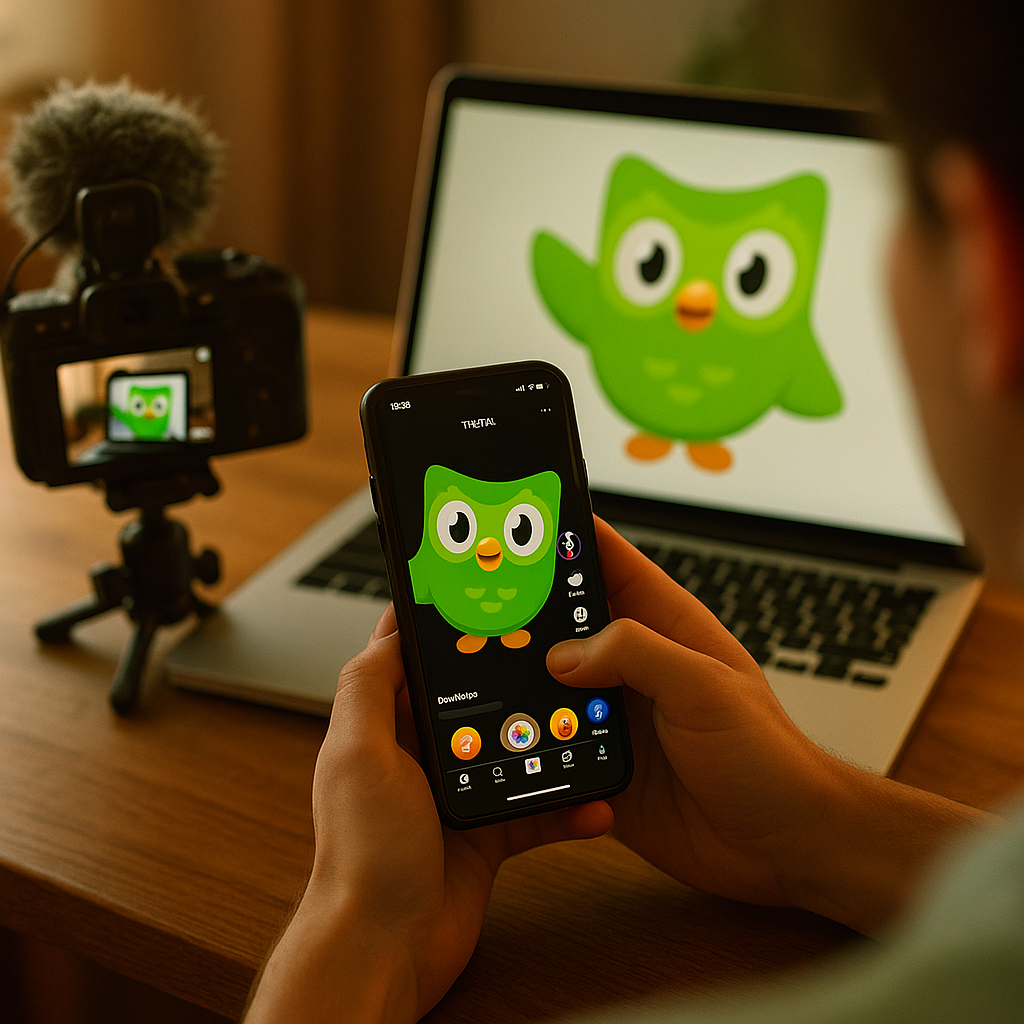
One TikTok video. Seven days of content. Zero extra shoots. That’s the TikTok content repurposing math Duolingo’s social team has quietly turned into a science, and it’s why the language app still dominates share-of-voice on a budget most Fortune 500 brands would consider a rounding error.
Duolingo’s owl mascot has appeared in roughly everything at this point: thirst traps, horror parodies, Bad Bunny cameos. But the real story isn’t the chaos. It’s the machine behind it. Marketers obsessing over one viral hit are missing the point entirely.
The Hero-to-Micro Pipeline, Explained
Duolingo’s social team, led by a lean group that has historically numbered under 10 people, doesn’t create content platform-by-platform. They create once, then fragment. A single hero TikTok, usually a 15-30 second sketch involving Duo the owl in some absurd scenario, becomes the raw material for a full week of derivative assets across TikTok, Instagram Reels, YouTube Shorts, X, and occasionally LinkedIn (yes, really, for recruiting content).
Here’s roughly how one hero asset gets sliced:
- Day 1: Original hero video posts natively on TikTok, timed to a trend or cultural moment.
- Day 2: A behind-the-scenes or “how we made this” clip goes to Instagram Stories and Reels, often filmed during the original shoot for near-zero incremental cost.
- Day 3: A reaction-style cutdown, showing the internal team’s response to the video’s performance, posts on TikTok and X.
- Day 4: Cross-posted repurpose on YouTube Shorts, sometimes with a slightly longer edit that adds context for a platform where discovery favors search intent.
- Day 5: A community reply video, responding to top comments from the original post, which restarts the engagement loop on the same platform it started.
- Day 6: A localized or regional variant gets pushed through country-specific accounts, a tactic detailed in depth in Duolingo’s TikTok localization strategy.
- Day 7: A recap or “best of” compilation stitches the week’s performance into a single asset, often used as paid boost creative.
None of this requires new production. That’s the entire point.
One 20-minute TikTok shoot can yield seven distinct content assets across five platforms, cutting per-asset production cost by roughly 80% compared to platform-specific shoots.
Why Repurposing Beats Reshooting
Ask any brand social lead what kills their content velocity and the answer is almost never ideas. It’s production capacity. Shooting native content for five platforms means five briefs, five edits, five approval cycles. That’s a resourcing nightmare for teams without in-house studios.
Duolingo sidesteps this by treating the hero video as a modular asset rather than a finished product. The original footage, the raw B-roll, the outtakes, the internal Slack reactions to the metrics, all of it becomes fair game for secondary content. It’s less “campaign” and more “content compost.”
This matters more in 2026 than it did a few years ago. Platforms have converged on near-identical short-form formats, but their algorithms reward native-feeling content, not obvious reposts. A straight cross-post from TikTok to Instagram, watermark and all, tends to get suppressed by Meta’s ranking systems. Duolingo’s team edits each derivative asset just enough to feel platform-appropriate, different captions, different pacing, sometimes different aspect ratios, without spending real production hours on it.
According to Sprout Social’s ongoing research into platform algorithm behavior, native-feeling edits consistently outperform unmodified cross-posts by wide margins on reach. Duolingo isn’t gaming an algorithm here. It’s just respecting the norms of each platform’s native user, one small edit at a time.
What “Micro-Content” Actually Means at Duolingo Scale
Micro-content isn’t just a shorter version of the hero video. It’s a distinct content object with its own hook, caption, and CTA, built to stand alone even if the viewer never saw the original. That distinction is what separates repurposing done well from lazy recycling.
Duolingo’s community team reportedly reviews top comments within the first two hours of a hero post to identify which micro-content angle will resonate. If commenters are reacting to a specific line of dialogue, that becomes the seed for a Day 3 or Day 5 asset. It’s reactive, not pre-planned. That’s a meaningfully different operating model than the traditional content calendar most brand teams still run on.
The Compliance and Brand-Safety Layer Nobody Talks About
Repurposing at this velocity introduces real risk if you’re not careful. Every derivative asset still needs to clear the same brand-safety and disclosure bar as the original. For a brand mascot doing borderline-suggestive comedy (Duo has a well-documented “thirst trap” era), that’s not trivial.
Duolingo’s legal and social teams reportedly run a lightweight approval checklist rather than a full review cycle for derivative content, since the source material has already cleared brand and legal review once. That single-approval-multiple-output model is a genuine efficiency unlock, but it only works if the original hero asset was conservative enough to survive five different contexts and captions without needing a fresh legal read each time.
Brands operating in more regulated categories, finance, healthcare, alcohol, don’t have this luxury. Every derivative touching a claims-adjacent word or a regional regulation (see the FTC’s endorsement guidance) needs its own compliance pass. That’s worth factoring into your own repurposing math before you assume Duolingo’s velocity is replicable overnight.
What This Costs (and Saves) in Practice
Let’s talk numbers, because “do more with less” is meaningless without a cost baseline.
A typical branded TikTok shoot with a small crew, wardrobe, and location runs anywhere from $3,000 to $15,000 depending on complexity, per data from eMarketer’s creator economy spend benchmarks. If a brand shoots natively for five platforms separately, that’s a potential five-figure weekly spend just on production, before media dollars enter the picture.
Duolingo’s model compresses that into one shoot and a handful of editing hours. Assume an in-house editor costs $40-60/hour and spends roughly 15-20 hours across the week producing derivative cuts. That’s under $1,200 in incremental cost to generate six additional content assets. Compare that to the $15,000-$75,000 it might cost to reshoot natively five times, and the ROI case writes itself.
This isn’t unique to language-learning apps. The same logic underpins Chobani’s TikTok Shop content engine and the nano-creator repurposing model detailed in Poppi’s TikTok Shop trust rebuild. Different categories, same underlying principle: one strong idea, fragmented intelligently, beats five mediocre ideas shot separately.
Where Most Brands Get Repurposing Wrong
Three failure patterns show up constantly when brands try to copy this model without the operational discipline behind it.
- Treating repurposing as an afterthought. If the hero video isn’t shot with modularity in mind, capturing extra B-roll, alternate takes, reaction-worthy moments, there’s nothing to repurpose. Duolingo’s team plans for fragmentation at the brief stage, not after the fact.
- Cross-posting without platform translation. A vertical TikTok video dumped onto YouTube Shorts with no caption or pacing adjustment reads as lazy, and audiences (and algorithms) notice.
- Ignoring the community layer. The reply videos and comment-driven content are arguably the highest-performing part of Duolingo’s cycle, and they’re the part most brands skip entirely because it requires a community manager empowered to move fast.
Duolingo’s approach also benefits from a mascot that can absorb tonal risk a human spokesperson couldn’t. That’s a structural advantage, not just a creative one. Brands without a flexible mascot or character need to think harder about how far a single hero asset can stretch before it feels repetitive or off-brand. The long-form YouTube strategy Duolingo runs alongside its TikTok chaos is a good example of knowing where the mascot format stops working and a different content style needs to take over.
Does This Model Hurt Engagement Over Time?
The honest answer: it can, if you don’t rotate hero concepts often enough. Audiences catch on to repurposing patterns quickly. Duolingo mitigates fatigue by varying hero concept types week to week, comedy sketch one week, meme-format reaction the next, occasional collab content with creators or other brands. The repurposing engine stays constant. The creative concept feeding it doesn’t.
That variability is also why Duolingo’s retention-focused campaigns lean on different content mechanics entirely than its top-of-funnel viral pushes. Repurposing works best on awareness content. Retention and conversion content generally need a more tailored, less recycled approach.
The Takeaway
Stop briefing five separate shoots for five platforms. Brief one hero asset with modularity built in, capture extra footage on purpose, and build a lightweight approval process for derivatives so your team can ship a week’s worth of content off a single production day.
Start small: pick your next planned hero video, map out three to four repurposing angles before you shoot, not after, and measure the incremental reach per dollar against your last platform-by-platform campaign.
FAQs
What is TikTok content repurposing?
TikTok content repurposing is the practice of taking a single piece of video content, usually a high-performing “hero” post, and adapting it into multiple derivative assets for other platforms or follow-up posts, rather than producing entirely new content for each channel.
Why does Duolingo’s repurposing strategy work so well?
It combines a flexible brand mascot that can absorb creative risk, a lean team structure that plans for modularity at the brief stage, and a lightweight approval process that avoids re-running full legal and brand reviews on every derivative asset.
Can smaller brands replicate this model without a big social team?
Yes, though it requires planning modularity into the original shoot (extra B-roll, alternate takes) and having at least one person empowered to move fast on community-driven content like reply videos. The core efficiency gain doesn’t require a large team, just a repeatable process.
What’s the biggest risk of repurposing content this aggressively?
Audience fatigue and algorithm suppression from unmodified cross-posts. Brands need to vary the hero concept regularly and adjust pacing, captions, and format for each platform rather than posting identical content everywhere.
How does this differ from a standard content calendar approach?
A standard content calendar pre-plans distinct content for each platform weeks in advance. Duolingo’s model is reactive: it uses real-time audience response to the hero video to decide which derivative angles to produce next, which requires more operational flexibility but yields higher-performing follow-up content.
FAQs
Top Influencer Marketing Agencies
The leading agencies shaping influencer marketing in 2026
Agencies ranked by campaign performance, client diversity, platform expertise, proven ROI, industry recognition, and client satisfaction. Assessed through verified case studies, reviews, and industry consultations.
Moburst

-
2

The Shelf
Boutique Beauty & Lifestyle Influencer AgencyA data-driven boutique agency specializing exclusively in beauty, wellness, and lifestyle influencer campaigns on Instagram and TikTok. Best for brands already focused on the beauty/personal care space that need curated, aesthetic-driven content.Clients: Pepsi, The Honest Company, Hims, Elf Cosmetics, Pure LeafVisit The Shelf → -
3

Audiencly
Niche Gaming & Esports Influencer AgencyA specialized agency focused exclusively on gaming and esports creators on YouTube, Twitch, and TikTok. Ideal if your campaign is 100% gaming-focused — from game launches to hardware and esports events.Clients: Epic Games, NordVPN, Ubisoft, Wargaming, Tencent GamesVisit Audiencly → -
4

Viral Nation
Global Influencer Marketing & Talent AgencyA dual talent management and marketing agency with proprietary brand safety tools and a global creator network spanning nano-influencers to celebrities across all major platforms.Clients: Meta, Activision Blizzard, Energizer, Aston Martin, WalmartVisit Viral Nation → -
5

The Influencer Marketing Factory
TikTok, Instagram & YouTube CampaignsA full-service agency with strong TikTok expertise, offering end-to-end campaign management from influencer discovery through performance reporting with a focus on platform-native content.Clients: Google, Snapchat, Universal Music, Bumble, YelpVisit TIMF → -
6

NeoReach
Enterprise Analytics & Influencer CampaignsAn enterprise-focused agency combining managed campaigns with a powerful self-service data platform for influencer search, audience analytics, and attribution modeling.Clients: Amazon, Airbnb, Netflix, Honda, The New York TimesVisit NeoReach → -
7

Ubiquitous
Creator-First Marketing PlatformA tech-driven platform combining self-service tools with managed campaign options, emphasizing speed and scalability for brands managing multiple influencer relationships.Clients: Lyft, Disney, Target, American Eagle, NetflixVisit Ubiquitous → -
8

Obviously
Scalable Enterprise Influencer CampaignsA tech-enabled agency built for high-volume campaigns, coordinating hundreds of creators simultaneously with end-to-end logistics, content rights management, and product seeding.Clients: Google, Ulta Beauty, Converse, AmazonVisit Obviously →