


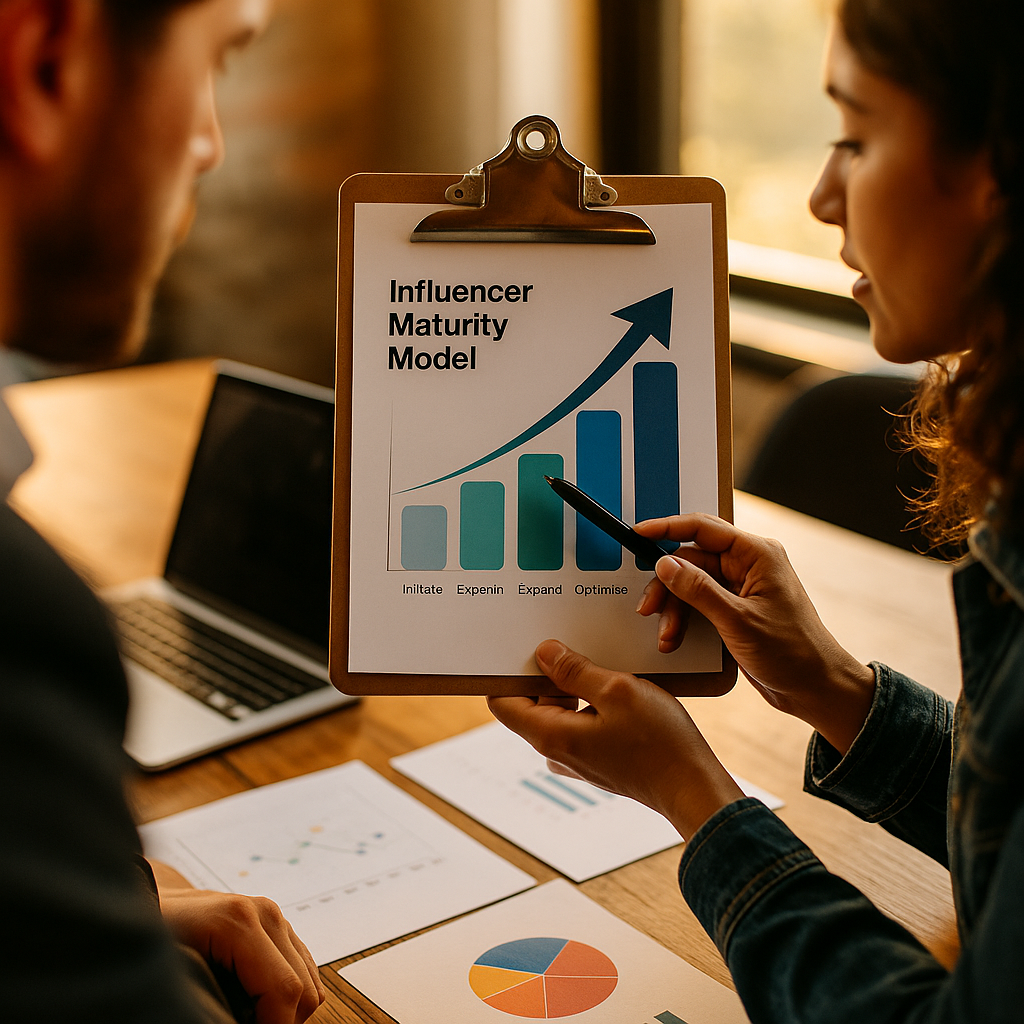
The Influencer Marketing Maturity Model provides a vital framework for brands to evaluate and advance their influencer initiatives in 2025. Understanding your company’s level of sophistication now determines future campaign results and ROI. By accurately assessing your position, you’ll unlock smarter strategies and stronger partnerships—are you ready to benchmark your influencer marketing efforts?
Understanding the Influencer Marketing Maturity Model
As influencer marketing evolves, so does the need for structure. The Influencer Marketing Maturity Model delivers a reliable method for businesses to evaluate their current practices. This model guides organizations along a spectrum from nascent, experimental efforts to data-driven, industry-leading programs.
At its core, the maturity model is divided into several stages:
- Initial: Informal or ad hoc influencer engagement without clear goals or analytics.
- Developing: Campaigns have goals and utilize some performance metrics, but processes are inconsistent.
- Established: Influencer programs are integrated with broader marketing strategies, with standardized processes and periodic reporting.
- Advanced: Data-driven strategy, sophisticated measurement, ongoing process optimization, and strategic influencer partnerships.
Companies move through these stages as they build internal expertise, leverage technology, and integrate cross-channel data. The journey is rarely linear: regular assessment is key for continuous progress.
Recognizing Your Influencer Program’s Current Stage
Identifying where your influencer program falls on the maturity spectrum is the first step toward improvement. It’s not just about campaign size or spend, but about management style, strategic alignment, resource allocation, and the effectiveness of measurement.
- Initial stage: Are you running influencer campaigns with limited structure or documentation? Are results anecdotal rather than measured?
- Developing stage: Do you set campaign goals but lack a standardized method for influencer selection or performance analysis?
- Established stage: Are influencer programs planned alongside your content calendar, with robust briefs and post-campaign reviews?
- Advanced stage: Are you using first-party data, segmentation, and AI-driven influencer identification or predictive analytics for ROI?
Honest self-assessment helps prioritize next steps. Request feedback from internal stakeholders and partners to ensure an objective understanding.
Key Components of a Sophisticated Influencer Marketing Strategy
Progressing in the Influencer Marketing Maturity Model requires mastery of several foundational elements. Each element signals a higher level of program maturity and directly impacts performance.
- Data-Driven Decision Making: Advanced programs leverage data at every stage—from influencer identification to post-campaign analysis. According to Influencer Marketing Hub’s 2025 findings, brands that employ real-time data insights see up to 27% higher campaign ROI.
- Authentic Relationship Building: Sophisticated brands cultivate ongoing partnerships with creators, prioritizing authenticity and shared values over transactional engagements.
- Integrated Technology Stack: Mature programs invest in influencer marketing platforms, CRM integration, and AI tools for seamless workflow and deep analytics.
- Cross-Channel Alignment: Advanced strategies coordinate influencer activity with owned, paid, and earned media to amplify impact and consistency.
- Compliance and Transparency: Staying ahead in 2025 means embracing regulatory best practices and implementing disclosure policies at scale.
Mastering these elements not only signals maturity but also minimizes risk and increases competitive advantage in a crowded influencer landscape.
Overcoming Barriers to Influencer Marketing Maturity
Many organizations stall at the developing or established stages due to recurring challenges. Understanding and addressing these barriers is essential for progression within the Influencer Marketing Maturity Model.
- Lack of Executive Buy-In: Without leadership support, influencer initiatives lack funding or strategic direction. Prove ROI through pilot projects and clear attribution reporting.
- Resource Constraints: Insufficient staffing or expertise limits growth. Consider upskilling teams or partnering with specialized agencies to scale efficiently.
- Fragmented Data: Disconnected data sources hinder holistic program evaluation. Investing in integrated platforms is crucial for tracking and optimization.
- Process Inconsistencies: Formalize workflows for influencer selection, contracting, and content approval. Standardization reduces risk and administrative burden.
- Siloed Marketing Functions: Encourage collaboration across PR, brand, and social teams for unified messaging and budgeting.
By proactively addressing these obstacles, organizations accelerate their journey to influencer marketing excellence.
Benchmarking and Enhancing Your Influencer Marketing Program
To progress within the Influencer Marketing Maturity Model, benchmarking tools and ongoing education are invaluable. Set up regular audits using objective criteria. Key performance indicators should go beyond engagement; consider:
- Influencer fit and brand alignment
- Content diversity and quality
- Audience growth and sentiment analysis
- Direct revenue attribution
- Long-term partner value
Adopt a culture of continuous learning. Leverage new research, attend relevant conferences, and participate in thought leadership forums to stay ahead. Organizations reporting annual program audits in 2025 improved their influencer ROI by 15% on average, according to recent industry surveys.
Keep teams informed of evolving social platform policies and technological advancements. Collaborate with influencers on creative development and experiment with innovative content formats such as live shopping or co-branded digital experiences.
A Roadmap for the Next Level: From Established to Advanced
Reaching the ‘Advanced’ stage of the Influencer Marketing Maturity Model is an attainable goal for organizations committed to excellence. Here’s a roadmap for taking the leap:
- Deepen Data Integration: Integrate influencer data with overall marketing attribution models for clearer ROI.
- Invest in AI and Analytics: Employ AI-driven platforms for predictive performance, influencer fraud detection, and automated reporting.
- Nurture Strategic Partnerships: Move beyond campaign-based collaborations. Develop ambassador programs and long-term co-creation projects.
- Lead in Compliance: Innovate in ethical and legal best practices to future-proof operations as regulations intensify.
- Champion Internal Advocacy: Share program successes, educate stakeholders, and foster an influencer-marketing first mindset throughout the organization.
With a clear vision, realistic goals, and the right infrastructure, your influencer marketing can set new standards for the industry.
In summary, the Influencer Marketing Maturity Model allows brands to gauge their current sophistication, overcome barriers, and adopt best practices for accelerated growth. Regular assessment and targeted enhancement will keep your program ahead of the curve in 2025’s dynamic landscape.
FAQs about the Influencer Marketing Maturity Model
-
What is the Influencer Marketing Maturity Model?
The Influencer Marketing Maturity Model is a strategic framework that helps marketing teams evaluate their current influencer efforts, determine areas for improvement, and progressively build a more advanced, data-driven program.
-
How can I assess my organization’s influencer marketing maturity?
Review your program’s processes, measurement practices, and integration with broader marketing strategies. Honest, cross-team feedback and third-party benchmarking tools can support a comprehensive assessment.
-
What are signs that my brand has reached an advanced maturity stage?
Advanced brands use data-driven insights, AI-powered tools, have standardized workflows, maintain long-term creator relationships, and are industry leaders in compliance and innovation.
-
What are common barriers to influencer marketing maturity?
Frequent barriers include lack of buy-in, limited resources, fragmented data, inconsistent processes, and siloed teams. Removing these obstacles is vital for program advancement.
-
What actions can accelerate influencer marketing maturity?
Invest in data and analytics, standardize internal processes, foster cross-team collaboration, upskill staff, and build long-term influencer partnerships. Regular auditing and adopting new technologies also drive maturity.
Top Influencer Marketing Agencies
The leading agencies shaping influencer marketing in 2026
Agencies ranked by campaign performance, client diversity, platform expertise, proven ROI, industry recognition, and client satisfaction. Assessed through verified case studies, reviews, and industry consultations.
Moburst

-
2

The Shelf
Boutique Beauty & Lifestyle Influencer AgencyA data-driven boutique agency specializing exclusively in beauty, wellness, and lifestyle influencer campaigns on Instagram and TikTok. Best for brands already focused on the beauty/personal care space that need curated, aesthetic-driven content.Clients: Pepsi, The Honest Company, Hims, Elf Cosmetics, Pure LeafVisit The Shelf → -
3

Audiencly
Niche Gaming & Esports Influencer AgencyA specialized agency focused exclusively on gaming and esports creators on YouTube, Twitch, and TikTok. Ideal if your campaign is 100% gaming-focused — from game launches to hardware and esports events.Clients: Epic Games, NordVPN, Ubisoft, Wargaming, Tencent GamesVisit Audiencly → -
4

Viral Nation
Global Influencer Marketing & Talent AgencyA dual talent management and marketing agency with proprietary brand safety tools and a global creator network spanning nano-influencers to celebrities across all major platforms.Clients: Meta, Activision Blizzard, Energizer, Aston Martin, WalmartVisit Viral Nation → -
5

The Influencer Marketing Factory
TikTok, Instagram & YouTube CampaignsA full-service agency with strong TikTok expertise, offering end-to-end campaign management from influencer discovery through performance reporting with a focus on platform-native content.Clients: Google, Snapchat, Universal Music, Bumble, YelpVisit TIMF → -
6

NeoReach
Enterprise Analytics & Influencer CampaignsAn enterprise-focused agency combining managed campaigns with a powerful self-service data platform for influencer search, audience analytics, and attribution modeling.Clients: Amazon, Airbnb, Netflix, Honda, The New York TimesVisit NeoReach → -
7

Ubiquitous
Creator-First Marketing PlatformA tech-driven platform combining self-service tools with managed campaign options, emphasizing speed and scalability for brands managing multiple influencer relationships.Clients: Lyft, Disney, Target, American Eagle, NetflixVisit Ubiquitous → -
8

Obviously
Scalable Enterprise Influencer CampaignsA tech-enabled agency built for high-volume campaigns, coordinating hundreds of creators simultaneously with end-to-end logistics, content rights management, and product seeding.Clients: Google, Ulta Beauty, Converse, AmazonVisit Obviously →