


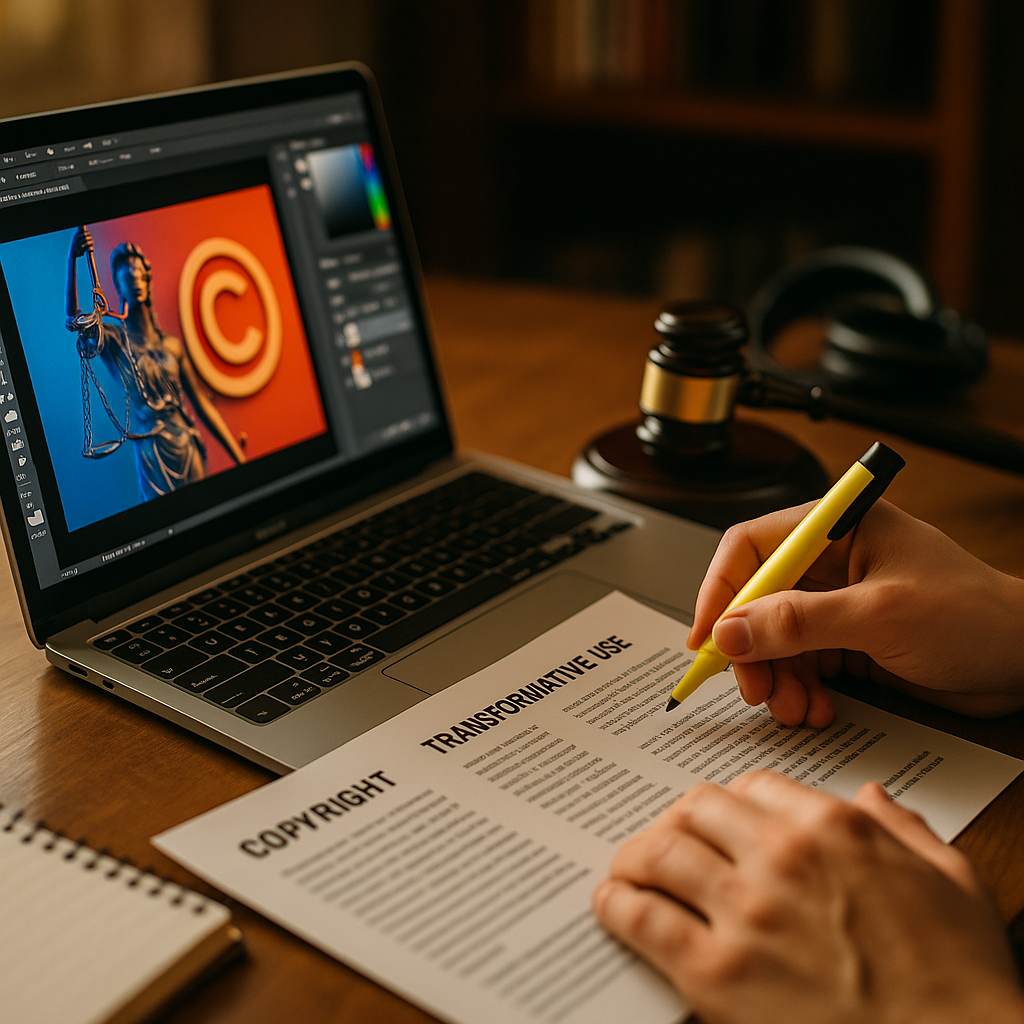
Understanding fair use and transformative works in copyright law is essential for creators, educators, and businesses navigating content use in today’s digital landscape. With copyright disputes and viral remixes more prevalent than ever in 2025, knowing your legal rights—and limitations—is crucial. So, how can you leverage fair use without crossing the line? Let’s explore the essentials.
What Is Fair Use in Copyright Law?
Fair use is a legal doctrine that allows for limited use of copyrighted material without the owner’s permission under specific circumstances. US copyright law, as codified in Section 107, lists four factors for determining fair use: the purpose and character of the use, the nature of the copyrighted work, the amount and substantiality used, and the effect on the work’s value. Each case is unique, requiring careful analysis.
Consider examples: quoting a book in a review, using snippets in news reporting, or parodying a song. In 2025’s content-driven economy, understanding these nuanced boundaries is essential for content creators, educators, and social media influencers alike.
Defining Transformative Works: A Key Secondary Keyword
A transformative work fundamentally changes or adds new expression, meaning, or message to the original material. It is not enough to merely copy or repackage content. For instance, a meme that recasts a famous photograph with new cultural context might be transformative; a simple repost is not.
Legal experts highlight that courts increasingly prioritize “transformativeness” when evaluating fair use. If your use adds genuine value, commentary, or fresh perspective to the original, your chances of a successful fair use defense improve. However, even transformative works have limits. They should not replace the original’s market or serve as a substitute.
Key Factors Courts Consider in Fair Use Cases
When disputes arise, courts examine the following four critical factors in fair use analysis:
- Purpose and Character: Is the new work commercial or educational? Is it transformative?
- Nature of the Copyrighted Work: Is it highly creative or mostly informational?
- Amount and Substantiality: How much of the original work was used, and were the “heart” or most significant aspects included?
- Effect on Market Value: Does the new work harm the market potential or value of the original?
Recent legal decisions highlight an increased emphasis on transformative use and market effect. In the age of AI-generated art and remixed digital content, courts in 2025 often rely on nuanced, fact-specific applications of these factors.
Common Examples of Fair Use and Transformative Works
Understanding practical applications helps demystify fair use and transformative works for everyday creators and users. Here are frequent situations:
- Educational and Research Uses: Quoting brief passages in academic work or critique, provided the use is noncommercial and appropriately cited.
- Parodies and Satire: Creating parody videos or memes that comment on or ridicule the original work in a clear, transformative way.
- Media Commentary: News organizations excerpting segments of movies or music for critical discussion.
- Artistic Transformations: Remixing songs, creating “fan edits” with substantial new context, or mashups that reimagine source material.
However, simple reposts or distribution without clear commentary or transformation rarely qualify. Always ask: Does this use add new value, perspective, or understanding?
Staying Compliant: Best Practices for Creators in 2025
With copyright litigation on the rise and digital tools making content sharing frictionless, it’s more important than ever to follow best practices:
- Document Intent: Keep detailed notes on why you believe your use is fair and transformative.
- Cite Sources: Give proper attribution even when not legally required—it demonstrates good faith.
- Limit Scope: Use only what’s necessary to make your point or create your new work.
- Stay Informed: Monitor changing interpretations; for example, AI-generated works are subject to evolving standards in 2025.
- Legal Consultation: When in doubt, consult an intellectual property attorney familiar with current case law.
Platforms like YouTube and TikTok offer fair use guidance and dispute resolution tools. Leverage these resources to minimize risk and maximize creative freedom.
Recent Trends and Hot Topics in Fair Use & Transformative Works
As copyright law adapts to new challenges in 2025, several emerging trends affect fair use and transformative works:
- Artificial Intelligence: AI-generated remixes and art prompt legal debates about what constitutes human authorship and transformation.
- Remix Culture: Social media platforms face pressure to clarify fair use rules for viral content and “duets.”
- International Expansion: US fair use has inspired similar exceptions in jurisdictions worldwide, but details vary. Always check local laws when sharing globally.
- Educational Tech: Schools increasingly rely on fair use for digital teaching materials, prompting new best practice guidelines.
Staying up to date with these developments ensures your approach to copyright is ethically and legally sound.
Conclusion: Navigating Fair Use and Transformative Works
Fair use and transformative works provide crucial flexibility for creators and educators in 2025. Understand the key factors, focus on adding value, and consult up-to-date resources. By following best practices and exercising good judgment, you can harness copyright law to empower creativity—not hinder it.
Frequently Asked Questions: Fair Use and Transformative Works
-
What is a transformative work in copyright law?
A transformative work adds new expression, meaning, or purpose to an existing creation. Courts favor such works if they do not simply copy but add value, commentary, or context.
-
How much of a copyrighted work can I use under fair use?
There is no fixed percentage. The amount must be reasonable and not represent the “heart” of the work. Courts evaluate both quality and quantity in context.
-
Can I claim fair use for commercial purposes?
While noncommercial use supports fair use, some commercial uses are permitted, especially if the new work is highly transformative. But commercial intent is one factor courts weigh carefully.
-
Are AI-generated remixes protected by fair use in 2025?
AI-generated works are an evolving area. As of 2025, courts analyze the human input and level of transformation. Purely automated copies rarely qualify, but human-guided remixes can be considered under fair use.
-
Does attribution guarantee fair use protection?
No. While citing sources is good practice, attribution alone does not satisfy legal requirements. The transformative nature, market effect, and amount used remain the core criteria.
Top Influencer Marketing Agencies
The leading agencies shaping influencer marketing in 2026
Agencies ranked by campaign performance, client diversity, platform expertise, proven ROI, industry recognition, and client satisfaction. Assessed through verified case studies, reviews, and industry consultations.
Moburst

-
2

The Shelf
Boutique Beauty & Lifestyle Influencer AgencyA data-driven boutique agency specializing exclusively in beauty, wellness, and lifestyle influencer campaigns on Instagram and TikTok. Best for brands already focused on the beauty/personal care space that need curated, aesthetic-driven content.Clients: Pepsi, The Honest Company, Hims, Elf Cosmetics, Pure LeafVisit The Shelf → -
3

Audiencly
Niche Gaming & Esports Influencer AgencyA specialized agency focused exclusively on gaming and esports creators on YouTube, Twitch, and TikTok. Ideal if your campaign is 100% gaming-focused — from game launches to hardware and esports events.Clients: Epic Games, NordVPN, Ubisoft, Wargaming, Tencent GamesVisit Audiencly → -
4

Viral Nation
Global Influencer Marketing & Talent AgencyA dual talent management and marketing agency with proprietary brand safety tools and a global creator network spanning nano-influencers to celebrities across all major platforms.Clients: Meta, Activision Blizzard, Energizer, Aston Martin, WalmartVisit Viral Nation → -
5

The Influencer Marketing Factory
TikTok, Instagram & YouTube CampaignsA full-service agency with strong TikTok expertise, offering end-to-end campaign management from influencer discovery through performance reporting with a focus on platform-native content.Clients: Google, Snapchat, Universal Music, Bumble, YelpVisit TIMF → -
6

NeoReach
Enterprise Analytics & Influencer CampaignsAn enterprise-focused agency combining managed campaigns with a powerful self-service data platform for influencer search, audience analytics, and attribution modeling.Clients: Amazon, Airbnb, Netflix, Honda, The New York TimesVisit NeoReach → -
7

Ubiquitous
Creator-First Marketing PlatformA tech-driven platform combining self-service tools with managed campaign options, emphasizing speed and scalability for brands managing multiple influencer relationships.Clients: Lyft, Disney, Target, American Eagle, NetflixVisit Ubiquitous → -
8

Obviously
Scalable Enterprise Influencer CampaignsA tech-enabled agency built for high-volume campaigns, coordinating hundreds of creators simultaneously with end-to-end logistics, content rights management, and product seeding.Clients: Google, Ulta Beauty, Converse, AmazonVisit Obviously →